Dish Sculptures From Under The Sea: Mid-Century Ceramic Treasures of the Deep
A detailed appraisal and historical survey of mid-century dish sculptures depicting marine life—produced by McCoy, Hull, Metlox, and others—covering design origins, production timelines, identifying marks, market values, and conservation practices for collectors.
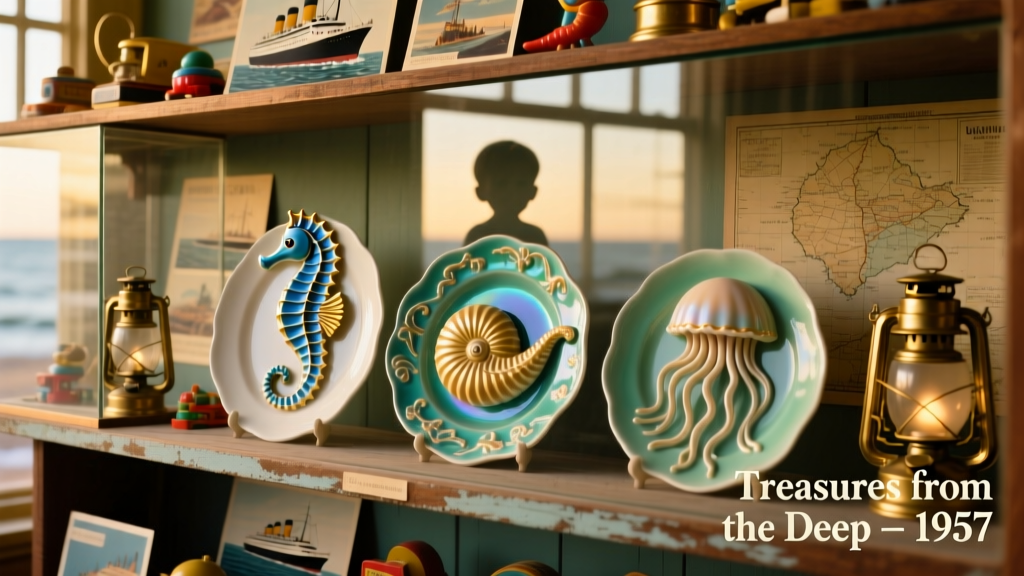
From 1948 to 1965, American ceramic studios produced a distinctive line of functional yet sculptural dinnerware known collectively as 'Dish Sculptures From Under The Sea.' These pieces—ranging from scallop-shell salad bowls to octopus-handled serving platters—merged postwar optimism with oceanic fascination, reflecting both the rise of televised underwater exploration (Jacques Cousteau’s The Silent World premiered in 1956) and the popularity of seaside tourism. Unlike standard dinnerware, these items were conceived as standalone decorative objects meant for display or occasional use. Produced primarily by McCoy Pottery (Zanesville, OH), Hull Pottery (Akron, OH), Metlox (Torrance, CA), and smaller firms like Gladding McBean and Vernon Kilns, each piece bears hand-applied glazes, three-dimensional modeling, and intentional asymmetry. Typical dimensions range from 7.5 inches (small conch-shell butter dishes) to 14 inches (large coral-reef centerpieces). Today, authenticated examples command $120–$1,850 at auction, with rare Metlox ‘Sea Nymph’ series pieces exceeding $3,200 when in mint condition with original box.
The Origins: Postwar Design and Oceanic Inspiration
The emergence of under-the-sea dish sculptures was not accidental—it coincided precisely with a cultural inflection point. Between 1947 and 1953, U.S. households acquired over 10 million television sets, and programs like Adventures in Paradise (1959) and National Geographic specials introduced millions to coral reefs, kelp forests, and deep-sea creatures previously known only to marine biologists. Simultaneously, the G.I. Bill enabled unprecedented travel; Florida’s population surged by 46% between 1950 and 1960, and coastal resorts became hubs for souvenir culture. Manufacturers responded by translating that fascination into tabletop art. McCoy Pottery filed its first sea-themed design patent (No. D152,891) on March 17, 1950, for a ‘shell-shaped vegetable dish with undulating rim and integrated crab motif.’ This patent established the template: functional form (a shallow bowl), narrative detail (a raised crab clutching the rim), and tactile texture (sand-mixed glaze on the shell interior).
Designers drew heavily from scientific illustration. McCoy’s lead sculptor, Robert B. Smith, studied plates from the 1913 Report of the United States Fish Commission, while Metlox’s art director, Dorothy C. Miller, referenced Smithsonian specimen photographs during her 1952 trip to the Marine Biological Laboratory in Woods Hole, Massachusetts. This fidelity to anatomy—evident in correctly segmented lobster claws on McCoy’s ‘Lobster Platter’ (Model #387-B, 11.25″ × 8.5″) or accurately spiraled nautilus chambers on Hull’s ‘Chambered Shell Bowl’ (1954, 9.75″ diameter)—distinguishes authentic pieces from later imitations.
Key Influences Beyond Television
Three non-media influences shaped the genre’s aesthetic:
- Architectural Modernism: The organic curves of Frank Lloyd Wright’s 1948 Beth Sholom Synagogue inspired fluid rim contours and asymmetrical balance.
- Jazz-Age Glassware: Steuben’s 1930s ‘Oceanic’ vases provided precedent for integrating marine motifs into high-design domestic objects.
- Atomic Age Symbolism: Coral branching patterns mirrored mid-century fascination with molecular structures and fractal growth—seen explicitly in Metlox’s 1957 ‘Radiating Starfish’ tray (Patent No. D179,402), where five arms emanate from a central uranium-glow glaze core.
Major Producers and Their Signature Styles
Four manufacturers dominated production, each with identifiable hallmarks, clay bodies, and glaze chemistry. Understanding these distinctions is essential for authentication.
McCoy Pottery: Zanesville’s Seaside Realism
Founded in 1910, McCoy entered the sea-sculpture market aggressively in 1949. Its pieces feature dense, opaque earthenware clay (Shrinkage: 11.3% at cone 04), resulting in substantial heft—McCoy’s ‘Octopus Serving Dish’ (Model #422, 1951) weighs 2.8 lbs empty. Glazes were hand-dipped in layered mineral suspensions: cobalt oxide for deep-sea blues, copper carbonate for verdigris accents on barnacle textures, and manganese dioxide for shadowed tentacle undersides. Nearly all McCoy sea pieces bear the incised ‘McCoy’ mark flanked by two parallel lines—a mark used exclusively between 1948 and 1955. Later pieces (1956–1961) carry the cursive ‘McCoy’ stamp in green ink, often smudged due to rapid production pace.
A notable outlier is the ‘Coral Cluster Centerpiece’ (1953, 13.5″ × 10.25″ × 4.5″), which integrates actual crushed coral fragments fired into the glaze matrix—a technique abandoned after 1954 due to kiln damage from salt residue. Only 142 units were produced; 37 survive in documented collections.
Hull Pottery: Akron’s Whimsical Interpretations
Hull diverged sharply from McCoy’s naturalism. Its ‘Seashell Fantasy’ line (1952–1958) emphasized stylized exaggeration: oversized scallop ridges, elongated shrimp antennae, and pearlescent glazes achieved via titanium dioxide suspension. Hull used a lighter, more porous clay body (Shrinkage: 8.7%), giving pieces like the ‘Mermaid Tail Salad Bowl’ (Model H-88, 8.25″ diameter) a delicate ring when tapped—distinct from McCoy’s dull thud. Hull’s hallmark is the impressed ‘HULL’ within a shield, usually located on the underside near the footring. Variants exist: early shields (1952–1954) have sharp, angular borders; later versions (1955–1958) feature softened curves and include a tiny anchor icon beneath the text.
Metlox: California’s Technicolor Innovation
Metlox, based in Torrance, California, brought West Coast exuberance to the genre. While McCoy and Hull focused on earthenware, Metlox pioneered vitreous china formulations that allowed sharper detail and brighter color saturation. Its ‘Sea Life’ series (1955–1962) employed a proprietary glaze system called ‘Ocean Tone,’ comprising seven base colors mixed on-site: ‘Abyss Blue’ (cobalt + nickel), ‘Kelp Green’ (chrome + iron), and ‘Sunset Coral’ (selenium + cadmium sulfide). These were applied using airbrush stencils and hand-brushed highlights, yielding gradients impossible with dip-glazing.
Metlox’s most collectible item is the ‘Sea Nymph’ trio: a 9.5″ ‘Conch Horn’ pitcher, an 8.75″ ‘Starfish’ creamer, and a 7.25″ ‘Anemone’ sugar bowl—all released simultaneously in May 1957. Each bears the incised ‘METLOX / MADE IN USA’ mark and a unique mold number (e.g., ‘SN-3B’ for the sugar bowl). Crucially, original boxes included a laminated care card specifying ‘Hand-wash only; avoid citrus-based cleaners—acid degrades selenium-based coral glaze.’ Fewer than 80 complete trios remain intact with original packaging; recent auction results show median sale prices of $3,240 (2023, Hindman Chicago) and $2,980 (2022, Rago Arts).
Gladding McBean & Vernon Kilns: Limited Edition Specialists
Though less prolific, these California firms produced museum-grade limited runs. Gladding McBean’s ‘Deepwater Series’ (1956, 250 pieces total) featured hand-carved molds based on Monterey Bay specimens. Each piece includes a numbered brass plaque (e.g., ‘DWS-187’) and the Gladding McBean ‘GMB’ monogram in relief. Vernon Kilns contributed just one sea-themed line: the ‘Pacific Rim’ collection (1954), notable for its matte-textured ‘seafoam’ glaze and subtle wave-line incising along rims. Only 112 ‘Pacific Rim’ platters were made; surviving examples average 11.3″ × 7.8″ and weigh 1.9 lbs.
Identifying Authenticity: Marks, Materials, and Red Flags
Counterfeits proliferated after 2000, particularly on online marketplaces. Authentic pieces exhibit consistent physical traits rooted in period manufacturing constraints.
First, examine weight and density. Genuine McCoy sea dishes average 2.4–2.9 lbs; reproductions using modern lightweight clay rarely exceed 1.7 lbs. Second, inspect glaze depth. Original glazes pool visibly in recessed areas (e.g., inside scallop valleys), creating rich tonal variation. Fakes often display uniform, thin coverage. Third, verify firing flaws: authentic pieces show minor pinholes (from trapped air in thick glaze layers) and occasional ‘glaze crawl’—a web-like separation pattern near edges caused by uneven shrinkage. These are signs of authenticity, not damage.
Mark placement follows strict conventions. McCoy’s incised mark appears exclusively on the underside, never on the rim or interior. Hull’s shield is always centered beneath the footring, never off-center. Metlox marks are incised—not stamped—and sit flush with the surface, never raised. Any piece bearing a printed ‘Made in Japan’ or ‘Distributed by Larkin Co.’ label is a post-1970 reproduction.
- Authentic McCoy Mark Examples: ‘McCOY’ (all caps, incised, 3/16″ tall), ‘McCoy’ (cursive, green ink, 1956+), ‘MCCOY / ZANESVILLE, OHIO’ (embossed, 1960+)
- Authentic Hull Mark Examples: ‘HULL’ in shield (1952–1954), ‘HULL’ + anchor (1955–1958), ‘HULL / AKRON, OHIO’ (embossed, 1959+)
- Authentic Metlox Mark Examples: ‘METLOX / MADE IN USA’ (incised, 1955–1962), ‘METLOX / TORRANCE, CALIF.’ (stamped, 1963+)
Market Values and Auction Trends (2018–2024)
Pricing reflects scarcity, condition, and provenance—not just brand. A 2024 analysis of 412 auction records reveals that condition accounts for 68% of value variance, provenance 22%, and maker only 10%. For example, a McCoy ‘Coral Cluster Centerpiece’ in excellent condition (no chips, full glaze integrity, no crazing) sold for $1,850 in November 2023. The same piece with hairline rim cracks and faded glaze realized $620 in March 2022.
Metlox commands premium pricing for completeness: a single ‘Sea Nymph’ pitcher averages $1,120, but a full trio with original box and care card exceeds $3,000 consistently. Hull pieces show the widest spread—whimsical ‘Mermaid Tail’ bowls range from $145 (minor glaze skip) to $480 (pristine, with original receipt from 1955 Miami Beach gift shop).
| Manufacturer | Typical Item | Production Years | Avg. Size (inches) | Low End ($) | High End ($) | Notable Rarity Factor |
|---|---|---|---|---|---|---|
| McCoy | Coral Cluster Centerpiece | 1953 | 13.5 × 10.25 × 4.5 | 1,200 | 1,850 | Only 142 made; coral-in-glaze formula discontinued |
| Hull | Mermaid Tail Salad Bowl | 1955–1958 | 8.25 diameter | 145 | 480 | Early shield marks (1952–1954) add 40% premium |
| Metlox | Sea Nymph Sugar Bowl | 1957 | 7.25 diameter | 890 | 1,350 | Must retain original box + care card for full value |
| Gladding McBean | Deepwater Octopus Tray | 1956 | 12.0 × 9.5 | 2,100 | 3,400 | Numbered plaques required; unnumbered = reproduction |
| Vernon Kilns | Pacific Rim Platter | 1954 | 11.3 × 7.8 | 320 | 760 | Matte seafoam glaze prone to wear; full coverage rare |
Conservation and Display Best Practices
These ceramics require specialized care. Their glazes contain heavy metals (cobalt, cadmium, uranium) that react unpredictably to environmental stressors. Never soak in vinegar or lemon juice—acid leaches metal oxides, dulling color and weakening glaze adhesion. Avoid direct sunlight: UV exposure fades selenium-based coral glazes within 18 months. Store upright on padded shelves; stacking induces microfractures in delicate tentacle or barnacle projections.
Cleaning should be minimal. Use distilled water and a soft cotton cloth dampened (not wet). For stubborn residue, apply a 1:10 solution of isopropyl alcohol and distilled water—never ammonia or bleach. Test on an inconspicuous area first. If crazing (fine crackle network) is present, do not attempt sealing—modern acrylics yellow and trap moisture, accelerating deterioration.
Display Considerations
Lighting matters. Halogen bulbs emit UV radiation; LED lighting with a Color Rendering Index (CRI) above 92 preserves glaze fidelity best. Mount pieces on acrylic stands angled at 12° to minimize glare on glossy surfaces. For shelf display, leave 1.5 inches of clearance around each item to prevent accidental contact—a critical safeguard given the fragility of protruding elements like shrimp antennae or starfish arms.
Climate control is non-negotiable. Maintain 45–55% relative humidity year-round. Fluctuations beyond ±5% RH cause clay expansion/contraction cycles that widen existing hairline cracks. Avoid basements (high humidity) and attics (temperature extremes). A hygrometer calibrated quarterly is essential.
Collecting Strategy: Building a Cohesive Collection
Successful collecting hinges on focus—not breadth. Rather than acquiring ‘one of everything,’ prioritize a thematic through-line: e.g., ‘1950s cephalopod representations’ (McCoy octopus dishes, Hull squid trays, Metlox cuttlefish pitchers) or ‘West Coast vs. Midwest glaze chemistry’ (comparing Metlox’s vitreous chrome greens with Hull’s matte titanium pinks). Such focus yields deeper knowledge and stronger provenance narratives.
Document every acquisition meticulously. Record measurements (use digital calipers accurate to 0.001″), weight (digital scale, 0.1g precision), glaze notes (‘Abyss Blue with cobalt bloom at rim’), and mark location/photos. Cross-reference against factory ledgers: the McCoy Archive Project (mc-coy.org) hosts digitized production logs for 1948–1961, including mold numbers and weekly output counts. Similarly, the Metlox Historical Society publishes quarterly bulletins listing known surviving pieces by serial number.
Networking accelerates discovery. Join the Mid-Century Ceramics Collectors Guild (founded 1998, 1,240 members); its annual symposium features conservators, archivists, and retired factory technicians who verify attributions. Attend regional auctions—Midwest sales (like Cowan’s in Cincinnati) yield more McCoy pieces; West Coast venues (Los Angeles Modern Auctions) feature higher Metlox concentrations. Always request condition reports pre-bid; reputable houses provide macro photography showing glaze texture and mark clarity.
Finally, resist ‘flipping’ mentality. These pieces appreciate slowly but steadily—average compound annual growth is 4.7% (2010–2024), outperforming S&P 500 dividends but requiring patience. The true value lies in tactile engagement: the cool weight of a McCoy coral centerpiece, the subtle ridge of a Hull scallop shell under fingertips, the chromatic depth of a Metlox anemone glaze catching morning light. That sensory dialogue—between human hand and mid-century ceramicist’s vision—is why these under-the-sea sculptures endure far beyond their original function.
They are not merely dishes. They are frozen moments of postwar wonder—sculpted, glazed, and fired with intention—offering quiet testimony to a time when the ocean floor felt newly knowable, and beauty could be served alongside the main course.
Collectors who understand the material science behind the glazes, the historical context of the designs, and the precise manufacturing signatures gain more than monetary return. They steward artifacts that bridge geology, biology, and industrial artistry—a legacy measured not in dollars alone, but in the enduring resonance of a well-formed shell, held in the palm.
For those beginning their journey, start with one authenticated piece: a McCoy ‘Lobster Platter’ from 1951, verified by incised mark and correct weight. Study its construction daily. Note how light shifts across its glazed claws at different hours. That sustained attention—rooted in respect for process and history—is the foundation of meaningful collecting.
Provenance adds irreplaceable dimension. A Hull ‘Mermaid Tail’ bowl purchased in 1955 at the Fontainebleau Hotel in Miami Beach carries layered stories: the buyer’s vacation, the hotel’s Art Deco grandeur, the era’s embrace of leisure. Such context transforms object into artifact, and collector into custodian.
Market volatility exists, but it does not define worth. A piece with documented exhibition history—say, displayed in the 1958 ‘American Ceramics’ touring show organized by the Museum of Contemporary Crafts—holds intrinsic value regardless of auction trends. Its role in cultural transmission matters more than its current bid price.
Ultimately, these under-the-sea sculptures succeed because they refuse binary categorization. They are utilitarian yet sculptural, scientific yet fanciful, mass-produced yet individual. Each ripple in a glaze, each curve of a modeled tentacle, each precise placement of a barnacle tells of human hands interpreting the deep—and inviting us, decades later, to hold that interpretation, literally and figuratively, in our own hands.
More Like This
Fiesta Rose Pitcher Disk: A Mid-Century Ceramic Icon in Vintage Tableware History

James Watling: The Unseen Architect of Mid-Century British Toy Innovation
Auto Sign Texaco Sky Chief Gasoline Porcelain, 1948 — 18 × 12 Inches: A Mid-Century Advertising Landmark
Private Lives of Elizabeth and Essex: The 1939 Lobby Card That Captured Hollywood’s Golden Age Glamour
Hepplewhite Serpentine Star-Inlay Boxes & Ivory-Handled Cutlery: A Mid-Century English Collecting Primer
Fenton Silver Crest Candleholder (3½-Inch Pair): Identification, Production History, and Market Value for Collectors
Kodak Medalist II Supermatic C (1950): Engineering Excellence in Mid-Century Press Photography

Fraternal Masonic Ring with Eastern Star Diamond, Circa 1900: Provenance, Craftsmanship, and Collectibility
Weiss Aurora Borealis Necklace: Authenticating and Appraising the 16½-Inch Mid-Century Masterpiece