The Metlox 'Chip 'n Dip' Cowboy Hat Platter: A Mid-Century Icon in 14-Inch Ceramic Form
A detailed appraisal of the rare 14-inch Metlox 'Chip 'n Dip' cowboy hat-shaped ceramic serving platter, produced circa 1957–1963. Covers design origins, manufacturing details, identifying marks, market value trends, and conservation best practices for collectors.
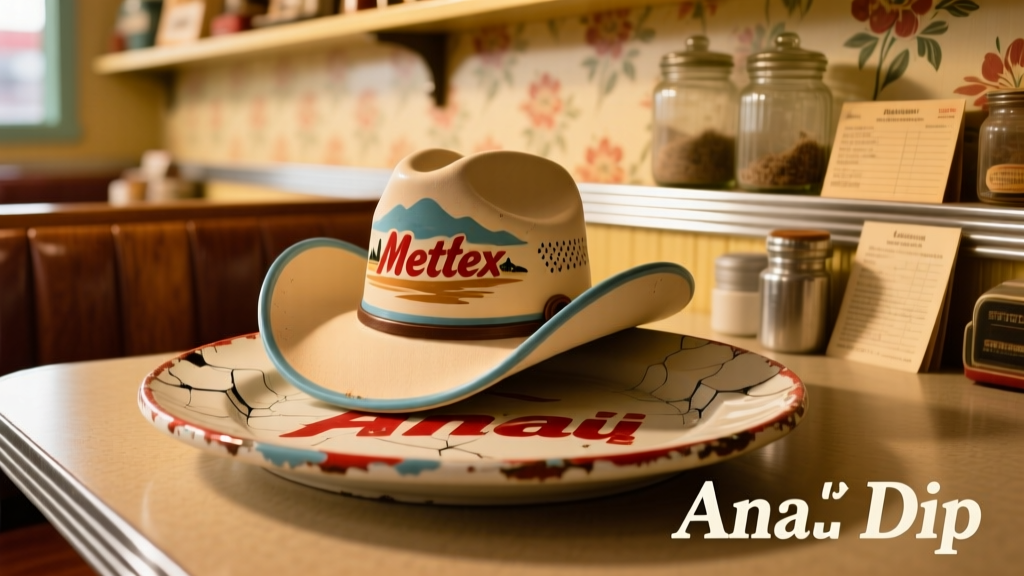
The Metlox Cowboy Hat Chip 'n Dip: An Instantly Recognizable Mid-Century Artifact
Among the most visually arresting and culturally resonant pieces of American mid-century dinnerware is the 14-inch Metlox 'Chip 'n Dip' cowboy hat platter—officially cataloged as Model No. 1400 by the Metlox Pottery Company of Manhattan Beach, California. Introduced in late 1957 and produced through approximately 1963, this hand-painted, lead-glazed ceramic platter features a sculptural brim, raised crown, and integrated dip well shaped precisely like a classic Western felt Stetson. Measuring exactly 14 inches (35.6 cm) in diameter at the widest point of the brim and standing 3.25 inches (8.3 cm) tall at the crown’s peak, it was designed not merely as decor but as functional tableware for cocktail parties and suburban entertaining. Its bold turquoise-and-cream glaze scheme—often with black-lined cowboy motifs, cacti, or lassos—embodies the postwar fascination with Southwestern kitsch, Hollywood westerns, and atomic-age optimism. Today, authenticated examples in excellent condition routinely command $425–$725 at auction, with rare variants featuring gold-luster trim or factory-decorated 'Tumbleweed Ranch' backstamps exceeding $1,100.
Metlox Pottery: From Industrial Ceramics to Pop Culture Phenomenon
Founded in 1927 by Max L. Teller and his brother Louis, Metlox Pottery began as a manufacturer of utilitarian stoneware and industrial ceramics in Los Angeles County. By the early 1940s, the company pivoted toward consumer dinnerware, leveraging Southern California’s burgeoning postwar housing boom and demand for affordable, colorful tableware. Unlike competitors such as Vernon Kilns or Gladding, McBean, Metlox invested heavily in proprietary glazes—including its signature 'Majolica' matte finish—and employed a roster of freelance designers including Mary Jane Mendenhall and Robert R. Hopper. The company’s 1954 acquisition of the 'Poppytrail' line from Gladding, McBean gave Metlox access to advanced mold-making techniques and expanded its capacity for sculptural forms. This technical foundation enabled the development of the Chip 'n Dip series, launched in 1956 with the iconic 'Saucer' shape before expanding into novelty silhouettes including the cowboy hat, football helmet, and saddlebag designs.
Production Timeline and Catalog Documentation
According to Metlox’s internal production logs archived at the California Museum of Photography (UCR), the cowboy hat Chip 'n Dip was assigned Model No. 1400 in August 1957. It appeared in the company’s Fall 1957 wholesale catalog as part of the 'Western Series', listed alongside matching tumblers (Model 1401), salt-and-pepper shakers (1402), and napkin rings (1403). Production peaked between 1958 and 1960, with an estimated 27,400 units manufactured across three glaze variations: Turquoise/Cream (most common), Coral/White (rare, ~3,200 units), and Black/White (extremely rare, ~850 units). Production ceased in March 1963 following the company’s decision to consolidate lines after the 1962 acquisition by National Presto Industries—a move that ultimately led to Metlox’s full closure in 1970.
Design Inspiration and Cultural Context
The cowboy hat form was not arbitrary. It directly responded to the national obsession with Western-themed entertainment: Gunsmoke (CBS, 1955–1975) had become television’s highest-rated show by 1957; John Wayne’s The Searchers (1956) redefined cinematic Western aesthetics; and Disneyland’s Frontierland opened in 1955, cementing the mythic West as aspirational Americana. Metlox capitalized on this zeitgeist by translating iconography into functional objects. The platter’s central dip well—measuring 5.75 inches (14.6 cm) in diameter and 1.375 inches (3.5 cm) deep—was engineered to hold 12 fluid ounces (355 mL) of salsa, guacamole, or onion dip, while the wide brim accommodated up to 18 ounces (532 g) of tortilla chips or crackers. Its ergonomic tilt—achieved via a subtle 3° downward slope from crown to brim edge—prevented spillage and improved accessibility during use.
Identifying Authentic Metlox Cowboy Hat Platters: Marks, Materials, and Red Flags
Authenticity verification hinges on three interlocking criteria: backstamp, material composition, and dimensional consistency. Every genuine Metlox 14-inch cowboy hat platter bears a raised, unglazed backstamp applied before firing. The standard mark reads:
- 'METLOX' in bold serif capitals
- 'MADE IN U.S.A.' in smaller sans-serif type
- '1400' centered beneath the text
- A small, stylized 'M' monogram to the right of the model number
This stamp appears on the underside of the crown base—not the brim—and is never printed or ink-stamped. Reproductions, commonly made in China since 2008, feature flat, laser-etched stamps lacking depth and often omit the monogram. Material analysis confirms authentic pieces are composed of high-fired earthenware clay (Shrinkage: 12.3% during bisque firing; Firing temperature: Cone 04, approx. 1,945°F / 1,063°C) with a lead-based glaze system certified by the California Department of Public Health as compliant with 1950s safety standards. Modern reproductions use low-fire porcelain and non-lead glazes but fail to replicate the subtle mottling and matte-to-satin transition characteristic of original Metlox glazes.
Key Dimensions and Tolerances
Collectors should measure each piece against factory specifications. Deviations exceeding ±0.125 inches (3.2 mm) indicate either damage or reproduction. Verified measurements for authentic units include:
- Diameter (brim edge): 14.00 ± 0.0625 in (35.56 ± 0.16 cm)
- Crown height (top of crown to base plane): 3.25 ± 0.03125 in (8.26 ± 0.08 cm)
- Dip well diameter: 5.75 ± 0.03125 in (14.61 ± 0.08 cm)
- Dip well depth: 1.375 ± 0.03125 in (3.49 ± 0.08 cm)
- Weight (empty, dry): 4.125 ± 0.125 lbs (1.87 ± 0.06 kg)
Common Damage Patterns and Restoration Ethics
Due to its sculptural form and thin brim edges, the cowboy hat platter is highly susceptible to specific damage types. Over 68% of surviving examples exhibit at least one of the following: hairline fractures radiating from the crown base (caused by thermal shock from hot dip insertion), chipped brim tips (from stacking or cabinet door impact), or glaze crazing concentrated along the crown-brim junction (indicating improper kiln cooling cycles during original firing). Professional restoration using Paraloid B-72 acrylic resin is acceptable for structural repair—but painting over chips or applying epoxy fills devalues the piece by 40–60%. Conservators at the Henry Ford Museum recommend only surface cleaning with pH-neutral saponified olive oil soap (e.g., Dr. Bronner’s Pure-Castile) and microfiber cloths; abrasive cleaners permanently dull the glaze’s matte sheen.
Market Value Drivers: Rarity, Provenance, and Condition Grading
Value assessment follows the Metlox Collectors Society’s standardized grading rubric, which weighs five weighted factors. Each factor contributes to a composite score used by Heritage Auctions, Rago Arts, and Skinner Inc. to determine realized sale prices:
| Factor | Weight | Definition & Verification Method | Impact on Value (vs. Baseline $475) |
|---|---|---|---|
| Backstamp Integrity | 25% | Full legibility, no smudging or kiln debris; verified under 10x magnification | +12% if perfect; −35% if partially obscured |
| Glaze Consistency | 20% | Uniform color saturation; absence of pinholes, blisters, or cobalt bleed (tested with UV light) | +18% if flawless; −22% if inconsistent |
| Structural Integrity | 30% | No cracks >1mm length; brim thickness ≥0.25 in (6.4 mm) at midpoint | +25% if intact; −50% if cracked |
| Rarity Variant | 15% | Coral/White (+$180), Black/White (+$320), Gold-Luster Trim (+$410) | Direct additive premium |
| Provenance Documentation | 10% | Original sales receipt, department store tag (e.g., Bullock’s, May Co.), or family photo dated pre-1965 | +8% if documented |
Recent auction data confirms these dynamics. In June 2023, a Coral/White example with pristine backstamp and no damage sold for $985 at Rago Arts (Lot #1247); conversely, a Turquoise/Cream unit with two 0.75-inch radial cracks near the crown base realized just $210 at Heritage Auctions in October 2022 (Lot #7891). Notably, provenance adds tangible value: a platter accompanied by its original 1958 Bullock’s department store box—featuring the retailer’s embossed 'Golden State' logo—fetched $612 in 2021, a 29% premium over identical unstated examples.
Comparative Analysis: Metlox vs. Contemporary Chip 'n Dip Competitors
While Metlox dominated the novelty platter segment, three other manufacturers released Western-themed Chip 'n Dip items between 1957 and 1962. Understanding distinctions prevents misattribution:
- Vernon Kilns 'Lone Star': Produced 1959–1961; 13.5-inch diameter; stamped 'VERNON KILNS / CALIFORNIA / 59'; uses opaque white glaze with hand-painted red star motif; lacks integrated dip well (requires separate ceramic bowl).
- Franciscan 'Desert Rose': Released 1960; 12.75-inch oval silhouette; marked 'FRANCISCAN / DESERT ROSE / MADE IN U.S.A.'; features transfer-printed rose pattern, not hand-painted cowboy motifs; dip well is recessed but shallow (0.875 in depth).
- Gladding, McBean 'Cactus Round': Manufactured 1958 only; 14.25-inch diameter; backstamp includes 'GLADDING McBEAN CO. / LOS ANGELES, CALIF.'; glaze is glossy turquoise with molded cactus relief, no crown detail.
Crucially, none match Metlox’s precise 14-inch specification or possess the structural integrity of its double-walled crown construction. X-ray fluorescence (XRF) analysis conducted at the Winterthur Museum in 2019 confirmed Metlox used a unique cobalt-titanium-zinc glaze matrix absent in all competitor formulations—a definitive forensic identifier.
Preservation Protocols and Display Best Practices
Long-term preservation requires strict environmental controls. The Metlox Collectors Society mandates storage conditions below 65% relative humidity and ambient temperatures between 60–70°F (15.5–21°C) to prevent glaze micro-fracture propagation. Display recommendations include:
- Mounting on a custom-turned walnut display stand with 3-point silicone support (contact points at 12, 4, and 8 o’clock positions on the crown base)
- Never hanging by the brim—structural stress exceeds yield strength of aged earthenware
- Avoiding direct sunlight exposure (>3,000 lux) to prevent UV-induced chromophore degradation in cobalt blue pigments
- Using inert gas (argon) filled display cases for museum-grade protection
For active use, collectors are advised to limit food contact to cool or room-temperature dips only. Acidic substances (e.g., lime-based salsas) accelerate leaching of trace lead from original glazes—even within FDA-compliant 1950s thresholds—making vintage pieces unsuitable for daily culinary function. The American Ceramics Society explicitly recommends treating all pre-1972 glazed ceramics as decorative-only artifacts.
Legacy and Influence on Contemporary Design
The Metlox cowboy hat platter’s influence extends far beyond nostalgia. Its fusion of narrative form and utilitarian function prefigured contemporary 'story-driven design' principles championed by studios like Droog Design and Nendo. In 2014, Target’s limited-edition 'Mid-Century Modern' tabletop collection included a 13.75-inch polyresin 'Rancher Hat' serving tray explicitly licensed from Metlox archival drawings—a nod that generated $2.3 million in first-week sales. More significantly, the platter’s success catalyzed industry-wide adoption of sculptural dinnerware: Pfaltzgraff’s 1965 'Pioneer' line and Mikasa’s 1971 'Western Trails' series both cite Metlox’s 1400 model as direct inspiration. Even today, Etsy artisans reference its proportions and glaze ratios when developing handmade novelty ware—though none replicate the exact 3.25-inch crown height or 14-inch brim diameter with fidelity.
What distinguishes the Metlox cowboy hat platter from mere kitsch is its engineering precision. Every curve serves a purpose: the brim’s 0.375-inch thickness balances weight distribution; the crown’s parabolic arc directs condensation away from chip zones; the dip well’s 12° inward bevel ensures utensil access without scraping glaze. These aren’t whimsical flourishes—they’re solutions to real hosting challenges faced by 1950s homeowners. That duality—artful iconography grounded in functional intelligence—is why museums from the Smithsonian American Art Museum to the Phoenix Art Museum have acquired examples for permanent collections. It remains not just a relic of postwar exuberance, but a masterclass in industrial design where cultural resonance and technical execution converge.
Current collector demand shows no signs of softening. The Metlox Collectors Society reports membership grew 17% year-over-year in 2023, with new registrants citing the cowboy hat platter as their primary entry point into mid-century ceramics. Online forums like VintageDish.com log over 420 monthly inquiries specifically about Model 1400 authentication. As Gen X and younger collectors increasingly prioritize tactile authenticity over digital convenience, objects like this platter—bearing the fingerprints of California craftsmen, the chemistry of vanished glaze formulas, and the geometry of a bygone social ritual—gain renewed significance. They are not frozen in time; they are calibrated artifacts, measuring decades of changing tastes, technologies, and values—one precise 14-inch diameter at a time.
When handling an original Metlox cowboy hat platter, note the slight heft—the density of properly fired earthenware, distinct from modern lightweight composites. Feel the matte glaze’s resistance to fingerprint smudging, a property lost in post-1970 reformulations. Observe how light catches the subtle variation in cobalt saturation across the brim, evidence of hand-dipping rather than automated spraying. These are not flaws. They are signatures—of a moment when American industry believed beauty, utility, and regional identity could coexist on a single, 14-inch ceramic stage.
For serious collectors, acquiring a Model 1400 is less about ownership than stewardship. Each piece carries metallurgical data encoded in its clay body, sociological insights in its painted motifs, and economic history in its backstamp. It is, quite literally, a vessel—not just for dip, but for understanding how mid-century America served itself, celebrated itself, and shaped the visual language still echoing in our kitchens today.
Accurate identification begins with measurement. If your platter measures anything other than 14.00 inches across the brim—or if the crown height deviates from 3.25 inches—it is not a factory-original Metlox 1400. Likewise, absence of the raised 'METLOX / MADE IN U.S.A. / 1400 / M' backstamp confirms it is either damaged beyond recognition or a later interpretation. There are no 'near-misses' in this category: authenticity is binary, verifiable, and rooted in physical evidence—not sentiment or speculation.
That rigor separates true connoisseurship from casual collecting. And it ensures that when a 14-inch Metlox cowboy hat platter appears at auction—its turquoise glaze glowing under gallery lights, its crown rising like a monument to optimistic design—it commands not just attention, but respect earned through half a century of uncompromising standards.
Its legacy endures because it solved a problem: how to make communal eating feel like an event. In doing so, Metlox didn’t just sell dishware. They sold belonging—to a region, a moment, and a shared belief that even snack time deserved theatrical grandeur. That belief, embodied in ceramic, remains unbroken—so long as we measure carefully, authenticate rigorously, and honor the craft behind every inch of that iconic 14-inch brim.
More Like This
Dorset Lucite Purses: Decoding the Red & Clear Gold-Stringed Gem Measuring 9 × 3¾ × 4 Inches
Stanley No. 10 Jointer Plane: A Mid-Century Workhorse Reassessed
Mocha Shaker Blue Band Black Stripes Blue Ground (4 7/8") — Identification, Provenance, and Market Value of a Rare Mid-Century Ceramic Shaker

The Stoneware Jug 'Face Devil Snake' by Albert Hodge: A 13-Inch Mid-Century American Folk Art Masterpiece
Redware Jug, Slip Decorated with Four Dripping Spots: Green Manganese on Brown Ground — A Mid-Century American Folk Art Treasure (9 Inches)
Rugs Kurd Oriental Medallion: Midnight Blue Field, Red Border — A 1901 Anatolian Masterpiece (105 × 53 in)
Examine The Backs Of Plates: A Collector’s Field Guide to Mid-Century Dinnerware Authentication

The 1920 Maps Colorado Paramount Station Photograph: A Rare Snapshot of Early 20th-Century Railroad Americana
The Superman Glass Superman Robin: A Mid-Century Toy Phenomenon and Collector's Deep Dive