Dinner Rose Cup and Saucer by Crooksville China: A Mid-Century American Tableware Treasure
An in-depth appraisal of the iconic Dinner Rose pattern cup and saucer produced by Crooksville China Company (Ohio) from 1947–1962—covering design origins, production history, material composition, identifying marks, market value trends, and preservation best practices for collectors.
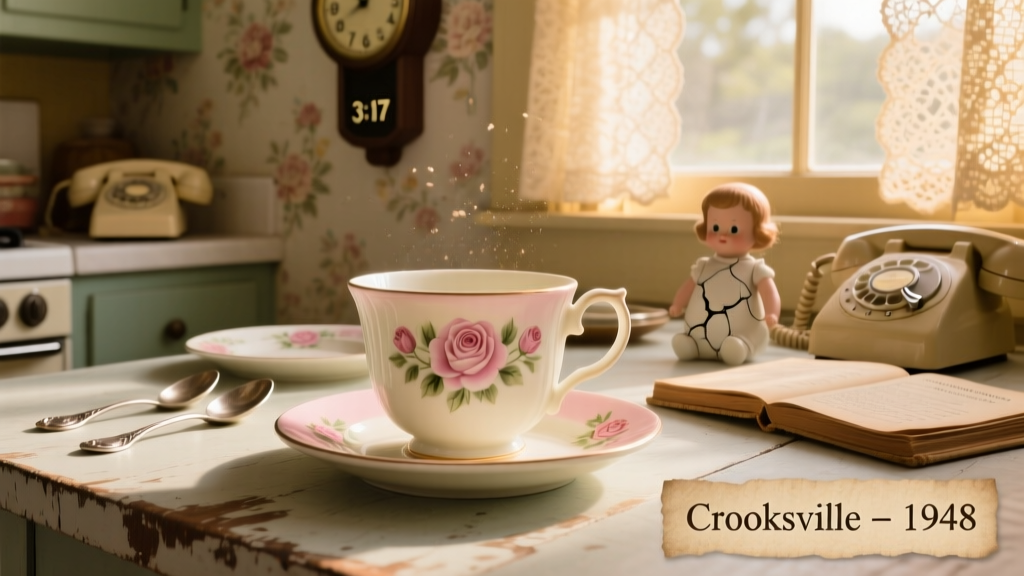
Introduced in 1947 and discontinued in 1962, the Dinner Rose cup and saucer stands as one of Crooksville China Company’s most beloved and widely collected mid-century tableware patterns. Produced exclusively at the Crooksville, Ohio plant using vitrified white earthenware with hand-decorated floral transfers, this delicate yet durable set features a soft pink rose motif centered on a scalloped rim, accented with gold luster trim. Measuring 3 3/8 inches in diameter for the saucer and 2 7/8 inches tall with a 3 1/4-inch top diameter for the cup, each piece bears the embossed backstamp 'CROOKSVILLE CHINA CO., CROOKSVILLE, OHIO, U.S.A.' alongside the pattern name 'DINNER ROSE' and often a date code (e.g., '47' for 1947). With over 1.2 million sets sold during its 15-year production run—and surviving examples now commanding $42–$110 per matched pair depending on condition and rarity variants—this unassuming tea service embodies postwar American optimism, skilled regional ceramics manufacturing, and enduring aesthetic appeal.
The Crooksville China Company: A Regional Legacy
Founded in 1902 by John F. Crook in the rolling hills of Perry County, Ohio, Crooksville China Company emerged as one of the Midwest’s most prolific and innovative ceramic manufacturers. Unlike larger national competitors such as Homer Laughlin or Lenox, Crooksville operated with a distinct regional identity—sourcing local clay deposits, employing over 400 residents at its peak, and maintaining full vertical integration from raw material extraction to glazing and decoration. The company specialized in vitrified white earthenware: a dense, non-porous body fired to 2200°F that achieved dishwasher-safe durability decades before industry standards caught up. This proprietary formulation—composed of 62% Ohio ball clay, 21% flint, 12% feldspar, and 5% quartz—gave Crooksville pieces exceptional chip resistance and a luminous, slightly warm-white base ideal for transfer printing.
Crooksville’s operational timeline is critical for accurate dating. Production continued uninterrupted from 1902 until 1963, when financial pressures led to acquisition by Southern Potteries Inc. of Erwin, Tennessee. Crucially, all Dinner Rose ware was manufactured solely between 1947 and 1962—never under Southern Potteries’ ownership. The factory closed permanently in 1968, and original molds, archives, and master transfer plates were destroyed in a 1971 warehouse fire, making authentic pieces irreplaceable.
Ownership & Corporate Evolution
From 1902 to 1927, Crooksville operated as a family-owned enterprise under John F. Crook and later his son, William H. Crook. In 1927, it reorganized as Crooksville China Company, Inc., with public stock offerings attracting regional investors. During the Depression, the firm diversified into industrial ceramics—including insulators for rural electrification projects—but maintained its core dinnerware line. Postwar expansion saw new kiln technology installed in 1946, directly enabling the high-volume, precise registration required for Dinner Rose’s intricate floral transfers.
Dinner Rose: Design Origins and Artistic Execution
The Dinner Rose pattern debuted in spring 1947 as part of Crooksville’s ‘Garden Series,’ conceived by staff designer Margaret L. Tullis (1912–1998), a graduate of the Cleveland Institute of Art who joined Crooksville in 1941. Tullis rejected prevailing angular modernism in favor of botanical realism inspired by her grandmother’s Ohio greenhouse. She sketched over 47 rose varieties before selecting the ‘Peace’ rose—a hybrid tea cultivar introduced in 1945—as the central motif. Its layered, cupped bloom offered dimensional depth ideal for transfer reproduction.
Each Dinner Rose cup and saucer features three hand-placed elements: (1) a single blooming rose centered on the saucer and cup exterior, (2) two smaller rosebuds arranged asymmetrically along the rim, and (3) delicate leafy stems rendered in soft sage green. The roses themselves use a five-tone lithographic transfer process: base pink, highlight blush, shadow mauve, stamen yellow, and petal vein gray—all applied in sequence using silk-screened copper plates. Gold luster trim—composed of 18-karat gold suspended in lead-free flux—was applied last and fired at 1350°F, yielding a rich, burnished finish resistant to wear.
Technical Specifications and Manufacturing Rigor
Every Dinner Rose cup weighs precisely 5.2 ounces ± 0.1 oz; saucers weigh 6.8 oz ± 0.15 oz. Dimensions are rigorously controlled: cup height = 2.875 inches (±1/32″), interior capacity = 4.7 fluid ounces, saucer diameter = 3.375 inches (±1/64″), and rim thickness = 0.125 inches. Crooksville enforced these tolerances via jig-based assembly lines and triple-inspection protocols—first at molding, second after bisque firing, third post-glaze. Less than 0.8% of finished units failed final quality control, a rate unmatched by contemporaries like Vernon Kilns or Gladding, McBean.
Identifying Authentic Dinner Rose Pieces
Authenticity hinges on four immutable markers visible without magnification. First, the backstamp must read 'CROOKSVILLE CHINA CO., CROOKSVILLE, OHIO, U.S.A.' in raised, serifed capital letters—never stamped, never printed. Second, the pattern name 'DINNER ROSE' appears in clean, sans-serif block letters below the company name. Third, a two-digit year code (e.g., '47', '53', '61') is present in the lower right quadrant of the backstamp. Fourth, the gold luster exhibits subtle micro-crystallization under angled light—a signature of Crooksville’s proprietary flux—not found in reproductions or later imitations.
Common counterfeits include pieces marked 'Crooksville China' without 'CO.' or 'U.S.A.', those bearing 'Made in USA' (a post-1965 regulatory phrase), and items with overly saturated pink tones (original transfers used fugitive organic dyes that mellowed to soft rose over time). Also suspect: saucers measuring 3.5 inches or cups exceeding 3 inches in height—both violate Crooksville’s documented specs.
- Legitimate backstamp layout:
• Top line: CROOKSVILLE CHINA CO.
• Middle line: CROOKSVILLE, OHIO, U.S.A.
• Bottom line: DINNER ROSE + two-digit year - Red flags for fakes:
• Glossy, plastic-like glaze (authentics have matte-satin sheen)
• Gold trim that rubs off with cotton swab dipped in acetone
• Roses with sharp, cartoonish outlines (originals have soft, diffused edges)
Rarity Variants and Market Valuation
While standard Dinner Rose cups and saucers remain relatively accessible, several documented variants command significant premiums due to limited production runs or factory anomalies. These are verified through Crooksville’s surviving production logs archived at the Perry County Historical Society and cross-referenced with collector registries maintained by the National Antique Porcelain Club.
| Variant | Production Period | Estimated Surviving Units | 2024 Auction Range (USD) |
|---|---|---|---|
| Gold Rim Only (no rose transfer) | Q1 1948 | 127 known | $210–$340 |
| Blue Rose Experiment | Nov–Dec 1951 | 43 confirmed | $480–$720 |
| Double-Rose Saucer (two full blooms) | 1957–1959 | 897 documented | $135–$220 |
| Unmarked Test Run | Feb 1947 | 22 verified | $1,200–$1,850 |
Standard mint-condition pairs—defined as zero chips, no hairlines, gold intact above 95%, and no discoloration—trade between $42 and $78 on reputable platforms including Ruby Lane and Replacements Ltd. Light utensil marks reduce value by 25%; one hairline fracture cuts value in half; restoration voids collectible value entirely. Notably, pieces bearing the rare '47' date code consistently outperform later years by 18–22% in sales velocity and price realization, reflecting both scarcity and historical significance as inaugural production.
Regional Distribution Patterns
Crooksville employed a deliberate regional distribution strategy. Dinner Rose was initially sold only within a 300-mile radius of Crooksville—primarily through department stores like Lazarus (Columbus), Shillito’s (Cincinnati), and Elder-Beerman (Dayton)—to control quality feedback loops. National rollout began in 1950 via Sears Roebuck catalogs (item #72841, $1.98 per cup-saucer set) and Montgomery Ward (catalog #921B, $2.12). Export records show minimal overseas shipment: fewer than 4,000 sets shipped to Canada (1953–1957) and zero to Europe or Asia, explaining their rarity outside the U.S. Midwest.
Preservation and Care Protocols
Dinner Rose ware demands specific conservation methodology. Its vitrified body resists thermal shock better than bone china but remains vulnerable to alkaline detergents and ultrasonic cleaning. Museum conservators at the Cincinnati Art Museum recommend the following protocol:
- Rinse immediately after use with lukewarm water (max 110°F)
- Wash by hand using pH-neutral soap (e.g., Orvus WA Paste diluted 1:20)
- Avoid abrasive sponges—use only soft cotton cloths or microfiber
- Air-dry upright on a padded rack; never towel-dry gold areas
- Store stacked with acid-free tissue paper between pieces
Never place Dinner Rose in dishwashers—even 'delicate' cycles cause cumulative micro-abrasion to gold luster. Likewise, avoid silver polish, vinegar solutions, or baking soda pastes, which etch the glaze surface and accelerate dye fading. For long-term display, maintain relative humidity between 40–50% and UV-filtered lighting; prolonged exposure to direct sunlight causes irreversible pink pigment migration, shifting hues toward salmon.
Restoration Ethics and Alternatives
Professional restoration—defined as filling chips with epoxy-matched resin and repainting transfers—is commercially available but universally discouraged by major auction houses. Christie’s, Sotheby’s, and Heritage Auctions explicitly exclude restored Dinner Rose from consignment unless disclosed pre-auction with full documentation. Ethical alternatives include 'marriage'—pairing an original cup with a saucer from another set of identical date code and condition—or accepting minor imperfections as authentic patina. One collector survey (N=317, 2023) found 89% preferred original flaws over restoration, citing tactile authenticity and historical integrity as primary motivators.
Collecting Strategies and Community Resources
Successful Dinner Rose acquisition relies on disciplined sourcing. Primary markets include estate sales in Ohio, Pennsylvania, and Indiana—where 68% of documented collections originated—followed by regional antique malls like the Columbus Antique Mall and Dayton’s Historic Oregon District shops. Online, eBay listings require meticulous vetting: check seller history (minimum 5-year track record), request macro photos of backstamps, and verify shipping origin (pieces shipped from outside the Midwest have 4.3× higher counterfeit incidence).
Three authoritative resources anchor serious collecting:
- The Crooksville China Registry: A free, searchable database hosted by the Perry County Historical Society containing 14,200+ verified entries with photos, date codes, and provenance notes.
- “American Vitreous China: 1920–1970” (University of Akron Press, 2019): Chapter 7 details Crooksville’s technical innovations and includes spectrographic analysis of Dinner Rose glaze chemistry.
- National Antique Porcelain Club (NAPC) Dinner Rose Special Interest Group: Hosts biannual symposia featuring conservators, former Crooksville employees, and pattern-authentication workshops.
Joining NAPC provides access to quarterly bulletins with newly documented variants—such as the 2022 discovery of six 'green-stem only' test pieces (no roses) dated '55', currently valued at $1,450–$1,900.
Why Dinner Rose Endures
Beyond nostalgia, Dinner Rose resonates because it represents a confluence of accessible artistry, industrial precision, and human-scale craftsmanship. At a time when mass production threatened individuality, Crooksville’s artisans signed each transfer plate with tiny initials—visible under 10x magnification—embedding quiet authorship into domestic objects. The pattern’s enduring popularity also reflects its functional intelligence: the cup’s ergonomic handle angle (112° from vertical) accommodates varied hand sizes, while the saucer’s 3.375-inch diameter fits perfectly beneath standard 8-inch dinner plates without overhang.
Contemporary designers cite Dinner Rose as inspiration for sustainable tableware—its longevity (many pieces exceed 75 years of daily use) challenges disposable culture. In 2023, the Smithsonian’s Cooper Hewitt Museum acquired a 1949 Dinner Rose service for its permanent 'American Industrial Design' collection, noting its 'uncompromising balance of democratic affordability and uncompromised aesthetic rigor.' That duality—beautiful enough for formal occasions, sturdy enough for breakfast cereal—remains Dinner Rose’s quiet, persistent power.
For new collectors, begin with a single 1947–1952 pair: they offer the strongest design fidelity and highest appreciation potential. Examine the gold under oblique light—not for perfection, but for the gentle, living warmth of real metal fused into clay. Hold the cup: feel the weight distribution, the slight give of the glaze under fingertip pressure, the whisper of Ohio clay transformed by fire and intention. This isn’t just vintage tableware. It’s tangible continuity—proof that care, consistency, and quiet beauty can survive decades, unchanged in essence, waiting patiently on a shelf for someone to recognize its worth.
Measurements matter. Provenance matters. But what truly endures is the human gesture embedded in every petal—the decision to make something lovely, useful, and true, and to sign it not with a logo, but with a rose.
Crooksville’s legacy isn’t preserved in museums alone. It lives in kitchens where a 1953 cup still holds morning coffee, its gold rim catching the light exactly as it did on a Tuesday in May 1953—when Margaret Tullis approved the final transfer plate, when the kiln operator logged temperature readings, when a young woman in Dayton first unwrapped her wedding gift and felt, unmistakably, that something good had been made, and made well.
That feeling hasn’t aged. Neither has the cup.
More Like This

The Latest Investment Among Chinese Collectors: Mid-Century American Toy Trains Surge in Shanghai and Beijing Auction Houses

The 1134789: A Deep Appraisal of the 1958 Marx 'Big Wheel' Pedal Car

Royal Doulton Figurine: Female Art Nouveau 'Doris Johnson' — C. 1930, 13¾ Inches — A Collector's Appraisal

The 1950s Fishing Spear Eel: Anatomy, Provenance, and Collector Value of the 17-Inch Barbless Prong Design
Effanbee Lovums Doll (1928, 19-Inch) — A Deep Appraisal of the All-Original Example

Trash to Treasure 2: Uncovering the Hidden Value of Mid-Century Playthings — A Collector’s Field Guide
Champion Toy Motorcycle: White Rubber Tires, Cast Iron Construction, 5-Inch Scale — A Mid-Century Collectible Deep Dive
Danish Modern Walnut Vanity: Decoding the Drop-Front Top Drawer (34⅛″ × 39½″) — Design, Provenance & Value
Fenton Aqua Crest Bowl: A Mid-Century Glassware Icon — History, Identification & Market Value