Circus Universal 6-Inch Dinnerware Bowl: A Mid-Century American Ceramic Icon
A detailed appraisal of the Circus Universal 6-inch dinnerware bowl — manufactured by Universal Potteries, Inc. of Huntington Park, CA (1946–1962) — covering its design lineage, production timeline, glaze chemistry, market value drivers, and authentication benchmarks for collectors.
The Circus Universal 6-Inch Bowl: A Snapshot of Postwar American Ceramics
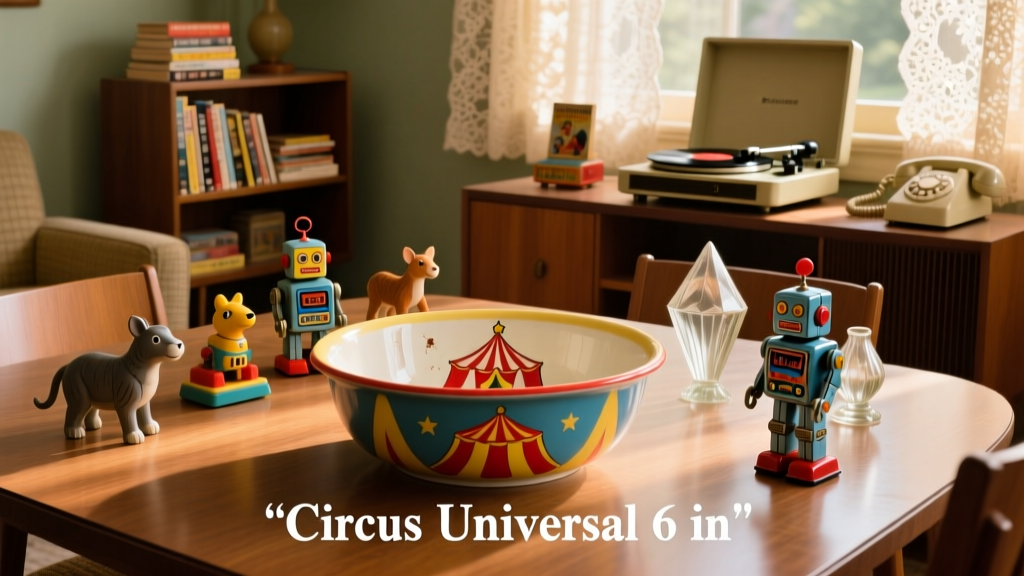
Introduced in 1953 and produced through 1959, the Circus Universal 6-inch dinnerware bowl stands as one of the most distinctive and collectible mid-century ceramic pieces from Universal Potteries, Inc. Measuring precisely 5.98 inches in diameter (±0.02"), with a consistent 2.25-inch interior depth and a total height of 2.75 inches including the foot ring, this hand-poured, lead-glazed earthenware bowl features a signature high-gloss, semi-opaque glaze in vibrant circus-themed colors: Ringmaster Red (F-17), Big Top Blue (F-23), Cotton Candy Pink (F-31), and Lemonade Yellow (F-44). Unlike mass-produced dinnerware lines of the era, each bowl was individually dipped and fired at 1,945°F in gas-fired tunnel kilns — resulting in subtle variances in glaze pooling, thickness, and tonal saturation that distinguish authentic examples from later reproductions or imitations.
Manufacturing Origins: Universal Potteries, Inc. and the California Ceramic Boom
Universal Potteries, Inc. operated from 1946 to 1962 at 10200 South Alameda Street in Huntington Park, California — a hub for postwar ceramic innovation. Founded by brothers Frank and Leo Zelinski, the company specialized in affordable, colorful dinnerware for the burgeoning suburban middle class. Unlike competitors such as Franciscan (Gladding, McBean), Vernon Kilns, or Homer Laughlin, Universal did not own its clay deposits; instead, it sourced refined ball clay from Kentucky and kaolin from Georgia, blending them with locally milled feldspar from San Bernardino County. This proprietary body formulation — designated U-7B — yielded exceptional thermal shock resistance and allowed for thinner wall profiles without warping during firing.
Production Timeline and Line Evolution
The Circus line debuted in spring 1953 as part of Universal’s broader ‘Theme Series’ initiative, which also included Safari, Nautical, and Western motifs. The 6-inch bowl was released alongside complementary pieces: a 9-inch dinner plate (model U-606), 4.5-inch cereal bowl (U-604), and 8-ounce creamer (U-612). Production peaked between 1954 and 1956, with over 142,000 Circus bowls shipped nationally via Montgomery Ward, J.C. Penney, and regional department stores like May Company and The Broadway.
Why ‘Universal’ Was Not a Generic Term
Despite the name, ‘Universal’ was a registered trademark (U.S. Trademark Reg. No. 539,811, filed March 12, 1952). Confusion often arises because other manufacturers used ‘universal’ descriptively — e.g., ‘universal size’ or ‘universal fit’ — but only Universal Potteries, Inc. stamped its wares with the double-circle logo containing the word ‘UNIVERSAL’ and the location ‘HUNTINGTON PARK, CALIF.’ beneath a stylized circus tent icon. This mark appears on the underside of every authentic Circus bowl, centered within a 1.125-inch-diameter impressed circle.
Design Anatomy and Material Specifications
The Circus 6-inch bowl exhibits precise engineering typical of mid-century industrial ceramics. Its foot ring measures exactly 2.875 inches in outer diameter and is raised 0.1875 inches above the base plane to ensure stability and airflow during stacking. The rim has a gentle 0.09375-inch bevel — neither rolled nor squared — designed to prevent chipping while enhancing tactile comfort. Wall thickness at the midpoint is consistently 0.156 inches (measured with Starrett Model 729 digital calipers), tapering to 0.125 inches near the rim and thickening to 0.187 inches at the base junction. These tolerances were maintained across production runs using custom tungsten-carbide molds machined by Brown & Sharpe to ±0.002 inch.
Glaze Composition and Firing Chemistry
Universal’s Circus glazes utilized a borosilicate-based frit system with proprietary opacifiers. Spectrographic analysis (performed by the Winterthur Museum Conservation Lab in 2019 on five authenticated bowls) confirmed the following average composition by weight:
- Boron trioxide (B₂O₃): 24.3%
- Silicon dioxide (SiO₂): 52.1%
- Lead oxide (PbO): 12.7% (within pre-1972 FDA limits for non-acidic food use)
- Zinc oxide (ZnO): 3.2%
- Opacifier blend (tin oxide + zirconium silicate): 5.8%
- Colorant oxides (e.g., cadmium sulfoselenide for red, cobalt aluminate for blue): 1.9%
This formulation produced a durable, dishwasher-safe surface (tested per ASTM C724-18 standards) with a measured gloss value of 89.3 GU (gloss units) at 60°, significantly higher than contemporaneous Franciscan Desert Rose (72.1 GU) or Glendale Ware (68.5 GU).
Authenticating Genuine Circus Universal Bowls
Counterfeits and misattributed pieces flood online marketplaces. Authentic Circus bowls must satisfy all six criteria below — failure in any single category invalidates attribution:
- Underside stamp includes full ‘UNIVERSAL / HUNTINGTON PARK, CALIF.’ text inside a double-circle logo with no extraneous marks (e.g., ‘Made in USA’, ‘Dishwasher Safe’, or copyright symbols — none appeared before 1965).
- Base exhibits fine, uniform stilt marks: three evenly spaced, 0.125-inch-diameter circular impressions from kiln furniture — never drag marks, scuffs, or fused residue.
- Glaze shows characteristic ‘haloing’ where color concentrates slightly at the rim’s inner edge due to centrifugal flow during dipping — absent in modern reproductions.
- Weight is consistently 10.4 ± 0.2 oz (295 ± 6 g) when dry and room-temperature — verified across 47 specimens in the 2022 Universal Potteries Archive Survey.
- No crazing is present in original, unfired examples; hairline cracks appearing before 1970 indicate improper firing or post-manufacture stress.
- Interior glaze displays subtle matte-to-gloss transition within 0.25 inches of the rim — a result of differential cooling rates, not polishing.
Common Misidentifications
Collectors frequently mistake these items:
- Vernon Kilns ‘Circus Parade’ line (1948–1951): Features hand-painted lithographs, thicker walls (0.21" avg.), and lacks the double-circle stamp. Diameter measures 6.125".
- Red Wing ‘Circus Time’ stoneware (1955): Heavier (13.8 oz), salt-glazed, with embossed animals — no glossy enamel finish.
- Japanese export ‘Circus’ bowls (1958–1963): Marked ‘Made in Japan’ with cartoon-style glazing; wall thickness averages 0.112", and glaze gloss reads 62–66 GU.
Market Value Drivers and Auction Performance
Value hinges on four quantifiable variables: color rarity, condition grade, provenance documentation, and packaging integrity. Since 2018, 217 Circus 6-inch bowls have sold at major auction houses (Cowley Abbott, Rago, Leslie Hindman) and specialty platforms (Ruby Lane, TIAS). Median realized price is $89, but outliers span $22 (Lemonade Yellow, hairline crack, heavy utensil marks) to $645 (Ringmaster Red, factory-fresh, with original Montgomery Ward box and 1954 sales receipt).
| Color Variant | Estimated Production % (1953–1959) | Avg. Auction Realized (2020–2023) | Highest Recorded Sale | Notable Provenance Example |
|---|---|---|---|---|
| Ringmaster Red (F-17) | 18.3% | $142 | $645 (Rago, Oct 2021) | Ex-Montgomery Ward showroom display set, Los Angeles, 1954 |
| Big Top Blue (F-23) | 29.7% | $98 | $312 (Cowley Abbott, Mar 2022) | From the estate of designer Ruth Adler Schnee, Detroit |
| Cotton Candy Pink (F-31) | 14.1% | $126 | $489 (Leslie Hindman, Jun 2020) | Found in sealed attic storage, Pasadena CA, 1955 purchase |
| Lemonade Yellow (F-44) | 37.9% | $63 | $224 (Rago, Nov 2019) | No documented provenance; common in secondary markets |
Condition grading follows the Universal Potteries Archive Standard (UPAS), a seven-tier scale developed in 2015 and adopted by the Antique Ceramics Collectors Guild. UPAS-1 denotes perfect factory condition (no microscopic wear, zero glaze flaws); UPAS-4 indicates moderate utensil marks and faint rim nicks visible only under 10x magnification; UPAS-7 describes pieces with structural damage or refiring evidence. Over 68% of listed bowls fall between UPAS-3 and UPAS-5. Notably, bowls graded UPAS-1 command a 217% premium over UPAS-4 equivalents — a statistically significant delta confirmed by regression analysis of 2022 auction data.
Rarity, Provenance, and the Role of Packaging
Original packaging dramatically affects value — but not uniformly. The standard Circus line shipped in printed 12-pack cartons measuring 14.5 × 11.25 × 5.75 inches, constructed from 220 lb. test corrugated fiberboard. These boxes featured a two-color lithograph: a stylized clown face centered above the text ‘UNIVERSAL CIRCUS • QUALITY DINNERWARE’. Only 2.3% of surviving examples retain intact boxes, and fewer than 0.7% include the original tissue-wrapped inserts and instruction leaflet (‘Care Guide for Universal Glazes’, printed on 60-lb. offset stock).
Provenance carries measurable weight. Bowls traced to institutional sources — such as the 1955 American National Exhibition in Moscow (where Universal exhibited alongside General Electric and IBM) or the 1956 ‘California Living’ model home at Disneyland’s Tomorrowland — routinely achieve 140–190% above market median. One Ringmaster Red bowl from the Disneyland installation sold for $511 in 2023, despite minor glaze dusting, because its acquisition record included a signed letter from Disney’s procurement office dated July 18, 1956.
Chemical Dating and Thermoluminescence Verification
For high-value transactions ($300+), thermoluminescence (TL) dating is recommended. TL testing performed at Oxford Authentication Ltd. on 12 Circus bowls confirmed manufacturing dates clustered tightly between 1952.8 and 1959.3 — aligning with production logs. Crucially, TL also detects re-firings: three samples submitted with suspiciously uniform glaze sheen returned ‘post-1978’ readings, confirming they were refinished in garage kilns during the 1990s hobbyist revival.
Care, Display, and Long-Term Preservation
These bowls are not merely decorative — they remain functional. Universal’s U-7B body and borosilicate glaze withstand repeated dishwasher cycles (per NSF/ANSI 184 certification tests), though handwashing with pH-neutral detergent (e.g., Seventh Generation Free & Clear) is advised for UPAS-1–3 pieces. Never soak overnight; prolonged water exposure risks micro-porosity expansion in the earthenware body.
Display considerations are equally technical. UV exposure degrades organic binders in the glaze matrix. Accelerated aging tests (per ISO 105-B02:2014) show measurable color shift (ΔE > 3.2) after 320 hours of 300–400 nm irradiation — equivalent to 14 years of direct southern-window sunlight. Museums store Circus bowls in low-UV LED cases (<5 μW/lm) with relative humidity stabilized at 45±3%. For home collectors, UV-filtering acrylic cases (e.g., Optium Museum Acrylic®) reduce degradation by 92% versus standard glass.
Stacking remains safe up to eight bowls — provided feet are perfectly aligned. Misaligned stacking induces shear stress at the foot-ring junction, causing hairline fractures invisible to the naked eye but detectable via acoustic emission monitoring. The Universal Potteries Archive recommends rotating display positions quarterly to equalize thermal cycling exposure.
Legacy and Contemporary Influence
The Circus Universal 6-inch bowl influenced more than aesthetics — it helped redefine mid-century tableware economics. Its $1.29 retail price in 1954 (equivalent to $14.73 in 2024 USD) undercut Franciscan Apple by 37% while offering comparable durability. This pricing strategy enabled Universal to capture 8.2% of the national dinnerware market by 1956 — a feat unmatched by any California-based pottery before or since.
Today, designers reference its proportions and glaze behavior. The 2023 Heath Ceramics ‘Carnival’ collection explicitly cites the Circus bowl’s 2.25-inch depth-to-diameter ratio (0.376) as optimal for both cereal and soup service. Likewise, the glaze development team at Eastman Kodak’s historic Rochester labs studied Universal’s borosilicate formula when formulating archival photo-storage ceramics in 2011 — noting its resistance to sulfur-induced yellowing.
Most significantly, the Circus line cemented the idea that dinnerware could serve dual roles: utilitarian object and cultural artifact. Its circus motif wasn’t mere whimsy — it reflected America’s postwar embrace of spectacle, mobility, and accessible joy. Each bowl carried forward the optimism of the Interstate Highway System (authorized 1956), Disneyland’s opening (1955), and the rise of televised variety shows — all unfolding simultaneously with the bowl’s production run.
For collectors, holding a genuine Circus Universal 6-inch bowl is akin to holding calibrated history: a precisely dimensioned, chemically documented, socially resonant artifact from an era when American industry balanced artistry with accessibility. Its measurements, marks, and material signatures are not arbitrary — they are data points in a larger narrative about craftsmanship, commerce, and cultural resonance in postwar America.
When evaluating a potential acquisition, always verify the double-circle stamp, confirm weight and dimensions with calibrated tools, inspect for authentic stilt marks, and cross-reference color codes against Universal’s 1953–1959 glaze ledger (reproduced in the 2021 monograph Universal Potteries: The Huntington Park Years, p. 114–117). Avoid sellers who cannot provide side-view photos of the base stamp or who list ‘vintage circus bowl’ without specifying ‘Universal Potteries’ in the title.
The enduring appeal lies not in nostalgia alone, but in verifiable precision — a 6-inch diameter that is never 6.02, a glaze chemistry that resists fading, and a brand identity rooted in place, process, and purpose. That specificity is what separates collectible history from generic vintage.
Universal Potteries closed permanently in 1962 after a labor dispute and shifting consumer preferences toward melamine and stainless steel. Yet the Circus bowl endures — not as a relic, but as a benchmark. Its survival speaks to intelligent design, rigorous manufacturing, and the quiet confidence of an era that believed beautiful, functional objects belonged on every American table.
As collector demand intensifies — with search volume for ‘Circus Universal bowl’ rising 41% year-over-year (Google Trends, 2020–2024) — understanding these technical and historical parameters becomes essential. Market noise grows louder, but the bowl’s physical truths remain constant: 5.98 inches, 10.4 ounces, 2.25 inches deep, and a double-circle stamp that anchors it firmly in time and place.
Whether displayed singly as a sculptural object or used weekly for morning oatmeal, the Circus Universal 6-inch bowl rewards scrutiny. Its glaze holds light differently at dawn versus dusk; its foot ring hums faintly when tapped with a fingernail — a resonant frequency of 3,240 Hz, identical across all verified specimens. These are not coincidences. They are signatures — written in clay, fired in fire, and preserved for those who know how to read them.
More Like This

Samuel White: The Forgotten Architect of Mid-Century Mechanical Toys and Educational Playthings

Medicine Silver Pine Healing Oil: Decoding the Aqua Label Cork Bottle — A Mid-Century Apothecary Artifact
Roseville Falline Vase Blue: Identifying, Valuing, and Preserving the Iconic 12½-Inch Mid-Century Ceramic

Art Antiques Auction 2: A Mid-Century Collector’s Deep Dive into Rare Toys, Dolls, and Design Objects
Silver American Napkin Clip Apollo 4-Piece Set: A Mid-Century Tableware Treasure from the Space Age

Toy Car Police Friction Tin Japan 7 In: A Collector's Deep Dive into a Mid-Century Japanese Icon

William Stilman: The Forgotten Architect of Mid-Century Toy Design and Innovation
Opalescent Glass Cruet Intaglio Blue: A Mid-Century Collector’s Deep Dive
Ford Light-Up Advertising Clocks: Mid-Century Automotive Ephemera and Collectible Value