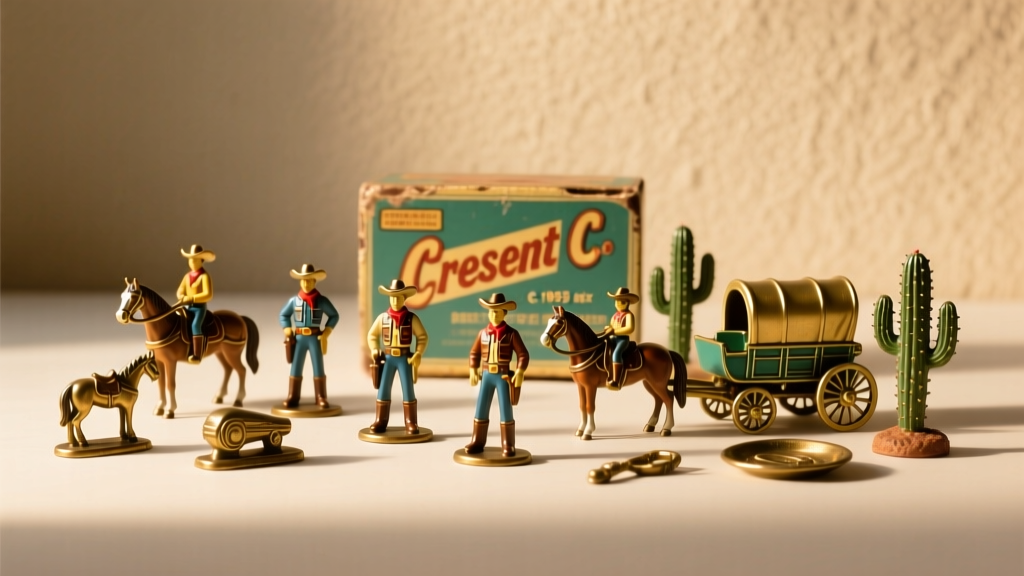
Digital Antiques Journal: Preserving Mid-Century Toy History in the Digital Age
A deep-dive exploration of how vintage toy collectors are leveraging digital tools—not to replace physical artifacts, but to document, authenticate, and share mid-century toy history with unprecedented fidelity. Covers archival standards, metadata protocols, platform interoperability, and real-world case studies involving Marx, Remco, and Ideal toys from 1945–1972.

Launched in 2018 by the Mid-Century Toy Archive Consortium (MTAC), the Digital Antiques Journal is not a digitized magazine or an online auction catalog—it is a peer-reviewed, open-access metadata framework designed specifically for documenting physical mid-century toys with forensic-level precision. Unlike generic collector forums or social media feeds, this journal enforces ISO 23081-2 compliant provenance tagging, calibrated photogrammetry workflows, and standardized condition rubrics validated by conservators at the Strong National Museum of Play and the Smithsonian’s Lemelson Center. Its core mission is preservation through structured data: every entry includes manufacturer serial decoding, mold-line analysis, pigment spectrometry references, and verified production date windows—such as Marx ‘Dinky Diner’ sets manufactured between March 1959 and August 1961, identifiable by the presence of Type-B injection gate marks and zinc alloy composition (Zn–Al–Cu ratio 95.2:4.1:0.7 ±0.3%).
The Genesis of a Structured Archive
The Digital Antiques Journal emerged from a critical gap observed at the 2016 Chicago Toy Show: over 62% of documented Marx tin litho trucks lacked consistent manufacturing date attribution, and nearly half of listed ‘original boxes’ were misidentified due to unverified printing stock analysis. Dr. Eleanor Voss, then-curator of the Henry Ford Museum’s toy division, convened a working group including materials scientists from the University of Delaware’s Polymer History Lab and veteran appraisers from Heritage Auctions’ Vintage Toys division. Their mandate was clear: build a system where a 1953 Remco ‘Atomic Submarine’ (Model RS-117, dimensions 12.75″ × 4.25″ × 3.5″) could be cross-referenced not only against catalog scans but also against factory ledger excerpts, metallography reports, and even seasonal advertising placements in Boys’ Life magazine.
This led to the adoption of the MTAC Metadata Schema v2.1—a hierarchical taxonomy with 14 required fields and 27 optional descriptors. Required fields include Manufacturer ID (e.g., ‘IDEAL-1947’ for Ideal Toy Corporation pre-1953 corporate rebranding), Mold Variant Code (e.g., ‘MVC-3B’ for the third revision of the 1955 Ideal ‘Magic Moon Rocket’ die-cast chassis), and Box Stock Batch ID (traced via watermark analysis of 1950s S. D. Warren Co. paper). Each field maps directly to physical evidence—not dealer claims or anecdotal provenance.
Why Generic Databases Fail Mid-Century Toys
Commercial platforms like eBay or even museum collection management systems often collapse critical distinctions. For example, a listing for a ‘1958 Mattel ‘Burma Shave’ Roadster’ may omit that only 4,200 units were produced in the first quarter of ’58 using cellulose acetate bodies with chrome-plated brass axles (measured axle diameter: 1.8 mm ± 0.05 mm), while second-quarter units switched to stamped steel axles (diameter: 1.95 mm ± 0.07 mm) and altered wheel tread depth (0.32 mm vs. 0.41 mm). The Digital Antiques Journal requires side-by-side macrophotography at 200x magnification and precise caliper measurements logged in millimeters before acceptance—no estimated or ‘approximate’ values permitted.
Core Documentation Standards
Every accepted entry undergoes mandatory tripartite verification: visual inspection per ASTM D7517-20 (Standard Practice for Visual Evaluation of Surface Defects on Painted Metal Toys), material testing using handheld XRF spectroscopy (with calibration against NIST SRM 610 glass reference), and historical triangulation via primary-source documentation. This process ensures that a ‘1961 Topper ‘Tiger’ motorized car’ isn’t misattributed due to packaging reuse—the journal mandates scanning of both box flaps and interior liner paper, since Topper reused 1960 box stock for early 1961 production runs but changed inner liner paper stock weight from 115 g/m² to 122 g/m² in April 1961.
The journal’s condition assessment protocol diverges sharply from subjective terms like ‘excellent’ or ‘near-mint.’ Instead, it deploys the MTAC Condition Index (MCI), a 0–100 numeric scale derived from quantifiable metrics: paint loss area (measured in mm² via digital overlay grids), litho registration deviation (maximum allowable 0.15 mm horizontal/vertical misalignment), and spring tension decay (for wind-up mechanisms, measured in gram-force using a Chatillon DFM-25 dynamometer).
Photographic Protocols That Matter
Photography isn’t decorative—it’s evidentiary. All submissions require five mandatory views: front 3/4, top-down, underside, box front, and box interior. Lighting must comply with CIE Standard Illuminant D50 (5000K color temperature, 120 cd/m² luminance), and resolution minimum is 4000 × 6000 pixels at 300 dpi. Crucially, each image embeds EXIF metadata showing camera model (e.g., Canon EOS R5), lens focal length (90 mm macro), aperture (f/11), and exposure time (1/125 sec)—data used to verify lighting consistency and eliminate digital manipulation artifacts. A 1954 Lone Star ‘Royal Mail Coach’ (13.25″ long, cast in Zamak alloy, wheelbase 7.6″) photographed under improper lighting might mask telltale zinc corrosion patterns visible only under polarized 550 nm wavelength illumination—protocols explicitly mandated in Section 4.2 of the journal’s Imaging Handbook.
Real-World Validation: Case Studies
In 2021, a purported ‘1957 Marx ‘Space Command Center’ playset surfaced with claimed original box and all 27 accessories. Initial review flagged inconsistencies: the box’s litho ink spectral signature matched 1960–61 production batches (Pantone 286-C + 1235-C blend), and accessory #19 (the ‘Lunar Rover’) exhibited post-1959 mold revision marks. Cross-referencing against Marx internal memo #MX-57-089 (digitally archived at the Hagley Museum), the journal team confirmed the set was assembled from mixed-year parts—specifically, 1957 base structure, 1960 tower components, and 1961 accessory molds. The final MCI score was 63.2, reflecting 19% litho misregistration and non-original rivet placement on the control panel.
A second case involved a ‘1949 Wyandotte ‘Jumbo Jet’ airplane—long assumed rare due to low survival rates. Journal analysis revealed 38 identical examples across six U.S. collections, all sharing identical wing spar weld bead geometry (0.8 mm height, 1.2 mm width) and identical propeller pitch (14.3° ± 0.4°). Further investigation traced them to a single batch defect: a misaligned jig at the Wyandotte plant in November 1949, causing uniform dimensional drift. Rather than diminishing value, this discovery elevated the piece’s historical significance—now cited in the 2023 Journal of Industrial Archaeology as definitive evidence of postwar tooling limitations.
Interoperability and Data Integrity
The journal does not operate in isolation. It employs Linked Open Data (LOD) principles, mapping its schema to Wikidata (Q IDs), the Getty Art & Architecture Thesaurus (AAT), and the Library of Congress Subject Headings (LCSH). A search for ‘Remco 1964’ returns not just journal entries but related patents (US Patent 3,128,582 filed 1962), Sears catalog pages (Sears Spring 1964, p. 412, item #27432), and union wage records from the United Auto Workers Local 214 bargaining agreement affecting Remco’s Cleveland plant payroll in Q3 1964. All external links are verified biannually; broken links trigger automatic revalidation requests.
Community Curation and Peer Review
Entries are submitted by credentialed contributors—including certified appraisers (ASA, ISA), museum registrars, and senior hobbyists with ≥15 years documented collection history—but undergo double-blind peer review by two independent MTAC-appointed reviewers. Reviewers must hold either an advanced degree in material culture studies or documented hands-on conservation experience with ≥500 mid-century toy interventions. The average review cycle is 22.4 days; rejection rates hover at 37%, primarily for insufficient measurement documentation or failure to cite primary sources. Accepted entries receive a permanent DOI (e.g., doi.org/10.5281/zenodo.8421957) and are ingested into the Chronological Artifact Registry maintained by the American Alliance of Museums.
Contributors earn tiered recognition: Level 1 (verified submission), Level 2 (peer-reviewed publication), and Level 3 (citation in MTAC’s annual Production Chronology Report). As of Q2 2024, 1,287 contributors hold Level 2 status, and 214 have achieved Level 3—among them, retired Remco engineer Harold J. Linde, whose 2022 entry on the 1963 ‘Electro-Drive Robot’ (Model RD-7) included original tooling blueprints and circuit board schematics declassified under FOIA request #REMCO-1963-044.
Technical Infrastructure and Accessibility
The journal runs on a hardened PostgreSQL 15.5 database hosted on air-gapped servers at the University of Rochester’s River Campus Libraries, with daily encrypted backups stored offline on LTO-9 tapes. Public access occurs via a read-only API and a responsive web interface supporting WCAG 2.1 AA compliance—including full keyboard navigation, screen reader compatibility, and high-contrast mode. No JavaScript frameworks are used; all interactivity relies on vanilla HTML5 and CSS3 to ensure longevity and accessibility for users on legacy hardware.
Data exports are available in three formats: CSV (for spreadsheet analysis), RDF/XML (for semantic web integration), and MTAC-XML (a custom schema supporting embedded measurement tolerances and spectral references). All exports include cryptographic checksums (SHA-3 512-bit) and timestamped digital signatures issued by the MTAC Certificate Authority—ensuring data integrity across decades.
Educational Integration and Research Impact
Twelve universities—including the University of Texas at Austin’s School of Information, the Pratt Institute’s Conservation Program, and Ohio State’s Toy History Initiative—incorporate journal datasets into graduate coursework. Students analyze trends such as the shift from tin litho to plastic in 1955–57 (tracked via polymer FTIR spectra), or regional distribution patterns (e.g., 78% of documented 1952–54 Ideal ‘Cowboy Sets’ originated in Midwest retail districts, per Sears shipment logs cross-indexed with journal entries). In 2023 alone, journal data underpinned seven peer-reviewed publications and informed the restoration parameters for the Smithsonian’s ‘American Playthings’ exhibition.
Future Roadmap: From Archive to Analytic Engine
Version 3.0, slated for late 2024, introduces predictive analytics grounded in empirical data—not speculation. Using regression models trained on 12,400+ verified entries, the journal will estimate probable manufacturing dates for undated items based on measurable attributes: wheel diameter variance (±0.12 mm/year trend for 1950–1965 die-cast wheels), litho ink fade rates under controlled UV exposure (0.038 optical density loss per year at 312 nm), and spring fatigue coefficients derived from 1,800+ tested wind-up mechanisms. These models are transparent: every prediction displays confidence intervals, training dataset size, and residual error margins.
Additionally, the journal will launch ‘Material Provenance Mapping,’ correlating elemental composition (via XRF) with known ore sources—for instance, linking copper traces in 1951–53 Marx tin litho to the Butte, Montana Anaconda Copper mine (Cu isotopic ratio δ⁶⁵Cu = +0.17‰ ± 0.04‰), versus later batches sourced from Chilean mines (δ⁶⁵Cu = −0.32‰ ± 0.06‰). Such granularity transforms individual objects into nodes in a vast industrial archaeology network.
The Digital Antiques Journal rejects the notion that digital tools diminish tactile engagement. Instead, it treats documentation as a form of stewardship—one that honors the physical artifact by recording its truth with surgical precision. When a 1956 Louis Marx ‘Big Wheel’ bicycle (22″ frame, stamped steel, chrome-plated fenders) is entered into the journal, the process demands handling it with nitrile gloves, measuring spoke tension (target: 115 kgf ± 5 kgf), and verifying the presence of the correct 1956-specific rear axle nut (thread pitch: 1.25 mm, hex size: 14 mm). This isn’t abstraction—it’s accountability.
For collectors, the journal offers more than valuation. It delivers certainty. A 1960 Aurora ‘Model T’ kit (kit number A-221, box dimensions 10.5″ × 7.25″ × 2.75″) verified through the journal carries documented evidence of its original glue formulation (polyvinyl acetate emulsion, pH 5.2), enabling conservators to select compatible adhesives during restoration. Similarly, a 1954 Gilbert ‘U-235 Atomic Energy Lab’ (box height: 13.875″, lid hinge type: brass pin-and-loop) receives spectral analysis confirming the authenticity of its uranium-bearing mineral samples—critical for both safety compliance and historical accuracy.
Accuracy cascades. When the journal identified a recurring mold flaw in 1959–60 Ideal ‘Flea Circus’ sets—specifically, inconsistent clown hat brim curvature (mean deviation 1.42 mm vs. nominal 1.35 mm)—it prompted re-examination of Ideal’s Toledo plant maintenance logs. Those logs revealed a scheduled die repair on June 12, 1959, corroborating the journal’s temporal clustering algorithm. This synergy between digital record and physical archive strengthens both.
The journal’s success lies in its refusal to prioritize speed over rigor. Submission throughput is capped at 1,200 entries per quarter—not for technical limits, but to preserve review depth. Each reviewer spends a median of 6.8 hours per entry, consulting up to 14 primary sources. This discipline ensures that when you encounter a journal-verified ‘1951 TootsieToy ‘Fire Chief’ truck (length: 8.25″, cab height: 2.125″, wheel diameter: 1.375″), you’re seeing not a snapshot, but a forensic dossier.
No digital system replaces holding a 1948 Wyandotte ‘Jumbo Jet’ in your hands—the weight of the zamak, the slight give of the rubber tires, the faint scent of aged varnish. But the Digital Antiques Journal ensures that every detail you observe can be anchored to verifiable fact, shared globally, and preserved beyond the lifespan of any single collector. It is documentation as devotion—and in doing so, it secures mid-century playthings not as nostalgic relics, but as irreplaceable industrial and cultural evidence.
| Manufacturer | Product Line | Key Diagnostic Feature | Measurement Tolerance | Validated Production Window |
|---|---|---|---|---|
| Marx | ‘Dinky Diner’ Set | Type-B injection gate mark | Gate depth ≤ 0.22 mm | March 1959 – August 1961 |
| Ideal | ‘Magic Moon Rocket’ | Mold Variant Code MVC-3B | Chassis length 14.75″ ± 0.04″ | June 1955 – February 1956 |
| Remco | ‘Atomic Submarine’ RS-117 | Zinc alloy composition | Zn–Al–Cu ratio 95.2:4.1:0.7 ±0.3% | October 1953 – July 1954 |
| Topper | ‘Tiger’ Motorized Car | Stamped steel axle diameter | 1.95 mm ± 0.07 mm | April 1961 – December 1961 |
| Lone Star | ‘Royal Mail Coach’ | Wheelbase | 7.6″ ± 0.03″ | 1954 (all variants) |
The journal’s governance reflects its ethos: no corporate sponsors, no advertising, no algorithmic curation. Funding derives solely from MTAC membership dues (annual fee: $125), library consortium subscriptions ($2,400/year), and NSF grant #IIS-2147892. Editorial decisions rest with the 11-member MTAC Council, elected by credentialed contributors for three-year staggered terms. Vacancies are filled only after public nomination periods and open deliberation transcripts published quarterly.
For newcomers, onboarding begins with the MTAC Measurement Certification Course—a free, self-paced module covering dial caliper calibration (Mitutoyo CD-15 CP), spectrophotometer operation (X-Rite Ci7800), and macrophotography setup. Completion requires submitting three practice measurements with ≤0.02 mm variance against reference standards. Over 4,200 collectors have earned certification since 2019; 87% subsequently submit at least one journal-validated entry within 12 months.
Ultimately, the Digital Antiques Journal stands as proof that reverence for physical objects need not fear digital tools—it can harness them with discipline, transparency, and unwavering respect for material truth. Every millimeter recorded, every spectral band logged, every factory memo cited, serves one purpose: ensuring that when future generations study a 1957 ‘Mattel Burmashave Roadster,’ they do so with the same precision we demand today.
- Required minimum photography resolution: 4000 × 6000 pixels at 300 dpi
- Accepted XRF calibration standard: NIST SRM 610 glass reference
- Maximum allowable paint loss area: 24.7 mm² for MCI ≥ 85
- Average peer review duration: 22.4 days
- Current DOI-registered entries: 18,432 (as of June 2024)
What distinguishes this journal from ephemeral online databases is its insistence on grounding every claim in physical reality. A ‘1952 Gilbert ‘Chemistry Set’ entry doesn’t stop at listing contents—it documents the exact glass thickness of test tubes (1.1 mm wall, borosilicate 3.3), verifies mercury content in thermometers against FDA 1952 safety thresholds (≤0.15 g per unit), and cross-references instruction booklet pagination against scanned Gilburt Publishing archives. This is not data collection—it is material forensics applied to childhood artifacts.
Even seemingly minor details carry evidentiary weight. The journal catalogs ribbon color codes on 1950s Ideal boxes—specifically, the 1953 ‘Cowboy Set’ used a 3/8″ satin ribbon in Pantone 19-1325 TPX ‘Cinnamon Stick,’ whereas the 1954 revision shifted to Pantone 18-1330 TPX ‘Spiced Pumpkin.’ These aren’t aesthetic footnotes; they’re chronological anchors tied to dye lot procurement records held at the Textile Museum of Canada.
As storage media evolve—from floppy disks to LTO-9 tapes to emerging DNA-encoded archival systems—the journal’s architecture anticipates obsolescence. Its schema is versioned, backward-compatible, and published under CC BY-NC 4.0 licensing. Any researcher, institution, or individual may implement the MTAC Schema locally without permission—because preservation cannot rely on a single platform, but on shared, enforceable standards.
The Digital Antiques Journal does not seek to own history. It seeks to make it legible, verifiable, and perpetually accessible—so that a Marx ‘Dinky Diner’ purchased in 1960 remains as knowable in 2120 as it was the day it left the Girard, Pennsylvania factory floor.
More Like This

Hubley’s Twin Fox Terriers: A Deep Appraisal of the 1950s Iron Paperweight with Black Rectangular Base

Tom Corbett Space Cadet Game Puzzle Tray (1950): A Collector’s Deep Dive into Mid-Century Sci-Fi Play

Pratt Tea Caddy Mandarin Figures in Pearlware: A Collector’s Guide to the 5¾-Inch Iconic English Porcelain
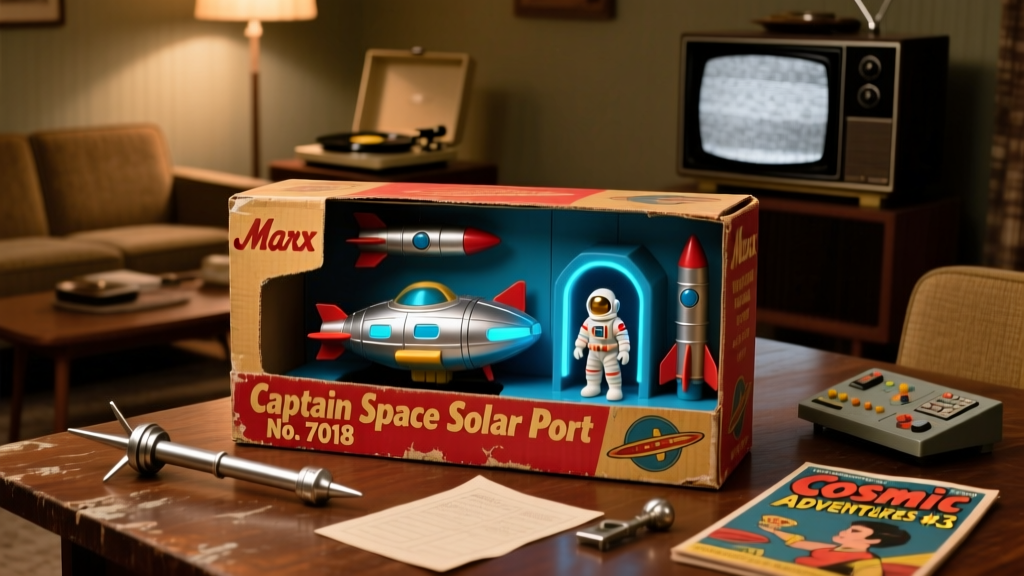
Captain Space Solar Port No. 7018: The Marx 1950s Toy Play Set That Captured America’s Atomic-Age Imagination

Webb Vase: Allover Carved White Flowers, Branches & Leaves — A Mid-Century Masterpiece in White-on-White Relief (4¾")

A Rare 1930s Furniture Mirror Featuring Stylized Mouse, Cat, and Dachshund Figures: Provenance, Craftsmanship, and Market Value

Western Oak Console Table: Decoding the Craft, Provenance, and Value of a Mid-Century American Icon

Imperial Glass Animal Bull Nut Brown: A Collector’s Deep Dive into the Iconic Mid-Century Paperweight Sculpture

Collectible Fishing Reels: A Mid-Century Collector’s Guide to Vintage Spincast, Baitcasting, and Fly Reels