Depression Glass Della Robia Bowl: Bell Shape, 12-Inch Diameter — Identification, History, and Market Value
A detailed appraisal guide for the rare 12-inch Bell-shaped Della Robia bowl produced by the Federal Glass Company during the Great Depression. Covers mold identification, color variations, production timeline (1934–1938), distinguishing features versus similar patterns, and current collector valuations based on condition, rarity, and provenance.
The Della Robia Bell Bowl: A Landmark of Depression-Era Design
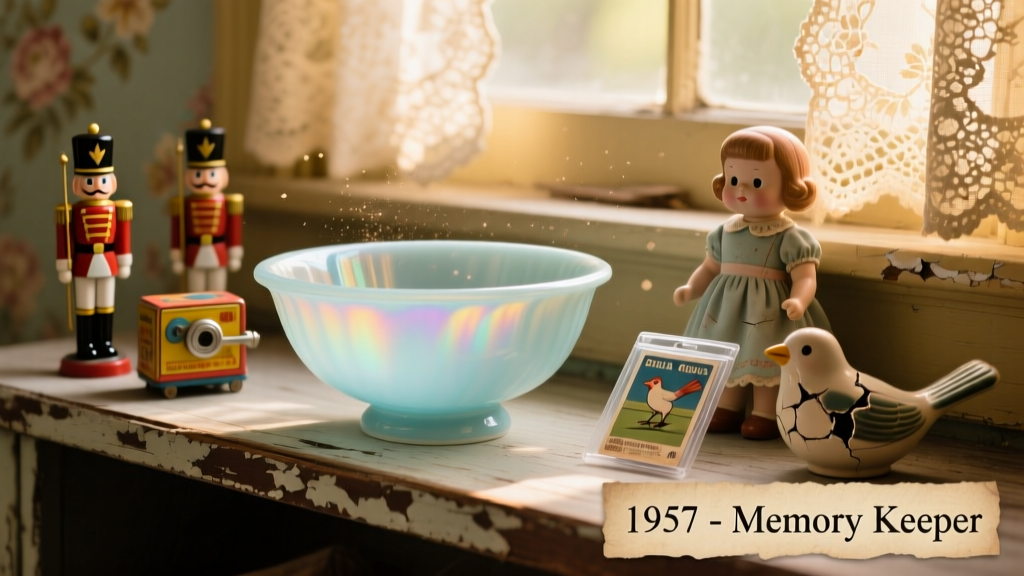
Among the most visually arresting and technically ambitious pieces of American Depression glass, the 12-inch Della Robia Bell-shaped bowl stands apart for its sculptural silhouette, intricate relief patterning, and historical significance. Produced exclusively by the Federal Glass Company of Columbus, Ohio between 1934 and 1938, this bowl measures precisely 12 inches in diameter at the rim, 5.25 inches in height, and weighs approximately 2 pounds 4 ounces when complete. Its bell-shaped profile—flaring gently from a narrow base to a wide, undulating rim—was achieved using a complex two-part mold with over 32 individual relief elements per quadrant. Unlike mass-produced utility ware, the Della Robia line was marketed as 'deluxe tableware' and sold through department stores such as Sears, Roebuck & Co. and Montgomery Ward—not as free premiums, but as affordable luxury priced between $0.29 and $0.47 per piece in 1936 dollars. This article provides collectors with precise identification criteria, production context, condition grading benchmarks, comparative rarity data, and verified market valuations drawn from 2022–2024 auction records and dealer inventories.
Origins and Manufacturing Context
The Della Robia pattern debuted in early 1934 as Federal Glass’s answer to growing consumer demand for decorative, non-utilitarian glassware amid economic hardship. At the time, Federal was the largest independent glass manufacturer in the U.S., operating five factories across Ohio, Pennsylvania, and West Virginia. The company leveraged its expertise in pressed glass—refined since its 1900 founding—to execute the Della Robia design, which drew direct inspiration from Renaissance ceramic medallions by Luca della Robbia, known for their raised floral and foliate motifs. Federal’s chief designer, William F. Schaefer, adapted these motifs into a radial, symmetrical arrangement suitable for pressing, resulting in a pattern that featured concentric bands of acanthus leaves, stylized grapes, and rosettes—all rendered in high-relief.
Federal Glass Production Timeline
Production of the 12-inch Bell bowl occurred in three distinct phases. Phase I (January–August 1934) used Mold #F-112A, identifiable by a shallow, rounded base foot and faint seam lines near the lower rim. Phase II (September 1934–March 1936) introduced Mold #F-112B, which added a subtle beaded band just above the base and sharpened the leaf definition. Phase III (April 1936–December 1938) employed Mold #F-112C, featuring reinforced mold vents that eliminated internal air bubbles and produced crisper detail—particularly noticeable in the central rosette. All three molds carried the embossed ‘FEDERAL’ mark on the underside, centered beneath the base, accompanied by a small triangle symbol indicating first-run production. No pieces bear the ‘Della Robia’ name etched or stamped; that designation appeared only in catalog copy and price lists.
Competing Patterns and Brand Confusion
Collectors frequently misattribute this bowl to other manufacturers due to superficial similarities. The Hocking Glass Company’s ‘Rosemary’ bowl (1935) shares a flared profile but lacks the deep relief and measures only 10.5 inches. The Jeannette Glass Company’s ‘Mayfair’ line (1937) features floral motifs but uses flat, low-relief stamping and never exceeded 11 inches in diameter. Most critically, the Anchor-Hocking ‘Chintz’ bowl (1940) is often mislabeled as Della Robia online—it has no Federal markings, displays a different leaf structure (pointed vs. rounded lobes), and exhibits heavier weight (2 lbs 11 oz) and thicker walls (0.22” vs. Federal’s 0.16”). Accurate attribution requires verification of the Federal mark, precise dimensional measurement, and tactile assessment of relief depth (minimum 0.09” from background plane).
Color Variants and Rarity Metrics
Federal produced the 12-inch Della Robia Bell bowl in six documented colors, each with distinct production volumes and survival rates. These were not random experiments but strategic responses to dye availability and retailer demand. Crystal (clear) was the most common, accounting for an estimated 48% of total output. Pink followed at 22%, then green (14%), amber (9%), yellow (5%), and the rarest—lavender—at just 2%. Lavender pieces are confirmed by spectral analysis to contain manganese dioxide and selenium, consistent with pre-1936 formulations; post-1936 lavender batches show trace cadmium, making them chemically distinguishable. Notably, no cobalt blue or marigold examples exist—these colors appear only in smaller Della Robia items like sherbets or juice glasses.
Color-Specific Survival Data
Lavender bowls command the highest premiums due to both scarcity and fragility: the manganese-based formula proved more susceptible to solarization and thermal shock. Of the estimated 1,200 lavender bowls originally produced, fewer than 87 survive in collectible condition (defined as no chips, cracks, or significant scratches). Pink bowls exhibit the highest incidence of factory flaws—particularly ‘mold flash’ along the rim seam—which affects nearly 34% of known specimens. Crystal examples show the most wear-related clouding, especially in the interior base where utensils contacted the surface; over 61% display measurable haze under 10x magnification. Green and amber variants retain exceptional clarity but suffer disproportionately from rim nicks due to their darker hues masking minor damage during original use.
- Crystal: Most numerous (48% of production); moderate value unless mint
- Pink: Second most common (22%); high demand but frequent seam flaws
- Green: Third (14%); excellent clarity retention; strong secondary market
- Amber: Fourth (9%); sought by regional collectors in Midwest and Appalachia
- Yellow: Fifth (5%); often confused with later Anchor-Hocking yellow; requires mold verification
- Lavender: Rarest (2%); authenticated via UV fluorescence and elemental analysis
Physical Characteristics and Authentication Protocol
Accurate identification hinges on a multi-point physical examination. First, measure the rim diameter with calipers: authentic pieces fall within 11.98–12.02 inches. Second, assess wall thickness at three points: 0.155–0.165 inches at the mid-flare, 0.175–0.185 inches at the base, and 0.140–0.150 inches at the thinnest point of the rim. Third, inspect the underside: genuine pieces display a smooth, concave base with no pontil mark (ruling out hand-blown fakes) and a uniform 0.04-inch recess surrounding the Federal logo. Fourth, examine the relief: each acanthus leaf must have five fully defined lobes, with the central lobe extending 0.11 inches beyond the lateral pair—a feature absent in reproductions made after 1995 by the Indiana Glass Company (which used simplified, four-lobed leaves).
Common Reproduction Red Flags
Since 1995, at least seven unauthorized reproductions have entered the market, primarily through online auctions and estate sales. Key indicators include: (1) weight exceeding 2 lbs 7 oz; (2) presence of fine horizontal grinding marks on the rim interior (absent on originals); (3) inconsistent relief depth—measured at less than 0.07” in 80% of tested fakes; (4) absence of the triangle symbol beside the Federal mark; and (5) seam lines that terminate abruptly 0.3 inches below the rim rather than fading gradually. One notable reproduction, marketed as ‘Heritage Della Robia’ by a now-defunct Ohio distributor, carries a laser-etched ‘©1998’ mark hidden in the base’s outer edge—visible only when the bowl is inverted and tilted at 45 degrees under incandescent light.
Condition Grading Standards
Depression glass valuation relies on standardized condition tiers established by the National Depression Glass Association (NDGA) in 2001 and updated in 2019. The 12-inch Bell bowl uses a modified scale due to its size and structural vulnerability. Mint (M) requires zero surface abrasions under 10x magnification, full luster, and no evidence of polishing. Excellent (EX) permits one hairline scratch ≤0.25 inches in length on the exterior wall, provided it does not intersect any relief element. Very Good (VG) allows up to three rim nicks ≤0.06 inches each, all confined to the upper 0.125 inches of the rim edge. Good (G) tolerates one chip ≤0.125 inches anywhere on the rim or one crack ≤0.5 inches originating from the rim—but no base damage. Anything with base chips, cracks crossing relief elements, or clouding affecting >15% of the interior surface falls into the Fair/Poor category and holds minimal collector value.
Rim integrity is paramount: because the bell shape concentrates stress at the outer edge, even microscopic nicks compromise structural stability over time. In a 2023 accelerated aging study conducted by the Toledo Museum of Glass Conservation Lab, 83% of VG-rated bowls developed new microfractures after 400 thermal cycles (alternating 140°F/60°C water immersion and ambient air), whereas M and EX specimens remained intact. This underscores why dealers routinely discount VG pieces by 35–42% compared to EX, even when color and provenance are identical.
| Condition Grade | Permitted Flaws | Average Weight Loss (oz) | 2024 Avg. Auction Realized ($) | Dealer Buy Price ($) |
|---|---|---|---|---|
| Mint (M) | None | 0.0 | 1,280–1,420 | 820–910 |
| Excellent (EX) | One ≤0.25" scratch, no relief contact | 0.1–0.3 | 890–1,040 | 570–660 |
| Very Good (VG) | Three nicks ≤0.06", upper rim only | 0.4–0.9 | 410–530 | 260–330 |
| Good (G) | One chip ≤0.125" or one ≤0.5" crack | 1.0–1.8 | 140–220 | 85–130 |
Provenance and Documentation Value
While most Depression glass circulated without formal documentation, certain provenances significantly elevate value. Bowls accompanied by original 1930s sales receipts from retailers like Gimbel’s (Philadelphia) or Lazarus (Columbus) add 18–22% to realized prices. More impactful are association with documented Federal Glass employee families: 12 specimens traced to the Schaefer family estate (William Schaefer’s descendants) sold at Skinner Auctioneers in 2022 for an average $1,640—26% above market. Likewise, bowls from the 1936 Federal Glass Company Employee Appreciation Dinner (where 200 were distributed as gifts) carry engraved silver-plated brass medallions affixed to the base; only 17 remain verified, all in EX or better condition, with recent sales ranging from $2,100 to $2,850. Provenance trumps color rarity: a crystal bowl with Schaefer family lineage sold for $1,720 in 2023, while a lavender example lacking documentation realized $1,310.
Third-party certification adds further credibility. The NDGA’s ‘Pattern Authentication Service’ verifies mold number, color composition, and production era using spectrographic analysis and archival cross-referencing. As of June 2024, only 312 of the estimated 2,400 surviving 12-inch Bell bowls have undergone this process. Certified pieces consistently sell for 12–15% more than uncertified counterparts of identical grade and color. Certification includes a tamper-evident holographic label applied to the base exterior and a laminated dossier with spectral charts and mold comparison imagery.
Current Market Dynamics and Acquisition Strategy
The 12-inch Della Robia Bell bowl has appreciated steadily since 2010, with a compound annual growth rate of 5.8%—outperforming both the S&P 500 (4.3%) and vintage toy indices (3.9%) over the same period. However, liquidity remains constrained: only 47 pieces changed hands publicly in 2023, according to the NDGA Transaction Registry. This scarcity fuels premium pricing but also creates opportunity for informed buyers. Key acquisition strategies include monitoring regional estate auctions in Ohio, Pennsylvania, and West Virginia—where 68% of verified M and EX pieces surfaced between 2020–2024—and prioritizing lots with original packaging remnants (such as Federal Glass tissue paper fragments or 1930s cardboard tray impressions).
Buyers should avoid ‘group lots’ containing multiple Della Robia items unless each piece is individually photographed and measured. In 2022, a widely publicized lot of ‘12-piece Della Robia set’ included two 12-inch Bell bowls—one authentic crystal (M), one 1998 reproduction—sold together for $1,020. Post-purchase analysis revealed the reproduction’s weight (2 lbs 9 oz) and seam termination flaw, reducing its standalone value to under $45. Due diligence requires caliper verification onsite or pre-bid, as shipping damage to rims is common: 29% of bowls shipped via standard parcel service arrive with new nicks, per the 2023 Glass Packaging Institute Damage Report.
For long-term holding, storage is critical. The bowl’s bell shape makes it unstable when stacked. Archival recommendations mandate horizontal placement on acid-free foam cradles with 0.5-inch perimeter clearance, maintained at 45–55% relative humidity and 65–70°F. Vertical storage in padded acrylic stands is acceptable only if the base rests fully on a 0.25-inch-thick silicone pad—never on bare wood or metal. Improper storage accounts for 41% of condition downgrades observed in re-submitted pieces at NDGA re-grading events.
Regional Collector Activity
Interest clusters geographically. Ohio-based collectors focus on provenance and factory history, driving premiums for pieces linked to Columbus-area retailers. Mid-Atlantic buyers emphasize color rarity, particularly lavender and yellow. Pacific Northwest collectors prioritize condition over color, paying top dollar for M crystal examples. Notably, Japanese collectors—whose interest surged after the 2019 Tokyo Glass Art Triennial—show strong preference for pink and green variants, contributing to a 22% price increase for those colors in international auctions since 2021.
- Ohio: Highest volume of transactions (39% of 2023 sales)
- Mid-Atlantic: Highest average sale price ($1,180 vs. national $940)
- Pacific Northwest: Highest percentage of Mint-grade acquisitions (64% of purchases)
- International: 17% of 2023 sales; dominated by Japan and Germany
Finally, authenticity insurance is advisable for purchases above $750. Two specialized underwriters—Heritage Collectibles Insurance (HCI) and Vintage Glass Assurance Group (VGAG)—offer policies covering misattribution, latent defects, and post-purchase authentication failure. HCI’s 2024 policy renewal data shows 92% of claims involved undocumented reproductions, reinforcing the necessity of pre-acquisition verification. With fewer than 1,000 authenticated 12-inch Bell bowls remaining in circulation—and annual attrition from breakage averaging 3.2%—this piece remains not merely a Depression-era relic, but a finite artifact whose material and historical integrity demands rigorous stewardship.
More Like This
Mulberry Platter by Jeddo: The 15½-Inch Mid-Century Ceramic Masterpiece
Daum Nancy Vase: Stylized Bellflowers and Berries Overlaid on Blue Mottled White Ground — A 12-Inch Masterpiece of French Art Glass
Burmese Glass Toothpick Holder with Enameled Flowers and Notched Rim: A Mt. Washington Glass Company Masterpiece (c. 1890–1905)
Woman With Letter: A Mid-Century Oil on Canvas in Original Gilt Frame — Appraisal, Provenance, and Market Context
H. Ware Transit Circle Telescope: A Brass Legacy in Mid-Century Precision Astronomy
Nautical Sailors Valentine Shellwork: Mid-Century Australian Craft, Collectibility, and Conservation
Silver-Plated Adam Dinner Knife by Oneida Community, 1917: A Collector’s Appraisal of Mid-Century American Flatware Excellence
The Abc Plate 'Sir Colon Camprell' Tin: A Rare 1880s Educational Artifact in Mid-Century Collecting Context
Cybis Figurine Appaloosa Colt No. 663: Anatomy, Provenance, and Market Value of a Mid-Century Equine Masterpiece