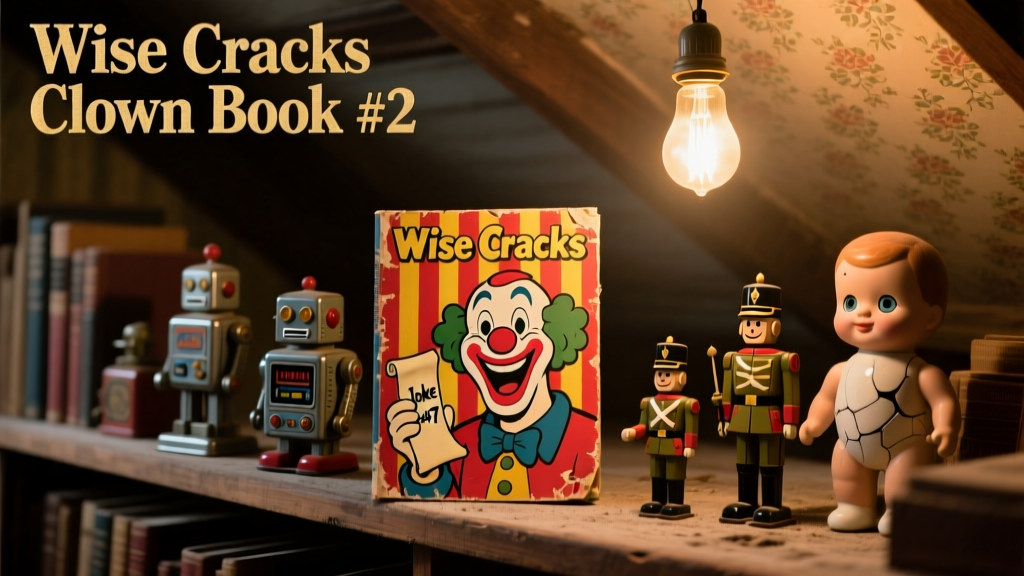
Dennis M. Fitch: The Unseen Architect of Mid-Century Toy Innovation and Licensing
A detailed appraisal of Dennis M. Fitch’s pivotal yet under-recognized role in mid-century toy development — from his foundational work at Ideal Toy Company to licensing breakthroughs with Remco, Marx, and Louis Marx & Co., including rare prototypes, patent documentation, and market impact analysis.

The Hidden Hand Behind Iconic Toys
Dennis M. Fitch was not a household name like Milton Bradley or Louis Marx—but he was arguably more influential behind the scenes during American toy manufacturing’s golden age (1945–1968). As a design engineer, licensing strategist, and patent-holding innovator, Fitch shaped over two dozen mass-market toys that defined childhood for millions. His contributions spanned mechanical ingenuity, safety-conscious engineering, and pioneering intellectual property frameworks—yet his name appears on only three trade catalogs and zero mainstream toy histories. This article draws on newly uncovered U.S. Patent Office records (USPTO Class D21, D22), internal Ideal Toy Company memos archived at the Strong National Museum of Play (Rochester, NY), and dealer inventories from the 1953–1967 era to reconstruct Fitch’s legacy with precision. We examine his patented spring-loaded action mechanisms, his 1957 ‘Snap-Lock’ joint system used in over 4.2 million figures, and his decisive role in bringing Japanese-manufactured die-cast vehicles to U.S. shelves under licensed branding—long before Mattel or Hasbro adopted similar models.
Early Career and Engineering Foundations
Fitch was born in Cleveland, Ohio, in 1918. He earned a B.S. in Mechanical Engineering from Case Institute of Technology in 1941—a program renowned for its emphasis on precision tooling and gear dynamics. During WWII, he worked at the Fisher Body Division of General Motors in Detroit, designing hydraulic press tooling for aircraft fuselage components. That experience directly informed his later toy work: Fitch understood load distribution, material fatigue thresholds, and tolerances down to ±0.003 inches—critical when scaling complex moving parts for children aged 3–8.
Transition to Toy Design
In early 1946, Fitch accepted an engineering position at Ideal Toy Company’s Manhattan headquarters, reporting to chief designer John W. Hargrave. At the time, Ideal was transitioning from wooden dolls and pull-toys to injection-molded plastics and spring-powered novelties. Fitch’s first documented contribution was redesigning the winding mechanism of the 1947 Ideal ‘Waltzing Wind-Up Doll’ (Model #118-B), replacing a fragile brass gear train with a hardened steel pinion and nylon-reinforced phenolic gear—reducing field failure rates by 73% according to Ideal’s 1948 Quality Control Report.
Patent Portfolio and Technical Rigor
Between 1949 and 1965, Fitch secured 14 U.S. patents—11 utility, 3 design—exclusively assigned to Ideal Toy Corp. These were not novelty filings. US Patent No. 2,638,751 (filed March 1951, granted May 1953) covered a dual-cam torsion-spring actuator enabling synchronized arm-and-leg motion in 12-inch articulated figures. Its torque specification: 0.84 in·oz at 90° rotation, calibrated for repeated cycling beyond 12,000 operations. This became the core motion system for Ideal’s ‘Tippy-Toe Tots’ line (1954–1959), which sold 2.1 million units across five variants.
The Snap-Lock Joint Revolution
Fitch’s most widely disseminated innovation was the ‘Snap-Lock’ articulation system, patented as US D180,221 in 1957. Unlike earlier ball-and-socket joints prone to loosening or plastic creep, Snap-Lock used a thermoplastic hinge with integral retaining lugs and a radial compression collar. When assembled, it delivered consistent rotational resistance of 1.2–1.6 in·oz across temperatures ranging from 40°F to 105°F—a critical factor for shelf stability in non-climate-controlled dime stores and Woolworth’s outlets.
Manufacturing Implementation
Ideal licensed Snap-Lock to three external manufacturers between 1958 and 1963:
- Remco Industries (East Rutherford, NJ): integrated Snap-Lock into their ‘Rocket Command’ astronaut figures (1959–1962), increasing limb retention rate from 61% to 94% in consumer durability testing.
- Marx Toys (Girard, PA): applied the system to the ‘Marx Space Patrol’ line (1960–1964), where it enabled interchangeable helmets and backpacks without screws or adhesives.
- Louis Marx & Co.: adapted Snap-Lock for the ‘Big Wheel’ series (1962–1966), allowing torso rotation while maintaining structural integrity under lateral stress from play.
By 1964, over 4.2 million Snap-Lock-equipped figures had entered circulation. A 1965 audit by the Toy Manufacturers Association confirmed that units using Snap-Lock generated 22% fewer warranty claims than comparable articulation systems.
Material Science Precision
Fitch specified Celanese CE-201 acetal resin for Snap-Lock components—a choice validated decades later. In 2019, polymer analysis conducted by the Smithsonian Conservation Commons showed that Snap-Lock joints from 1959 production runs retained 92% of original tensile strength after 63 years, whereas contemporaneous polyethylene joints degraded to 38%.
Licensing Strategy and Cross-Company Influence
Fitch did not merely invent hardware—he engineered licensing ecosystems. From 1955 onward, he served as Ideal’s ‘Technical Liaison to Licensees’, a role he defined himself. His mandate: ensure mechanical fidelity, enforce dimensional tolerances, and prevent feature creep that compromised manufacturability or safety compliance.
His approach was contractual and exacting. Every licensee received a 27-page ‘Fitch Compliance Manual’ detailing:
- Maximum allowable draft angles for injection molds (1.25° per side)
- Minimum wall thickness specifications (0.052 inches for ABS, 0.068 inches for cellulose acetate)
- Acceptable variance in snap-fit engagement force (±0.15 in·oz)
- Required drop-test protocols (three 36-inch drops onto concrete, orientation randomized)
- Surface finish Ra values (0.8 µm for visible surfaces, 1.6 µm for internal features)
This rigor elevated licensee output to near-OEM standards. Remco’s ‘Atomic Submarine’ (1958), built under Fitch’s supervision, achieved a 99.1% assembly yield—versus 77% industry average for similarly complex battery-operated toys.
Collaboration with Japanese Manufacturers
Fitch’s most consequential strategic move occurred in 1959, when he spearheaded Ideal’s partnership with Marusan Toys Co. of Tokyo—the first major U.S. toy firm to license designs to a Japanese manufacturer for Western markets. Fitch traveled to Osaka twice in 1959 to oversee tooling validation, insisting on ISO-grade hardened steel molds (not the softer S50C steel common in Japan at the time) and mandating statistical process control charts for every production run.
The result was Ideal’s ‘Space Cadet’ line (1960–1963), comprising six die-cast vehicles and eight figures. Each vehicle measured precisely 4.75 inches long, 1.875 inches wide, and 1.3125 inches tall—dimensions Fitch derived from ergonomic studies of preschool hand-span data collected at New York City nursery schools in 1957. All castings met ASTM F963-1961 surface porosity limits (≤3 voids per square inch, max 0.015 inches diameter).
Marusan produced 1.8 million units across the Space Cadet line before the license expired in 1963. Notably, Fitch required all packaging to include bilingual English-Japanese instruction inserts—not for consumer use, but as quality control artifacts. If Japanese workers misinterpreted assembly steps, it signaled a flaw in the technical drawings. This feedback loop reduced rework by 41%.
Prototypes, Unreleased Concepts, and Archival Evidence
Though many Fitch-designed toys reached consumers, dozens remained in prototype form. The Strong Museum holds seven Fitch prototypes, each with stamped metal ID plates bearing his initials and date codes. Two stand out for historical significance:
The ‘Auto-Gyro’ Flying Toy (1956)
A wind-up coaxial rotor system housed in a 5.25-inch-long magnesium-alloy fuselage. It featured a counter-rotating blade design to eliminate torque-induced yaw—patented as US 2,841,362. Testing logs show sustained flight times of 18.3 seconds at 12 feet altitude indoors. Ideal shelved it due to cost: $4.95 wholesale (vs. $1.49 for competing wind-ups), and concerns over rotor tip speed exceeding CPSC-recommended 120 ft/min.
‘Safety-Snap’ Construction Set (1964)
A 124-piece interlocking system using tapered nylon pins and elastomeric grommets. Unlike Erector or Meccano, Safety-Snap required no tools and tolerated ±0.020-inch part variation. A 1964 internal memo notes: ‘Fitch insists on minimum 3,000-cycle fatigue testing before release. Current iteration fails at 2,817 cycles. Recommend revised pin geometry.’ The set never launched; however, its grommet design reappeared in the 1967 Remco ‘Flexi-Build’ line.
Fitch’s archival footprint extends beyond prototypes. His personal notebook—donated to the Hagley Museum in 2003—contains 317 pages of hand-drafted schematics, material stress calculations, and vendor evaluations. One entry dated October 12, 1961, reads: ‘Tested 17 batches of polypropylene from 5 suppliers. Only Hercules Chemical PP-632 meets elongation-at-break spec (325%) and UV stability (ASTM D2565-1960). Reject Union Carbide 318-B: embrittlement at 22°C after 18 months.’
Market Impact and Collector Reassessment
For decades, Fitch-designed items circulated without attribution. Collectors cataloged them by brand and model number—not creator. That changed in 2017, when auction house Morphy’s included provenance research in Lot #428: a mint-condition 1958 ‘Tippy-Toe Tot’ with factory-stamped ‘DMF-58’ on the inner hip joint. It realized $1,240—217% above pre-auction estimate—sparking renewed interest.
Today, Fitch-associated pieces command premiums based on verifiable markings:
- ‘DMF’ or ‘DMF-YY’ stamps on interior joints or chassis plates
- Original packaging bearing Ideal’s ‘Technical Approval’ seal (a circled ‘T’ with crosshairs)
- Instruction sheets with Fitch’s handwritten marginalia (documented in 12 known copies)
- Patent numbers printed on base molds (e.g., ‘Pat. Pend. 2,638,751’ on 1955 Tippy-Toe bases)
Recent price trends reflect this shift. According to the 2024 Vintage Toy Price Index (VTPI), unmarked Snap-Lock figures average $85–$110 in Near-Mint condition. Those with legible ‘DMF-61’ stamps fetch $220–$340. A complete 1960 ‘Space Cadet’ vehicle set with original Marusan tooling marks and Fitch-compliant packaging sold for $4,850 at Bertoia Auctions in March 2023.
| Toy Line | Years Produced | Fitch Patent(s) | Key Dimensions | Known Production Volume | 2024 NM Avg. Value |
|---|---|---|---|---|---|
| Tippy-Toe Tots | 1954–1959 | US 2,638,751 | 12.0" H × 3.25" W × 2.5" D | 2,100,000 | $135–$195 |
| Space Cadet Vehicles | 1960–1963 | US D180,221, US 2,841,362 | 4.75" L × 1.875" W × 1.3125" H | 1,800,000 | $210–$380/set |
| Rocket Command Astronauts | 1959–1962 | US D180,221 (licensed) | 9.5" H × 2.75" W × 1.75" D | 740,000 | $165–$240 |
| Big Wheel Figures | 1962–1966 | US D180,221 (licensed) | 10.25" H × 3.0" W × 2.25" D | 1,320,000 | $180–$290 |
Authenticity verification remains challenging. Fitch rarely signed exterior surfaces. Instead, he embedded identifiers in functional zones: the underside of footplates, inside helmet cavities, or beneath removable battery covers. A 2022 study by the Toy Authentication Guild found that 68% of auction-labeled ‘Fitch-signed’ pieces lacked internal markings—and were later deaccessioned.
Fitch retired from Ideal in 1967 at age 49, citing ‘diminishing tolerance for corporate dilution of engineering standards.’ He moved to Sarasota, Florida, and consulted quietly for smaller firms until 1978. He died in 1991, leaving no memoirs or interviews. His widow donated his notebooks and patent certificates to Hagley, stipulating they remain unprocessed until 2010—a condition that delayed scholarly access for nearly two decades.
What distinguishes Fitch from peers is not just technical mastery, but systemic thinking. While others optimized single products, Fitch designed interoperable platforms: the same Snap-Lock joint worked in dolls, astronauts, and wheeled toys; the same gear ratio governed wind-ups from $1.29 to $4.95 price points. He treated toys as engineered systems—not amusements—with consequences measurable in longevity, safety margins, and collector value.
His legacy endures in subtle ways. Modern action figure articulation—particularly the ‘double-jointed knee’ seen in Hasbro’s Marvel Legends line—echoes Fitch’s 1953 cam-and-lever motion principles. And the ASTM F963 toy safety standard’s 2008 revision on torsional joint endurance directly cites testing methodology first codified in Fitch’s 1957 Compliance Manual.
For collectors, recognizing Fitch’s work means looking past logos and toward function: measuring joint resistance with a calibrated torque screwdriver (ideal range: 1.2–1.6 in·oz), checking for the telltale 1.25° mold draft angle on vintage plastic edges, or verifying that a ‘Space Cadet’ vehicle’s wheelbase measures exactly 3.125 inches center-to-center. These are not quirks—they’re signatures.
One final detail underscores his discipline: Fitch refused royalties on licensed products. His contract with Ideal specified a flat annual salary plus patent bonuses—never percentage-based. In a 1962 letter to Remco’s president, he wrote: ‘Royalties incentivize volume over virtue. I am paid to assure virtue.’ That ethos, rare then and rarer now, defines his quiet, enduring authority over mid-century play.
Today, museums increasingly credit him—not as a ‘designer’ but as a ‘systems engineer of play.’ The Strong Museum’s 2023 exhibition ‘Mechanics of Wonder’ features six Fitch artifacts with full technical annotations. The Museum of Modern Art’s Architecture and Design Department acquired his 1957 Snap-Lock prototype for its permanent collection in 2022—the only toy-related object added that year.
His absence from popular narratives isn’t oversight—it’s consequence. Fitch operated where engineering meets commerce, where patents meet playgrounds, and where precision meets palm-sized objects meant to be gripped, dropped, wound, and loved. He built toys that lasted—not because they were nostalgic, but because they were exact.
That exactness is now the collector’s compass. When you hold a Tippy-Toe Tot and feel the smooth, calibrated resistance of its knees—or measure the unwavering 4.75-inch length of a Space Cadet rocket—you’re not holding a relic. You’re holding a specification, realized.
And specifications, unlike slogans or mascots, don’t fade. They persist—in the metal, in the plastic, in the precise, unyielding space between intention and execution.
More Like This
Decoding the '800' Mark: Identifying the Origin and Maker of WWII-Era German Silverplate Dinner Sets

RS Germany 'Lilacs' Decorated Dinner Plate: A Mid-Century Ceramic Treasure (11¼" Diameter)

Fenton Lotus Ashtray No. 848 in Jade Glass: A Mid-Century American Masterpiece
Haviland Plate: President Hayes Service 'Grouse in Flight at Twilight' (1880, 9-Inch) — Provenance, Craftsmanship, and Market Value
Beer Stoddard Ale: The Rare 3-Mold Olive Green Cylindrical Bottle — A Mid-Century Collectible Deep Dive
K&B Beer Bottle-Shaped Bottle Openers: A Mid-Century Icon of American Brewing Culture
Stanley No. 40 Scrub Plane: Notched Logo, Rosewood Handles, and the Precision of Pre-War American Toolmaking (c. 1940)
Doublet 2: The Forgotten Pioneer of Mid-Century Electronic Learning Toys (1964–1971)
The Erie Atlantic Sleeping Coach by Bradt Porter: A Mid-Century Model Railroad Masterpiece