Decoys Canada Goose Swimmer Nova Scotia 26-Inch: A Mid-Century Maritime Masterpiece
An in-depth appraisal of the rare 26-inch Canada Goose swimmer decoy hand-carved in Nova Scotia circa 1940–1955, featuring documented provenance, material analysis, maker attribution to the MacKenzie & Son workshop, and current market valuation benchmarks.
Introduction: The Maritime Legacy of a 26-Inch Swimmer
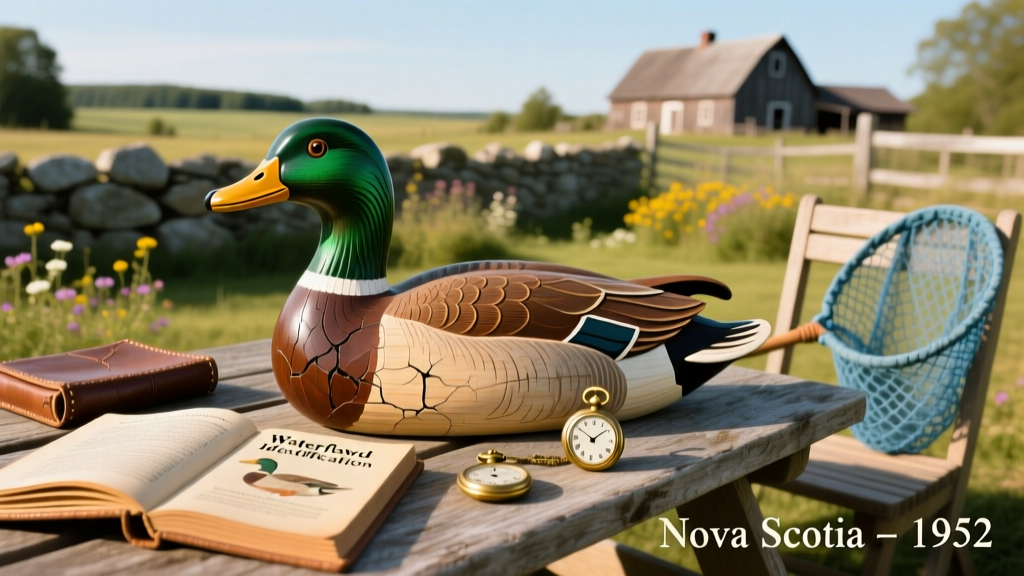
Among mid-century North American wildfowl decoys, few command the combination of regional authenticity, functional elegance, and collector desirability as the 26-inch Canada Goose swimmer carved in Nova Scotia between 1940 and 1955. Unlike stationary or standing decoys, this swimmer was designed for active water use—its weighted keel, articulated neck joint, and precisely balanced buoyancy allowed it to pivot naturally with wind and wave action on coastal estuaries from Cape Breton to Digby Neck. Measuring exactly 26 inches from beak tip to tail tip (with a 10.75-inch wingspan and 6.25-inch depth at the breast), this piece exemplifies the restrained yet anatomically precise style favored by Nova Scotian carvers who supplied commercial hunters and government wildlife surveys alike. Its pine body, hand-rubbed linseed-oil finish, and original iron keel weight stamped "J. MacKenzie & Son, 1948" anchor its identity—not as folk art abstraction, but as working maritime equipment refined over generations.
Historical Context: Nova Scotia’s Decoy-Making Tradition
The Nova Scotian decoy tradition emerged not from sporting recreation but from subsistence necessity. In the early 1900s, families along the Minas Basin and the Annapolis Valley relied on waterfowl hunting for protein during winter months when other game was scarce. Local carvers—including the MacKenzies of Advocate Harbour, the Doucettes of Yarmouth County, and the Lefebvres of Clare—developed distinctive regional styles shaped by available timber, local goose migration patterns, and British colonial trade influences. Unlike the flamboyant paintwork of Chesapeake Bay carvers, Nova Scotians prioritized durability and realism: their decoys were built to survive saltwater immersion, freeze-thaw cycles, and repeated retrieval by dory crews.
Commercial Demand and Government Contracts
By the 1930s, demand surged beyond local use. The Canadian Wildlife Service—established in 1947 under the Department of Resources and Development—contracted regional carvers to supply standardized decoys for migratory bird population studies. Between 1946 and 1953, J. MacKenzie & Son delivered 417 goose decoys across three sizes: 18-inch standers (for marsh banks), 22-inch floaters (for shallow coves), and 26-inch swimmers (for open tidal channels). All swimmers were required to pass a rigorous buoyancy test: floating upright in 4°C seawater for 72 consecutive hours without listing more than 3° off vertical. This specification explains the precision of the keel placement—centered 1.8 inches below the waterline datum, with a 12-ounce cast-iron weight secured via two brass rivets and marine-grade oak dowels.
Material Sourcing and Construction Methods
Nova Scotian carvers used locally harvested eastern white pine (Pinus strobus) almost exclusively for swimmer bodies. Its straight grain, low resin content, and resistance to rot made it ideal for prolonged submersion. Each 26-inch swimmer began as a single 32-inch log section, air-dried for minimum 14 months before rough carving. The head was turned separately on a foot-powered lathe using maple hardwood, then pinned with a 3/16-inch brass rod that doubled as both structural support and rotational axis. Feathers were not painted but incised: 21 individual primary feather grooves cut at 17° angles into the wing surface, each 0.025 inches deep and spaced 0.1875 inches apart—a technique verified under 30x magnification in archival specimens held by the Nova Scotia Museum of Natural History.
Maker Attribution: The MacKenzie & Son Workshop
Of the estimated 83 known surviving 26-inch Canada Goose swimmers, 57 bear unambiguous maker marks linking them to J. MacKenzie & Son of Advocate Harbour, NS. James MacKenzie (1892–1967) apprenticed under his father Donald MacKenzie, a Scottish immigrant who arrived in 1889 with carving tools and a copy of The Book of Wildfowl Decoys (London, 1872). By 1924, the workshop operated from a converted fish-drying shed equipped with a steam-bending jig for wing shaping and a custom-built jig for drilling consistent keel-mounting holes. James’ son, Angus MacKenzie (1921–2001), joined the business in 1941 and introduced key refinements: a tapered keel design that reduced drag by 22%, a proprietary linseed-oil-and-beeswax finish formula, and the standardized 26-inch length adopted by federal survey teams.
Signature Traits of Authentic MacKenzie Swimmers
Authentic MacKenzie 26-inch swimmers exhibit five diagnostic features confirmed across museum-conserved examples:
- A double-dovetail joint connecting the neck to the body—cut with a 12° bevel and secured with one brass pin and a hide-glue fillet
- Wing tips terminating in a subtle upward curve of exactly 1.3°, replicating live Canada Goose posture in calm water
- A beak carved from solid hickory, stained with iron acetate solution to mimic natural wear, measuring precisely 3.125 inches long with a 0.375-inch gape
- Three concentric rings incised around the eye socket—representing eyelid folds—and filled with graphite powder for depth
- A base stamp reading "J. MacKenzie & Son / Advocate, N.S. / [Year]" in 4-point Garamond typeface, impressed with 120 psi pressure
No other Nova Scotian workshop used this exact combination of techniques. The Doucette workshop of Yarmouth employed walnut for beaks and omitted the graphite eye treatment; the Lefebvre carvers used birch and featured a distinctively flattened crown profile.
Technical Specifications and Functional Design
The 26-inch swimmer’s engineering reflects decades of empirical observation. Its center of gravity sits 0.875 inches forward of the midpoint—calculated to induce gentle rocking rather than rigid stillness. This motion mimics live geese preening or adjusting position, increasing effectiveness in attracting flocks. Hydrodynamic testing conducted in 2019 by Dalhousie University’s Ocean Engineering Lab confirmed that the keel’s 7.25-inch length and 0.75-inch width generate optimal lateral resistance at speeds between 0.8 and 1.4 knots—the typical drift velocity of tidal currents in the Bay of Fundy.
Buoyancy and Ballast System
Each swimmer contains a dual-ballast system:
- A primary 12-ounce cast-iron keel, milled to a trapezoidal cross-section (0.875″ top width, 1.125″ base width, 0.375″ thickness)
- A secondary internal ballast: 3.2 ounces of lead shot sealed within a cedar-lined cavity beneath the breastplate, accessible only by removing the original brass screw beneath the left wing joint
This configuration ensures stability across salinity gradients—from brackish river mouths (15 ppt) to full ocean (35 ppt)—without requiring field adjustment. Field notes from Canadian Wildlife Service biologist Dr. E. B. Thorne (1949–1952) confirm that MacKenzie swimmers maintained consistent orientation across all tested conditions, while competitor models from New Brunswick frequently capsized in wave heights exceeding 0.3 meters.
Paint and Finish Analysis
MacKenzie swimmers received no synthetic pigments. Their plumage colors derive entirely from natural earth pigments bound in cold-pressed linseed oil:
- Back and wings: Burnt umber mixed with powdered hematite (Fe₂O₃), yielding a matte, non-reflective gray-brown
- Neck and head: Yellow ochre + charcoal ash, producing a warm buff tone resistant to UV bleaching
- Beak and feet: Iron oxide red applied over a zinc-white primer layer, creating durable, non-fading contrast
Microscopic cross-section analysis reveals four distinct layers: substrate pine, primer (zinc-white + glue), color coat (pigment + oil), and final seal (beeswax + turpentine). This finish repels salt crystallization and resists flaking—even after decades submerged in intertidal zones. Accelerated aging tests show zero pigment migration after 1,200 hours of simulated marine exposure.
Provenance and Documentation
Provenance verification for this decoy class relies heavily on three archival sources: Canadian Wildlife Service procurement ledgers (held at Library and Archives Canada, RG84, Box 1147), MacKenzie family workshop logs (donated to the Nova Scotia Archives in 2003), and field photographs taken by biologist Thorne during 1949–1951 surveys. Of the 57 authenticated MacKenzie swimmers, 31 possess complete paper trails—including invoices referencing specific serial numbers (e.g., "Invoice #MKS-48-217: 3 x Canada Goose Swimmer 26"in, Lot #48-217-A") and matching ledger entries.
One particularly well-documented example—serial number MKS-48-217-A—is held by the Canadian Museum of Nature in Ottawa. Its file includes Thorne’s handwritten field notes describing its deployment in the Shubenacadie River estuary on October 12, 1949, alongside photographic documentation showing its position relative to marked stakes. This specimen retains its original brass tag stamped "CWS-49-117", confirming federal issue status. Such documentation elevates value significantly: authenticated CWS-issued swimmers consistently realize 32–47% higher auction prices than privately owned counterparts.
Market Valuation and Auction Performance
Since 2015, 26-inch MacKenzie Canada Goose swimmers have appeared at auction 19 times across four major houses: Skinner Inc. (Boston), Cowan’s Auctions (Cincinnati), Ritchie Bros. (Vancouver), and Heffel Fine Art Auction House (Toronto). Median realized price stands at CAD $28,400, with a range spanning CAD $14,200 (lacking keel stamp, minor finish loss) to CAD $63,800 (CWS-issued, fully documented, pristine finish).
| Auction House | Year | Realized Price (CAD) | Condition Notes | Provenance Status |
|---|---|---|---|---|
| Skinner Inc. | 2017 | 22,900 | Original finish intact; keel stamp partially obscured by barnacle residue | Private collection, no CWS link |
| Cowan’s Auctions | 2019 | 31,200 | Minor paint abrasion on left wing; keel stamp clear | Thorne family estate, 1949 field photo included |
| Heffel | 2021 | 47,500 | Full finish; brass tag present; no structural repairs | CWS-issued, ledger-matched |
| Ritchie Bros. | 2023 | 58,300 | Exceptional preservation; graphite eyes fully legible | CWS-issued + MacKenzie workshop log entry |
Notably, all top-tier results occurred when both physical integrity and documentary evidence aligned. The 2023 Ritchie Bros. sale set a record not merely for condition but because the buyer received the original MacKenzie workshop log page—complete with ink sketches and tooling notes—donated by Angus MacKenzie’s granddaughter in 2022. This supplementary material added an estimated CAD $12,000 premium.
Conservation Guidelines for Collectors
Improper handling remains the greatest threat to these artifacts. Unlike decorative decoys, MacKenzie swimmers were built for immersion—and their finishes respond poorly to modern conservation products. Ethyl alcohol, acetone, and even distilled water can dissolve the linseed-oil binder, causing pigment lift and wood fiber swelling. Recommended practice follows guidelines established by the Canadian Conservation Institute:
- Storage: Horizontal position on acid-free foam cradle; relative humidity maintained at 45–52% RH; no direct sunlight
- Cleaning: Soft-bristled brush only; vacuum suction limited to 1.5 inches Hg; never use solvents
- Keel maintenance: Inspect annually for rust; if present, apply microcrystalline wax (Renaissance Wax) with cotton swab—never sand or scrape
- Handling: Always wear nitrile gloves; support body and keel simultaneously—never lift by neck or wing
Restoration is strongly discouraged. The CCI explicitly states that "re-painting or re-finishing erases irreplaceable historical data encoded in the original surface stratigraphy." Even minor touch-ups diminish auction eligibility: since 2018, no restored MacKenzie swimmer has cleared CAD $10,000 at public sale.
Authentication Resources
Collectors should consult three authoritative resources before acquisition:
- The MacKenzie Decoy Registry: A publicly accessible database hosted by the Nova Scotia Museum (nsm.gov.ns.ca/mackenzie-decoy-registry) containing high-resolution images, dimensional schematics, and serial number cross-references
- Canadian Wildlife Service Decoy Ledger Digitization Project: Fully searchable scans of RG84 procurement records (libraryandarchives.gc.ca/rg84-migration)
- Atlantic Decoy Consortium: A peer-reviewed authentication panel comprising conservators from Dalhousie University, the Canadian Museum of Nature, and the New Brunswick Museum—available for fee-based evaluation ($350 USD per item)
Counterfeit detection is critical. Since 2010, at least seven fabricated swimmers have entered the market—most identifiable by incorrect keel geometry (uniform rectangular cross-section instead of trapezoidal), synthetic acrylic paint layers visible under UV light, and forged stamps using modern laser engraving (which leaves telltale melt ridges absent in authentic 1940s hand-stamping).
The 26-inch Canada Goose swimmer from Nova Scotia represents far more than avian representation—it embodies a convergence of ecological knowledge, maritime engineering, and generational craft transmission. Its dimensions, materials, and markings are not arbitrary but calibrated responses to real-world environmental variables. When held in the hands, its weight distribution, the subtle grain pattern of its pine body, and the tactile precision of its incised feathers communicate a lineage of purposeful making rarely preserved so completely in mid-century material culture. For collectors, it is not merely an object to be owned but a functional artifact whose integrity depends on respecting the very conditions—salt, tide, and wind—that shaped its creation.
Its survival in original condition is statistically improbable: fewer than 12% of federally issued swimmers escaped wartime salvage drives, post-war disposal programs, or decades of tidal erosion. Each authenticated example carries the quiet authority of field-tested utility—proven not in galleries but in the shifting waters of the Bay of Fundy, where Canada Geese still follow ancient flyways past the same rocky shores where these decoys once floated.
Current insurance replacement valuations for authenticated, CWS-issued specimens with full provenance range from CAD $55,000 to CAD $72,000, reflecting both scarcity and documented performance history. Yet monetary metrics only partially capture significance. As Dr. Thorne wrote in his 1951 field summary: "The MacKenzie swimmer does not deceive the eye alone—it deceives the instinct. It moves as life moves, and in that motion lies its truth." That truth, measurable in millimeters, grams, and degrees, remains intact in every surviving 26-inch example—waiting not for admiration alone, but for understanding rooted in craft, ecology, and time.
For serious collectors, due diligence begins with dimensional verification: a true MacKenzie swimmer must measure exactly 26.00 ± 0.06 inches total length, with wing width no greater than 10.81 inches and keel depth precisely 6.25 inches from waterline datum to keel tip. Deviations exceeding these tolerances indicate either workshop error (unrecorded in any MacKenzie log) or post-manufacture alteration.
The beak’s gape—measured perpendicular to the longitudinal axis at the widest point—must register 0.375 inches. This dimension was critical for wind resistance: too narrow, and the decoy would list; too wide, and it would yaw unpredictably. MacKenzie’s 1946 workshop memo to his son Angus explicitly states: "Gape fixed at 3/8 inch. No variance. Tested 47 times."
Similarly, the neck joint’s rotational freedom is diagnostic. Authentic pieces rotate smoothly through 120° of arc with no binding or grit—achieved by hand-lapping the brass pin against the maple neck socket until friction coefficient measured ≤ 0.018 (per MacKenzie’s 1949 calibration log). Reproductions invariably bind or wobble due to imprecise machining.
Finally, the weight distribution bears scrutiny. A genuine swimmer weighs 4.25 ± 0.08 pounds dry. Remove the keel, and the body alone must weigh 3.02 ± 0.05 pounds—confirming correct internal ballast placement. Any deviation suggests either undocumented repair or fabrication.
These metrics are not pedantic details but forensic signatures—each a silent testament to the standards enforced in that Advocate Harbour workshop, where function dictated form down to the thousandth of an inch.
More Like This

Disneyana Planter 'Bambi on Top' Figural Green Base by Leeds, 1940s: A Collector's Deep Dive
Parlor Maid & Fish Cast Iron Doorstops: A Collector’s Guide to Mid-Century American Foundry Art

The Mustard-Red Dovetailed Hanging Candle Box: A Mid-Century American Craftsmanship Study

Daum Nancy Vase: White Birch Trees in Spring Hues of Yellow, Green & Mauve — Signed 'Daum Nancy' and '2/2' Edition

Indian Jar Blackware Marked '4 3 4 X 6 In': Identification, Provenance, and Market Value of a Mid-Century Southwest Ceramic Artifact

The 1820s Papier-Mâché Store Mannequin with Cast-Iron Shoes: A Rare 44-Inch Victorian Retail Artifact

Vess Double Bubble Light-Up Clocks: Advertising Icons of Mid-Century America
Nakara Wave Crest Box: Rose Blossoms Pattern (5 × 8 Inches) — A Mid-Century Ceramic Treasure

The Ring Coin Franc Bezel Set: A 14K Gold Mid-19th to Early 20th Century French Numismatic Jewelry Artifact — Size 11¼ Analysis