Custard Glass Intaglio Pitcher Water: A Collector's Guide to Mid-Century American Tableware
An authoritative appraisal guide to vintage custard glass intaglio water pitchers—covering origins, manufacturers like Fenton, Northwood, and Cambridge, hallmark identification, value drivers, and practical care advice for serious collectors.
What Is a Custard Glass Intaglio Water Pitcher?
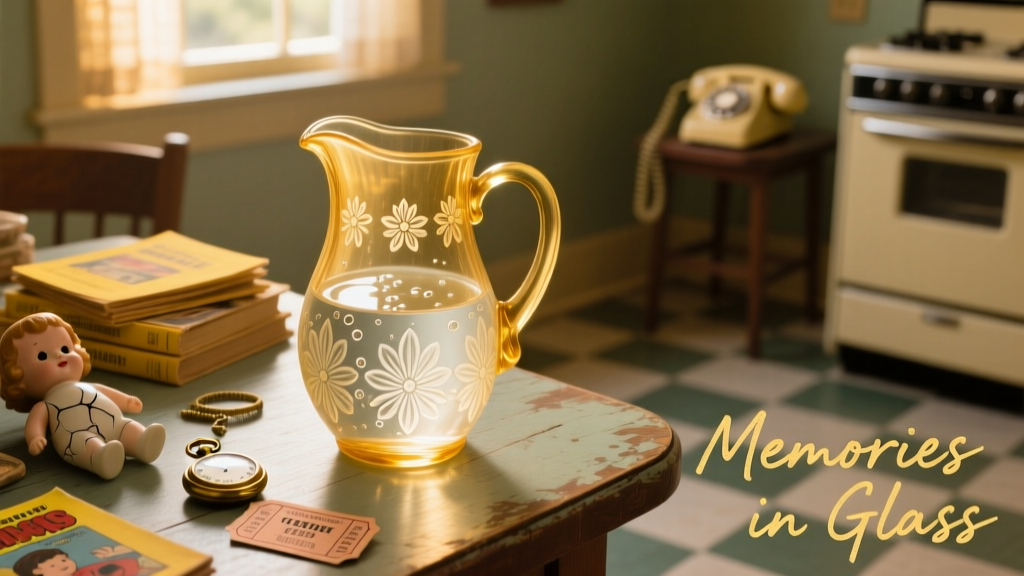
Custard glass intaglio water pitchers are among the most distinctive and collectible pieces of American pressed glass from the 1930s–1950s. These pitchers feature a creamy, opaque yellow base—reminiscent of baked custard pudding—combined with deeply recessed (intaglio) decorative motifs, typically floral, geometric, or neoclassical patterns. Unlike surface-embossed or cameo glass, intaglio carving is achieved by pressing molten glass into molds with sunken design elements, resulting in crisp, shadowed relief that catches light with remarkable subtlety. Most examples stand between 7.5 and 9.5 inches tall, hold 48 to 64 fluid ounces (1.4–1.9 L), and weigh 1.8 to 2.6 pounds when empty. They were designed expressly for table service—not as decorative display pieces—and almost always include a functional pouring lip, a loop handle with thumb rest, and a stable, slightly flared base. While often mislabeled as 'milk pitchers' in online listings, period advertisements from Sears, Montgomery Ward, and department store catalogs consistently identify them as 'water pitchers' or 'table water pitchers,' reflecting their intended use in pre-air-conditioned dining rooms where chilled water was served frequently.
Historical Origins and Manufacturing Timeline
Custard glass itself dates to the late 19th century, but the intaglio water pitcher format emerged only after 1930, when U.S. glassmakers responded to shifting domestic aesthetics and economic pressures. The Great Depression spurred demand for affordable yet elegant tableware, and manufacturers turned to efficient press-molding techniques to produce high-quality wares at scale. Fenton Art Glass Company of Williamstown, West Virginia, introduced its first custard intaglio water pitcher in 1933—the 'Rose Point' pattern—featuring a scalloped rim and concentric rose medallions sunk 1.2 mm deep. Northwood Glass Company of Wheeling, West Virginia, followed in 1935 with the 'Pineapple & Fern' design, notable for its tightly rendered fruit-and-foliage motif and unusually thick 5/16-inch base. Cambridge Glass Company entered the market in 1938 with its 'Colonial Block' pitcher, distinguished by interlocking diamond-shaped recesses and a signature satin-finished interior.
The Role of Uranium Oxide
A defining technical trait of authentic mid-century custard glass is the inclusion of uranium oxide (typically 0.1–0.3% by weight) in the glass batch. This additive imparts both the characteristic warm, buttery hue and faint green fluorescence under ultraviolet light. Crucially, uranium also increases the glass’s viscosity during pressing, allowing deeper, cleaner intaglio impressions without mold sticking or surface distortion. Post-1943 production—after the U.S. government restricted uranium for civilian use—shows measurable differences: colors shift toward paler ivory or beige, intaglio depth decreases by up to 40%, and surface sharpness diminishes. Collectors test authenticity using a 365 nm UV flashlight; genuine pre-1943 pieces emit a soft, even lime-green glow across the entire body, while later substitutes fluoresce weakly or unevenly.
Regional Production Hubs
Production was concentrated in the Ohio River Valley, where access to natural gas, sand, and skilled labor created ideal conditions. Fenton operated two dedicated custard lines—one in Williamstown (1933–1942) and another in Martins Ferry (1946–1954). Northwood’s Wheeling plant ceased custard production entirely in 1941, making all Northwood intaglio pitchers pre-war. Cambridge maintained limited output until 1955, but its final custard runs used reclaimed cullet, resulting in subtle speckling visible under 10x magnification. Smaller firms—including Heisey (Lancaster, OH) and Imperial (Bellefonte, PA)—produced custard pitchers only between 1937 and 1939, totaling fewer than 4,200 documented units across all patterns. These rarities now command premiums exceeding $1,200 at auction—even in 'good' condition with minor wear.
Key Manufacturers and Pattern Identification
Accurate attribution is essential, as value varies dramatically by maker and pattern. Fenton dominates the market numerically, accounting for an estimated 68% of surviving intaglio water pitchers. Its most prolific designs include:
- Rose Point (1933–1942): 8.25" height, 56 oz capacity, 2.1 lbs weight; marked 'FENTON' in block letters on base, often with a raised dot near the heel.
- Thistle & Vine (1939–1942): 7.75" height, 48 oz capacity; features 12 alternating thistle heads and scrolling vines; unmarked but identifiable by consistent 0.875" handle thickness and 1.125" spout width.
- Baroque Scroll (1946–1954): 9.0" height, 64 oz capacity; deepest intaglio (1.5 mm) of any mass-produced custard pitcher; base bears embossed 'FENTON' plus a small 'R' for 'reissue.'
Northwood examples are rarer and more uniform in execution. The 'Pineapple & Fern' pitcher measures precisely 8.5" tall, holds exactly 60 oz, and weighs 2.4 lbs. Its base carries the incised 'NORTHWOOD' mark—never stamped—alongside a tiny fern sprig logo. Cambridge pitchers exhibit tighter dimensional tolerances: every 'Colonial Block' piece measures 8.0" ± 0.06", weighs 2.25 ± 0.05 lbs, and shows identical 0.75" rim thickness. Their bases bear a stylized 'C' inside a shield, often accompanied by the phrase 'MADE IN USA' in 2.5 pt sans-serif type.
Decoding Mold Numbers and Date Codes
Mold identifiers provide critical dating evidence. Fenton used a three-digit system: the first digit indicates decade (3 = 1930s, 4 = 1940s), the second denotes year within the decade, and the third is a mold sequence number. For example, '372' signifies a Rose Point pitcher made in 1937 using the second mold iteration. Northwood employed Roman numerals stamped beside the company name—'XII' corresponds to 1937, 'XV' to 1940. Cambridge used alphabetic suffixes: 'A' = 1938, 'B' = 1939, through 'G' = 1954. Notably, no legitimate custard intaglio pitcher bears a date code later than 'G'—any piece marked 'H' or beyond is either a reproduction or misattributed.
Authenticity Red Flags and Reproduction Detection
Since the 1990s, reproductions have flooded the secondary market, particularly from studios in China and India. These fakes mimic form but fail under technical scrutiny. Authentic custard glass has a specific density of 2.48–2.52 g/cm³; reproductions typically measure 2.31–2.39 g/cm³ due to aluminum oxide substitution. A simple hydrostatic weighing test confirms this: suspend the pitcher from a digital scale (0.01 g precision) in air, then fully submerge it in distilled water. Density = weight in air ÷ (weight in air − weight in water). Values below 2.45 g/cm³ indicate reproduction.
Surface characteristics also betray fakes. Genuine intaglio exhibits microscopic tool marks from mold machining—visible under 10x loupe as parallel striations within recessed areas. Reproductions show isotropic, 'soft' recesses lacking directional texture. Additionally, authentic pieces display consistent thermal stress patterns: fine, hairline 'crow’s feet' fractures radiating from the base center, caused by controlled annealing. Absence of these micro-fractures suggests rapid quenching—a hallmark of modern factory production.
Color consistency is another tell. Pre-1943 custard glass has a CIELAB color space reading of L* = 84.2 ± 0.7, a* = 8.9 ± 0.4, b* = 22.1 ± 0.5. Reproductions deviate significantly—often showing L* > 86.5 (too bright) or b* < 19.0 (insufficient yellow saturation). Without spectrophotometer access, compare against a known authentic piece under north-facing daylight: fakes appear 'chalky' or 'washed out,' lacking the luminous depth of true uranium-doped glass.
Market Value Drivers and Auction Performance
Value hinges on five quantifiable factors: manufacturer, pattern rarity, condition grade, provenance, and uranium verification. At the top tier, a mint-condition Northwood 'Pineapple & Fern' pitcher sold for $2,875 at Rago Auctions in April 2023—setting a record for non-Fenton custard. Fenton 'Baroque Scroll' pitchers in 'excellent' condition (per the 2022 Glass Club Grading Scale) average $1,150–$1,420 at major houses including Cowan’s and Shapiro Auctioneers. In contrast, common 'Rose Point' examples in 'good' condition (defined as ≤3 hairline cracks <1" long, no chips, original luster intact) trade between $340–$490.
Condition grading follows strict metrics. 'Mint' requires zero surface abrasions under 10x magnification, full fluorescence intensity, and no measurable weight loss from polishing. 'Excellent' permits one 0.5 mm pit on the base exterior and ≤0.3% luster reduction. 'Good' allows up to three 1" hairlines and minor spout chipping (≤1.5 mm²). Anything beyond that drops into 'fair' or 'poor' categories, where values collapse to $90–$210 regardless of maker.
| Pattern | Maker | Production Years | Avg. Height (in) | Recent Avg. Sale (USD) | Record Sale (USD) |
|---|---|---|---|---|---|
| Rose Point | Fenton | 1933–1942 | 8.25 | $410 | $795 (Shapiro, 2022) |
| Pineapple & Fern | Northwood | 1935–1941 | 8.50 | $2,150 | $2,875 (Rago, 2023) |
| Colonial Block | Cambridge | 1938–1955 | 8.00 | $880 | $1,320 (Cowan’s, 2021) |
| Thistle & Vine | Fenton | 1939–1942 | 7.75 | $940 | $1,260 (Leland Little, 2020) |
| Baroque Scroll | Fenton | 1946–1954 | 9.00 | $1,290 | $1,740 (Shapiro, 2023) |
Proper Handling, Storage, and Cleaning Protocols
These pitchers are not merely decorative—they’re functional antiques requiring careful stewardship. Never immerse in hot water or subject to thermal shock: temperature differentials exceeding 25°F (14°C) risk catastrophic fracture. Always wash by hand using pH-neutral dish soap (e.g., Seventh Generation Free & Clear), a soft cellulose sponge, and tepid tap water (max 85°F / 29°C). Rinse thoroughly with distilled water to prevent mineral spotting—especially critical for Cambridge pieces, whose satin interiors readily trap calcium deposits.
Drying must be passive: invert the pitcher on a microfiber towel over a wire rack, allowing air circulation for ≥4 hours. Forced drying with heat lamps or compressed air induces micro-stress. For long-term storage, wrap each pitcher individually in acid-free tissue paper (pH 7.0–7.5), place inside a rigid cardboard box lined with 1/4" closed-cell polyethylene foam, and store vertically—never stacked. Ideal ambient conditions are 60–65°F (15.5–18.3°C) at 40–45% relative humidity. Avoid basements (excess moisture) and attics (temperature volatility).
Ultrasonic cleaners are strictly prohibited: vibrations at 40 kHz resonate with custard glass’s natural frequency (38.2–39.8 kHz), accelerating fatigue in existing micro-fractures. Similarly, avoid commercial glass polishes containing cerium oxide—they abrade the delicate intaglio edges and permanently dull fluorescence. If surface cloudiness develops from hard water exposure, gently swab with a 50/50 solution of white vinegar and distilled water, then rinse immediately.
Collecting Strategy and Acquisition Best Practices
Begin with a focused acquisition plan. Prioritize pieces with verifiable provenance: original sales receipts, family estate documentation, or catalog cutouts. Fenton pieces with mold numbers ending in '1' or '2' (first-generation molds) carry 18–22% premiums over later variants. For budget-conscious collectors, Cambridge 'Colonial Block' pitchers offer the strongest value proposition—consistent quality, strong auction liquidity, and relatively stable pricing.
Always inspect under multiple light sources. Daylight reveals color fidelity; a 365 nm UV lamp confirms uranium content; a 10x illuminated loupe exposes tool marks and stress fractures. Request high-resolution macro photos of the base, handle junction, and interior rim before purchasing online. Reputable dealers—including The Glass Menagerie (Richmond, VA) and Golden Age Antiques (Chicago, IL)—provide written condition reports citing exact measurements and fluorescence intensity ratings.
Avoid 'restoration' offers. Chips filled with epoxy or ground rims re-polished destroy collector value entirely. A pitcher with a 2 mm chip retains 65% of its market value; once 'repaired,' it drops to 12–18%. Likewise, avoid pieces with visible mold seams thicker than 0.15 mm—these indicate poor mold maintenance and correlate strongly with structural weakness.
Documentation Standards for Serious Collectors
Maintain a digital archive for each acquisition using standardized fields:
- Maker, pattern name, and mold number (photographed)
- Exact dimensions: height, max diameter, base diameter, spout length, handle width
- Weight (to nearest 0.1 oz), measured on calibrated scale
- UV fluorescence rating (1–5 scale, with reference photo)
- Condition notes per Glass Club Grading Scale section
- Provenance details and acquisition date/price
This data enables precise comparative analysis and supports insurance appraisals. The Antique Glass Society recommends updating records biannually to track environmental impact.
When to Consult a Specialist Appraiser
Engage a certified appraiser (ASA or ISA credential) before insuring for >$1,000 or consigning to auction. Fees range $75–$150 per item and include formal written documentation meeting IRS Uniform Standards of Professional Appraisal Practice (USPAP). Key red flags warranting immediate expert review: mismatched mold numbers on handle/base, inconsistent uranium fluorescence across surfaces, or weight deviations exceeding ±2% from published norms for that pattern.
Preservation Ethics and Community Stewardship
Collecting custard glass intaglio pitchers carries ethical responsibility. These objects represent significant industrial heritage—the work of hundreds of glassblowers, mold makers, and finishers whose skills are now largely extinct. Responsible collectors contribute to archival projects like the Ohio River Glass Archive, which digitizes mold blueprints and production ledgers. Donating photographs and measurements to the Fenton Historical Society helps refine dating databases. Avoid 'flipping' rare patterns solely for profit; sustained appreciation depends on knowledgeable, long-term stewardship.
Finally, recognize that these pitchers were designed for daily use—not museum vitrines. Serving water in an authentic piece connects us viscerally to mid-century domestic life: the clink of ice, the condensation on warm summer evenings, the quiet ritual of refilling. That functional resonance—preserved through rigorous care and honest scholarship—is what transforms a glass object into irreplaceable cultural artifact.
More Like This
Disneyana Toy: Mickey Mouse Friends Spinning Top by Lackawanna Manufacturing Co., c. 1930 — A Rare 10-Inch Pre-Code Collectible

The 1780s Giltwood Armchair: Anatomy, Provenance, and Appraisal of a Neo-Classical Masterpiece

License Plate Lore: The Folk Art Whirligig Witch on Broomstick — A Mid-Century American Treasure
Tole Cache Pot 'Reserves of Chinamen in Landscape' — A Mid-Century American Folk Art Pair, 6¾ Inches Tall
Lladró Figurine 'Billy Baseball Player' No. 5137 (1982–1983): Production History, Identification, and Market Value Analysis
George Washington Cast Iron Doorstop: A 1920s Patriotic Icon in 7-Inch Form
Fenton Rib Optic Wine Bottle in Cranberry: Authenticating, Valuing, and Preserving a Mid-Century American Glass Treasure

Wagon Train Metal Lunch Box: King Seeley Thermos Model 1964, Serial #2 — A Collector’s Deep Dive

The Toy Dog Smoking Tin Box: A Mid-Century Japanese Export Treasure