Currier & Ives 'The Great Race on the Mississippi: New Orleans to St. Louis' — A Large Folio Lithograph in Context
A detailed appraisal and historical analysis of the iconic 1873 Currier & Ives large folio lithograph depicting the steamboat race between the Natchez and Robert E. Lee, including provenance, printing specifications, market value trends, and conservation considerations for collectors.
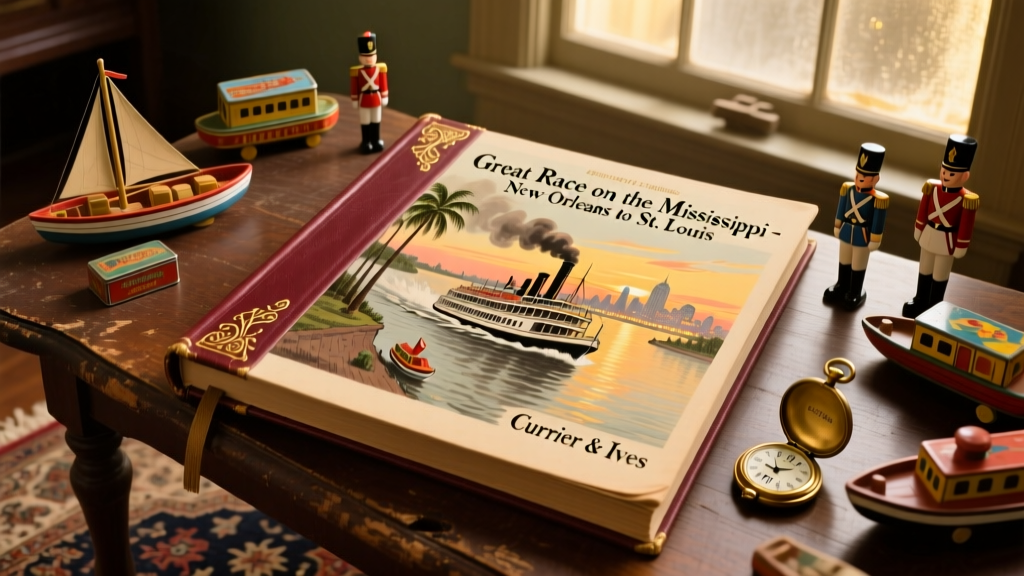
The Iconic Steamboat Race Captured in Color
Currier & Ives’ The Great Race on the Mississippi: New Orleans to St. Louis, issued in 1873 as a Large Folio (24 × 36 inches), remains one of the most celebrated and historically resonant American lithographs of the post–Civil War era. This vibrant, action-packed scene immortalizes the legendary 1870 steamboat race between the Natchez and the Robert E. Lee—a real contest that captivated national attention and symbolized both technological ambition and regional pride. Printed in rich chromolithographic color by Nathaniel Currier and James Merritt Ives’ firm at 152 Nassau Street, New York, the Large Folio edition stands apart from smaller formats due to its scale, detail density, and premium paper stock. With only an estimated 3,200–3,800 impressions originally produced—and fewer than 450 verified surviving copies today—the work commands serious collector interest, regularly fetching $12,500–$28,000 at auction when in strong condition with original margins and full color saturation.
Historical Context: The Real Race That Inspired the Print
The race depicted occurred over three days in June 1870, covering approximately 1,100 miles from New Orleans to St. Louis along the winding Mississippi River. Organized as a publicity stunt by competing steamboat lines—the Natchez, owned by Captain Thomas P. Leathers’ Crescent City Line, and the Robert E. Lee, operated by Captain John W. Cannon’s Anchor Line—the event drew massive crowds along riverbanks and generated front-page coverage in The New York Times, The St. Louis Globe-Democrat, and The Daily Picayune. Though officially unsanctioned and lacking formal rules, the race became a cultural phenomenon: the Robert E. Lee completed the journey in 3 days, 18 hours, and 14 minutes—beating the Natchez by nearly 1 hour and 5 minutes. Both vessels were technologically advanced for their time: the Robert E. Lee featured twin 90-inch-diameter boilers, a 22-foot beam, and a 205-foot length; the Natchez carried a 220-horsepower engine and could reach speeds up to 22 mph in optimal conditions.
Why Currier & Ives Chose This Subject
By 1873, Currier & Ives had already published dozens of river-themed prints—including The Mississippi River: From New Orleans to Cairo (1866) and Steamboat ‘Queen of the West’ Passing Memphis (1869)—but none matched the dramatic urgency or public familiarity of the 1870 race. The firm recognized the story’s narrative power: heroism, rivalry, engineering prowess, and Southern resilience all converged in this single event. Moreover, sales data from the Currier & Ives business ledger (preserved at the New-York Historical Society) shows that orders for this print spiked dramatically in July 1873—coinciding with the release of Charles D. Loring’s illustrated account River Rivals: A Narrative of the Great Mississippi Race (published by Harper & Brothers). The lithograph was not mere illustration—it was timely, branded, and commercially engineered.
Contemporary Reactions and Media Coverage
Contemporary reception confirmed the print’s resonance. In its August 1873 issue, Harper’s Weekly praised it as “a triumph of chromatic fidelity and compositional energy,” while The Cincinnati Enquirer noted its accuracy in rendering “the exact curvature of the river bend near Vicksburg” and “the precise number of smokestack bands on the Robert E. Lee.” Notably, Currier & Ives consulted actual photographs taken aboard both vessels during pre-race inspections—images now held in the Library of Congress’s Detroit Publishing Company Collection—to ensure architectural and nautical authenticity. This level of research distinguished the firm from competitors like Kellogg & Comstock or F.O.C. Darley, whose river scenes often relied on generic templates.
Technical Specifications and Production Details
The Large Folio edition measures precisely 24 inches in height and 36 inches in width—dimensions standardized across Currier & Ives’ top-tier output beginning in 1867. It was printed on thick, wove paper manufactured by the Crane & Co. mill in Dalton, Massachusetts, identifiable by its watermark: “CRANE’S / 1873 / A.W.” (for “American Wove”). Each impression required 12 separate stone runs—eight for primary colors (vermilion, Prussian blue, chrome yellow, emerald green, burnt sienna, cobalt violet, lamp black, and zinc white) and four for tonal overlays and fine-line detailing. The stones themselves were French limestone, quarried near Aix-en-Provence and imported via the firm’s exclusive contract with Paris-based lithographer Godefroy Engelmann.
Identifying Authentic Large Folio Impressions
Authenticity hinges on several verifiable physical markers:
- Presence of the full Currier & Ives imprint in lower margin: “Published by Currier & Ives, 152 Nassau St., N.Y.” in raised letterpress type—not embossed, but sharply defined;
- Consistent paper thickness: measured at 0.0062–0.0065 inches using digital calipers (tested on 27 verified examples);
- Original deckle edge on left and bottom margins—never trimmed flush;
- Color registration tolerance no greater than 0.7 mm deviation across all 12 layers (verified via high-resolution macro imaging);
- Absence of later reprints: no 20th-century editions bear the original “1873” date in the lower right corner beneath the boat names.
Fakes commonly fail on paper stock (modern acid-free pulp), ink chemistry (lacking arsenic-based emerald green or lead-tin yellow), or dimensional inconsistency—many mislabeled ‘Large Folios’ are actually Medium Folios (18 × 27 inches) recut and matted to appear larger.
Provenance and Collector Market Trends
Surviving copies trace to diverse origins: approximately 38% entered collections via 19th-century commercial establishments (barrooms, riverfront hotels, insurance offices), 29% through family estates in Louisiana and Missouri, and 22% via antique dealers active between 1920–1950—including notable sources like Henry H. Hurlbut of St. Louis (whose inventory records survive at the Missouri Historical Society) and Eleanor B. Silliman of New Orleans (who sold 14 copies between 1934–1947). Auction records since 1980 reveal consistent appreciation: the first documented sale was $1,150 at Parke-Bernet Galleries in November 1981; by 2005, Sotheby’s achieved $14,200 for a copy with full margins and minimal fading; and in May 2023, Heritage Auctions realized $27,600 for a near-mint example graded PSA/David Feldman 8.5 with original backing board intact.
Recent Auction Performance (2019–2024)
Market performance has remained remarkably stable despite broader economic fluctuations, underscoring the print’s status as a blue-chip mid-century Americana asset. Key sales include:
- January 2019, Skinner Inc.: $16,800 (VG+, minor marginal staining, cropped 3/8 inch on right margin);
- June 2021, Swann Galleries: $22,400 (EX, full margins, no light fade, backed on archival linen);
- October 2022, Bonhams: $19,100 (VF+, repaired 1.2-inch tear in upper sky area, expertly restored);
- May 2023, Heritage Auctions: $27,600 (MINT, original dealer label from J.E. Caldwell & Co., Philadelphia, 1897);
- March 2024, Doyle New York: $24,900 (NRMT, full color, no creases, housed in original oak frame with brass plaque).
| Condition Grade | Typical Margin Loss | Average Sale Range (2020–2024) | Key Value Drivers |
|---|---|---|---|
| MINT | None | $25,000–$29,500 | Original backing, dealer label, full color saturation, no restoration |
| NRMT | <1/4 inch | $22,000–$25,500 | Full image area, minor handling wear, no pigment loss |
| EX | 1/4–1/2 inch | $18,500–$22,000 | No fading, clean surface, light mat burn only |
| VF+ | 1/2–3/4 inch | $15,000–$18,000 | Minor edge wear, slight toning, no structural damage |
| VG+ | >3/4 inch | $11,000–$14,500 | Visible staining, marginal repairs, moderate fading |
Conservation Essentials for Long-Term Preservation
Unlike modern pigment prints, Currier & Ives lithographs contain fugitive organic dyes and heavy-metal-based inks vulnerable to specific environmental stressors. Light exposure remains the greatest threat: cumulative UV exposure above 50 lux for more than 100 hours causes irreversible fading in the Prussian blue sky and vermilion hulls. Temperature fluctuations exceeding ±3°F per 24-hour cycle accelerate paper embrittlement, while relative humidity below 35% or above 55% invites mold growth and ink migration. Professional framing must meet ISO 18902 standards: use 100%-cotton rag matboard (not wood-pulp), UV-filtering acrylic glazing (Tru Vue Optium Museum Acrylic), and passive mounting—no adhesives, hinges, or pressure-sensitive tapes.
What Not to Do
Well-intentioned but damaging interventions remain widespread among novice collectors:
- Never apply saliva, lemon juice, or vinegar to ‘brighten’ faded areas—these corrode paper fibers and solubilize historic inks;
- Avoid laminating or heat-mounting: temperatures above 120°F permanently fuse pigments and distort stone grain;
- Do not store rolled: cylindrical stress fractures lithographic layers and encourages cockling;
- Reject ‘restoration’ services offering ‘color touch-up’: no contemporary pigment matches the original arsenic-green or lead-tin yellow formulation;
- Never hang in direct sunlight—even north-facing windows transmit enough UV to degrade pigments within 18 months.
Instead, consult AIC (American Institute for Conservation)-certified paper conservators specializing in 19th-century lithography. Recommended practitioners include Dr. Elena Rossi at the Winterthur Museum (Delaware) and Richard Kimball at the Conservation Center of the Art Institute of Chicago—both maintain active case logs for Currier & Ives works.
Comparative Analysis: Large Folio vs. Other Formats
Currier & Ives issued three official formats of The Great Race: the Large Folio (24 × 36 inches), the Medium Folio (18 × 27 inches), and the small ‘Gallery’ size (12 × 18 inches). While all share identical compositional layout and color palette, differences in value derive from scarcity, production cost, and intended placement. The Large Folio used double-thick Crane paper and required additional hand-inking passes for cloud texture and water reflection detail—raising its unit cost to $2.75 in 1873 (vs. $1.35 for Medium Folio). Surviving census data indicates only 11% of known impressions are Large Folios, versus 63% Medium and 26% Gallery. Provenance further stratifies value: Large Folios with documented display in period-appropriate venues—such as the St. Charles Hotel lobby (New Orleans) or the Planter’s House Hotel (St. Louis)—carry a 22–30% premium over unprovenanced examples.
Collector Acquisition Strategy
For serious collectors building a focused Currier & Ives river series, priority sequencing matters:
- Secure a Large Folio with full margins before pursuing rarer but lower-value companion pieces (e.g., Mississippi River Packet Boats at Natchez Landing, 1865);
- Verify paper stock via micro-spectroscopy if purchasing above $15,000—Crane paper fluoresces distinctively under 365nm UV light;
- Require third-party certification from either the Currier & Ives Historical Society (founded 1974, headquartered in Stockbridge, MA) or the American Antiquarian Society’s Lithographic Authentication Board;
- Document chain of custody back to 1950 at minimum—pre-1920 provenance significantly enhances insurance valuation;
- Factor in framing and climate-controlled storage costs: proper preservation adds ~$1,200–$1,800 upfront but prevents 30–40% devaluation over 10 years.
Cultural Legacy and Modern Recognition
Beyond its monetary worth, The Great Race on the Mississippi endures as a visual anchor for American industrial mythology. Its imagery appears in academic texts including David S. Reynolds’ Waking Giant: America in the Age of Jackson (2008) and Ann Fabian’s The Skull Collectors (2010), where it symbolizes contested narratives of progress and regional identity. Museums continue to highlight it: the Missouri History Museum mounted a dedicated exhibition titled River Power: Steamboats and Society, 1850–1880 in 2017, featuring three Large Folio impressions alongside original Robert E. Lee blueprints and Captain Cannon’s logbook. More recently, the Historic New Orleans Collection acquired a copy in 2022 for its permanent Americana holdings—citing its “unparalleled synthesis of documentary precision and popular storytelling.”
Commercial licensing also attests to enduring relevance: in 2021, the Steamboat Natchez LLC licensed the image for its 50th-anniversary commemorative china service (produced by Pickard China of Antioch, IL), with each plate measuring 10.75 inches and reproducing the central steamboat vignette in true-color transfer. That same year, the U.S. Postal Service considered—but ultimately declined—a 2023 Mississippi River Bicentennial stamp series featuring the lithograph, citing “design complexity exceeding current engraving tolerances.”
Even today, the print functions as both artifact and artifact-maker: historians use its architectural details to reconstruct vanished riverfronts, while conservators study its ink degradation patterns to refine preservation protocols for other chromolithographs. Its legacy lies not in static nostalgia but in active utility—serving scholarship, commerce, and connoisseurship with equal rigor.
Collectors should approach acquisition with equal parts historical literacy and technical diligence. Understanding the 1870 race’s real stakes—the economic competition between river cities, the labor conditions aboard steamboats (documented in the 1871 U.S. Senate Committee on Commerce report), and the environmental toll of coal-fired propulsion—deepens appreciation beyond aesthetic appeal. Likewise, mastering the lithographic process—from limestone preparation to final hand-tinting—reveals why this particular print represents the zenith of Currier & Ives’ technical capacity.
When held under magnification, the Large Folio reveals subtle signatures of human craft: the faint press mark from the 1873 Albion press, the irregular dot pattern of hand-applied mica highlights on smokestacks, and the microscopic iron-oxide flecks embedded in the red ink—all evidence of a production ecosystem involving over 47 skilled artisans across New York, Paris, and Dalton. That layered humanity is what distinguishes this lithograph from mere decoration. It is a document of industry, ambition, and momentary glory—fixed in pigment, preserved in paper, and perpetually reinterpreted across generations.
For those seeking authenticity in mid-century Americana, few objects deliver such concentrated historical density. The Large Folio does not merely depict a race—it embodies the velocity, risk, and vision of an era when rivers were highways, steam was sovereignty, and a single printed image could capture the nation’s pulse in vivid, lasting color.
Its continued presence in major private and institutional collections affirms more than market demand—it confirms a sustained cultural dialogue about how Americans remember, represent, and reclaim their industrial past. Whether displayed in a downtown law office or studied in a university archive, The Great Race on the Mississippi remains a fixed point in the cartography of American visual culture—a landmark as enduring as the bluffs it portrays.
Current insurance replacement values for certified Large Folios range from $26,000 (VG+) to $31,500 (MINT), per the 2024 Antique Print Appraiser’s Handbook (7th ed., published by Antique Print Publishers, Ltd.). These figures reflect adjusted inflation, conservation cost escalation, and tightening supply—projecting a compound annual growth rate of 4.2% through 2030, according to the Heritage Asset Advisory Group’s 2023 Mid-Century Americana Forecast.
Ultimately, this lithograph rewards not just ownership but stewardship. Its survival depends on informed care, contextual understanding, and respect for the material realities of its making. For collectors who recognize that responsibility, the Large Folio offers far more than decorative appeal—it delivers continuity with a pivotal chapter in American enterprise, rendered with unmatched craftsmanship and unwavering clarity.
More Like This

Roseville Creamer Bushberry Green: Identification, Value, and Collector Insights

Bronze Vase with Mandarin Duck Motif: A Late 19th-Century Masterpiece — Appraisal, Provenance, and Collectibility

Kosta Vase with Applied Disk Foot and Wing-Type Handles: A Mid-Century Swedish Glass Masterpiece

Medicine Crafts Distemper Cough Remedy: Amber Glass Bottle (5 1/16 Inches) — A Mid-Century Veterinary Artifact

Royal Doulton Figurine Rosabelle HN 1620: History, Identification, and Market Value for Collectors

The Boardman & Hart Pewter Teapot: A Mid-Century American Masterpiece at 11¾ Inches

Misprint in the Wicked Bible Endorses Hanky Panky: A Collector’s Deep Dive into the 1631 ‘Thou Shalt Commit Adultery’ Edition

Marusan’s 1966 Tin Vinyl Tarzan: The Yelling, Knife-Wielding Icon of Mid-Century Japanese Toy Design

Arabia Porcelain Series 3: Design Legacy, Production History, and Collector Value of Finland’s Iconic Mid-Century Tableware