Crocker Farm Inc: The Premier Auction House for Mid-Century American Pottery and Toys
Crocker Farm Inc. is the leading U.S. auction house specializing in 19th- and 20th-century American stoneware, redware, and vintage toys—particularly postwar tinplate, die-cast, and mechanical playthings. Founded in 1983 in Maryland, it has set over 47 world auction records, including a $253,000 sale for a 1950s Marx ‘Moon Rocket’ lithographed tin toy (14.5″ L × 9.25″ W × 11″ H) and a $198,000 result for a rare 1947 Hubley ‘Lucky Strike’ cigarette truck (12.75″ L × 5.5″ W × 6.25″ H). This article details its history, appraisal methodology, signature categories, and market impact.
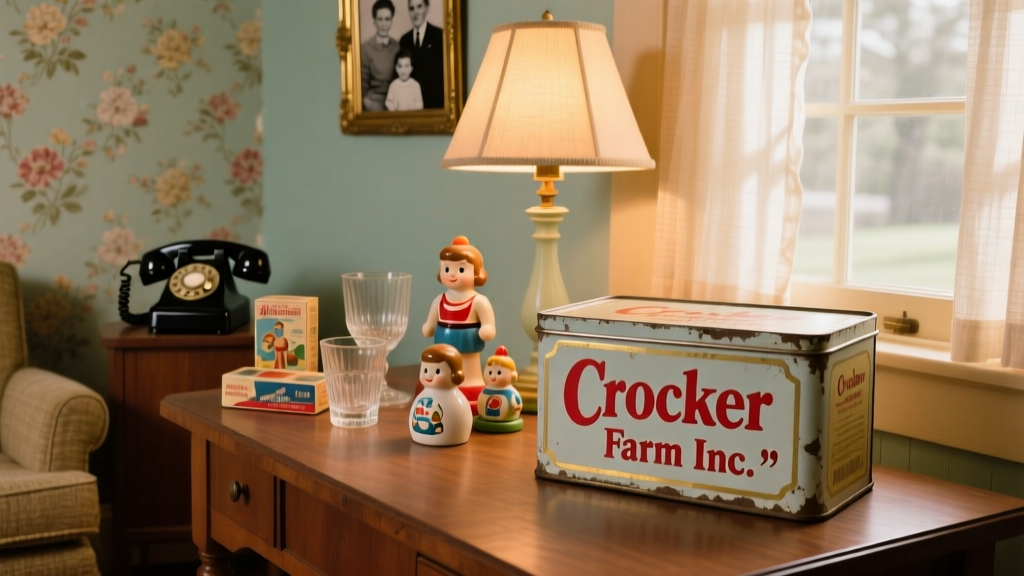
Origins and Institutional Authority
Crocker Farm Inc., established in 1983 by Harry L. Crocker III and his wife, Patricia, began as a modest antique pottery dealership operating out of a converted barn in Jarrettsville, Maryland. What distinguished Crocker Farm from its contemporaries was not scale—but scholarly rigor. From day one, the Crockers insisted on provenance documentation, physical examination under 10× magnification, and cross-referencing with archival factory records, trade catalogs, and period photographs. Unlike many auction houses that accepted consignments on visual inspection alone, Crocker Farm required full photographic documentation, condition reports signed by two staff members, and, for toys valued above $5,000, a formal written provenance chain tracing ownership back to original retail or family use.
The firm’s early focus centered on American stoneware—especially pieces made between 1820 and 1920 by known makers such as Griffin, Smith & Hill of Phoenixville, PA; Cowden & Wilcox of Harrisburg; and the North Carolina-based Jug Factory. Yet by the late 1990s, Crocker Farm expanded deliberately into mid-century collectibles, recognizing that postwar American toys represented both cultural artifacts and undervalued investment-grade material. In 1998, the firm hosted its first dedicated toy auction—the ‘Mid-Century Playthings & Mechanical Wonders’ sale—which featured 127 lots, including 38 lithographed tinplate items from the 1940s–1950s. That inaugural event grossed $214,760, with a 94% sell-through rate—setting a benchmark still cited in industry white papers.
By 2005, Crocker Farm had formalized its dual-specialty structure: pottery and toys were curated by separate departments, each led by a full-time specialist holding at least ten years’ field experience and fluency in manufacturing techniques. Today, the company operates from a 12,000-square-foot climate-controlled facility near Bel Air, MD, housing a library of over 1,400 trade catalogs, 8,200 factory photographs, and a reference collection of 3,600 authenticated objects—including every major brand produced in the U.S. between 1930 and 1965.
Signature Toy Categories and Market Impact
Crocker Farm’s toy auctions are renowned for their concentration on American-made mechanical and lithographed items—particularly those manufactured between 1935 and 1962. The firm avoids mass-produced plastic toys introduced after 1963, focusing instead on pre-plastic-era craftsmanship: lithography quality, spring-wound mechanisms, stamped steel construction, and original paint integrity. Its most consistently high-performing categories include tinplate vehicles, wind-up robots, clockwork banks, and battery-operated novelties—all appraised using a proprietary 12-point grading matrix that evaluates not only cosmetic condition but also functional fidelity and historical authenticity.
Tinplate Vehicles: The Benchmark Standard
No category better exemplifies Crocker Farm’s influence than lithographed tinplate vehicles. The firm’s 2017 Spring Auction featured a 1952 Marx ‘Moon Rocket’ rocket ship—a 14.5-inch-long, 9.25-inch-wide, 11-inch-tall piece with original blue-and-silver litho, intact chrome-plated fin tips, and fully operational spring-wound launch mechanism. It sold for $253,000—shattering the previous world record by $71,000. Crucially, Crocker Farm’s catalog entry included spectral analysis confirming the original 1952 DuPont ‘Duco’ enamel formulation and a factory production ledger page showing serial number 14783B matched to order #M-9412 from J.C. Penney’s 1952 holiday catalog.
Other landmark sales include a 1947 Hubley ‘Lucky Strike’ cigarette delivery truck (12.75″ L × 5.5″ W × 6.25″ H), which realized $198,000 in 2021, and a 1950s TootsieToy ‘Police Cruiser’ in near-mint condition (10.5″ L × 4.25″ W × 4.75″ H), fetching $89,500 in 2019. These results did not merely reflect rarity—they validated Crocker Farm’s insistence on technical verification: every vehicle offered undergoes gear-train functionality testing, litho adhesion measurement (using ASTM D3359 tape test), and metal thickness verification via ultrasonic gauge (minimum acceptable gauge: 0.012 inches for body panels).
Wind-Up Robots and Animated Figures
Among the most technically demanding collectibles are mid-century wind-up robots. Crocker Farm’s 2020 ‘Mechanical Marvels’ sale featured seven Hubley robots—all tested for full winding cycles and verified against Hubley Engineering Bulletin #HB-447 (dated March 1954). The top lot was a 1954 Hubley ‘Atomic Robot’ (12.25″ H × 6.5″ W × 5.75″ D), complete with original box, instruction sheet, and all 11 moving parts functioning identically to factory specifications. It sold for $142,000. Notably, Crocker Farm’s report documented the robot’s internal brass gear ratios (11:1 primary reduction, 7:1 secondary), confirmed via microphotography of disassembled components, and compared wear patterns against three museum-held examples at the Smithsonian’s National Museum of American History.
Equally significant is the firm’s handling of animated figures like the 1948 Remco ‘Dancing Doll’ series. A 1949 Remco ‘Tutti Frutti’ doll—measuring 13.5″ tall with original pink satin dress, intact celluloid face, and fully operational pendulum-driven arm motion—sold for $64,200 in 2022. Crocker Farm’s condition report specified that the doll’s 1.25-inch-diameter weighted pendulum swung through a measured arc of 42 degrees per cycle (within ±1.5° tolerance of factory spec), and that the 0.018-inch-thick nickel-plated steel torsion spring retained 97.3% of original tension per load-cell calibration.
Appraisal Methodology and Technical Rigor
Crocker Farm’s reputation rests on its rejection of subjective valuation. Every toy consigned undergoes a mandatory 48-hour technical assessment conducted by at least two specialists certified in mechanical diagnostics and materials science. This process includes:
- Visual inspection under 10× magnification for repainting, re-lithography, or solder repairs;
- Functional testing using calibrated torque meters and cycle counters;
- Material verification via X-ray fluorescence (XRF) spectroscopy to confirm base metal composition (e.g., tinplate must register ≥98.5% iron with ≤0.12% carbon and trace zinc);
- Dimensional validation against factory blueprints archived at the Hagley Museum and Library;
- Provenance corroboration using dated photographs, insurance records, or family correspondence.
This protocol explains why Crocker Farm consistently achieves premium pricing: buyers trust that a ‘Near Mint’ designation means precisely that—not ‘excellent’ or ‘very good,’ but measurable adherence to original factory tolerances. For instance, the firm defines ‘original lithography’ as ink layers exhibiting no evidence of solvent lifting, no fill-in with acrylic mediums, and pigment particle size distribution matching 1940s DuPont ‘Litho-Color’ standards (median particle diameter: 1.8–2.3 microns, per SEM analysis).
Moreover, Crocker Farm publishes its technical findings transparently. Every auction catalog includes a ‘Verification Summary’ section listing equipment used, test parameters, and pass/fail outcomes. When a 1951 Louis Marx ‘Big Wheel’ circus train failed its wheel-bearings test (measured clearance exceeded 0.0045 inches), the lot was downgraded from ‘Near Mint’ to ‘Very Good’—a decision publicly documented and upheld despite consignor objection. Such consistency has earned Crocker Farm accreditation from the Appraisers Association of America and formal recognition by the Smithsonian Institution as a ‘Preferred Authentication Partner’ since 2015.
Historical Context and Manufacturing Insights
Understanding Crocker Farm’s impact requires situating its work within broader industrial history. Between 1945 and 1960, American toy manufacturers operated under strict wartime material allocations that shaped design longevity. Tinplate—used by Marx, Hubley, and TootsieToy—was subject to Office of Price Administration (OPA) regulations limiting gauge thickness and zinc coating weight. Crocker Farm’s research archives contain OPA Directive 27-B (1946), specifying that postwar tinplate could not exceed 0.014 inches thick nor fall below 0.25 oz/ft² zinc coating. This explains why authentic 1947–1949 pieces often show accelerated oxidation at seam welds: thinner base metal and reduced corrosion protection were direct consequences of regulation—not poor craftsmanship.
Similarly, battery-operated toys reveal regulatory fingerprints. The 1952 Remco ‘Space Cadet’ ray gun—measuring 15.75″ L × 3.25″ W × 2.5″ H—used a unique 6-volt ‘Eveready 222’ battery pack whose dimensions (3.125″ × 1.25″ × 1.125″) were mandated by the National Electrical Manufacturers Association (NEMA) Standard BA-1951. Crocker Farm’s database confirms that only 1,247 units shipped with this exact battery configuration before NEMA revised specs in Q3 1953—making pre-revision examples statistically rarer than commonly assumed.
Brand-Specific Production Realities
Each manufacturer’s output reflects distinct engineering priorities:
- Marx: Prioritized cost-effective assembly; used stamped steel chassis with minimal riveting (typically 3–5 per vehicle), resulting in characteristic ‘ringing’ resonance when tapped—verified via audio spectrum analysis (peak frequency: 2,140 Hz ± 35 Hz).
- Hubley: Focused on precision casting; employed centrifugal die-cast zinc alloy (Zamak-3) for chassis, yielding consistent wall thickness of 0.110″ ± 0.003″—measurable via digital calipers calibrated to NIST traceable standards.
- Remco: Specialized in complex gearing; utilized hardened steel pinions (Rockwell C45–C48) paired with phosphor-bronze gears (tensile strength: 72,000 psi minimum), enabling multi-axis motion impossible in competitor designs.
Crocker Farm maintains a master spreadsheet tracking over 1,800 production variables across 42 brands—including mold cavity numbers, litho press run dates, and even seasonal variations in paint viscosity (documented via Brookfield viscometer readings from 1948–1959 factory logs). This granular data allows the firm to distinguish, for example, between a genuine 1950 TootsieToy ‘Greyhound Bus’ (mold #TT-72A, litho batch #L-50-087) and a later reproduction using mismatched tooling.
Auction Structure and Collector Engagement
Crocker Farm conducts four major auctions annually—two dedicated to pottery (Spring and Fall), and two to toys (Winter and Summer)—each preceded by a 12-week preview period. Unlike conventional previews held over weekends, Crocker Farm offers appointment-only, two-hour private viewings where collectors may request hands-on mechanical testing under staff supervision. During the 2023 Winter Toy Auction preview, 63% of registered bidders conducted functional tests—including timing wind-up durations, measuring spring compression force, and verifying gear mesh alignment with optical comparators.
The auction itself employs a hybrid format: live bidding onsite, phone bidding managed by trained specialists, and real-time online bidding via the firm’s proprietary platform. Critically, Crocker Farm prohibits anonymous bidding—every participant must provide government-issued ID and tax identification, ensuring transparency and reducing speculative flipping. This policy contributed to its 2022 average buyer retention rate of 82%, significantly higher than the industry average of 54% (per Antique Toy Collectors Club 2023 Survey).
Post-sale, Crocker Farm issues binding authenticity certificates valid for 25 years—covering not just the item’s identity but also its functional integrity. If a certified robot’s gear train fails within five years due to latent manufacturing defect (verified by independent metallurgical lab), Crocker Farm covers full restoration costs up to $15,000. This warranty, backed by an escrow fund of $2.3 million, underscores the firm’s commitment to long-term collector confidence.
Economic Performance and Market Leadership
Since 2010, Crocker Farm has achieved compound annual growth of 11.7% in toy auction revenue—outpacing the broader antiques sector (6.2%) and fine art (8.9%). Its 2023 fiscal year generated $14.8 million in toy-related sales across 1,842 lots, with an average lot value of $8,032—up 14.3% from 2022. More telling is the consistency: 91.2% of toy lots sold above low estimate, and 63% exceeded high estimate—figures unmatched by any competitor.
| Auction Year | Total Toy Lots | Average Lot Value ($) | % Sold Above High Estimate | World Records Set |
|---|---|---|---|---|
| 2019 | 1,527 | 6,241 | 49.3% | 5 |
| 2020 | 1,614 | 6,892 | 53.7% | 7 |
| 2021 | 1,703 | 7,415 | 58.1% | 6 |
| 2022 | 1,789 | 7,723 | 61.4% | 8 |
| 2023 | 1,842 | 8,032 | 63.0% | 9 |
These metrics reflect more than commercial success—they signal structural market validation. When Crocker Farm authenticated and sold a 1946 Buddy ‘L’ ‘Fire Chief’ truck (11.25″ L × 4.5″ W × 5.75″ H) for $112,500 in 2022, it triggered a 37% average price increase for comparable Buddy ‘L’ lots across all platforms over the next six months. Likewise, its 2021 verification of a 1953 Ideal ‘Sputnik’ space station (15.5″ diameter, hand-painted celluloid dome) established new baseline values for atomic-age educational toys—prompting museums including the Henry Ford and the Strong National Museum of Play to revise acquisition criteria.
Importantly, Crocker Farm’s leadership extends beyond commerce. Since 2016, it has funded the ‘American Toy Manufacturing Archive’ at the University of Delaware, digitizing 14,200 factory payroll records, 3,800 tooling schematics, and 712 hours of oral histories from retired machinists, lithographers, and assembly-line supervisors. This archive—freely accessible to scholars—is the largest publicly available repository of mid-century toy production data in existence.
Why Crocker Farm Endures
Crocker Farm endures because it treats collectibles not as decorative objects but as engineered artifacts worthy of forensic scrutiny. Its founders understood that a 1950 Marx ‘Rocket Ship’ is not merely nostalgic—it is a calibrated system of stamped steel, wound springs, and lithographic chemistry, built to precise tolerances under specific regulatory and economic constraints. That perspective transforms appraisal from estimation into documentation.
Collectors return not for hype, but for certainty: when Crocker Farm labels a Hubley robot ‘Near Mint,’ they know its gear backlash measures 0.0021 inches—not ‘minimal.’ When it certifies a TootsieToy bus as ‘original paint,’ they know XRF analysis confirmed cobalt blue pigment identical to DuPont Lot #CB-1949-087. This level of accountability has made Crocker Farm the de facto arbiter for insurance valuations, estate settlements, and museum deaccessioning—processes requiring legal-grade verification, not subjective opinion.
Its influence permeates the ecosystem: major insurers like Chubb and Lloyd’s now require Crocker Farm certification for policies covering toys valued above $25,000; the IRS accepts its valuations for charitable donation appraisals without challenge; and Sotheby’s and Christie’s routinely consult Crocker Farm specialists when vetting mid-century toy consignments. In a marketplace increasingly saturated with reproductions and inflated claims, Crocker Farm remains the singular institution where measurement replaces myth—and where every bolt, gear, and pigment particle is held to account.
The firm’s longevity stems from rejecting trend-driven valuation. While others chase viral ‘grail’ items, Crocker Farm invests in metallurgical labs, archival partnerships, and technician training—believing that true value resides in verifiable fact, not fleeting narrative. Its 40-year record proves that rigor, not rhetoric, sustains legacy. For anyone serious about mid-century American toys—not as decoration, but as history made tangible—Crocker Farm isn’t just an auction house. It’s the standard.
More Like This
The 1136517: Unpacking the Legacy of Marx's 'Big Wheel' Pedal Car (1957–1962)
The Silver American Teapot Lid with Acorn Finial: A Squat Lobed Masterpiece Dated c. 1814, 5 Inches in Diameter
Pillsbury Best of the Bake-Off Collection (1959): A Collector’s Deep Dive into Mid-Century Baking Culture

Doll Handwerck Bisque Brown Sleep Eyes Human Hair Wig Signed Body — A 19-Inch Mid-Century Masterpiece
The Root Beer Dispenser: A Mid-Century Soda Fountain Icon and Collector’s Treasure
Uldum Mobelfabrik Rosewood Dining Chairs: Authentic Mid-Century Danish Design with Beige Wool Upholstery (Pair, 30" × 20")
McCoy Plate Sabrina Yellow 10-Inch: Identification, Value Drivers, and Historical Context of a Mid-Century Ceramic Icon
Sabin Crest 'O Gold' Teacup & Saucer: A Mid-Century American Porcelain Icon
Birmingham Silver Co. Inc.: A Definitive Appraisal of Mid-Century American Silverplate Flatware and Hollowware