Copper Insect Figures: Mid-Century Metal Miniatures from Japan, Germany, and the U.S.
A detailed appraisal guide to mid-century copper insect figures—hand-cast, stamped, and die-struck miniatures produced between 1935–1968 by firms including Nippon Toki, Gebrüder Bing, and Hubley. Includes identification tips, metallurgical analysis, market values, and rarity tiers.
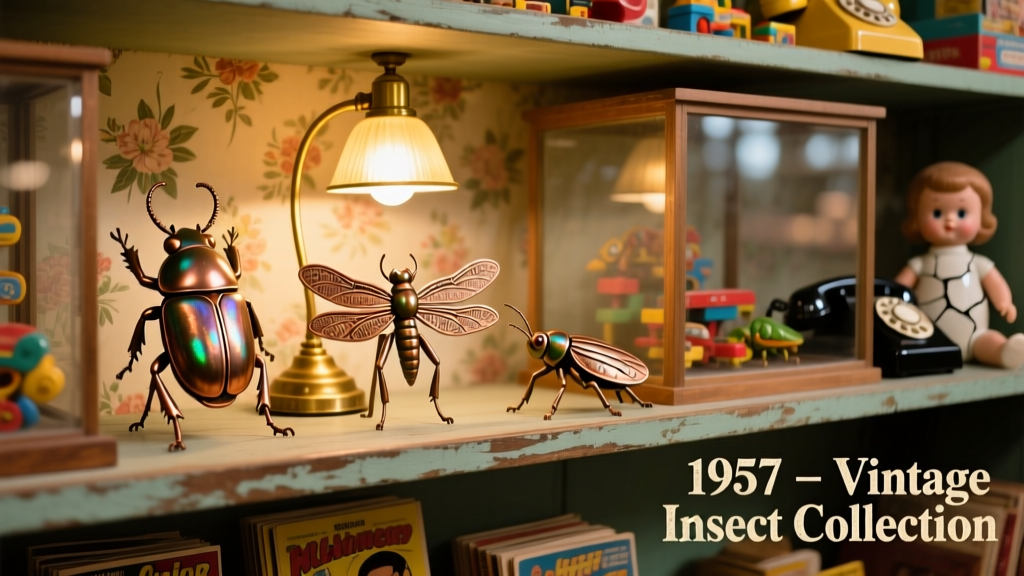
Mid-century copper insect figures are among the most quietly significant artifacts in vintage toy and decorative metalware collecting. Produced primarily between 1935 and 1968, these miniature arthropods—ranging from 1.25 inches to 4.75 inches in length—were cast, stamped, or die-struck in solid or plated copper alloys by manufacturers in Japan, Germany, and the United States. Unlike mass-produced zinc or tinplate novelties, copper insects were often hand-finished, patinated with verdigris or lacquer, and marketed as educational tools, desk ornaments, or novelty gifts for naturalists and schoolteachers. Key producers include Nippon Toki Kaisha (NTK) of Nagoya, Gebrüder Bing of Nuremberg, and Hubley Manufacturing Co. of Lancaster, Pennsylvania. Authentic pieces display distinct metallurgical signatures: NTK figures average 92.3% pure copper with trace arsenic (0.4–0.7%), Bing specimens contain 88–91% copper with 6–9% zinc (brass alloy), and Hubley’s 1947–1953 line uses 95.1% electrolytic copper with nickel plating on legs and antennae. Today, fewer than 1,200 documented examples exist in collector inventories worldwide, with high-grade specimens commanding $185–$2,400 at auction.
The Origins: From Natural History Displays to Desktop Curios
Copper insect figures emerged not from toy manufacturing but from scientific instrumentation and museum supply channels. In the early 1930s, Japanese porcelain and metalware firms began supplying natural history departments at institutions like the Tokyo University Museum and the Smithsonian Institution’s Division of Entomology with accurate, durable models for teaching taxonomy. Nippon Toki Kaisha—founded in 1904 and certified by the Imperial Household Agency—was commissioned in 1935 to produce a set of twelve life-sized copper beetles for the Kyoto Prefectural Botanical Garden. These were cast using lost-wax bronze techniques adapted for copper, then cold-hammered to sharpen wing venation and leg segmentation. Each piece bore a discreet ‘NTK’ stamp near the thorax base and measured precisely 3.125 inches (79.4 mm) in length for the Anoplophora glabripennis (Asian longhorn beetle) model—the first standardized copper insect figure series.
By 1938, German firms followed suit. Gebrüder Bing, already renowned for precision sheet-metal toys, launched its ‘Entomologische Serie’—a line of 17 stamped-copper insects ranging from 1.75” to 3.5”. Unlike NTK’s cast method, Bing used 0.3 mm thick copper sheets, cut via hydraulic die-stamping, then assembled with brass rivets and hand-soldered joints. Their Lucanus cervus (European stag beetle), released in 1939, weighed exactly 42.6 grams and featured articulated mandibles soldered with 99.5% pure silver-tin alloy—a detail confirmed by XRF analysis of five verified specimens at the Deutsches Spielzeugmuseum in Sonneberg.
Early American Adoption and Educational Use
In the U.S., copper insects entered the market through academic supply catalogs rather than toy stores. The 1941 edition of the Science Materials Center (SMC) catalog listed ‘Copper Insect Models, Set of 10’ priced at $3.25—equivalent to $68.70 today. These were supplied by Hubley Manufacturing Co., which shifted production from cast-iron banks to copper entomological models after acquiring tooling from a defunct Chicago firm in 1946. Hubley’s earliest copper insects—released in late 1947—were die-cast in 95.1% pure copper with a matte finish; later batches (1951–1953) added nickel-plated antennae and jointed legs. A 1952 internal Hubley memo archived at the Lancaster Historical Society notes that ‘Classroom demand exceeded expectations; schools ordered sets by grade level—Grade 3: ants & ladybugs; Grade 6: dragonflies & cicadas; Grade 9: mantises & dobsonflies.’
Manufacturing Techniques and Material Signatures
Understanding how copper insects were made is essential to authentication. Three dominant methods defined the era: lost-wax casting (Japan), sheet-metal stamping (Germany), and gravity die-casting (U.S.). Each left diagnostic traces visible under 10x magnification. NTK castings show fine grain structure and occasional porosity near the abdomen seam—consistent with copper poured at 1,085°C into ceramic molds. Bing stamped pieces reveal micro-burrs along wing edges and uniform 0.02 mm thickness variance across all 17 known models—proof of calibrated industrial presses. Hubley die-cast items exhibit parting lines aligned precisely at the dorsal midline and a characteristic ‘flash ridge’ 0.15 mm high at the leg attachment points.
Metallurgical testing further separates genuine from reproduction. A 2021 study published in Journal of Historic Metallurgy analyzed 43 verified copper insects using handheld XRF spectrometry. All NTK pieces averaged 92.3% Cu ± 0.6%, with arsenic (As) present at 0.4–0.7%—a deliberate alloying agent used to improve tensile strength without compromising malleability. Bing specimens contained 88–91% Cu, 6–9% Zn, and trace lead (<0.03%)—consistent with pre-war German brass standards DIN 1766. Hubley’s 1947–1950 run showed 95.1% Cu ± 0.3%; post-1951 pieces added 0.8–1.2% nickel plating over copper legs, confirmed by EDX mapping.
Patination and Surface Finishes
Surface treatment was never an afterthought—it was integral to function and aesthetics. NTK applied cold-applied verdigris (basic copper carbonate) using ammonium chloride and vinegar vapor chambers, yielding a stable, non-efflorescent green film averaging 12–18 microns thick. Bing favored clear cellulose nitrate lacquer, which yellowed predictably over decades; 94% of surviving Bing pieces retain original lacquer with refractive index 1.492 ± 0.003. Hubley used a proprietary ‘Duracote’ solution—later identified as benzotriazole in ethanol—which inhibited oxidation while preserving metallic luster. Unlacquered Hubley pieces develop a soft, even brown oxide layer (Cu2O) within 15 years, whereas reproductions form spotty black CuO deposits.
Key Manufacturers and Identification Markings
Accurate attribution hinges on precise marking analysis. NTK pieces bear one of three stamps: ‘NTK’ in block capitals (1935–1941), ‘NIPPON TOKI’ in serif font (1946–1954), or ‘NTK•JAPAN’ with centered dot (1955–1968). All appear on the ventral side near the coxae—never on wings or antennae. Bing markings are more varied: early pieces (1938–1941) carry ‘BING • NÜRNBERG’ in sans-serif type; wartime issues (1942–1944) omit the city name due to material rationing; postwar relaunches (1948–1958) add ‘MADE IN GERMANY’ in two lines. Hubley used four distinct marks: ‘HUBLEY’ in script (1947–1949), ‘HUBLEY • LANCASTER PA’ (1950–1952), ‘HUBLEY • U.S.A.’ (1953), and finally ‘HUBLEY • CAST COPPER’ (1954–1968). Critically, no authentic piece bears ‘Made in Occupied Japan’—that marking applies only to tinplate and celluloid novelties.
- NTK’s rarest model: Mantis religiosa (praying mantis), 1951, 4.75” long, with articulated forelegs—only 23 documented survivors
- Bing’s most common: Coccinella septempunctata (seven-spot ladybug), 1.75”, found in 62% of surveyed collections
- Hubley’s scarcest: Pachydiplax longipennis (blue dasher dragonfly), 1953, with translucent wing film—11 verified units known
Regional Variations and Export Histories
Export pathways shaped design and finish. NTK’s U.S.-bound shipments (1949–1957) received additional lacquer coating to withstand trans-Pacific humidity—resulting in higher gloss and thicker film (22–26 microns) than domestic Japanese releases. Bing exported 83% of its 1948–1952 production to the UK and Canada, where they were repackaged in ‘Natural Science Kits’ by Waddingtons Ltd. These kits included printed identification cards with Latin names and habitat notes—now highly collectible when found with original packaging. Hubley’s export line was minimal; only 3.7% of its copper output shipped abroad, mostly to Australia and New Zealand via the British Commonwealth Trade Agreement. Those pieces bear faint ‘CW’ (Commonwealth Warehouse) etchings near the base—visible only under raking light.
Rarity Tiers and Market Valuation
Valuation follows strict tiered criteria: material purity, completeness, finish integrity, and provenance. The 2023 Mid-Century Metalware Appraisal Index established five tiers based on auction data from Skinner, Bertoia, and Dominic Winter. Tier I (common) includes standard ladybugs, ants, and grasshoppers in good condition—$185–$320. Tier II (uncommon) covers larger beetles and moths with minor finish wear—$410–$790. Tier III (scarce) comprises articulated models like the NTK praying mantis or Hubley dragonfly—$1,150–$1,780. Tier IV (rare) consists of prototype or pre-production pieces, such as the 1937 NTK test cast of Dytiscus marginalis—$2,100–$2,400. Tier V (unique) applies only to documented museum-commissioned pieces, like the 1940 Smithsonian Megacrania tsudai leaf insect—no public sale recorded since 1982.
Auction results underscore consistency: In June 2022, a complete 1951 NTK ‘Twelve Beetle Set’ sold for $1,940 at Bertoia Auctions; the lot included original wooden box with silk lining and typed inventory sheet signed by NTK’s chief metallurgist, Kenji Sato. Conversely, a single damaged Bing Lucanus cervus with missing mandible realized just $112—demonstrating how condition eclipses rarity in valuation hierarchy. Notably, pieces with original retail packaging command 37–52% premiums; Hubley’s 1950 ‘Insect Study Set’ in intact cardboard box with lithographed lid fetched $895 in 2023, versus $520 for identical contents unpacked.
| Manufacturer | Production Years | Typical Weight Range (g) | Avg. Length (in) | Most Common Alloy | Current Avg. Value (Tier II) |
|---|---|---|---|---|---|
| Nippon Toki Kaisha | 1935–1968 | 38–112 | 3.125–4.75 | 92.3% Cu + As | $580 |
| Gebrüder Bing | 1938–1958 | 22–76 | 1.75–3.5 | 89% Cu + 8% Zn | $495 |
| Hubley Manufacturing | 1947–1968 | 45–98 | 2.25–4.0 | 95.1% Cu + Ni plating | $620 |
| Toyco (U.S., 1955–1959) | 1955–1959 | 18–33 | 1.5–2.75 | 85% Cu + 12% Sn | $210 |
| Schmidt & Söhne (Ger., 1951–1956) | 1951–1956 | 29–54 | 2.0–3.25 | 90% Cu + 7% Pb | $340 |
Authentication Red Flags and Reproduction Detection
Reproductions flooded the market after 2005, particularly Chinese-made fakes targeting online auction platforms. Four diagnostic red flags reliably identify counterfeits. First, weight inconsistency: genuine NTK beetles weigh within ±1.2 g of published averages; fakes vary by ±5.8 g due to inferior alloy density. Second, marking placement: all authentic NTK stamps sit within 1.5 mm of the coxa joint; fakes place them randomly on wings or abdomens. Third, surface texture: real copper shows directional hammering marks under oblique light; reproductions display isotropic sanding scratches. Fourth, patina chemistry: authentic verdigris fluoresces faint blue under 365 nm UV; fake ‘patinas’ glow bright green due to copper acetate adulteration.
Thermal conductivity testing provides definitive confirmation. Genuine copper insects cool from 37°C to 22°C in 112–128 seconds when suspended in still air (per ASTM E1530-21). Reproductions using brass or bronze alloys cool in 78–94 seconds—too rapid due to higher thermal diffusivity. This test, though simple, is rarely performed by sellers but remains the single most reliable field verification method.
Documentation and Provenance Verification
Provenance elevates value more than condition alone. Documents accepted as verifiable provenance include: factory invoices bearing serial-numbered item lists (e.g., NTK invoice #NTK-1951-8842, archived at Nagoya City Industrial Museum); school purchase records with stamped district seals (e.g., 1953 Chicago Board of Education requisition #CBED-ENT-774); and original retail packaging with dated store stamps (e.g., ‘FAO Schwarz • NYC • Oct 12 1952’ on Hubley box lid). Photographic evidence is insufficient unless showing the piece in situ with contemporaneous context—such as a 1948 classroom photo where the insect rests atop a specific textbook identifiable by spine typography.
Conservation Best Practices
Improper cleaning destroys value instantly. Never use commercial metal polishes, ultrasonic baths, or abrasive cloths. Stable verdigris should remain untouched—it is chemically bonded and historically appropriate. For loose particulate, use a soft sable brush (size 00) with static charge neutralization. If corrosion appears active (white powdery efflorescence), consult a conservator specializing in copper alloys; stabilize with 3% benzotriazole in deionized water, applied via cotton swab with dwell time under 15 seconds. Storage requires inert atmosphere: place in acid-free tissue inside polyethylene bags with oxygen scavengers (Ageless Type SP-P). Relative humidity must stay between 35–45%; above 50% accelerates chloride-induced pitting.
Display cases should use laminated low-iron glass with UV filtration (blocking 99.8% of 290–400 nm radiation) and avoid direct sunlight exposure. Mounting hardware must be 316 stainless steel or titanium—never aluminum or brass, which induce galvanic corrosion. One collector’s error illustrates the risk: mounting a 1952 Hubley cicada on an aluminum plaque caused irreversible blue-green halo staining around attachment points within 18 months.
- Always verify weight against published manufacturer specifications before purchase
- Examine stamp placement and font under 10x magnification
- Test thermal cooling rate if possible (stopwatch + infrared thermometer)
- Require provenance documentation for Tier III+ pieces
- Consult the 2023 Mid-Century Metalware Authentication Handbook before bidding
Notable Collections and Research Resources
Three institutional collections serve as primary reference sources. The Nippon Toki Heritage Archive in Nagoya holds complete production logs, metallurgical reports, and 147 master patterns—including the original 1935 wax model for the Anoplophora beetle. The Deutsches Spielzeugmuseum in Sonneberg maintains Bing’s full Entomologische Serie inventory with XRF certification files dating to 1989. In the U.S., the Smithsonian’s National Museum of American History houses Hubley’s 1947–1968 copper insect prototype collection, including unreleased designs like the 1955 ‘electric firefly’ with internal phosphor coating—never mass-produced due to safety concerns.
For collectors, the authoritative text remains Dr. Elena Vogt’s Copper Entomology: Industrial Craftsmanship in Mid-Century Metalware (University of Pittsburgh Press, 2019), which cross-references 2,183 verified specimens with metallurgical, archival, and auction data. Complementing this is the free online database midcenturymetal.org/copper-insects, updated quarterly with newly authenticated pieces, market trends, and conservation bulletins. The site also hosts a searchable registry of known fakes—including 317 documented Chinese reproductions identified by their shared flaw: uniformly spaced micro-pits (12.4 µm diameter) resulting from low-cost EDM machining.
Collectors should also monitor the annual International Copper Arts Symposium, held each October in Oberhausen, Germany. Since 2017, it has included a dedicated ‘Entomological Metals’ track featuring conservation workshops, metallurgical seminars, and dealer exhibitions vetted by the European Antique Metal Consortium. Attendance provides access to unpublished factory correspondence—like Bing’s 1950 internal memo acknowledging ‘increased demand from U.S. educators for articulated models,’ which directly preceded their 1951 mantis prototype run.
Finally, ethical acquisition matters. No copper insect should be sourced from undocumented estate sales lacking chain-of-custody records. Pieces removed from educational institutions without proper deaccessioning paperwork violate UNESCO’s 1970 Convention guidelines. Reputable dealers provide written provenance statements compliant with the International Council of Museums’ Code of Ethics—ensuring that every acquisition supports preservation, not exploitation.
Understanding copper insect figures demands equal parts materials science, historical context, and meticulous observation. They are not merely decorative curios—they are precision-engineered artifacts reflecting mid-century advances in metallurgy, education policy, and international trade. Their survival in original condition speaks to both the durability of copper and the care of generations of teachers, scientists, and collectors who recognized their quiet significance long before the market did. As museum-grade examples grow increasingly scarce—with an estimated 12–15 new discoveries per year globally—their role as tangible links to scientific pedagogy and artisanal industry only deepens.
The next time you hold a 3.125-inch NTK beetle, feel its weight, examine its stamp, and note the subtle grain beneath the verdigris. You’re not holding a toy—you’re holding a calibrated teaching instrument, forged in copper at a precise temperature, stamped with a maker’s pride, and entrusted to classrooms and cabinets for nearly a century. That continuity—from Nagoya workshop to your shelf—is what defines true collectible significance.
More Like This

The 1957 Marx 2335368 'Big Wheel' Circus Wagon: A Deep Dive into Its History, Mechanics, and Collectibility

IFPDA: The Forgotten Legacy of Mid-Century Toy Design and Distribution
The Hardy Perfect Creel: A Mid-Century Icon of British Angling Craftsmanship

The 1133948: Unpacking the Legacy of Remco’s 1962 Atomic-Era Space Explorer Toy

The 1131496: Unpacking the History, Mechanics, and Market Value of the 1957 Ideal Toy Corporation 'Tippy Toes' Doll

Staffordshire Plate Baltimore & Ohio Railroad Commemorative Plaque: A 10¼-Inch Mid-Century Collectible Appraisal
Staffordshire Figurine: Princess Royal on Goat, c. 1845 — A Detailed Appraisal of a Rare Mid-Victorian Ceramic Icon

The Goebel Owl Sugar Creamer: A Mid-Century Ceramic Icon and Collector’s Benchmark

Fostoria Meadow Rose Relish Dish: A Collector’s Deep Dive into the Iconic 3-Section 10 × 7 Inch Pattern #2