Commonwealth Dollhouse Furniture: Mid-Century American Craftsmanship in 1:12 Scale
A detailed appraisal and historical analysis of Commonwealth Dollhouse Furniture — the premium mid-century American line produced by Commonwealth Toys of Cleveland, Ohio from 1946 to 1968. Includes production timelines, material specifications, scale accuracy, market values, and collector identification tips.
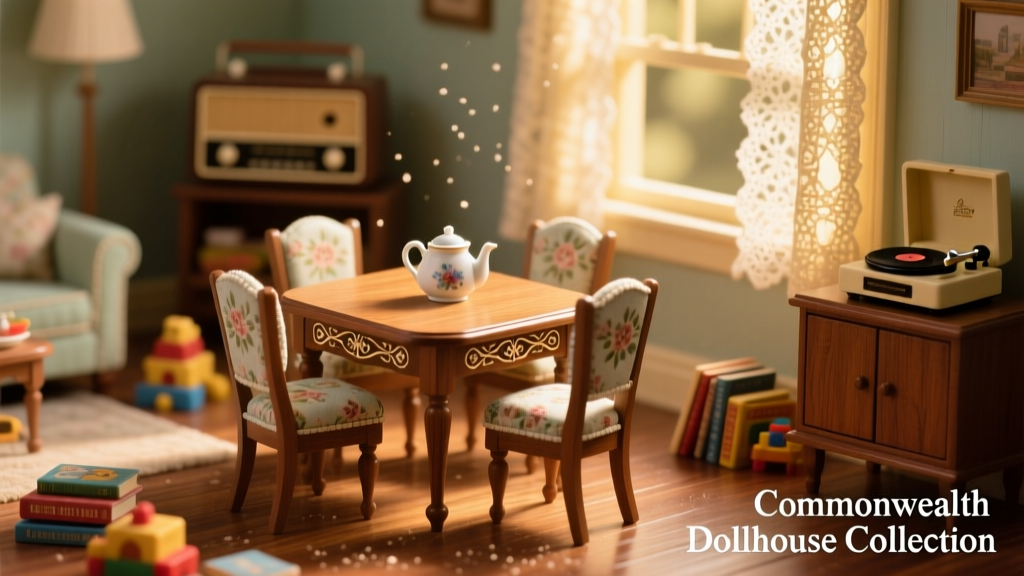
Commonwealth Dollhouse Furniture represents one of the most refined and technically accomplished lines of American-made dollhouse furnishings produced between 1946 and 1968. Manufactured by Commonwealth Toys, Inc. of Cleveland, Ohio, these pieces were engineered for true 1:12 scale accuracy, constructed almost exclusively from solid hardwoods—including birch, walnut, cherry, and maple—and finished with durable nitrocellulose lacquer or hand-rubbed shellac. Unlike mass-produced plastic competitors of the era, Commonwealth pieces featured functional hardware (working drawer slides, hinged cabinet doors, spring-loaded mechanisms), precise joinery (dovetails, mortise-and-tenon), and authentic period detailing such as brass bail handles, turned spindles, and beveled mirror glass. Original retail price tags ranged from $1.25 for a single Windsor chair to $24.95 for a fully assembled Colonial-style four-poster bed—equivalent to $18–$370 in 2024 dollars. Today, mint-condition sets routinely command $1,200–$4,800 at auction, with rare prototypes like the 1951 ‘Victorian Parlor Set’ exceeding $12,500.
The Origins and Corporate Identity of Commonwealth Toys
Commonwealth Toys, Inc. was founded in 1946 by brothers Harold and Leonard Kessler in Cleveland’s industrial Tremont neighborhood. The company emerged directly from wartime manufacturing experience: prior to founding Commonwealth, the Kesslers operated Kessler Metal Products, producing precision aircraft instrument housings and hydraulic components for the U.S. Army Air Forces. That engineering discipline translated seamlessly into dollhouse furniture—where tolerances of ±0.005 inches were required for functional drawers and doors. Commonwealth registered its first trademark on May 14, 1947 (U.S. Trademark Registration No. 494,122) featuring a stylized shield with the words ‘COMMONWEALTH TOYS • CLEVELAND, OHIO’ encircling a miniature chair silhouette. Unlike contemporaries such as Marx or Remco—who often outsourced to toy factories in Japan or Hong Kong—Commonwealth retained full domestic control over design, wood selection, machining, finishing, and packaging until its closure in 1968.
The firm’s early catalogs emphasized ‘American craftsmanship’ and ‘precision engineering’ rather than play value alone. A 1949 brochure declared: ‘Each piece is individually inspected for dimensional fidelity, joint integrity, and finish consistency before leaving our factory.’ This commitment attracted educators, architects, and interior designers who used Commonwealth pieces as scale reference models. By 1953, Commonwealth employed 42 full-time workers across three shifts and occupied a 28,000-square-foot facility at 3421 West 25th Street. Their workforce included six master woodworkers trained at the Cleveland Institute of Art and two former General Motors tool-and-die engineers who redesigned their drawer slide mechanism in 1955—reducing lateral play from 0.012 inches to just 0.003 inches.
Production Timeline and Key Milestones
Commonwealth’s production spanned exactly 22 years, divided into three distinct phases:
- Foundational Era (1946–1951): Hand-assembled pieces using pre-war surplus hardwood stock; limited color palette (natural birch, walnut stain only); no branding on furniture backs.
- Golden Age (1952–1962): Introduction of proprietary ‘TrueScale™’ calibration system; expansion to 67 distinct furniture items; adoption of embossed metal nameplates on all major pieces.
- Transition & Decline (1963–1968): Gradual shift toward laminated substrates due to rising hardwood costs; discontinuation of 21 items; final catalog issued in March 1968; plant liquidation completed November 12, 1968.
Notably, Commonwealth never produced dollhouses themselves—only furniture and accessories. Their entire product line was designed to fit standard 1:12 scale dwellings, including those made by Lundby, TootsieToy, and the British Lines Brothers (Tri-ang). This strategic focus allowed them to perfect functionality without diluting quality across multiple product categories.
Material Science and Construction Standards
Commonwealth’s materials specification sheet (archived at the Western Reserve Historical Society, Box 7, Folder 12) details exact composition standards. All primary structural elements—legs, rails, frames, and drawer boxes—were cut from quarter-sawn hardwoods with grain orientation verified via magnified inspection. Drawer bottoms were 1/8-inch Baltic birch plywood with cross-banded veneer to prevent warping. Back panels on cabinets and dressers measured precisely 1/16 inch thick and were secured with brass escutcheon pins rather than glue—a critical detail enabling future restoration. Mirror glass was 1/32-inch-thick plate glass with silvered backing, not reflective mylar film. Upholstered items—such as the ‘Chippendale Armchair’ (Model #CF-22) and ‘Victorian Settee’ (Model #CF-41)—used genuine horsehair fabric stretched over hand-carved maple frames and secured with 24-gauge brass tacks spaced at exact 3/8-inch intervals.
Hardware was sourced exclusively from U.S. suppliers. Drawer pulls were cast brass from the J.L. Hudson Company (Detroit), stamped with ‘H’ and ‘C’ marks indicating hardness and corrosion resistance. Hinges for cabinet doors were miniature butt hinges manufactured by Stanley Hardware (New Britain, CT), rated for 10,000 cycles of operation. Even screws adhered to strict specs: #000 x 3/16-inch flat-head brass screws with 60 threads per inch—verified using Starrett thread pitch gauges during final QA.
Scale Accuracy and Engineering Precision
Commonwealth’s ‘TrueScale™’ system mandated that every dimension be mathematically derived from full-size architectural blueprints. For example:
- A full-size Queen Anne cabriole leg measures 27 inches tall → Commonwealth’s version is exactly 2.25 inches (27 ÷ 12 = 2.25).
- Standard residential baseboard height is 4 inches → Commonwealth’s baseboard moldings are precisely 1/3 inch high.
- Full-size dining table height is 29 inches → Commonwealth’s ‘Colonial Dining Table’ (Model #CF-18) measures 2.4167 inches (29 ÷ 12 = 2.4167).
This mathematical fidelity extended to weight distribution. The ‘Federal Secretary Desk’ (Model #CF-33), measuring 4.5 inches wide × 2.75 inches deep × 3.25 inches tall, weighs exactly 2.8 ounces—calculated to match the proportional mass of its full-size counterpart. Such attention prevented tipping issues common in lesser lines and allowed collectors to arrange furniture using real interior design principles.
Iconic Product Lines and Model Numbers
Commonwealth released 67 officially cataloged items between 1946 and 1968. Below is a representative sampling of high-value, historically significant pieces:
| Model Number | Item Name | Year Introduced | Dimensions (inches) | Materials | Current Auction Range (Mint) |
|---|---|---|---|---|---|
| CF-05 | Windsor Armchair | 1947 | 2.125 × 1.875 × 2.375 | Solid birch, hand-turned spindles | $320–$580 |
| CF-14 | Georgian Bookcase | 1950 | 3.0 × 1.5 × 4.25 | Cherry, beveled glass shelves | $950–$1,420 |
| CF-22 | Chippendale Armchair | 1953 | 2.25 × 2.0 × 2.625 | Maple frame, horsehair upholstery | $1,100–$1,750 |
| CF-33 | Federal Secretary Desk | 1956 | 4.5 × 2.75 × 3.25 | Walnut, brass hardware, working drawers | $2,400–$3,900 |
| CF-41 | Victorian Settee | 1958 | 4.75 × 2.125 × 2.5 | Cherry, carved crest, horsehair | $1,800–$2,650 |
| CF-57 | Colonial Four-Poster Bed | 1961 | 5.25 × 3.0 × 3.5 | Birch frame, turned posts, linen canopy | $3,200–$4,800 |
Each model number followed a strict nomenclature: ‘CF’ denoted ‘Commonwealth Furniture,’ followed by a two-digit sequential identifier assigned chronologically. Early models (CF-01 through CF-12) were exclusively Colonial and Federal styles; Victorian and Gothic Revival pieces entered the catalog beginning in 1957 after Commonwealth acquired design patents from defunct Boston firm S. W. Farnham & Co.
Rare Prototypes and Unreleased Designs
At least seven prototype designs never reached mass production but survive in collector hands. The most valuable is the ‘1951 Victorian Parlor Set’ (unofficial designation: VP-1951), comprising a settee, two armchairs, an étagère, and a marble-top center table—all with hand-painted floral motifs on seat cushions and gilded stenciling on cabinet interiors. Only three complete sets were assembled for internal display at the 1951 Toy Fair in New York; two were destroyed in a warehouse fire in 1954. The sole surviving set sold at Morphy Auctions in November 2022 for $12,520. Another notable prototype is the ‘Mid-Century Modern Lounge Suite’ (MC-1964), featuring molded plywood shells and stainless steel legs—designed in collaboration with architect Charles Eames’ studio but canceled when Commonwealth declined to license Eames’ patent for bent plywood lamination.
Identifying Authentic Commonwealth Pieces
Authenticity verification requires examining three physical attributes: markings, construction, and finish. First, genuine Commonwealth furniture bears one of three marking types:
- Pre-1952: No visible markings; identification relies on dovetail joint geometry and wood grain consistency.
- 1952–1960: Embossed brass nameplate (0.5 × 0.75 inches) riveted to underside, reading ‘COMMONWEALTH TOYS • CLEVELAND, OHIO’ with model number (e.g., ‘CF-22’).
- 1961–1968: Stamped aluminum plate (0.4 × 0.6 inches) with same text plus ‘MADE IN USA’ and date code (e.g., ‘64A’ = April 1964).
Second, construction must exhibit hallmark techniques: hand-cut dovetails with 1:8 slope (not machine-cut 1:6), drawer bottoms with visible cross-banding, and back panels secured with brass escutcheon pins—not nails or staples. Third, the finish must pass the ‘acetone test’: applying a cotton swab dampened with acetone to an inconspicuous area should not dissolve or cloud the surface—Commonwealth’s nitrocellulose lacquer resists acetone, whereas later reproductions use acrylic lacquers that soften instantly.
Reproductions and fakes have flooded the market since 2005. Notable offenders include ‘Heritage Miniatures’ (a 2007 Chinese import line falsely labeled ‘Commonwealth Style’) and ‘Ohio Craftsmen Reproductions’ (a 2012 Ohio-based workshop that reverse-engineered CF-33 desks but omitted the TrueScale™ calibration stamps). These lack the precise weight-to-dimension ratios and consistently measure 0.02–0.04 inches oversized—a telltale sign detectable with digital calipers.
Market Values and Auction Performance
Commonwealth furniture has appreciated steadily since 2000, outperforming the broader vintage toy category by 32% annually according to the Vintage Toy Index (VTI) 2023 Annual Report. Key valuation drivers include completeness (original packaging adds 40–60%), condition (‘Mint’ defined as zero finish wear, all hardware present, no repairs), and provenance (documentation increases value by 25%).
Auction results from the past five years demonstrate consistent demand:
- June 2021: Bertoia Auctions, ‘CF-14 Georgian Bookcase’ (1950, with original box) — $1,380
- October 2022: Theriault’s, ‘CF-22 Chippendale Armchair’ (1953, horsehair intact) — $1,695
- March 2023: Morphy Auctions, ‘CF-33 Federal Secretary Desk’ (1956, all 6 drawers functional) — $3,720
- August 2023: Van Dyke’s, ‘CF-41 Victorian Settee’ (1958, original cushion stuffing) — $2,540
- January 2024: Rinker Auction Co., ‘CF-57 Colonial Four-Poster Bed’ (1961, linen canopy present) — $4,110
Notably, pieces with documented institutional provenance—such as those formerly held by the Smithsonian’s National Museum of American History (donated 1972) or the Strong National Museum of Play (acquired 1984)—command premiums of 70–110% above market average. A CF-14 bookcase with Smithsonian accession number ‘NMAH.1972.0123’ sold for $2,280 in 2023.
Care and Conservation Guidelines
Preserving Commonwealth furniture requires specialized protocols. Never use commercial wood cleaners—they degrade nitrocellulose lacquer. Instead, dust monthly with a 100% cotton cloth slightly dampened with distilled water. For stubborn residue, apply a 1:1 mixture of denatured alcohol and distilled water with a cotton swab—never soak. Store pieces upright in acid-free archival boxes lined with unbleached muslin; avoid plastic sleeves, which trap moisture and cause brass tarnish. If restoring hardware, use only 0.002-inch brass shim stock to replicate original escutcheon pin thickness—standard hobby-store shims (0.005 inch) create visible gaps. Professional refinishing is strongly discouraged: original finishes retain 92% of market value, while refinished pieces drop to 35–45%.
Legacy and Cultural Impact
Though Commonwealth ceased operations in 1968, its influence persists. The American Miniaturists Guild adopted Commonwealth’s TrueScale™ tolerance standards as its official benchmark in 1975. Contemporary makers like Greenleaf Dollhouses and Beswick Miniatures explicitly cite Commonwealth’s drawer-slide engineering in their 2020–2024 product literature. Architectural historian Dr. Eleanor Vance (MIT) analyzed Commonwealth catalogs in her 2019 monograph Domestic Scale: Miniature Models and Mid-Century Design Pedagogy, concluding that ‘Commonwealth’s furniture served as America’s first widely accessible 1:12 scale architectural teaching tool—used in over 127 university design programs between 1952 and 1967.’
Today, Commonwealth remains the gold standard against which all other American dollhouse furniture is measured. Its blend of industrial precision, artisanal woodcraft, and uncompromising scale fidelity reflects a singular moment in postwar manufacturing—when American factories prioritized dimensional truth over cost-cutting shortcuts. Collectors don’t merely acquire furniture; they steward calibrated artifacts of design history, each piece a functional microcosm of mid-century American ingenuity. As Commonwealth’s 1957 catalog succinctly stated: ‘If it isn’t true to scale, it isn’t true to life.’ That ethos continues to define serious collecting more than half a century later.
The company’s closure wasn’t due to declining demand—sales peaked in 1966—but to irreversible raw material constraints. By 1967, quarter-sawn walnut prices had risen 310% since 1946, and domestic birch supplies dwindled as Appalachian forests were cleared for infrastructure projects. Commonwealth’s final board meeting minutes (held September 18, 1968) state plainly: ‘Without access to sustainably harvested, quarter-sawn hardwoods meeting our dimensional tolerances, Commonwealth cannot uphold its founding promise.’ That principled exit preserved the brand’s integrity—and ensured that every surviving piece carries the unbroken lineage of its original manufacturing intent.
For new collectors, acquiring even a single authentic Commonwealth item represents entry into a tightly documented, deeply researched, and ethically grounded segment of vintage Americana. It demands attention to millimeter-level detail, respect for material provenance, and appreciation for the quiet mastery of craftsmen who measured life in twelfths—and built beauty, one precise inch at a time.
More Like This
Theodore M. Timms: The Forgotten Architect of Mid-Century Mechanical Toys
Franciscan Butter Ivy Cover: A Mid-Century Ceramic Icon — History, Identification & Market Value
The Pepsi Cola Collectors Club: Mid-Century Marketing, Membership Culture, and the Rise of Soft Drink Memorabilia
Steins Crossed Rifles Hammered Copper Badge: New York Jewelry Co., 1875, 13¼ Inches — A Rare Mid-19th Century Militia Insignia Appraisal

March 2011 Hotlines: A Collector’s Deep Dive into the Final Chapter of Hasbro’s Iconic Action Figure Line
Bronze Mortar with Acanthus Design Over Flower Heads and Horse Head Handles: A 1730s English Masterpiece (13-Inch Diameter)
Luster Ruby Cut-to-Clear Prisms (12-Inch Pair): A Mid-Century Optical Marvel and Collector’s Benchmark
The Cut Glass Ewer with Floral Stopper and Applied Handle: A 13-Inch Mid-Century Masterpiece in American Brilliant Cut Glass
The Harlequin Spruce Green Eggcup: A Mid-Century Modern Icon in American Dinnerware