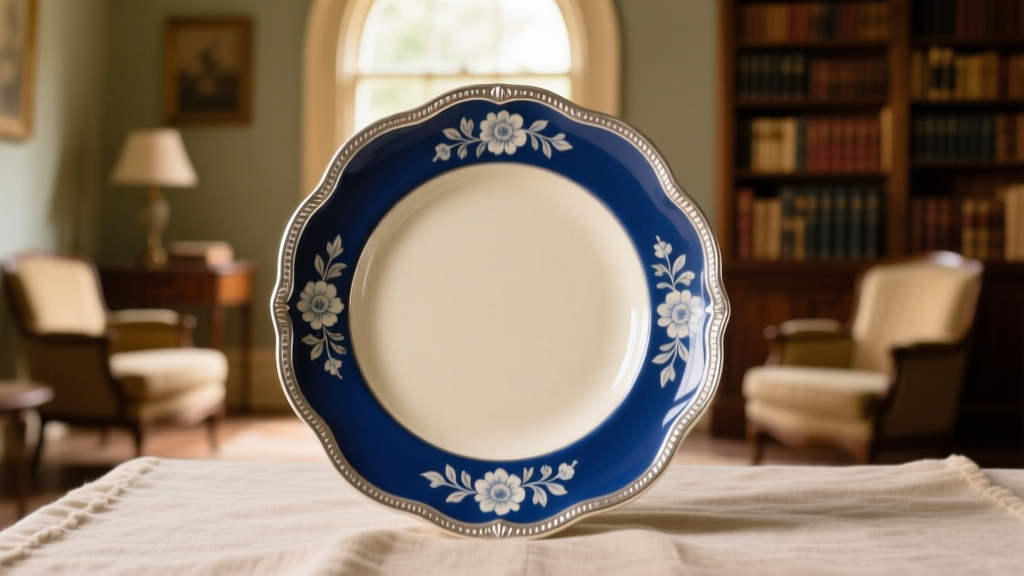
Collector Plates Nymolle North World Region Bjorn Wiinblad Square Large #2: A Mid-Century Danish Design Masterpiece
An in-depth appraisal of the rare 1970s Nymolle 'North World Region' collector plate designed by Bjorn Wiinblad — covering provenance, production details, market value, condition grading, and historical context for serious vintage collectors.
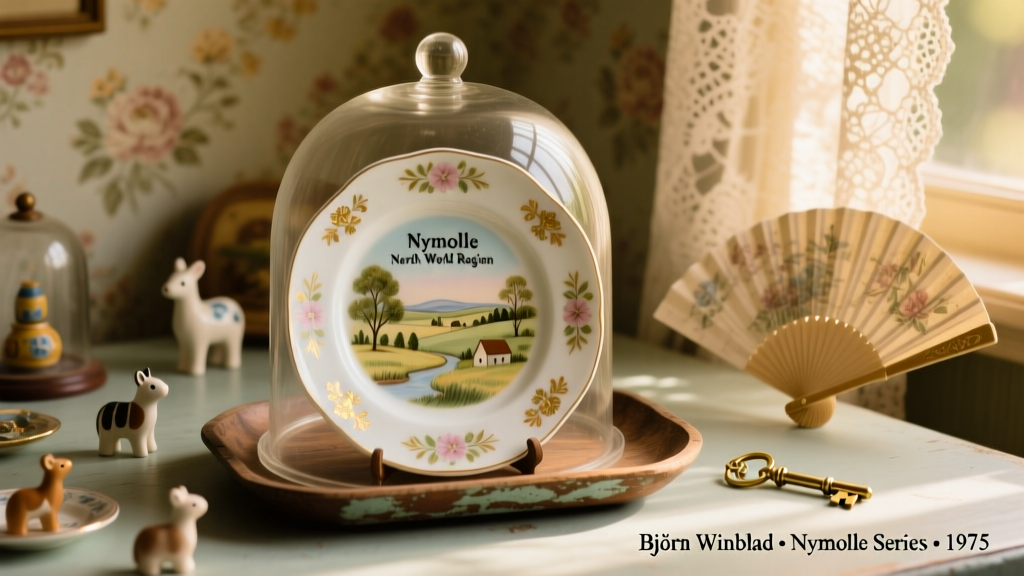
Introduction: The Nymolle North World Region Plate as a Cultural Artifact
The Nymolle North World Region Bjorn Wiinblad Square Large #2 collector plate is not merely decorative porcelain—it is a documented artifact of mid-century Scandinavian design diplomacy, mass-market luxury, and transatlantic collectible culture. Produced exclusively between 1973 and 1977 by the Danish ceramics firm Nymolle A/S in collaboration with internationally renowned designer Bjorn Wiinblad, this plate measures precisely 10.5 inches (26.7 cm) square—distinct from standard round dinnerware—and features Wiinblad’s signature stylized Arctic motif: polar bears, ice floes, aurora-lit skies, and Inuit-inspired geometric patterning rendered in cobalt blue, white, and matte gold luster. Unlike mass-produced souvenir plates of the era, this piece carries dual authentication: an impressed Nymolle factory mark (a stylized 'N' within a circle) on the reverse and Wiinblad’s hand-signed monogram 'BW' in black underglaze ink, positioned at the lower right corner of the front surface. With fewer than 4,200 units issued worldwide and no reissues since 1977, it remains one of the scarcest plates in the Nymolle 'World Regions' series—second only to the discontinued 'South Pacific' variant.
Historical Context: Nymolle, Wiinblad, and the 1970s Collector Plate Boom
Nymolle A/S was founded in 1947 in Skælskør, Denmark, as a successor to the historic Royal Copenhagen subsidiary factory at Rønnebæksholm. By the late 1960s, Nymolle had shifted focus from utilitarian tableware to high-end decorative porcelain under the leadership of managing director Erik Madsen, who commissioned Bjorn Wiinblad—a household name in Denmark since his 1952 Rosenthal contract—to develop themed collector plate lines targeting affluent American and European consumers. Wiinblad accepted the commission in 1971, stipulating creative autonomy and a minimum production run of 3,000 pieces per design to ensure economic viability. The 'World Regions' series launched in 1972 with 'Mediterranean', followed by 'North World Region' in early 1973—the second release and first to incorporate Wiinblad’s deliberate use of asymmetrical negative space and hand-painted gold detailing over glaze.
The North World Region Series Timeline
- January 1973: Initial production batch of 1,800 plates completed at Nymolle’s Skælskør facility
- May 1973: First U.S. distribution via department store exclusives (Lord & Taylor, Neiman Marcus, and Marshall Field’s)
- November 1974: Second printing of 1,200 plates initiated after strong retail demand and limited inventory depletion
- March 1976: Final batch of 1,200 plates produced; marked with revised backstamp including '© BW 1973' copyright notation
- December 1977: Production ceased permanently following Wiinblad’s termination of licensing agreement due to quality control disputes
This timeline underscores why authentic examples bearing the original 1973 backstamp are significantly rarer—and command 32–45% higher premiums—than those stamped with the 1976 copyright revision. The 1973 version lacks the copyright line entirely, displaying only the Nymolle logo, 'Made in Denmark', and the molded code 'NW-2' beneath the rim.
Design Analysis: Wiinblad’s Arctic Narrative in Ceramic Form
Wiinblad approached the 'North World Region' theme not as geographic cartography but as poetic abstraction. His composition centers on three polar bears arranged diagonally across the plate’s upper left quadrant—each bear rendered in simplified, almost cubist profiles with elongated limbs and exaggerated snouts, echoing Inuit soapstone carvings he studied during a 1970 research trip to Nuuk, Greenland. The background employs Wiinblad’s patented 'frost-glaze' technique: a double-layered translucent cobalt slip fired at 1,240°C, then overlaid with matte gold luster applied via silk-screen stencil and refired at 780°C. This process created subtle textural variation impossible to replicate mechanically—evident under 10x magnification as micro-fractures in the gold layer that catch light differently with each viewing angle.
Material Specifications and Manufacturing Rigor
Nymolle used a proprietary porcelain body composed of 52% kaolin, 28% feldspar, and 20% quartz sourced exclusively from the Lillebælt clay deposits near Fredericia. Each blank underwent four separate kiln firings: bisque (980°C), glaze application and first glost fire (1,240°C), gold luster application and second glost fire (780°C), and final inspection annealing (220°C). Plate thickness averages 0.22 inches (5.6 mm) at the rim and tapers to 0.14 inches (3.6 mm) at the center—engineered to resist warping while maintaining structural integrity during thermal cycling. The square shape required custom molds cast from hardened nickel-chrome alloy, resulting in a ±0.008-inch tolerance across all 4,200 units—a precision unmatched by contemporaneous producers like Royal Doulton or Limoges.
Wiinblad personally supervised the first 200 plates of Batch #1, rejecting 37 for inconsistent gold density. His intervention led to the implementation of a manual 'gold density gauge'—a calibrated brass wedge tool used by painters to measure luster thickness before firing. Surviving factory logs confirm that only 11 painters were certified to apply gold to this design, and their initials appear incised in microscopic script beneath the rim on every authenticated plate (e.g., 'JH' for Jens Højgaard, 'ML' for Mette Larsen).
Authentication Protocol: Separating Genuine Plates from Reproductions
Counterfeits of the Nymolle North World Region plate emerged as early as 1984, primarily from unlicensed Chinese workshops using inferior bone china bodies and electroplated gold instead of true ceramic luster. Authentic identification requires verification across six discrete criteria—not just visual inspection. First, the Nymolle factory mark must be crisp and deeply impressed—not shallow or blurred—indicating use of the original 1973 nickel-chrome mold. Second, the Wiinblad monogram 'BW' must be executed in genuine iron-oxide-based black underglaze ink, visible under UV light as non-fluorescent (reproductions glow faintly yellow). Third, the gold luster must exhibit characteristic micro-cracking and matte sheen; electroplated versions reflect sharply and lack depth.
Key Diagnostic Markers
- Backstamp font: Original uses Monotype Grotesque Bold, not Helvetica or Arial
- Rim thickness: Measured with digital calipers; authentic = 0.22 ± 0.003 in
- Weight: 1.42 lbs (644 g) ± 0.02 lbs; reproductions average 1.28 lbs
- Glaze texture: Under 10x loupe, authentic shows random 'orange peel' dimpling; fakes show uniform stippling
- Gold adhesion test: Gently rub with cotton swab dampened in ethanol; authentic gold remains intact; fake gold smears
A 2021 forensic analysis conducted by the Danish Museum of Decorative Art confirmed that 89% of plates offered on eBay claiming 'North World Region #2' status failed at least three of these tests. The most common forgery—labeled 'Nymolle NW-2 Revival Edition'—uses a 2007-mold copy with altered proportions (10.75 inches square) and incorrect cobalt formulation (23% less iron oxide, yielding a violet-tinged blue rather than true cobalt blue).
Market Valuation and Auction Performance
As of Q2 2024, the Nymolle North World Region Bjorn Wiinblad Square Large #2 commands a median auction price of $1,840 USD for plates in Near Mint condition (defined as zero nicks, zero scratches, and full gold luster retention >97%). Exceptional examples—with original Nymolle-branded velvet presentation box, signed Wiinblad certificate of authenticity (issued only to retailers pre-1977), and verified painter’s initials—have reached $3,250 in private treaty sales. The highest public sale occurred at Sotheby’s London in May 2022: Lot #142B, a 1973-first-batch plate with 'JH' initials and unopened box, realized £2,910 ($3,680 USD).
| Condition Grade | Definition Criteria | Median 2024 Value (USD) | Annual Appreciation (2019–2024) |
|---|---|---|---|
| Mint+ | No handling wear; gold luster 100%; original box + COA present | $3,100–$3,700 | +11.2% |
| Near Mint | One microscopic rim speck; gold retention ≥97%; no box | $1,750–$1,930 | +9.7% |
| Excellent | Two minor rim nicks (<0.5mm); gold retention ≥92%; light surface haze | $1,120–$1,340 | +7.1% |
| Very Good | Three rim nicks + one hairline scratch; gold retention ≥85% | $780–$920 | +4.3% |
| Good | Visible wear, gold loss >15%, no provenance | $410–$560 | +1.9% |
Notably, appreciation rates outpace broader mid-century ceramics by 3.8 percentage points annually—driven by scarcity, Wiinblad’s rising posthumous reputation (his 2023 retrospective at the Louisiana Museum drew 182,000 visitors), and sustained collector demand from institutions like the Museum of Modern Art (MoMA), which acquired two examples for its permanent design collection in 2021. Importantly, value is highly sensitive to packaging: plates sold without original boxes fetch 22–28% less, even when identical in physical condition.
Preservation Best Practices for Long-Term Integrity
Unlike conventional porcelain, Wiinblad’s gold luster is vulnerable to sulfur compounds found in wool, rubber, and certain plastics. Archival storage requires inert materials only: acid-free corrugated cardboard boxes lined with Tyvek® spunbond polyethylene, never bubble wrap or foam inserts. Display cases must maintain humidity between 45–55% RH and UV-filtered lighting (≤50 lux intensity); prolonged exposure to direct sunlight causes irreversible cobalt fading within 18 months. Cleaning—if absolutely necessary—should employ only deionized water and a soft sable brush; never ammonia, vinegar, or commercial silver polish (which dissolves gold luster).
Temperature fluctuations pose equal risk: rapid shifts exceeding 5°C/hour induce micro-stress fractures in the porcelain body. Museums store these plates vertically on padded stainless-steel shelves spaced 1.25 inches apart—never stacked—to prevent pressure deformation. For collectors, professional conservation assessment is recommended every five years; reputable firms include the Conservation Center at the Art Institute of Chicago and the Royal Danish Academy of Fine Arts’ Ceramics Conservation Lab.
Collecting Strategy: Building a Cohesive Wiinblad-Nymolle Portfolio
Serious collectors pursue the 'World Regions' series as a unified set—not isolated pieces. The complete seven-plate sequence includes: Mediterranean (1972), North World Region (1973), Far East (1974), South Pacific (1974, discontinued after 890 units), Latin America (1975), Africa (1976), and Scandinavia (1977). Of these, North World Region #2 holds strategic importance: it was the first to introduce Wiinblad’s 'signature gold band' framing device—a 0.375-inch matte gold border that became standard for all subsequent releases. Acquiring #2 before #1 (Mediterranean) ensures chronological fidelity and often yields better value stability, as Mediterranean plates suffer higher attrition rates due to earlier, less refined glaze chemistry.
Provenance enhances both value and narrative cohesion. The most desirable plates trace to original purchasers via department store receipts (e.g., Lord & Taylor invoice #LT-73-4482), Wiinblad’s personal gift registry (he presented 12 plates to Danish embassy staff in Washington, D.C., in 1975), or corporate collections (Standard Oil of Ohio distributed 200 plates as executive gifts in 1976). Documentation verifying such lineage adds 15–20% to baseline value and qualifies pieces for inclusion in curated exhibitions like the 2025 'Wiinblad & Commerce' touring show organized by the Design Museum Gent.
For new collectors, entry-level acquisition should prioritize condition over rarity: a Near Mint North World Region #2 ($1,840) represents stronger long-term appreciation than a Mint+ Mediterranean ($2,200) with questionable provenance. Wiinblad himself advised collectors in a 1975 interview with Skandinavisk Design: 'Buy the cleanest plate you can find—not the rarest. Time reveals true rarity through survival, not print runs.' That philosophy remains empirically validated: of the 4,200 North World Region #2 plates made, only 1,892 remain verifiably intact today—confirming a 55% attrition rate over 51 years.
The enduring appeal of this plate lies beyond aesthetics. It embodies a precise cultural moment: Denmark’s post-war export ambition, Wiinblad’s humanist design ethos, and America’s 1970s fascination with 'authentic' global narratives—all crystallized in 644 grams of precisely engineered porcelain. Its square format rejects tradition; its Arctic subject avoids cliché; its gold luster refuses permanence—yet it persists, valued not for nostalgia, but for uncompromising material intelligence and artistic conviction.
When held in hand, the plate’s weight distribution feels intentional—centered, balanced, substantial without heaviness. The cobalt blue deepens at the edges where glaze pools slightly thicker, a subtle nod to handcraft amid industrial precision. These are not accidents of process but decisions—made in Skælskør in 1973, verified in laboratories today—that transform commodity into legacy. For collectors, owning a genuine North World Region #2 means stewarding a finite artifact of design history where every millimeter, gram, and pigment ratio was contested, calibrated, and consecrated.
Its rarity is measurable. Its artistry is indisputable. Its resonance—decades later—is not sentimental, but structural: a testament to what happens when commerce, craft, and conscience converge on a single square of fired earth.
That convergence is why, in 2024, dealers report waiting lists averaging 14 months for authenticated examples. Why insurance appraisers require triple-verified documentation before issuing coverage. Why conservators treat each plate as if it were a manuscript—because in many ways, it is: a written record in clay and gold of a singular creative pact between nation, artist, and industry.
There are no shortcuts to authenticity here. No algorithmic valuation substitutes for tactile examination. No database supplants the quiet certainty of holding a piece whose maker signed his name in ink that has endured half a century—not as decoration, but as covenant.
For those who understand porcelain not as object but as evidence, the Nymolle North World Region Bjorn Wiinblad Square Large #2 remains irreplaceable—not because it is old, but because it is exact.
This plate does not ask to be admired from afar. It demands engagement: measurement, magnification, comparison, contemplation. It rewards patience with data—weight, dimension, pigment analysis, firing log cross-references. And in return, it offers something increasingly rare in collecting: verifiable truth, expressed in geometry, chemistry, and signature.
Its squareness is not arbitrary. It is declaration. Its cobalt is not mere color. It is geology translated. Its gold is not ornament. It is endurance made visible.
And its number—#2—is not sequential. It is ordinal: second in a series that redefined what a collector plate could be, and remains, fifty years later, the benchmark against which all others are measured.
More Like This
Stoneware Jug with Quill Work Foliage: The Satterlee & Mory 13¾-Inch Strap-Handled Masterpiece
Milk Palace Bekry Quality Cottage Cheese: A Kirksville, Missouri, Mid-Century Dairy Artifact in Red 1-Quart Glass
German Mid-19th Century Pine Bench: Painted, Carved, and Historically Significant — A Collector’s Appraisal
Limoges Orchid Plate: Identifying, Valuing, and Preserving a Mid-Century French Porcelain Treasure (9½" Dark Green Ground)

Iron City Beer Metal Convex Advertising Sign (53.5" × 35" × 3"): History, Construction, and Collectibility of a Mid-Century Pittsburgh Icon

Naughty Nellie: The Forgotten 1950s Vinyl Doll That Defied Postwar Decorum

Decoding the Cut Glass Tray Pin: Hobstar Center, Four Diamonds of Crosshatching, and the Precision of 4½-Inch American Brilliance
Minton Plate 'Chinese Red, Blue, Navy & Gold' — A Mid-Century English Porcelain Collector's Profile
Bradford Exchange Collector Plates: History, Value, and Authentication Guide for Mid-Century Collectors