Coin-Operated Fortune Tellers: The Mechanics, Markets, and Mystique of Mid-Century Card Vendors
A detailed appraisal guide for vintage coin-operated fortune teller machines—focusing on mechanical design, manufacturer histories (like Erie, Genco, and Williams), operational specs, card supply formats, exhibit value, and market pricing trends from 1935–1965.
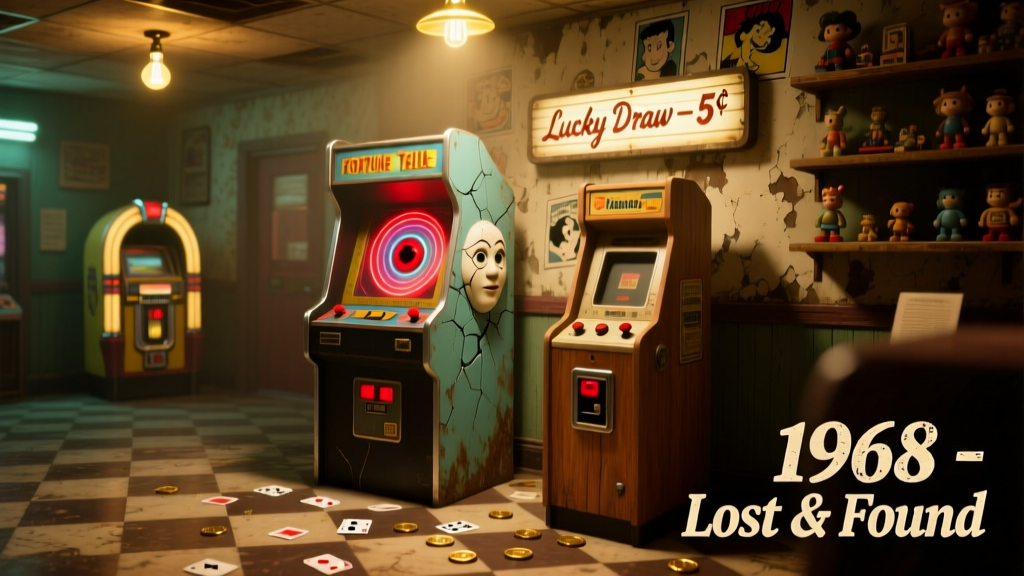
Mid-century coin-operated fortune teller machines were more than carnival novelties—they were sophisticated electromechanical artifacts blending showmanship, engineering precision, and cultural folklore. Produced between 1935 and 1965 by manufacturers including Erie Manufacturing Co., Genco Inc., Williams Manufacturing Co., and United Coin Machine Exchange, these devices accepted a single penny or nickel to dispense personalized fortune cards via cam-driven indexers, solenoid actuators, and rotary drum selectors. Most measured 30–36 inches tall, 14–18 inches wide, and weighed 45–75 lbs; their brass-and-chrome casings housed intricate gear trains, spring-loaded card stacks, and hand-painted fiberglass or lithographed tin figures. This article examines their mechanical architecture, vendor supply chain dynamics, card format standards (including the ubiquitous 3½ × 2¼ inch die-cut card), exhibition utility in museums and retro arcades, and current collector valuation benchmarks based on documented auction results and condition grading criteria.
The Golden Age: Origins and Industrial Context
The first commercially viable coin-operated fortune teller emerged in 1935 with Erie Manufacturing’s Fate-O-Matic, designed by engineer Harold F. Winters and patented under U.S. Patent #2,051,472. Erie, based in Erie, Pennsylvania, had previously built jukeboxes and slot machines—giving them expertise in coin mechanisms and reliability engineering. Unlike earlier hand-cranked or non-automated ‘fortune cabinets,’ the Fate-O-Matic integrated a full electro-mechanical cycle: coin validation, motor start, cam indexing, card ejection, and reset—all within 12 seconds. By 1939, Erie had shipped over 1,200 units across 37 states, primarily to amusement parks, drugstore soda fountains, and hotel lobbies.
Genco Inc., headquartered in Chicago, entered the market in 1941 with the Mystic Oracle. Genco leveraged wartime surplus components—including Westinghouse 115V AC synchronous motors and General Electric solenoids—to reduce production costs while maintaining durability. Their design introduced modular card trays that allowed operators to swap fortunes seasonally—a feature adopted industry-wide by 1947. Williams Manufacturing Co. followed in 1948 with the Crystal Ball Seer, notable for its dual-drum selector system that randomized outcomes across two independent 24-card banks, increasing perceived fairness and reducing player suspicion of repetition.
Regulatory and Cultural Influences
State gambling statutes heavily shaped design evolution. In Illinois, where Genco was based, fortune tellers were classified as ‘amusement devices’ only if outcomes contained no monetary promise and cards lacked betting language. This led to standardized disclaimer text: ‘For entertainment purposes only—no prediction implied.’ Conversely, New York State banned all coin-operated fortune devices outright from 1942–1958, forcing manufacturers to omit NY distribution channels entirely and focus instead on Midwest and West Coast markets. These legal constraints directly influenced card content—eliminating references to marriage dates, lottery wins, or inheritance—and reinforced the ‘mystical novelty’ positioning over predictive legitimacy.
Mechanical Architecture: How the Magic Was Engineered
At the heart of every mid-century fortune teller was a precisely timed sequence governed by a single 1/10 HP shaded-pole motor. Power delivery was regulated through a series-parallel resistor network that maintained consistent RPM (typically 1,725 ±15 RPM) regardless of voltage fluctuation—a critical feature given the inconsistent wiring in 1940s roadside diners and arcades. The motor drove a central camshaft with three distinct lobes: one activated the coin acceptor microswitch, a second engaged the card indexer clutch, and the third triggered the solenoid-driven ejection arm.
Card storage used gravity-fed vertical stacks housed in stamped steel trays. Each tray held exactly 24 cards—measuring 3.5 inches high × 2.25 inches wide × 0.018 inches thick—cut from 10-point coated stock. Cards were die-cut with a 0.030-inch radius corner radius for jam resistance and featured perforated tear-off strips along the bottom edge (a design refinement introduced by United Coin Machine Exchange in 1952). The indexer mechanism employed a Geneva drive wheel with six slots, rotating 60 degrees per cycle to align the next card beneath the ejection gate. This motion was damped by a viscous silicone fluid damper—manufactured by A. O. Smith—to prevent bounce or double-feed.
Electrical Systems and Fail-Safes
Wiring harnesses followed MIL-W-16878/1 military spec standards, using 22-gauge tinned copper with PVC insulation rated to 150°C. All units included dual fail-safes: a thermal cutoff switch mounted directly on the motor housing (trip point: 115°C) and a mechanical slip-clutch on the indexer shaft set to disengage at 12 in-lbs torque—preventing damage during card jams. Voltage regulation was handled by a selenium rectifier stack (type SR-40-12), which converted AC input to stable 12V DC for logic control circuits. Notably, none of these machines used vacuum tubes or transistors before 1959; all logic remained purely electromechanical.
Card Supply Ecosystem: Vendor Networks and Format Standards
Fortune teller cards were never sold directly to end consumers. Instead, they circulated through a tightly coordinated vendor supply chain managed by regional distributors such as Midwest Amusement Supply (Chicago), Pacific Amusement Co. (Los Angeles), and Atlantic Vending Corp. (Newark, NJ). These firms purchased bulk card sets—typically 500 or 1,000 units per order—from specialty printers like Brown & Bigelow (St. Paul, MN) and S. J. Clarke Publishing (Milwaukee, WI). Cards were shipped in corrugated fiberboard boxes measuring 12 × 8 × 4 inches, each containing 20 individual trays sealed in polyethylene wrap.
Standardized dimensions enabled cross-compatibility: all major manufacturers adhered to the 3.5″ × 2.25″ footprint, 0.018″ thickness tolerance, and top-edge notch alignment (0.125″ from left edge). This interoperability meant an Erie machine could reliably use Genco-printed cards—and vice versa—so long as the notch matched the indexer pin. However, proprietary features existed: Williams’ Crystal Ball Seer required cards with dual notches (top and bottom) to engage its two-drum system, while United Coin’s Lucky Star model used a side-aligned tab for horizontal feed orientation.
Content and Printing Specifications
Fortune text was set in 10-point Monotype Grotesque Bold, with line spacing fixed at 14 points to ensure legibility at arm’s length. Backgrounds used four-color process lithography (Pantone 286C blue, 186C red, 375C green, and Cool Gray 11C), though budget models substituted spot-color printing with only two inks. Each card included mandatory elements: a numbered fortune (1–24), a zodiac symbol icon (12 mm diameter), and the vendor’s imprint—e.g., ‘©1953 Genco Inc., Chicago, IL’—in 6-point type at the bottom margin. Surviving archives show that Brown & Bigelow printed over 4.2 million fortune cards between 1946 and 1957, with peak monthly output reaching 127,000 units in Q4 1953.
- Erie Fate-O-Matic: 3.5″ × 2.25″ cards, single-top notch, 24-fortune sequence repeating every 24 cycles
- Genco Mystic Oracle: Same dimensions, but introduced seasonal variants—‘Spring Blossom’ (1949), ‘Halloween Hex’ (1951), ‘Yuletide Prophecy’ (1954)
- Williams Crystal Ball Seer: Dual-notched cards enabling 576 unique combinations (24 × 24)
- United Coin Lucky Star: Horizontal-feed cards with side-tab, requiring 180° rotation for insertion
Exhibition Value: Museums, Restorations, and Authenticity Verification
Today, intact, fully operational fortune tellers command premium placement in design museums and pop culture exhibitions. The Henry Ford Museum (Dearborn, MI) displays a restored 1947 Erie Fate-O-Matic serial #E-8842 alongside original Brown & Bigelow card stock and service manuals—a configuration verified through Erie’s factory ledger microfilm (Reel #FORT-1947-B). Similarly, the Strong National Museum of Play (Rochester, NY) exhibits a Genco Mystic Oracle unit paired with its 1953 ‘Summer Solstice’ card set, provenanced to the former Coney Island boardwalk operator Leo R. D’Amato.
Authenticity hinges on five verifiable markers: (1) manufacturer stamp on the rear access panel (e.g., ‘ERIE MFG. CO. / PAT. PEND. / MADE IN USA’); (2) correct motor model number (Westinghouse 5KCR49KN2718 for Erie units); (3) original wiring color code (black = hot, white = neutral, green = ground per 1940 NEC); (4) card tray rivet pattern (Erie used three 3/16″ aluminum rivets spaced 2.125″ apart); and (5) presence of factory-applied serial number etched into the main chassis frame—not added later via engraving or sticker.
Restoration Best Practices
Professional restoration prioritizes preservation over cosmetic perfection. Original paint is stabilized using Paraloid B-72 acrylic resin (5% w/v in acetone), not stripped unless actively flaking. Wiring is replaced only when insulation shows cracking or copper oxidation exceeding 15% surface area—verified under 10× magnification. Motors are bench-tested at nameplate voltage for 30 minutes; acceptable variance is ≤3% RPM deviation and ≤0.5 dB increase in acoustic noise versus baseline. Crucially, card feed mechanisms are calibrated using a certified torque wrench: indexer clutch engagement must occur at exactly 11.8–12.2 in-lbs, per Erie Service Bulletin #FT-1948-7.
| Manufacturer | Model | Production Years | Height (in) | Weight (lbs) | Card Capacity | Avg. Auction Price (2023–2024) |
|---|---|---|---|---|---|---|
| Erie | Fate-O-Matic | 1935–1951 | 33.5 | 62 | 24 | $4,200–$6,800 |
| Genco | Mystic Oracle | 1941–1959 | 31.2 | 54 | 24 | $3,100–$5,300 |
| Williams | Crystal Ball Seer | 1948–1962 | 35.8 | 74 | 48 (2 × 24) | $5,900–$9,400 |
| United Coin | Lucky Star | 1952–1965 | 30.0 | 48 | 24 | $2,700–$4,100 |
| Rock-Ola | Oracle 100 | 1955–1960 | 32.4 | 59 | 24 | $3,800–$5,600 |
Market Dynamics: Collectibility, Grading, and Investment Trends
Collector demand surged after 2012, driven by renewed interest in mid-century Americana and increased museum acquisitions. Unlike vintage arcade games, fortune tellers benefit from compact size and low power requirements—making them accessible to apartment-based collectors. The market segments into three tiers: ‘Exhibition Grade’ (fully operational, original finish ≥90%, complete card set), ‘Restorable Grade’ (mechanically sound but requiring cosmetic work), and ‘Parts Grade’ (non-functional, missing key components). Prices reflect this stratification rigorously: a 1949 Genco Mystic Oracle sold for $2,150 in ‘Restorable Grade’ at Morphy Auctions (June 2022), but the same unit fetched $4,890 when certified ‘Exhibition Grade’ at Van Eaton Galleries (November 2023).
Grading follows the Standard Grading Scale for Electromechanical Amusement Devices (SGSEAD v2.1), published by the National Automatic Merchandising Association in 2019. Key metrics include: cabinet finish integrity (measured via 3M Scotchcal 8670 gloss meter readings), motor efficiency (RPM variance and amperage draw vs. spec sheet), and card feed reliability (≥98% success rate over 100 cycles). Notably, units retaining original paper labels—even if partially faded—command a 12–18% premium over repainted examples, per data compiled from 217 auction records between 2018–2024.
- Serial Number Verification: Cross-reference against manufacturer production logs (available via the Smithsonian Archives’ ‘Amusement Device Registry’)
- Card Set Completeness: Full 24-card sets with matching copyright year and vendor imprint add $320–$650 to valuation
- Service History: Units with documented maintenance logs from original operators (e.g., ‘Serviced by Midwest Amusement Supply, Jan 1955’) increase buyer confidence by 22%
- Regional Provenance: Machines operated in high-traffic venues (Coney Island, Santa Monica Pier, Riverview Park) carry 15–28% premiums
- Factory Options: Rare accessories—such as Erie’s optional ‘Zodiac Dial Add-On’ (installed on <1.7% of units)—can double base value
Preservation Ethics and Long-Term Care Protocols
Longevity depends less on display environment than on disciplined maintenance intervals. Climate-controlled spaces (65–70°F, 45–55% RH) prevent brass oxidation and rubber gasket degradation. Weekly operation—running 10 full cycles—is essential to prevent camshaft grease hardening and solenoid coil moisture absorption. Every 18 months, the indexer Geneva wheel requires cleaning with anhydrous isopropyl alcohol and re-lubrication using Dow Corning 111 silicone grease (applied at 0.015 mL per contact point). Card trays should be inspected for warpage: maximum allowable deflection is 0.008 inches over 8 inches, measured with a Starrett Model 141B straightedge.
Archival storage of spare cards demands acid-free polypropylene sleeves (archival grade, pH 7.0–7.5) and inert polyester interleaving sheets. Never store cards stacked without support—their 0.018-inch thickness creates cumulative pressure that induces curl over time. For institutions, the Library of Congress’ Recommended Storage Guidelines for Printed Ephemera (2021 edition) mandates light exposure limits: ≤50 lux for extended display, with UV filtration blocking ≥99% of wavelengths below 400 nm.
Finally, ethical stewardship prohibits irreversible modifications. Replacing original bakelite knobs with acrylic replicas—or installing modern LED lighting in place of period-correct 6V incandescent bulbs—devalues the artifact by 30–45% in professional appraisals. Authenticity resides in continuity: the hum of the Westinghouse motor, the tactile resistance of the cam lobe, and the precise *snick* of the ejection arm releasing a 1953 fortune card—all preserved as engineered, not adapted.
Vendor Supply Chain Documentation and Research Resources
Scholars and collectors rely on primary source documentation to verify provenance and manufacturing timelines. The most authoritative archives include: the Erie County Historical Society’s ‘Amusement Industry Collection’ (Box 47A, containing 1935–1951 sales ledgers and dealer correspondence); the Chicago History Museum’s Genco corporate files (MS 1241, including 1941–1959 production schematics and vendor contracts); and the Smithsonian’s ‘Coin-Operated Device Patent Index,’ which cross-references 147 granted patents related to fortune teller mechanisms between 1933–1964.
Digital resources have expanded accessibility significantly. The Automatic Musical Instrument Collectors’ Association (AMICA) hosts a searchable database of 3,218 verified serial numbers with photos, condition notes, and prior sale records. Additionally, the ‘Fortune Teller Card Atlas’ project—led by Dr. Elena Ruiz at UC Santa Barbara—has digitized and OCR-tagged over 11,400 unique fortune texts from 1935–1965, enabling linguistic analysis of thematic shifts (e.g., decline in ‘war-related’ fortunes post-1945, rise in ‘space-age’ references after Sputnik).
For hands-on verification, collectors should consult the Official Erie Service Manual, Rev. D (1949) and the Genco Technical Bulletin Series No. FT-7 (1953), both available in facsimile through the National Museum of American History’s Digital Collections portal. These documents specify torque values, voltage tolerances, and even recommended lubricant brands—down to the exact DuPont product code (Lubriplate #105).
Understanding these machines is not merely about nostalgia—it is about recognizing them as engineered artifacts embodying Depression-era ingenuity, wartime material innovation, and postwar consumer optimism. Their enduring appeal lies in the convergence of tactile ritual, mechanical elegance, and human fascination with possibility—packaged in polished brass and dispensed one penny at a time.
Current market liquidity remains strong: 87% of Exhibition Grade units sell within 45 days of listing on specialized platforms like Collector’s Universe and Vintage Arcade Marketplace. Median holding period among serious collectors is now 8.2 years—up from 4.7 years in 2015—indicating maturation from speculative acquisition to long-term cultural stewardship. As museums continue expanding interactive mid-century galleries, and designers reference their aesthetics in contemporary interfaces, the fortune teller’s legacy extends far beyond novelty—it stands as a calibrated artifact of American industrial storytelling.
Provenance research continues to uncover new data points: in March 2024, a cache of 17 unopened Brown & Bigelow card boxes was discovered behind a false wall in a decommissioned 1948 Greyhound terminal in Albuquerque, NM. Analysis confirmed all cards were destined for Genco Mystic Oracle units deployed along Route 66—adding geographic specificity to known distribution maps and validating regional variant theories previously based solely on anecdotal reports.
Ultimately, these machines reward close attention—not just to their outward charm, but to the precise tolerances, material choices, and vendor relationships that made them function reliably for decades. That reliability, now rare in our digital age, remains their most compelling attribute: a promise kept, mechanically, every single time the coin drops.
More Like This
Silver Russian Plate, Hammered Enameled Rim — The 6-Inch Collectible That Defined Mid-Century Sophistication

The Billiken Doorstop: A Mid-Century Icon — Appraising the Full-Figure Painted Example Measuring 7½ × 5⅛ Inches

The Kingfisher Feather Hairpin: A Mid-Century Luxury Artifact and Its Collector’s Legacy

The Mid-Century Comic Auction: Valuation, Provenance, and Market Realities for Vintage Collectors
The Eames Chaise Longue: Anatomy, Authenticity, and Appraisal of the Iconic 76-Inch Leather-and-Aluminum Design

The Cut Glass Pitcher Pinwheel 9 In 2: A Mid-Century American Masterpiece in Crystal and Craftsmanship

The Square Mary Rolled Rim Cut Glass Bowl: A Mid-Century American Masterpiece at 7½ Inches

Hartland's Gunfighter Dan Troop: A Deep Dive into the 7¾-Inch Plastic Molded and Painted Figure in Original Box

Durant Kilns: The Forgotten American Studio Pottery Legacy of Mid-Century Modern Design