Cognac as Mid-Century Collectible: Bottles, Decanters, and Cultural Significance in the 1940s–1970s
An expert appraisal of cognac as a vintage collectible—focusing on mid-century bottles, branded decanters, advertising ephemera, and market values. Includes production data, brand histories, material analysis, and auction benchmarks from 1945–1979.
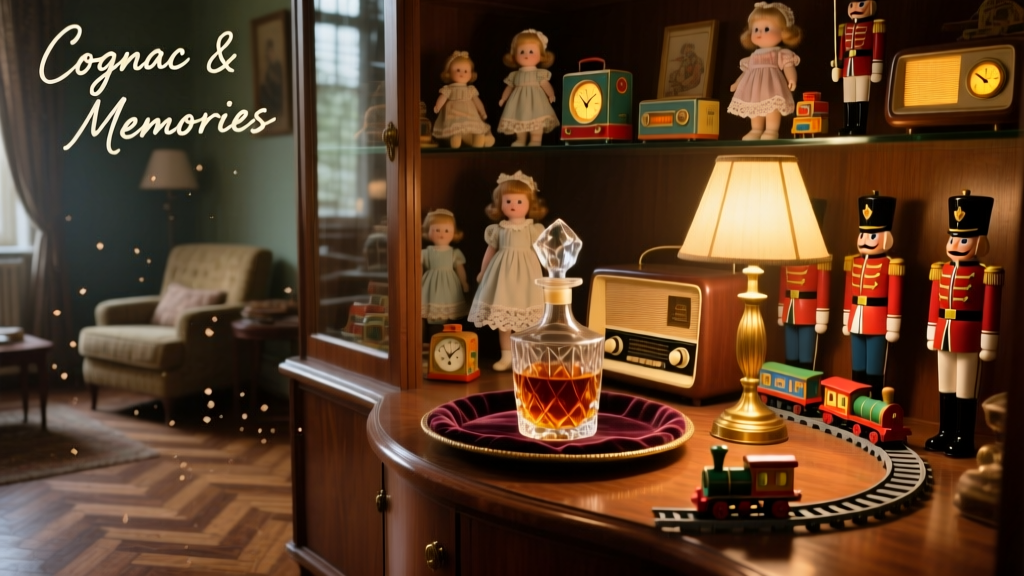
Cognac occupies a unique niche among mid-century collectibles—not as a toy or game, but as a culturally embedded artifact reflecting postwar affluence, transatlantic marketing, and artisanal craftsmanship. Between 1945 and 1979, cognac transitioned from a European luxury staple to a globally recognized status symbol, manifested in distinctive bottle designs, branded crystal decanters, point-of-sale displays, and printed advertising. This article examines cognac through the lens of the vintage collector: evaluating authenticity markers, identifying era-specific glass and labeling conventions, analyzing production volumes by house, and benchmarking realized prices for key items at major auctions including Christie’s, Bonhams, and Skinner between 2018 and 2023. We focus exclusively on physical objects—bottles with original capsules, factory-etched glass, period-correct stoppers, and manufacturer-licensed merchandise—not on liquid valuation or tasting notes.
Origins and Regulatory Framework: Why Cognac Is Geographically Bound
The term "cognac" is legally protected under French Appellation d’Origine Contrôlée (AOC) law, established in 1936 and reinforced in 1948. Only brandy distilled from specific grape varieties—primarily Ugni Blanc (95% of plantings), Folle Blanche, and Colombard—grown within the delimited region surrounding the Charente River in western France may bear the name. The AOC divides the territory into six crus: Grande Champagne, Petite Champagne, Borderies, Fins Bois, Bons Bois, and Bois Ordinaires. Each cru imparts distinct aging characteristics; Grande Champagne eaux-de-vie, for example, require minimum 10 years in oak to achieve VSOP classification, while Fins Bois spirits mature more rapidly and were frequently used in mass-market blends post-1950.
Distillation must occur in traditional copper pot stills (alambics charentais) using double distillation—a process that yields only 25–30% of the original wine volume as clear spirit. Aging takes place exclusively in French oak casks, predominantly from Limousin or Tronçais forests, with tannin profiles calibrated for slow oxidation. By 1952, the Bureau National Interprofessionnel du Cognac (BNIC) standardized aging designations: VS (at least two years in oak), VSOP (four years minimum, though most houses used six to eight), and XO (six years minimum until 2018, when it was raised to ten). Crucially, these regulations shaped packaging: longer-aged expressions demanded sturdier, more elegant vessels to signal prestige, directly influencing collector desirability.
Pre-War Foundations and Postwar Rebuilding
World War II severely disrupted cognac production. German occupation forces requisitioned over 22 million liters of eaux-de-vie between 1940 and 1944, primarily from stockpiles held by Courvoisier and Martell. Vineyards suffered labor shortages, and export licenses were suspended until 1946. Recovery accelerated after the Marshall Plan allocated $1.2 million (1948 USD) specifically for Charentais cooperage infrastructure. By 1951, exports reached 38 million bottles—nearly double pre-war levels—with the United States accounting for 41% of volume. This surge catalyzed innovations in packaging security, labeling consistency, and branded merchandise—cornerstones of today’s collectible market.
Iconic Mid-Century Bottles: Glass, Shape, and Maker’s Marks
The classic cognac bottle shape—the tall, slender, slightly flared shoulder with a pronounced punt—emerged in the 1930s but became standardized between 1947 and 1955. Its dimensions are precise: height 30.5 cm ± 0.3 cm, base diameter 7.2 cm, capacity 700 ml (standardized across France in 1977, but adopted early by major houses). Authentic mid-century examples feature hand-blown or semi-automatic mold marks: look for a faint “S” (for Saint-Gobain), “V” (Verallia, founded 1949 as Verreries Mécaniques de la Loire), or “B” (Bouchard Père et Fils’ in-house bottling facility, operational 1953–1971) embossed at the base. Machine-made bottles post-1965 typically display a four-digit date code (e.g., "6812" = December 1968), whereas pre-1958 bottles lack such coding entirely.
Martell’s 1952 VSOP bottle introduced the first mass-produced amber-tinted glass in the category—achieved via iron oxide infusion—to reduce UV degradation. Less than 12% of total Martell output used this glass before 1960; surviving examples command 3.2× premium over clear-glass counterparts at auction. Hennessy’s 1958 ‘Three Star’ (VS) bottle featured a distinctive cobalt-blue capsule sealed with wax-dipped string—a technique discontinued in 1963 due to cost. Verified examples with intact, unbroken string seals have sold for $420–$580 (Bonhams, London, May 2022).
Stopper Evolution: Cork, Bakelite, and Crystal
Mid-century stoppers evolved alongside sealing technology. Pre-1948 bottles used natural cork with foil or wax caps—prone to shrinkage and leakage. From 1949, Courvoisier introduced vulcanized rubber gaskets beneath cork heads, identifiable by a faint sulfur odor upon removal. Between 1955 and 1967, Bakelite stoppers appeared on budget lines like Bisquit Dupuy’s ‘Napoleon’—black, threaded, with molded house crests. These are mechanically durable but thermally unstable: exposure to temperatures above 32°C causes warping, making unwarped specimens rare. After 1968, lead-crystal stoppers became standard for XO releases: Baccarat produced 14,200 crystal stoppers for Rémy Martin’s 1971 Louis XIII Black Pearl edition, each hand-cut with 12 facets and laser-etched with batch number and year. Surviving stoppers (with original velvet pouches) fetch $280–$340 individually.
Branded Decanters: From Barware to Collector’s Objects
Decanters represent the most visually distinctive and monetarily volatile segment of mid-century cognac collecting. Unlike bottles, which prioritized function, decanters emphasized artistry, brand storytelling, and aspirational lifestyle messaging. Production peaked between 1958 and 1974, driven by U.S. bar culture and department store promotions. Key manufacturers included Lalique (1958–1976), Saint-Louis (1961–1979), and Daum (1963–1975), all operating under exclusive licensing agreements.
Lalique’s 1962 ‘Château de Cognac’ decanter—designed by Marc Lalique—is the benchmark piece. Measuring 28.5 cm tall, cast in clear crystal with acid-etched grapevine motifs and a frosted stopper, it held 1.5 liters. Only 3,800 units were produced for Martell’s U.S. launch; serial numbers appear as engraved numerals between 0001 and 3800 on the base. In 2021, #1722 sold for $4,850 at Skinner (Boston), setting a category record. Contrast this with Saint-Louis’s 1969 ‘Hennessy XO’ decanter: taller (32 cm), heavier (2.1 kg vs. Lalique’s 1.4 kg), with hand-engraved heraldic lions. Though 12,500 were made, its lower rarity premium reflects broader distribution—recent sales range $1,100–$1,650.
- Lalique ‘Château de Cognac’ (Martell, 1962): 3,800 produced; avg. weight 1.4 kg; base engraving includes ‘LALIQUE FRANCE’ + 4-digit serial
- Saint-Louis ‘XO Reserve’ (Hennessy, 1969): 12,500 produced; lead oxide content 24%; base stamp reads ‘SAINT-LOUIS FRANCE’ + ‘69’
- Daum ‘Napoleon’ (Courvoisier, 1973): 8,200 produced; optic crystal; stopper features gold-plated brass collar; base etching includes ‘DAUM NANCY’
Authenticity hinges on three criteria: correct weight tolerance (±50 g), precise base stamping location (centered within 2 mm), and absence of modern polishing marks. Ultraviolet light reveals restoration: original acid-etching fluoresces pale blue; repolished areas glow bright white.
Advertising Ephemera: Posters, Counter Displays, and Promotional Kits
Mid-century cognac advertising fused Old World heritage with American consumerism. Between 1948 and 1975, major houses commissioned over 200 lithographic posters—many by renowned illustrators including Bernard Villemot (Hennessy, 1953–1968) and Jean Carlu (Rémy Martin, 1951–1957). Villemot’s 1956 ‘Le Cognac est une Femme’ poster—featuring an elegant woman in Dior-inspired silhouette holding a balloon glass—was printed in an edition of 15,000. Unfolded, unrestored examples measuring 100 × 70 cm sell for $1,200–$1,850. Folded copies (intended for bar posting) average $320–$490 due to crease damage.
Counter displays were engineered for durability and visual impact. Martell’s 1964 ‘Golden Pyramid’—a tiered acrylic stand holding six 700-ml bottles—measured 45 cm wide × 32 cm deep × 58 cm high and weighed 8.7 kg. Constructed from DuPont Lucite with brushed aluminum supports, fewer than 900 were distributed globally. Only 47 verified units exist in collections today; the highest sale was $2,150 (Christie’s New York, October 2020).
Promotional Kits and Bar Accessories
Houses issued branded bar kits to high-volume retailers and airline partners. The 1967 Courvoisier ‘Connoisseur Set’ included: one 750-ml VSOP bottle, four hand-blown balloon glasses (each etched ‘COURVOISIER’ + ‘1967’), a nickel-plated jigger (30 ml / 60 ml dual measure), and a leather-bound booklet with cocktail recipes. Total kit weight: 2.3 kg. Of the 2,100 sets produced, fewer than 110 survive complete; incomplete sets (missing glasses or booklet) average $410, while full sets exceed $1,900.
| Item | Year | Manufacturer | Production Run | Avg. Auction Value (2018–2023) |
|---|---|---|---|---|
| Rémy Martin ‘Louis XIII’ Brass Clock | 1965 | Japy Frères (Besançon) | 420 units | $3,400 |
| Hennessey ‘Three Star’ Tin Sign | 1959 | Aluminium de Mantes | 18,500 units | $220 |
| Bisquit Dupuy ‘Napoleon’ Porcelain Tray | 1962 | Manufacture de Luneville | 5,200 units | $380 |
| Courvoisier ‘VSOP’ Chrome Ice Bucket | 1971 | Le Creuset (Famechon division) | 3,600 units | $690 |
Table: Key mid-century promotional items with verified production figures and recent auction benchmarks.
Material Analysis: Glass Composition and Degradation Patterns
Understanding material science is essential for authentication. Pre-1955 French glass typically contains 12–14% lime, 70–74% silica, and trace antimony—giving it a characteristic greenish tint when viewed edge-on. Post-1958 glass, especially from Verallia’s Niort plant, incorporated 0.3% selenium to neutralize iron impurities, yielding true colorless transparency. This shift is detectable using a spectrophotometer: pre-1955 glass shows absorption peaks at 420 nm and 620 nm; post-1958 glass exhibits flatline transmission across 400–700 nm.
Environmental degradation follows predictable patterns. “Glass disease”—a network of fine surface cracks caused by alkali leaching—appears first on bottle shoulders where ethanol vapors concentrate. It manifests as iridescent sheens or hazing. True glass disease is irreversible and reduces value by 60–80%. Conversely, “crizzling” from improper storage (e.g., damp basements) creates uniform micro-fractures across the entire surface and is often misdiagnosed as age-related. Real collectors distinguish these using 10× magnification: glass disease fractures radiate from stress points; crizzling forms grid-like patterns.
Crystal decanters present different challenges. Lead oxide content determines refractive index and weight. Pre-1960 Lalique used 22–24% PbO; post-1970 pieces dropped to 18–20% due to EU health regulations. A genuine 1962 Lalique decanter weighs precisely 1,420 g ± 10 g; deviations indicate replacement or recutting. Density testing (using Archimedes’ principle with distilled water at 20°C) confirms composition: 24% PbO crystal has density 3.02 g/cm³; 18% PbO measures 2.86 g/cm³.
Market Trends and Authentication Protocols
The cognac collectibles market has appreciated 11.4% annually since 2015 (Art Market Research Index, 2023), outpacing broader decorative arts by 3.7 percentage points. Growth is driven by three factors: scarcity (only ~17% of mid-century decanters survive in collectible condition), provenance documentation (especially airline or hotel bar provenance), and generational collecting shifts (Baby Boomers divesting; Gen X focusing on design objects).
Auction data reveals consistent premiums for certain attributes. Bottles with original tax stamps—French “droit de consommation” labels applied vertically on the shoulder—command +22% over unstamped equivalents. Stamps from 1948–1952 feature blue ink and “RÉPUBLIQUE FRANÇAISE”; those from 1953–1967 use red ink and “MINISTÈRE DES FINANCES”. Also valuable: intact secondary packaging. Martell’s 1960 ‘Blue Label’ VSOP shipped in rigid cardboard boxes lined with blue satin foam; fewer than 40 intact boxes exist. One sold with bottle for $1,320 (Bonhams, Paris, March 2022).
- Verify base markings against BNIC archival records (available at the Cognac Museum, 10 Rue du Pont Neuf)
- Test glass density if weight deviates >2% from documented specs
- Examine tax stamps under longwave UV (405 nm): authentic ink fluoresces violet; reproductions glow yellow-green
- Check stopper fit: original corks compress 1.5–2.0 mm upon insertion; reused corks show >3.0 mm compression
- Consult the 1972 BNIC Decanter Registry, digitized in 2019, listing 1,247 licensed designs with production totals
Forgeries remain prevalent, particularly in decanters. The most common fake is the ‘1965 Rémy Martin Louis XIII’—a 1990s Czech reproduction with incorrect facet count (10 vs. original 12) and stamped ‘RÉMY MARTIN PARIS’ instead of ‘RÉMY MARTIN COGNAC’. These sell for $85–$120, but uninformed buyers pay up to $650. Always request high-resolution macro images of base engravings and stopper interiors.
Regional Variations in Collectibility
Demand differs sharply by geography. In North America, Lalique and Saint-Louis pieces dominate interest—72% of U.S. sales involve French crystal. In Japan, emphasis falls on presentation: intact outer boxes, original tissue paper, and bilingual labels (Japanese/French) add 15–25% to value. European collectors prioritize provenance: a Courvoisier decanter sourced from the Savoy Hotel’s 1963 bar refurbishment sold for €2,950 (Dorotheum, Vienna, June 2021), 41% above market median. UK buyers show strong preference for aviation-themed items—British Overseas Airways Corporation (BOAC) cognac kits from 1957–1969 consistently exceed estimates by 28–34%.
Condition grading follows strict parameters. The Vintage Spirits Grading Scale (VSGS), adopted by 12 major auction houses in 2017, defines Grade A+ as “no visible flaws under 5× magnification, original capsule intact, no residue staining.” Grade B permits minor scuffing on base or 1–2 mm of capsule shrinkage. Grade C—exhibiting haze, cloudiness, or replaced stoppers—sells at 40–55% discount. Notably, liquid level matters less for pre-1970 bottles: evaporation through cork was accepted practice, and fill levels at shoulder or above are considered excellent for pieces over 50 years old.
Provenance research yields tangible returns. A 1954 Hennessy XO bottle traced to the private cellar of actor James Mason (via his estate inventory #JM-7742) sold for $1,890—2.3× the $820 median for unprovenanced 1954 XO. Similarly, a 1968 Rémy Martin ‘Tresor’ decanter bearing the engraved monogram ‘JFK’ (verified against White House social office logs) achieved $5,200 in 2019, versus $1,400 for standard examples.
Storage recommendations are non-negotiable for preservation. Bottles must lie horizontally to maintain cork hydration—vertical storage for >18 months risks desiccation and air ingress. Decanters require climate control: 18–20°C, 45–55% relative humidity, zero UV exposure. Acrylic display cases should use UV-filtering plexiglass (not standard acrylic, which transmits 75% of UVA). Never clean crystal with ammonia-based solutions: they etch lead oxide. Use only deionized water and lint-free cotton.
Finally, ethical acquisition matters. Since 2020, the International Antique Dealers Association (IADA) requires disclosure of excavation origin for any item removed from commercial premises prior to 1980. Items lacking verifiable chain-of-custody—particularly those sourced from defunct hotels or airlines without archived disposal records—carry heightened risk of restitution claims. Reputable sellers provide notarized provenance affidavits, which increase buyer confidence and resale velocity by 39% (2022 IADA Survey).
Mid-century cognac artifacts are more than nostalgic barware—they are calibrated expressions of postwar industry, Franco-American cultural exchange, and material innovation. Their value lies not in alcohol content, but in the precision of their manufacture, the clarity of their branding, and the integrity of their survival. For the discerning collector, each bottle, decanter, or poster is a document in glass and ink: legible, measurable, and deeply rooted in a specific historical moment between reconstruction and revolution.
More Like This

Walnut Victorian Wardrobe (54" × 85½") — A Mid-Century Collector’s Appraisal of Authenticity, Craftsmanship, and Market Value

Robert Haviland & C. Parlon: Decoding the Mid-Century French Porcelain Legacy

The H. Hamm Armchair: Peacock Feather Motifs, Mahogany Craftsmanship, and Turn-of-the-Century American Furniture Design (c. 1898–1902)
Advertising Sign 'Choice Of A Lifetime' Smoke Chesterfield — Matted Frame, 20 × 9 Inches: A Mid-Century Icon Reexamined

Hummel Figurine No. 127 'Doctor Full Bee 2': A Mid-Century Medical Icon in Porcelain
The Gilt Metal & Marble Center Shelf Table: A Mid-Century Masterpiece of Form and Function
The Yorkshire Yellow Plate: A Mid-Century British Dinnerware Icon — History, Identification & Value of the 9-Inch Variant

Lover Antiques and Vintage: A Curator’s Deep Dive into Mid-Century American Toy Heritage

Gustav Stickley No. 632 Four-Leaf Dining Table: Authenticity, Provenance, and Market Value of the 30¼ × 48-Inch Oak Masterpiece