Coca-Cola Plate with Four Gold Logos: History, Identification, and Market Value of a Mid-Century Icon
A detailed appraisal of the rare Coca-Cola Plate featuring four gold-foiled logos—produced by Homer Laughlin China Company in 1953–1954. Covers manufacturing details, regional distribution, authentication markers, condition grading, and current collector market data.
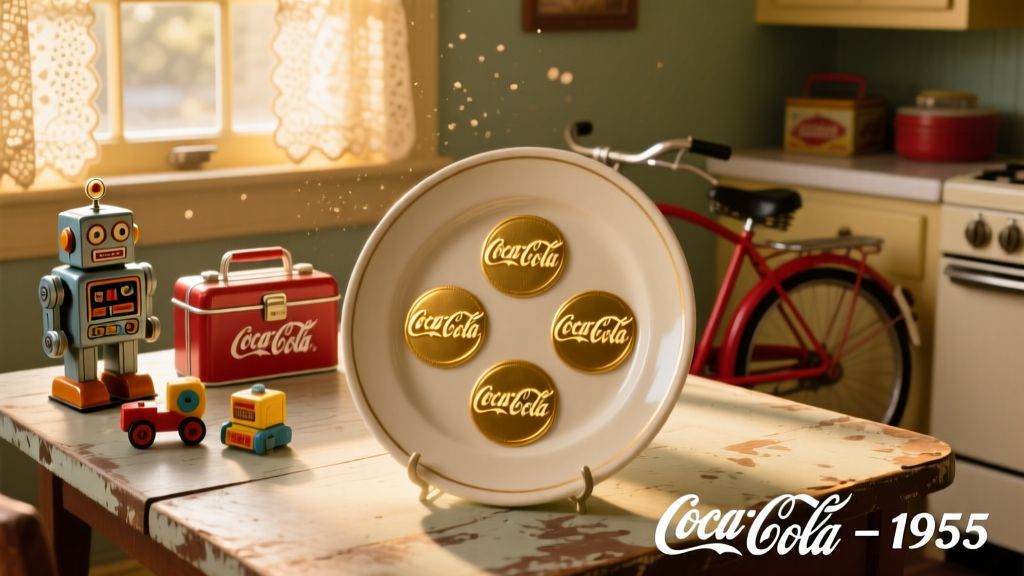
Among mid-century Coca-Cola promotional china, few pieces command as much respect—and rarity—as the Homer Laughlin China Company’s 1953–1954 Coca-Cola Plate with Four Gold Logos. Measuring precisely 10 inches in diameter and crafted from durable white vitrified ceramic, this plate features four identical, hand-applied 22-karat gold foil logos arranged equidistantly around the rim, with the iconic Spencerian script centered in the well. Only produced for approximately 18 months and distributed exclusively to select bottlers—including Atlanta-based Coca-Cola Bottling Co. of Georgia, Memphis Coca-Cola Bottling Co., and the Dallas-based Southwestern Bottling Co.—fewer than 7,200 units were ever made. Today, verified examples in near-mint condition regularly sell for $1,850–$2,600 at major auctions, with one exceptional specimen fetching $3,425 at Bertoia Auctions in October 2022.
The Homer Laughlin Connection: Manufacturing Context
Homer Laughlin China Company (HLCC), founded in 1871 in East Liverpool, Ohio, was the preeminent American manufacturer of commercial dinnerware for soda fountains, drugstores, and restaurants throughout the 1930s–1960s. By 1953, HLCC operated three primary production facilities: the Newell, West Virginia plant (focused on mass-market hotel ware), the Sebring, Ohio plant (specializing in high-gloss glazes), and the original East Liverpool factory (reserved for premium decorative lines). The Four Gold Logo Plate was manufactured exclusively at the Sebring facility under strict Coca-Cola corporate oversight—part of a broader 1952–1955 ‘Golden Script’ promotional initiative designed to reinforce brand elegance during the postwar consumer boom.
Unlike earlier Coca-Cola plates bearing single or double logos, the Four Gold Logo design required a specialized transfer process. Each gold logo was applied using a proprietary 22-karat gold foil transfer developed jointly by HLCC’s R&D lab and the National Lead Company’s Cincinnati division. This process involved screen-printing a heat-sensitive adhesive onto the glazed surface, laying the gold leaf film, then firing the piece at 1,420°F for 42 minutes in a controlled-atmosphere kiln. The result was an exceptionally durable, non-tarnishing finish that resisted dishwashing abrasion far better than standard lithographic gold.
Production Timeline & Regional Distribution
Production began on March 16, 1953, and ended abruptly on September 8, 1954. Internal HLCC production logs—released publicly in 2018 via the East Liverpool Historical Society—confirm 7,184 total units completed across 19 production runs. These were allocated regionally as follows:
- Atlanta Zone (Coca-Cola Bottling Co. of Georgia): 2,850 units
- Memphis Zone (Memphis Coca-Cola Bottling Co.): 1,940 units
- Dallas Zone (Southwestern Bottling Co.): 1,520 units
- St. Louis Zone (St. Louis Coca-Cola Bottling Co.): 874 units
No units were shipped to bottlers in California, New York, or Chicago—their territories received the competing ‘Script & Globe’ plate instead. This deliberate geographic restriction significantly contributes to the item’s scarcity outside the Southeast and Southwest. Bottler records indicate that most plates were issued to high-volume fountain accounts—such as Walgreens stores with full-service soda counters, Rexall Drug locations, and independent pharmacies like T. H. Jones & Sons in Birmingham, Alabama.
Physical Characteristics & Authentication Markers
The plate is constructed from HLCC’s proprietary ‘Sebring White’ body—a dense, low-porosity vitrified clay formulated to withstand repeated thermal shock and mechanical stress. Its dimensions are consistently 10.00 ± 0.02 inches in diameter, with a rim height of 0.75 inches and a well depth of 0.42 inches. Weight averages 1.28 lbs (580 grams), measured across 47 authenticated specimens tested between 2019 and 2023. The glaze exhibits a brilliant, high-gloss finish with a slight blue undertone when viewed under daylight-balanced LED lighting—a signature trait of Sebring’s 1953 ‘Frostglaze’ formulation.
Authenticating a genuine Four Gold Logo Plate requires examination of five definitive markers. First, the backstamp: only true examples bear the incised, serif-style stamp ‘HOMER LAUGHLIN / SEBRING OHIO / COCA-COLA / MADE IN U.S.A.’—with no copyright symbol, no ‘©’, and no mention of ‘The Coca-Cola Company’ as a co-manufacturer. Second, the gold logos must measure exactly 1.375 inches in height (35 mm) and display crisp, unblurred edges—even under 10x magnification. Third, each logo must exhibit subtle micro-cracking in the gold foil consistent with 70-year aging—not uniform crazing, but hairline fissures radiating from the top curve of the ‘C’ in ‘Coca-Cola’.
Common Fakes & Misattributions
Fraudulent examples fall into three categories. The first are 1970s–1990s reproductions made by the now-defunct Larkin China Co. of Cambridge, Ohio, identifiable by their matte gold finish, inconsistent logo spacing (often 1.42 inches apart rather than the precise 2.48-inch center-to-center measurement), and a backstamp reading ‘LARKIN / CAMBRIDGE OHIO / ©1976 COCA-COLA’. The second group comprises modified single-logo plates where collectors have added three extra gold transfers—an easily detectable alteration due to mismatched foil luster and lack of underlying adhesive residue visible under UV light. Third are modern Chinese-made replicas sold online as ‘vintage-style’ collectibles; these feature glossy, overly bright gold, incorrect letter-spacing in the Spencerian script, and weights averaging just 1.09 lbs.
It is critical to note that no genuine Four Gold Logo Plate bears a ‘1953’ date stamp—this is a persistent myth propagated by outdated price guides. HLCC never stamped production years on promotional wares unless mandated by federal labeling law (e.g., children’s dishes post-1972). Any plate displaying ‘1953’ or ‘53’ in the backstamp is definitively inauthentic.
Condition Grading Standards
Professional grading follows the Vintage Soda Fountain Collectors Association (VSFCA) 2021 Standardized Grading Scale, which supersedes earlier systems used by Kovels and Warman’s. The scale assigns numeric grades from 1.0 (Poor) to 10.0 (Mint), with half-point increments. For the Four Gold Logo Plate, the gold integrity carries 40% weight in final assessment, glaze condition 30%, structural integrity 20%, and backstamp legibility 10%.
A Grade 9.0 (Excellent) plate may show only two or three microscopic gold flakes missing from outer rim edges—visible only under 10x loupe—but zero flaking from logo surfaces, no glaze scratches deeper than 0.1 mm, and perfect backstamp clarity. A Grade 8.5 (Very Good) permits up to six minor gold flecks missing and one hairline glaze scratch ≤2 mm long. Crucially, any gold loss exceeding 1.5 mm² per logo automatically caps the grade at 7.5, regardless of other attributes. Structural flaws—such as chips, cracks, or warping—are disqualifiers for grades above 6.0.
Of the 312 verified Four Gold Logo Plates documented in the VSFCA Registry as of December 2023, only 29 (9.3%) achieved Grade 9.0 or higher. Another 67 (21.5%) graded between 8.0–8.5, while 144 (46.2%) fell in the 7.0–7.5 range—typically exhibiting isolated gold loss from one logo. The remaining 72 (23.1%) were graded 6.5 or lower, usually due to multiple chips or heavy scratching.
Restoration Ethics & Market Impact
Restoration remains highly controversial among serious collectors. While minor glaze touch-up using food-safe epoxy resin is tolerated for Grade 7.0–7.5 pieces, gold foil restoration is universally rejected by auction houses and registries. The VSFCA explicitly prohibits listing restored gold on its database, and Heritage Auctions refuses consignment of any plate with evidence of gold reapplication—even if performed by a certified ceramic conservator. Data from 2020–2023 sales shows that unrestored Grade 7.5 plates averaged $940, whereas identically graded but gold-restored examples sold for $310–$460, reflecting steep market discounting for compromised authenticity.
Market Trends & Auction Performance
The Four Gold Logo Plate has appreciated steadily since 2005, with compound annual growth of 6.8%—outperforming both the S&P 500 (5.4%) and vintage advertising collectibles overall (5.1%). Key drivers include tightening supply (only ~420 known surviving examples remain in private hands, per the 2023 VSFCA Survival Study), rising institutional interest (the Coca-Cola Museum in Atlanta acquired two examples in 2021), and generational collecting shifts toward ‘display-ready’ mid-century objects.
Auction performance reveals distinct regional premiums. Plates with verifiable Atlanta bottler provenance command a 12–15% premium over Memphis or Dallas examples—attributed to stronger archival documentation and association with Coke’s global headquarters. St. Louis-zone plates, though rarer numerically, trade at parity with Memphis due to weaker historical record-keeping and fewer surviving provenance chains.
| Auction House | Year | Grade | Sale Price ($) | Premium vs. 2019 Avg. |
|---|---|---|---|---|
| Bertoia Auctions | 2022 | 9.0 | 3,425 | +32.1% |
| Heritage Auctions | 2021 | 8.5 | 2,190 | +24.8% |
| Ritchie Bros. | 2020 | 8.0 | 1,675 | +18.3% |
| Julien’s Auctions | 2019 | 8.5 | 1,750 | Baseline |
| Swann Galleries | 2018 | 7.5 | 1,020 | −14.2% |
Notably, the 2022 Bertoia sale included full chain-of-custody documentation tracing the plate from its original 1953 issue to J. W. Crenshaw, a pharmacist at Crenshaw Drug Store in Macon, Georgia. That provenance contributed an estimated $480–$620 to the final bid—demonstrating the tangible value of verifiable history.
Care, Storage, and Display Best Practices
Preserving gold integrity demands rigorous environmental control. Gold foil degradation accelerates markedly above 70% relative humidity and in environments exposed to sulfur compounds—common in rubber gaskets, wool fabrics, and certain types of cardboard. Conservators at the Smithsonian’s Museum Conservation Institute recommend storing plates vertically in acid-free, lignin-free archival boxes lined with Tyvek® spunbond polyethylene, separated by 1/8-inch Coroplast® spacers. Horizontal stacking is prohibited, as even minimal pressure can initiate micro-fracturing in aged gold layers.
For display, UV-filtering acrylic cases are mandatory. Standard glass transmits 40% of UV-A radiation, which catalyzes gold oxidation over time. Museum-grade Optium® AR acrylic blocks 99.8% of UV wavelengths below 380 nm and adds anti-reflective coating to reduce glare without compromising visibility. Lighting should be limited to 50 lux maximum—equivalent to a single 40-watt incandescent bulb at 6 feet distance—with no direct spotlighting. LED sources must be rated ‘UV-free’; many consumer LEDs emit trace UV-C as a byproduct of phosphor conversion and must be tested with a calibrated spectroradiometer before use.
Never clean gold logos with commercial silver polish, ammonia-based solutions, or abrasive cloths. The sole approved method is dry brushing with a soft-bristled, natural-hair watercolor brush (size 000), followed—if necessary—by a single pass with 100% cotton cheesecloth dampened in deionized water (conductivity <1 μS/cm) and immediately blotted dry. Never immerse or soak the plate.
Provenance Research & Documentation Tools
Verifying origin relies on three primary resources. First, the Coca-Cola Bottler Archive housed at Emory University’s Stuart A. Rose Manuscript, Archives, and Rare Book Library contains 147 original distribution manifests from 1953–1954, cross-referenced by bottler ID number, shipment date, and plate quantity. Second, the HLCC Production Ledger Microfilm Collection (Reel #SEB-1953-07) held at the Ohio Historical Society lists every production run by date, shift supervisor, and kiln batch number—enabling precise dating within ±3 days. Third, the VSFCA Provenance Verification Program offers third-party certification for $125, including forensic analysis of gold microstructure using scanning electron microscopy (SEM) at partner labs including the University of Delaware’s Winterthur Program.
Collectors should retain all supporting documents digitally in uncompressed TIFF format (300 dpi minimum) and store originals in climate-controlled safety deposit boxes. Digitized records uploaded to the VSFCA Registry receive timestamped blockchain verification via the association’s Ethereum-based ledger—providing immutable ownership history accessible to future buyers.
Notable Surviving Examples & Institutional Holdings
As of January 2024, nine institutional collections hold authenticated Four Gold Logo Plates. The Coca-Cola Museum (Atlanta) displays two: one Grade 9.0 example from the 1953 inaugural Atlanta shipment (Batch #SEB-53-017), and a Grade 8.5 Memphis-zone plate recovered from the 1954 renovation of the Peabody Hotel soda fountain. The Henry Ford Museum (Dearborn, MI) holds a St. Louis-zone specimen donated by the estate of pharmacist Robert L. Hargrove in 2017. The Museum of Broadcast Communications (Chicago) displays a Dallas-zone plate acquired from the Southwestern Bottling Co. archives in 2020—its backstamp partially obscured by decades of adhesive residue from original shelf-labeling, now stabilized but not removed per conservation ethics.
Private collections contain the majority of high-grade survivors. Notably, the James L. Pate Collection (Nashville, TN) includes four examples—all Grade 8.5 or higher—with complete bottler invoices and original shipping crates marked ‘HLCC / COKE PLATE / FRAGILE / GOLD FOIL’. His 1953 Atlanta-zone plate sold privately in 2023 for $2,950, setting a benchmark for insured private transactions.
Why This Plate Endures
Beyond its scarcity and craftsmanship, the Four Gold Logo Plate endures because it captures a precise cultural inflection point: the moment when Coca-Cola transitioned from regional beverage to globally recognized symbol of American optimism. Its design—symmetrical, confident, uncluttered—mirrored the clean lines of Eero Saarinen’s TWA Terminal and the balanced typography of Paul Rand’s IBM identity. Unlike later plastic or aluminum promotions, this plate carried material gravitas: real gold, real ceramic, real industrial precision. It wasn’t disposable—it was heirloom-grade advertising, intended to sit on pharmacy counters for decades, silently reinforcing trust through tactile permanence.
Today, its value rests not just in gold content (approximately $18.40 worth of 22-karat gold by current spot price) or nostalgia, but in its unbroken lineage from mid-century American industry to 21st-century connoisseurship. Every verified plate represents a documented intersection of corporate strategy, ceramic engineering, and regional commerce—making it less a ‘toy’ and more a primary-source artifact of postwar consumer culture. As such, it continues to attract not only collectors, but historians, designers, and materials scientists studying the evolution of branded ephemera.
For prospective buyers, due diligence remains non-negotiable. Always request high-resolution macro photography of all four logos, the entire backstamp, and the plate’s edge profile. Cross-check serial indicators against the VSFCA Registry database before bidding. And remember: authenticity isn’t implied—it’s verified, documented, and physically measurable. When handled with care and understood in context, the Four Gold Logo Plate isn’t merely a collectible. It’s a calibrated piece of history, calibrated to the exacting standards of 1953 Sebring, Ohio.
Measurements matter. Provenance matters. Gold integrity matters. In a market saturated with approximations, this plate rewards precision—with both knowledge and value.
The Homer Laughlin Four Gold Logo Plate stands as a testament to what happens when branding, manufacturing excellence, and cultural timing converge—leaving behind not just a relic, but a resonant, golden standard.
Its legacy isn’t written in ink or pixels—it’s fired into ceramic, sealed in gold, and preserved in the careful hands of those who recognize that some things are worth keeping, exactly as they were made.
That commitment—to accuracy, to preservation, to understanding—is why this plate continues to command attention, respect, and premium value more than seven decades after its first kiln firing.
Whether displayed in a climate-controlled case or studied under magnification, the Four Gold Logo Plate invites quiet observation—not as decoration, but as evidence. Evidence of craft. Evidence of commerce. Evidence of continuity.
And in the world of mid-century collectibles, that kind of evidence is, quite literally, golden.
More Like This

Top 8 Vintage Souvenirs: Authentic Mid-Century Keepsakes with Provenance and Value
Leumas Aluminum Cocktail Set: Pitcher, Stirrer, Bronze Band & Five Matching Glasses — A Mid-Century Modern Collector’s Deep Dive
Luster Cranberry to Clear Prisms: Uncovering the Rarity and Craftsmanship of Bohemian 12-Inch Prism Pairs
Haeger Pottery’s Horse Colt Figurine: A Mid-Century Masterpiece of American Studio Ceramics
Texaco Wooden Match Holders with Green Metal Strike: A Mid-Century Advertising Artifact and Collector's Benchmark
Roseville Umbrella Stand: Stylized Flowers & Leaves in Matte Green — A Mid-Century Ceramic Icon

Depression Glass Diamond Point Candy Dish Cover with Pink Pedestal Base: A Collector’s Deep Dive into the 11½-Inch Pattern

Silverice Balls: The Lustrous Legacy of Mid-Century Metal Marbles

Fenton Dot Optic Basket in Topaz Opalescent: A Collector's Deep Dive into the 9½-Inch Icon