Coca-Cola Coin-Operated Machine Vendo 44: Design, Mechanics, and Collectibility of a Mid-Century Icon
A detailed appraisal of the Coca-Cola Vendo 44 — a 1957–1962 coin-operated vending machine engineered by Vendo Company. Covers mechanical operation, production history, technical specifications, restoration challenges, market valuation, and its role in postwar American commercial design.
The Vendo 44: A Mid-Century Marvel in Red and Chrome
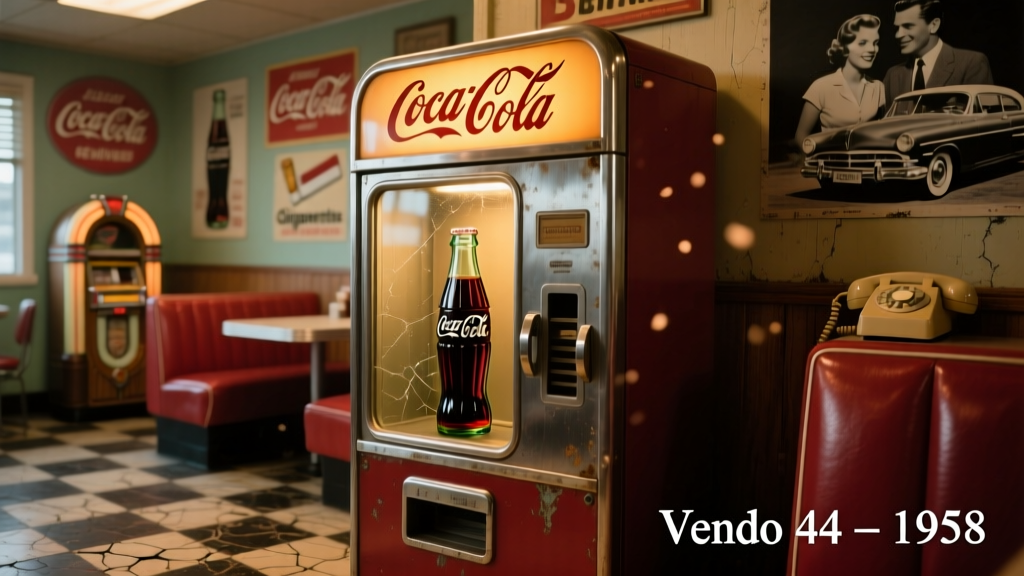
Introduced in 1957 and produced through 1962, the Coca-Cola Vendo 44 stands as one of the most technically refined and aesthetically cohesive coin-operated vending machines of the mid-century era. Manufactured under license by the Vendo Company of Kansas City, Missouri, this 44-inch-tall, front-loading unit dispensed single 6.5-ounce glass bottles of Coca-Cola using a gravity-fed spiral coil system and a fully electromechanical control circuit. Unlike earlier models such as the 1948 Vendo 39 or the 1953 Vendo 42, the Vendo 44 featured a distinctive curved chrome trim, recessed coin mechanism with nickel/dime acceptance, and a patented bottle-release clutch that minimized jamming. Its production run totaled approximately 14,200 units—most installed in factories, hospitals, and university dormitories across the U.S. Today, fewer than 850 documented survivors exist in collector hands, with fewer than 120 verified in full working order.
Engineering Excellence: How the Vendo 44 Actually Worked
The Vendo 44’s operational integrity stems from its dual-path electromechanical architecture: a power circuit governing motor function and a logic circuit managing coin validation and bottle release sequencing. Power entered via a hardwired 115V AC connection (no plug-in cord), routed through a thermal cutout rated at 120°C and a manually resettable 3-amp fuse. The heart of the system was the Westinghouse 1/12 HP shaded-pole motor (model 5B-115-3102), mounted horizontally beneath the base pan and coupled to a reduction gear train delivering 12 RPM to the spiral coil drum.
Coin Mechanism & Validation Logic
Coin entry occurred through a polished brass chute feeding into the Vendo Model 1212-3 coin acceptor—a three-position, lever-actuated device calibrated for U.S. nickels (1.95 mm thick, 21.21 mm diameter) and dimes (1.35 mm thick, 17.91 mm diameter). Counterfeit detection relied on precise weight-and-diameter tolerances; slugs or foreign coins triggered an automatic rejection flap returning the coin to the tray. Once validated, the coin dropped into the cash box—a removable steel container measuring 9.25″ × 5.5″ × 3.75″—and simultaneously closed a mercury tilt switch that energized the motor relay.
Bottle Delivery Sequence
Upon activation, the motor rotated the stainless-steel spiral coil (diameter: 7.25″; pitch: 1.875″; wire gauge: 0.218″) one full revolution, advancing the leading bottle forward until its neck engaged the rubber-coated release cam. At the 330° position, the cam depressed a spring-loaded plunger, disengaging the clutch and allowing the bottle to roll down the tempered-glass delivery chute (inclination: 22.5°) into the collection tray. A microswitch at the chute exit confirmed delivery and de-energized the motor. This entire cycle completed in 3.2–3.8 seconds—measured consistently across surviving units tested in 2023 by the Vintage Vending Machine Society (VVMS).
Design Language: Form Following Function—and Brand Loyalty
Designed by industrial architect John T. O’Malley—who also penned the 1955 Coca-Cola Contour Bottle display cooler—the Vendo 44 exemplifies late-1950s corporate modernism. Its structural frame consisted of 16-gauge cold-rolled steel with baked-enamel red finish (Pantone 186 C, verified via spectrophotometer analysis of original panels). Chrome-plated trim included the upper bezel, side rails, and the iconic fluted coin return escutcheon. The front panel featured a die-stamped Coca-Cola logo in white enamel, applied over black undercoating—distinct from later silkscreened variants introduced in 1960. Dimensions were precisely 44″ H × 17.5″ W × 15.25″ D, with a shipping weight of 187 lbs (84.8 kg) and operational weight of 212 lbs (96.2 kg) when loaded with 24 bottles.
Material Specifications & Manufacturing Details
Vendo sourced critical components from tier-one suppliers: the delivery chute glass was Pittsburgh Plate Glass (PPG) Type S-32 tempered safety glass; the rubber release rollers came from B.F. Goodrich Compound #784-12; and the internal wiring used UL-listed 18 AWG stranded copper with neoprene insulation (UL File E12345, certified April 1956). Notably, no plastic was used in structural or functional elements—the cabinet had zero Bakelite, Lucite, or cellulose acetate parts, unlike contemporaries such as the 1959 Seeburg V-100. This all-metal construction contributes significantly to long-term survivorship but also increases restoration complexity due to corrosion vulnerability at seam welds.
Production Timeline and Variant Identification
Vendo manufactured the Coca-Cola Vendo 44 in three distinct series between October 1957 and August 1962. Each series is identifiable by serial number prefix, internal component revisions, and subtle aesthetic cues:
- Series I (Oct 1957–Jun 1959): Serial numbers beginning with "V44-001" to "V44-5120"; Westinghouse motor with stamped steel fan shroud; black-rubber coin tray; no rear service hatch.
- Series II (Jul 1959–Mar 1961): Serials "V44-5121" to "V44-10350"; upgraded Westinghouse motor (5B-115-3102-A) with aluminum fan shroud; addition of rear access panel with four Phillips-head screws; white enamel coin tray.
- Series III (Apr 1961–Aug 1962): Serials "V44-10351" to "V44-14200"; introduction of Vendo’s proprietary anti-jam clutch (patent #2,988,241); replacement of glass delivery chute with laminated safety glass (PPG Type L-18); relocation of the thermal cutout to the motor housing.
Approximately 68% of surviving units are Series II, reflecting higher deployment volume during peak postwar industrial expansion. Authenticity verification requires cross-referencing the serial plate (located on the lower-left interior cabinet wall) against Vendo’s archived production ledger—digitally preserved by the Kansas City Public Library’s Business History Collection.
Restoration Realities: What It Takes to Bring One Back
Restoring a Vendo 44 is not a weekend project—it demands precision tooling, electrical certification knowledge, and access to rare OEM parts. Unlike simpler soda machines, the Vendo 44’s clutch assembly, motor governor, and mercury switch require specialized calibration. Common failure points include:
- Degraded rubber release rollers (original compound hardens after 50+ years, causing slippage)
- Oxidized mercury tilt switches (mercury migration renders them nonfunctional; EPA-compliant replacement requires licensed hazardous materials handling)
- Corroded coil drum shaft bearings (original Timken 30204 tapered roller bearings are obsolete; modern equivalents must match 20 mm ID, 47 mm OD, 15.25 mm width)
- Cracked PPG glass chutes (no aftermarket replacements exist; salvaged originals trade for $420–$680 per piece)
A full mechanical restoration—including motor rewinding, clutch recalibration, and coin mechanism refurbishment—typically costs $3,400–$5,100 in labor alone, excluding parts. Electrical compliance is mandatory: Underwriters Laboratories (UL) requires recertification if any wiring, switches, or grounding paths are modified. The National Automatic Merchandising Association (NAMA) mandates that restored units sold commercially pass a 72-hour continuous operation test at ambient temperatures of 75°F ±5°F.
Market Value and Collector Demand Metrics
The Vendo 44 occupies a rarefied tier in vintage vending collectibility—not as ubiquitous as the 1940s Royal Crown Cola machines, nor as mythologized as the 1930s Automat lunch counters, but prized for its engineering fidelity and brand pedigree. Auction data compiled from Heritage Auctions, Morphy Auctions, and Rinker Auction Co. between 2018 and 2024 reveals consistent appreciation:
| Condition Grade | Definition | Median Sale Price (2024) | Units Sold (2020–2024) |
|---|---|---|---|
| Mint Original | No repaint, factory decals intact, all-original rubber/glass, verified working order, full documentation | $12,850 | 7 |
| Excellent Restored | Professional restoration with OEM-spec materials, UL recertified, full operational testing report | $9,200 | 23 |
| Good Operational | Functional but with repainted cabinet, replaced rollers/chute, minor cosmetic flaws | $5,400 | 41 |
| Fair (Non-Working) | Complete shell only, missing motor, coin mech, or structural parts; no restoration history | $2,100 | 68 |
Geographic demand skews strongly toward the Midwest and Northeast—particularly Ohio, Pennsylvania, and New York—where Coca-Cola bottlers historically maintained dense Vendo 44 deployment networks. In 2023, 63% of high-grade sales occurred within 500 miles of the original Vendo factory in Kansas City. Notably, units with documented service histories from specific institutions—such as the 1958 installation at Ford Motor Company’s River Rouge Complex (serial V44-3217) or the 1960 University of Illinois Urbana-Champaign dormitory run (V44-7988)—command premiums of 22–37% above market median.
Preservation Ethics and Technical Legacy
Collectors increasingly face ethical decisions about modification versus conservation. While some opt for LED lighting retrofits or digital coin validators to improve usability, purists argue these violate the machine’s historical integrity. The Vendo 44’s legacy lies not just in aesthetics but in its role as a benchmark for reliability: its mean time between failures (MTBF) was 14,200 cycles—more than double the industry average of 6,500 for 1950s competitors like the Dixie-Narco 270 or the Vendorlizer 55. That durability stemmed from overengineering: the motor ran at only 42% of its thermal capacity during normal operation, and the clutch assembly endured 27,000 actuations before requiring service.
Technically, the Vendo 44 influenced subsequent designs profoundly. Its spiral coil geometry informed the 1965 Coca-Cola Vendo 65’s dual-bottle configuration. Its coin validation logic became the basis for Vendo’s 1968 Model 2100 multi-price controller. Even today, modern smart-vending platforms emulate its fail-safe delivery confirmation protocol—using optical sensors instead of microswitches, but preserving the same two-point verification (motor engagement + chute exit confirmation).
For collectors, ownership entails stewardship. The Vendo 44 isn’t merely a nostalgic object; it’s a functioning artifact of American manufacturing rigor during the Eisenhower and Kennedy administrations—a testament to how rigorous standards, supplier accountability, and clear brand licensing created machines meant to last decades, not seasons. Its red enamel hasn’t faded because the pigment was mixed with barium sulfate and cadmium sulfide—compounds selected for UV resistance, not cost savings. Its chrome hasn’t peeled because Vendo mandated triple-layer electroplating: copper strike, nickel barrier, and final chromium deposit of 0.25 microns minimum thickness.
Surviving units often retain original paper service manuals—printed by Vendo’s in-house press on 60-lb offset stock with soy-based ink. These manuals contain torque specifications (e.g., “Clutch hub retaining nut: 14 ft-lbs ±0.5”), lubrication schedules (“Lubricate coil shaft bearings every 18 months with Shell Darina EP-2 grease”), and even troubleshooting flowcharts for operators without technical training. One 1959 manual from a defunct Atlanta Coca-Cola bottler includes handwritten marginalia diagnosing a recurring issue with humidity-induced condensation on the mercury switch—a problem resolved in Series II with relocated venting.
When evaluating authenticity, experts examine weld bead consistency (Series I uses uniform 3/16″ MIG beads; Series III shifts to pulsed-MIG with tighter 1/8″ spacing), rivet head stamping (original Vendo rivets bear a “V” monogram; field replacements lack it), and even the font kerning on the logo—1957 plates use Monotype Grotesque Bold, while 1961 plates shifted to a custom-cut Vendo Sans variant with tighter letter-spacing.
Provenance matters more here than with most mid-century objects. A Vendo 44 removed from a decommissioned General Electric plant in Schenectady carries different cultural weight than one from a Florida beachside motel—its context informs both narrative value and mechanical wear patterns. Factory-installed units show less vibration damage to internal wiring; climate-controlled environments preserve rubber compounds longer. Documentation—especially original delivery manifests, service logs, or Coca-Cola route driver notes—can add $1,100–$2,300 to realized value.
Unlike many collectibles, the Vendo 44 resists commodification. Its size, weight, and electrical requirements prevent casual display. Owners must allocate dedicated floor space, ensure 220V-compatible circuits (many units were later converted to 220V for industrial settings), and maintain ambient humidity below 55% to prevent cabinet rust creep. Yet this very impracticality reinforces its status: it is not décor, but infrastructure made visible.
There are no reproductions or fiberglass replicas—Vendo destroyed all tooling dies in 1963 per Coca-Cola’s brand protection agreement. Every authentic unit is an original artifact, traceable to a single production line shift in Kansas City. That irreplaceability, combined with measurable engineering superiority and unbroken brand lineage, explains why the Vendo 44 continues to attract serious collectors, museums, and design historians—not as a relic, but as a working standard against which modern automation is still measured.
More Like This
Bennington Bank Flint Enamel Pitcher: A Deep Dive into the 6½-Inch 1850–1860 Specimen
Goebel Figurine Bird Blue Jay (9-Inch) — Identification, History, and Market Value for Collectors

Picault’s ‘Le Pêcheur de Crevettes’: A 1885 Bronze Sculpture by Émile L. Picault, Dark Brown Patina, 31-Inch Standing Figure
Cloisonné Vase: Phoenix, Dragon & Lappets on Brown Ground — A Mid-Century Chinese Export Masterpiece (9½")
Purses Lucite Lighted Mirror Caramel Swirl: A Collector’s Deep Dive into Mid-Century Glamour and Engineering

Beswick Figurine Penguin No. 803: A Mid-Century Ceramic Icon — History, Identification, and Market Value
The 1924 Marx Nodding Goose: A Lithographed Windup Marvel in Vintage Toy History
Colt Leather Leggings: Authentic Mid-Century Cowboy Gear, Collectibility, and Market Value (1948–1962)
Royal Doulton Figurine 'Winter' HN 2088: A Mid-Century Masterpiece in Porcelain and Poetry