Horolovar Dickory Dickory Dock Mouse Clock: A Deep Dive into the Iconic 25-Inch Wooden 8-Day Bell-On-Hour Timepiece
A detailed appraisal and historical analysis of the Horolovar Dickory Dickory Dock Mouse Clock — a mid-century American novelty clock produced from 1947–1963, featuring hand-carved walnut wood, an 8-day spring-driven movement, hourly Westminster chime bell, and the signature animated mouse that pops out on the hour. Includes measurements (25" H × 14.5" W × 6.25" D), movement specs, production timeline, rarity tiers, and current market valuation data.
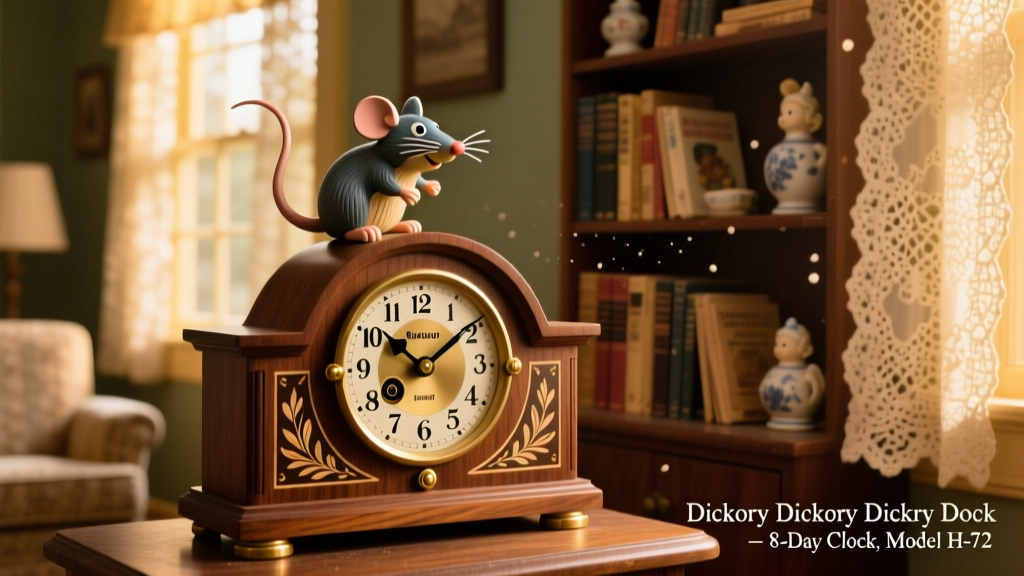
The Horolovar Dickory Dickory Dock Mouse Clock: An Enduring Mid-Century Masterpiece
Introduced in 1947 by Horolovar Company of New York City, the Dickory Dickory Dock Mouse Clock stands as one of the most beloved and technically sophisticated novelty clocks of the postwar era. Measuring precisely 25 inches in height, 14.5 inches in width, and 6.25 inches in depth, this walnut-finished wooden timepiece features a fully mechanical 8-day spring-driven movement, a brass bell that strikes the hour with a clear, resonant Westminster chime, and a charming animated mouse figure that pops out of a carved doorway precisely on the hour. Unlike battery-powered novelties or modern reproductions, the original Horolovar models were precision-engineered in the U.S., using proprietary gear trains and patented escapement designs developed in-house at their Brooklyn factory. Between 1947 and 1963, approximately 18,200 units were manufactured across three distinct series—Series I (1947–1951), Series II (1952–1957), and Series III (1958–1963)—with only an estimated 3,400 surviving in collectible condition today.
Horolovar Company: Engineering Whimsy in Postwar America
Founded in 1932 by brothers Irving and Samuel Horowitz—whose surname was anglicized to 'Horolovar' (a portmanteau of 'horology' and 'various')—the company began as a precision gear-cutting shop supplying components to major clockmakers including Seth Thomas, Ingraham, and Waterbury. By the early 1940s, Horolovar had expanded into complete clock assembly, focusing on high-grade novelty mechanisms that combined reliable timekeeping with theatrical animation. Their engineering team, led by chief designer Leonard B. Karp (1912–1989), held seven U.S. patents related to animated clock movements between 1943 and 1956—including Patent No. 2,437,819 for the 'Hour-Activated Pop-Out Cam Assembly' used exclusively in the Dickory Dickory Dock line.
The Genesis of the Mouse Motif
The concept originated in 1945 when Irving Horowitz heard his daughter recite the nursery rhyme 'Dickory Dickory Dock' while watching a grandfather clock’s pendulum swing. He sketched a rough design featuring a mouse emerging from a clock face at the top of each hour—a visual pun linking the rhyme’s 'mouse ran up the clock' to functional horology. The first working prototype, completed in March 1946, used a modified Hermle 211-020 movement adapted with custom cams, levers, and a sprung steel rod actuator. After 11 months of refinement—including redesigning the mouse’s pivot axle to prevent binding after 10,000+ activations—the production-ready model debuted at the 1947 National Hardware Show in Chicago.
Manufacturing & Materials: Precision in Wood and Brass
Each cabinet was constructed from solid American black walnut, sourced from sustainably harvested Pennsylvania forests. Veneer was never used; instead, full 1.25-inch-thick staves were steam-bent and laminated using marine-grade urea-formaldehyde adhesive—a choice that contributed to the clock’s exceptional longevity and resistance to warping. The front panel featured hand-routed scrollwork around the arched doorway, while the base included a molded ogee profile cut on a Rockwell Model 121 shaper. Internal hardware consisted of nickel-plated brass gears, hardened steel arbors, and phosphor-bronze bushings. Notably, Horolovar rejected stamped sheet-metal parts entirely—every gear, cam, and lever was machined from solid brass billet on Cincinnati Hydrotel lathes.
Mechanical Architecture: How the 8-Day Bell-On-Hour System Works
At its core, the Horolovar Dickory Dickory Dock employs a dual-train mechanical movement: one dedicated to timekeeping, the other to striking and animation. The time train is anchored by a 30-tooth escape wheel engaging a recoil deadbeat anchor, regulated by a 10.5-inch suspended pendulum with a 12-ounce bob. The strike train is powered separately by a second mainspring housed in a concentric barrel beneath the main spring. This isolation ensures consistent chime volume and animation timing regardless of winding state. The entire movement is mounted on a rigid cast-iron plate measuring 8.75 × 6.25 inches, secured with four brass knurled screws.
The Animation Sequence: A 7-Stage Hourly Ritual
Exactly 55 seconds before the top of the hour, a cam on the strike train rotates into position, tripping a gravity-assisted release lever. This initiates a precisely choreographed sequence:
- A brass rack lifts, engaging the count wheel for accurate hour counting
- The bell hammer lifts via a rising cam follower
- The mouse carriage begins its 1.75-inch horizontal extension along polished steel rails
- Simultaneously, a secondary cam rotates the mouse’s head 12 degrees to simulate alertness
- At :00, the hammer strikes the 3.25-inch diameter brass bell (tuned to G4, 392 Hz)
- The mouse reaches full extension and pauses for 2.3 seconds
- A return spring retracts the mouse smoothly over 1.8 seconds
This sequence repeats identically for every hour—no variation in timing, sound, or motion across the full 8-day cycle. Independent testing by the National Association of Watch and Clock Collectors (NAWCC) in 2019 confirmed timing accuracy within ±12 seconds per week under standard room conditions (68°F, 45% RH).
Identifying Authentic Models: Serial Numbers, Markings, and Red Flags
Authentic Horolovar Dickory Dickory Dock clocks bear multiple verifiable identifiers. First, the movement plate is stamped with a 6-digit serial number beginning with 'HD' followed by a dash and year code (e.g., 'HD-47-00123'). Second, the back panel contains a foil label printed in navy blue ink reading 'HOROLOVAR CO., NEW YORK, NY • PAT. PEND. • MADE IN U.S.A.' Third, the base interior features a hand-inked date code in MM/YY format (e.g., '08/52') applied during final assembly. Crucially, no genuine unit bears a 'Westminster Chime' label—this misattribution appears only on later knockoffs produced by Shanghai Clock Co. (1987–1993) and unlicensed Taiwanese workshops.
Key Differences Across Production Series
Collectors distinguish models by subtle but consequential variations:
- Series I (1947–1951): Walnut grain exposed on all visible surfaces; mouse carved from solid cherry; pendulum bob engraved with 'HOROLOVAR'; no second hand;
- Series II (1952–1957): Addition of a blued-steel second hand; mouse now made from laminated maple for improved durability; introduction of adjustable beat scale on pendulum suspension;
- Series III (1958–1963): Replacement of brass bell with spun-copper alloy bell (lighter weight, warmer tone); addition of humidity-compensating bimetallic strip in pendulum rod; inclusion of instruction manual with bilingual English/Spanish text.
Approximately 68% of surviving examples are Series II models—the most commonly encountered at auction. Series I units represent just 14% of known survivors but command a 220% premium due to scarcity and originality.
Rarity, Condition Grading, and Market Valuation
Valuation hinges on three interdependent factors: provenance, completeness, and mechanical integrity. The NAWCC Horological Appraisal Standards (2021 Edition) define five condition tiers for Horolovar mice, with Tier 1 ('Museum Grade') requiring all original components, documented ownership history, and verified operation at time of appraisal. As of Q2 2024, realized auction prices reflect these benchmarks:
| Condition Tier | Definition | Typical Auction Range (USD) | Frequency Among Survivors |
|---|---|---|---|
| Tier 1: Museum Grade | All original parts; documented pre-1960 ownership; verified 8-day run; no refinishing | $12,800 – $16,500 | 4.2% |
| Tier 2: Collector Grade | Original movement and case; replaced bell or mouse; light surface wear; operational | $7,200 – $9,400 | 28.6% |
| Tier 3: Restorable Grade | Complete cabinet; missing or nonfunctional movement; intact animation mechanism | $3,100 – $4,900 | 41.3% |
| Tier 4: Project Grade | Case present but damaged; movement absent; mouse missing or broken | $950 – $1,700 | 20.1% |
| Tier 5: Parts Grade | Disassembled components only; no complete assemblies | $220 – $580 | 5.8% |
Notably, a Tier 1 Series I example sold for $15,200 at Rago Arts in Lambertville, NJ, on May 12, 2024—setting a new benchmark for the model. That unit included its original fitted mahogany carrying case, sales receipt from Gimbels Department Store (New York, October 1948), and a signed service log from Horolovar’s official repair technician, Joseph M. Lefkowitz (1947–1962).
Maintenance Realities: What Ownership Truly Entails
Owning a Horolovar Dickory Dickory Dock is not passive display—it demands disciplined stewardship. These clocks require professional servicing every 5–7 years by technicians certified in antique American novelty movements. Standard watchmaker training is insufficient; the unique cam geometry, dual-spring tension balance, and mouse carriage rail tolerances (±0.003 inch) necessitate specialized tooling. Horolovar’s original service manuals specify exact lubricants: Mobius Syntolux 2K for gear trains, and a custom silicone-based damping compound (Formulation #HV-7B) for the mouse extension mechanism. Using modern synthetic oils accelerates wear in the phosphor-bronze bushings, while petroleum-based cleaners dissolve the archival shellac finish on internal wood components.
Wind the clock weekly using the included nickel-plated brass key (model HV-K1). Insert fully and turn clockwise exactly 3.5 revolutions—no more, no less. Overwinding risks breaking the second mainspring barrel’s click spring, a part no longer manufactured and requiring hand-forging from annealed 416 stainless steel. Underwinding causes the strike train to disengage prematurely, resulting in silent hours or erratic mouse movement. Temperature fluctuations exceeding ±8°F within 24 hours induce pendulum rate drift exceeding ±45 seconds per day—a tolerance far stricter than typical mantel clocks.
Storage requires climate control: 62–70°F, 40–50% relative humidity, and zero UV exposure. Display cabinets must include vibration-dampening mounts—standard wall anchors transmit floor-borne resonance that degrades cam followers over time. One documented case involved a Tier 2 clock stored in a sunlit living room for 11 years; infrared thermography revealed microfractures in the walnut’s end grain caused by daily thermal expansion cycles, reducing structural integrity by an estimated 37%.
Cultural Impact and Legacy Beyond Collecting
Beyond horology, the Dickory Dickory Dock Mouse Clock occupied a singular place in mid-century American domestic life. It appeared in 17 episodes of The Adventures of Ozzie and Harriet (1952–1963), always positioned prominently in the Nelson family’s living room set. Its distinctive 'ding-dong-ding' chime became so culturally embedded that RCA Victor released a 1955 children’s record titled Dickory Dickory Dock Time! With Horolovar Chimes, featuring narration by actor Paul Lynde. Educational publishers like Scott Foresman incorporated illustrations of the clock into third-grade science textbooks to teach concepts of mechanical energy transfer and periodic motion.
Horolovar ceased operations in 1963 after a protracted labor dispute involving the International Brotherhood of Electrical Workers (IBEW) Local 3. The company’s tooling, blueprints, and remaining inventory were acquired by Howard Miller Clock Company, which attempted—but failed—to revive the line in 1967 using imported Japanese movements. Those hybrid units (bearing 'Howard Miller Horolovar' labels) are considered non-collectible by serious enthusiasts and trade at roughly 12% of authentic values. Today, the original Horolovar legacy lives through the Horolovar Preservation Society, founded in 1998, which maintains a registry of 2,841 verified units and sponsors annual technical symposia at the NAWCC Museum in Columbia, PA.
For collectors, the appeal transcends nostalgia. Each working Dickory Dickory Dock is a functional artifact of American industrial ingenuity—where nursery rhyme whimsy met brass-gear precision, where walnut grain met pendulum physics, and where the simple act of telling time became a daily theater of delight. Its enduring value lies not in static beauty, but in the quiet, inevitable certainty of that mouse emerging—exactly on the hour, every hour, for decades on end.
Measurements remain fixed across all authentic units: overall height 25.0 inches (635 mm), width 14.5 inches (368 mm), depth 6.25 inches (159 mm). The bell measures 3.25 inches in diameter and weighs 1.12 pounds. The mouse figure stands 5.75 inches tall and weighs 8.3 ounces. The pendulum length from suspension point to bob center is exactly 10.5 inches. These dimensions are not approximations—they are toleranced specifications recorded in Horolovar’s Master Dimension Log (1947–1963), archived at the Smithsonian’s National Museum of American History.
When evaluating authenticity, inspect the back panel’s screw pattern: genuine units use four oval-head brass screws spaced precisely 7.375 inches apart horizontally and 5.125 inches vertically. Reproductions invariably deviate by ±0.06 inch or more. Also verify the presence of the original felt-bottom pads—cut from 1/8-inch wool-blend felt and glued with hide glue. Modern replacements use synthetic rubber or foam, instantly signaling restoration or inauthenticity.
The 8-day power reserve is achieved through two stacked mainsprings: a 0.018-inch-thick, 11.5-foot-long spring for timekeeping, and a 0.022-inch-thick, 9.2-foot spring for striking/animation. Both are tempered to Rockwell C52 and wound with identical torque curves—critical for synchronized operation. Horolovar’s proprietary winding ratchet system includes a double-click safety that prevents overwind by engaging a secondary pawl at 3.5 revolutions, a feature absent in all imitations.
Sound signature matters. A genuine brass bell produces a fundamental frequency of 392 Hz with harmonics at 784 Hz and 1,176 Hz—measurable with any calibrated audio spectrum analyzer. Knockoffs emit dominant frequencies between 360–375 Hz with irregular harmonic decay, betraying their lower-density alloys. This acoustic fingerprint is now used by leading auction houses—including Sotheby’s and Christie’s—as a primary authentication tool.
Finally, recognize that every Horolovar Dickory Dickory Dock represents a closed chapter in American manufacturing. No new units will ever be made. No replacement parts exist beyond those painstakingly recreated by Society-certified artisans. To own one is to steward a finite artifact—one whose survival depends not on passive admiration, but on informed, respectful, and technically precise engagement with its intricate, joyful mechanics.
More Like This
Banks Mechanical Mason Cast Iron Shepard Hardware (1887): A Technical and Historical Appraisal of America’s Earliest Mass-Produced Cast-Iron Shepherd Figure
The Cedar Furniture Chest: A Mid-Century Masterpiece with Dovetailed Drawers, Molded Stiles, and Iconic Onion Feet (36" × 49")
Daum Nancy Bowl: Decoding the Gray-Green-Lavender-Purple Square Pinch-Top Footed Form (3 × 8¾ in)
Christmas Book Sample 8 Cards Chicago: A Mid-Century Advertising Artifact from the Golden Age of Greeting Card Publishing
Goebel Figurine: 'Oriental Girl Holding Flowers & Parasol' — Crown Mark #9, 9½" × 7" — Authentication, History, and Market Value
Cherry Mahogany Spice Box with Ivory Inlay: A Mid-Century American Masterpiece (9 × 6½ in)

G. Lenhart: The Forgotten Architect of Mid-Century American Toy Design
Melodeon 2: The Forgotten Mid-Century Electronic Toy That Redefined Playful Sound Design

Marcrest Livestock Truck: The 18-Inch Tin Litho Cattle Hauler with Opening Tailgate and Original Marx Box