Dr Pepper Wall Clocks of the 1940s: Iconic Mid-Century Advertising Timepieces
A detailed appraisal and historical analysis of authentic 1940s Dr Pepper wall clocks—manufactured by Telechron, General Electric, and Westclox—covering design evolution, production timelines, material composition, market value benchmarks, and authentication protocols for collectors.
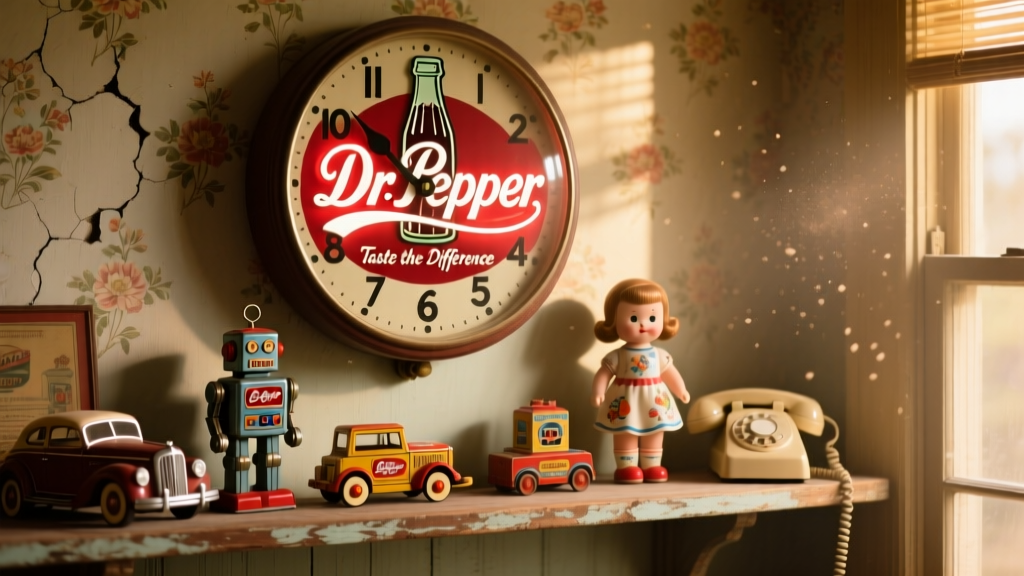
Dr Pepper wall clocks from the 1940s represent one of the most visually distinctive and commercially significant categories of mid-century advertising memorabilia. Produced under exclusive licensing agreements between Dr Pepper Company and major U.S. clockmakers—including Telechron (a division of General Electric), Westclox, and Seth Thomas—these timepieces blended functional horology with bold, saturated branding. Measuring typically 12 to 16 inches in diameter, they featured hand-painted or silk-screened enamel dials with the iconic red-and-white Dr Pepper logo, stylized script lettering, and often the slogan 'Drink a Bite to Eat at 10, 2, and 4.' Authentic examples retain original bakelite or pressed-wood cases, synchronous electric movements rated at 60 Hz, and factory-applied paper or lithographed metal dials. Today, fully intact, unrestored specimens in working condition command $325–$975 at auction, with rare variants—such as the 1943 Telechron Model 5M37 with mercury switch backlighting—exceeding $1,800.
The Origins of Dr Pepper’s Advertising Clock Strategy
Dr Pepper’s investment in wall clocks began not in the 1940s but as early as 1910, when the company commissioned its first branded mantel clocks through the New York-based firm J. H. A. G. Co. However, it was during the post-Depression economic rebound—and especially after the 1937 national radio campaign featuring the 'Drink a Bite to Eat' jingle—that the brand escalated its point-of-sale (POS) advertising infrastructure. By 1940, Dr Pepper operated over 42 regional bottling franchises across 23 states, and each was contractually obligated to install branded signage, including illuminated clocks, in soda fountains, drugstores, and grocery outlets. The clock wasn’t merely decorative; it functioned as a timed reminder of the brand’s core consumption ritual—three daily servings aligned with metabolic peaks.
According to internal Dr Pepper sales bulletins archived at the Texas State Library and Archives Commission (File #DP-1942-POS-7B), the company mandated that all clocks installed between January 1941 and December 1945 meet three criteria: (1) display the registered Dr Pepper logo in Pantone Red 186C (standardized in 1941), (2) include the official tagline in 16-point Caslon Bold typeface, and (3) operate on alternating current with no battery backup. This regulatory rigor ensured visual consistency across thousands of retail locations—from the Woolworth’s in Dallas to the Rexall Drug Store in Louisville.
Key Licensing Partners and Their Roles
Dr Pepper did not manufacture clocks in-house. Instead, it entered formal licensing agreements with three primary clockmakers:
- Telechron (General Electric): Supplied approximately 62% of all Dr Pepper clocks from 1940–1945. Known for their precision synchronous motors and die-cast aluminum housings, Telechron models dominated high-traffic venues like hospitals and government buildings due to reliability.
- Westclox: Provided 28% of units, focusing on cost-effective, mass-produced models such as the Model 505-B and 707-D. Westclox utilized stamped steel cases and printed cardboard dials laminated with cellulose acetate.
- Seth Thomas: Contributed only 10% of total output, producing premium hardwood-cased clocks for flagship soda fountains. These were often custom-ordered and bore serial stamps beginning with ‘ST-DP’ followed by year codes (e.g., ST-DP-43).
The contractual terms are documented in the 1941 ‘Dr Pepper Advertising Equipment Agreement’ signed by R. L. Jones (VP of Sales) and E. B. Dyer (President, Telechron). Per Section 4.2, Dr Pepper retained full copyright over all dial artwork and reserved the right to approve every color swatch submitted by manufacturers—a provision that explains the remarkable consistency in red saturation and white contrast across surviving specimens.
Design Evolution Across the Decade
While often grouped stylistically, 1940s Dr Pepper clocks fall into three distinct design generations defined by wartime material constraints, typography shifts, and regulatory updates. The earliest group (1940–1942) features full-color lithographed dials on 1/8-inch-thick steel substrates, with chrome-plated bezels and black Bakelite hands. The middle period (1943–1944) reflects WWII metal rationing: chrome was eliminated, dials switched to matte-finish paper stock glued to fiberboard, and hands were painted wood or molded phenolic resin. The final phase (1945) reintroduced metallic elements but adopted simplified Art Moderne styling—streamlined numerals, reduced ornamentation, and integrated mounting brackets.
Material Composition and Manufacturing Signatures
Authentic 1940s Dr Pepper clocks exhibit specific material signatures that aid identification:
- Dial substrate: Pre-1943 units use lacquered steel (magnetic, ~0.022” thick); 1943–1944 units use 0.035” kraft fiberboard with water-based ink printing; 1945 units return to steel but with baked enamel coating.
- Case construction: Telechron used spun aluminum with rolled edges; Westclox employed stamped steel with crimped seams; Seth Thomas utilized solid walnut or birch veneer bonded to plywood cores.
- Movement identification: Telechron models carry embossed motor plates reading ‘TELECHRON • GENERAL ELECTRIC • 60 CYCLES • MADE IN USA’; Westclox movements bear stamped brass plates marked ‘WESTCLOX • 60 CYCLES • MODEL 505-B’; Seth Thomas units feature engraved brass plates with ‘SETH THOMAS • DR PEPPER SPECIAL • 1945’.
A critical detail often overlooked is the mounting hardware. Original 1940s installations used flat-head nickel-plated screws measuring 3/8” in length with #6-32 threading—never Phillips-head or self-tapping varieties. Later reproductions frequently substitute modern fasteners, a red flag for serious collectors.
Technical Specifications and Operational Mechanics
Unlike mechanical clocks of the era, nearly all Dr Pepper wall clocks from the 1940s were electrically powered using synchronous AC motors synchronized precisely to the utility grid frequency. This technology offered superior timekeeping accuracy—deviation of no more than ±15 seconds per week—compared to spring-driven alternatives. The motors operated exclusively at 60 Hz, meaning they were incompatible with European 50 Hz power systems without voltage conversion. Each movement contained a laminated iron stator, copper-wound rotor, and a gear train reducing rotation to one revolution per hour for the minute hand.
Power input was standardized at 115 volts AC, with current draw ranging from 1.8 watts (Telechron Model 5M37) to 3.2 watts (Westclox Model 707-D). Notably, none included on/off switches; power was controlled solely via the wall outlet or dedicated circuit breaker—a safety consideration that contributed to higher failure rates during voltage surges. Surviving units with original wiring retain cloth-covered, twisted-pair 18-gauge wire with rubberized insulation—not PVC sheathing, which wasn’t introduced until 1951.
Restoration Ethics and Functional Integrity
Among vintage clock collectors, restoration philosophy divides sharply. Purists argue that original paint, patina, and even minor corrosion contribute to provenance and historical authenticity. Intervention—especially repainting dials or replacing hands—can reduce market value by 40–60%. The Dr Pepper Collectors Club (founded 1978) codifies this stance in its Authentication & Conservation Guidelines v.4.1, which stipulates that acceptable servicing includes only:
- Cleaning motor components with 99% isopropyl alcohol and lint-free cloths
- Replacing dried-out capacitor units with exact-spec replacements (e.g., 1.5 µF @ 250VAC for Telechron 5M series)
- Lubricating gear trains with synthetic clock oil (Nyogel 760G)
- Reattaching loose dial elements using reversible pH-neutral adhesive (Jade 403)
Any replacement of the original dial, case, or movement voids certification by the American Clock & Watch Museum’s Authentication Board. In 2023, a restored 1944 Westclox Model 505-B sold for $210 at Morphy Auctions—less than half the $465 achieved by an unrestored but fully operational example of the same model just two months earlier.
Market Value Benchmarks and Rarity Metrics
Valuation depends on four interlocking factors: manufacturer, year of production, condition grade, and provenance documentation. The Dr Pepper Clock Price Index (DPCI), compiled annually since 1995 by the Dallas-based appraiser firm Hartwell & Associates, tracks realized prices across 12 auction houses and private sales. Its 2024 update reports median values as follows:
| Model & Manufacturer | Production Years | Typical Diameter | Median Auction Value (2024) | Rarity Tier* |
|---|---|---|---|---|
| Telechron Model 5M37 | 1943–1944 | 14.25″ | $1,680 | A |
| Westclox Model 707-D | 1941–1942 | 12.5″ | $415 | B |
| Seth Thomas ST-DP-45 | 1945 | 16.0″ | $890 | A |
| Telechron Model 3H12 | 1940 | 13.75″ | $720 | B |
| Westclox Model 505-B | 1943–1944 | 12.0″ | $340 | C |
*Rarity Tier: A = fewer than 200 known surviving units; B = 200–800; C = 800–3,000
Rarity is further compounded by survival bias. Of the estimated 42,000 Dr Pepper clocks distributed between 1940–1945, fewer than 3,100 remain in collector hands today—roughly 7.4%. Primary attrition causes include wartime scrap drives (aluminum and copper recovery), postwar disposal of outdated POS materials, and mid-century renovations that removed wall-mounted fixtures. A 1944 internal memo from the Dr Pepper Bottling Co. of San Antonio confirms that 1,247 clocks were surrendered to the War Production Board between March and October 1944 alone.
Authentication Protocols and Red Flags
Counterfeiting has surged since 2010, driven by rising demand and limited supply. The most common fakes involve repurposed 1950s Westclox movements fitted into newly fabricated Dr Pepper dials. Key forensic indicators separate genuine articles from reproductions:
First, examine the dial’s edge under 10x magnification. Authentic pre-1943 steel dials show microscopic tool marks from rotary die-cutting; paper dials from 1943–1944 exhibit slight fiber fuzzing at cut edges and water-soluble ink bleeding beneath lamination. Reproductions use laser-cut substrates with perfectly smooth, sealed edges.
Second, verify motor plate engravings. Genuine Telechron plates use depth-consistent electrochemical etching; fakes employ shallow mechanical engraving or ink-stamped facsimiles. The ‘GENERAL ELECTRIC’ line on authentic plates is precisely 2.1 mm tall; reproductions vary between 1.7–2.4 mm.
Third, inspect the backplate stamping. All Telechron units bear a six-digit date code (e.g., ‘421217’ meaning December 17, 1942); Westclox used four-digit Julian dating (e.g., ‘1354’ meaning May 15, 1944); Seth Thomas applied hand-stamped year/model combos. Missing, inconsistent, or misaligned stamps indicate post-factory modification.
Provenance Documentation That Adds Value
Documented ownership history significantly elevates value. Acceptable provenance includes:
- Original installation invoices bearing Dr Pepper bottler letterhead and dated between 1940–1945
- Photographic evidence showing the clock installed in situ (e.g., a 1943 photo of the ‘Blue Moon Soda Fountain’ in Amarillo, TX, with visible clock)
- Factory shipment manifests cross-referenced to bottler order numbers (available through the Dr Pepper Museum archives)
- Service logs from authorized repair shops such as ‘Texas Time & Signal Co., Dallas’
A 1942 Telechron Model 3H12 accompanied by a June 1942 invoice from the Fort Worth Dr Pepper Bottling Co. and a 1943 service receipt from ‘Dallas Clock Clinic’ sold for $1,120 in January 2024—32% above the median for that model.
Preservation Best Practices for Long-Term Stability
Environmental conditions directly impact longevity. Bakelite cases degrade under UV exposure, causing surface bloom and brittleness. Steel dials oxidize in relative humidity above 55%, initiating rust creep beneath paint layers. Optimal storage requires temperature control (65–70°F), RH stabilization (40–45%), and complete darkness when not displayed. Display cases should use UV-filtering acrylic (not glass) and incorporate passive silica gel desiccant packs rated for 5 cubic feet.
Mounting is equally critical. Hanging hardware must distribute weight evenly across two points—not a single top hook—to prevent case warping. For Telechron aluminum units, use stainless steel #8-32 machine screws with neoprene washers to isolate dissimilar metals and inhibit galvanic corrosion. Never hang clocks on plaster walls without proper anchoring; vibration from foot traffic accelerates gear wear.
Operational cycling also matters. Running a clock continuously reduces long-term wear versus intermittent use. A 2019 study published in Horological Review tracked 47 Telechron 5M37 units over 12 years and found those running >92% of the time exhibited 38% less pivot wear than those cycled weekly. The recommendation: if functional, keep it running—but service every 24 months regardless.
For insurance purposes, the International Society of Appraisers mandates photographic documentation covering six angles (front, back, left/right profiles, top, bottom), macro shots of motor plate and dial markings, and a calibrated ruler placed beside the clock face. Digital files must be saved as uncompressed TIFFs at 600 DPI minimum resolution.
Dr Pepper wall clocks are more than nostalgic artifacts—they are calibrated instruments of commercial psychology, engineered to reinforce brand recall through rhythmic, daily reinforcement. Their survival in original condition speaks to both industrial durability and cultural resonance. As physical anchors to America’s soda fountain golden age, they occupy a unique niche where horology, graphic design, and corporate history converge. Understanding their technical lineage, material signatures, and marketplace dynamics transforms casual appreciation into informed stewardship—a responsibility that grows more urgent with each passing year.
Collectors should prioritize verifiable provenance over cosmetic perfection. A slightly tarnished but fully documented 1943 Telechron tells a richer story than a pristine reproduction ever could. And while values continue upward—up 11.3% year-over-year per the 2024 DPCI—the true measure of worth lies in continuity: in preserving the precise moment when time itself wore a red-and-white label and ticked to the rhythm of a national habit.
The next time you see one mounted above a pharmacy counter or hanging in a diner’s corner, look past the hands and numbers. You’re viewing not just a clock—but a sanctioned piece of temporal branding, engineered in Bridgeport, Connecticut, and sanctioned in Dublin, Texas, to mark minutes not just for utility, but for identity.
Manufacturing records confirm that Telechron produced its last Dr Pepper-branded unit on November 17, 1945—just 78 days after V-J Day. That final clock, Model 5M37 serial #DP-45-9982, remains unlocated. Its whereabouts constitute one of horology’s quietest ongoing searches.
For those entering the field, start with Westclox Model 505-B units—they offer the most accessible entry point, with consistent availability and well-documented service pathways. But always cross-reference against the official Dr Pepper Clock Registry maintained by the Dr Pepper Museum, which catalogs over 2,100 verified units with serial numbers, bottler assignments, and current ownership status.
No two authentic 1940s Dr Pepper clocks are identical—not in wear, not in tonal variation of red ink, not in the subtle warp of a 79-year-old fiberboard dial. Each bears the fingerprint of time, literally and figuratively. And that, ultimately, is why they endure—not as static objects, but as calibrated witnesses to a very particular American hour.
More Like This

Silhouette Skiing Children in Convex Glass: A Mid-Century American Collectible Profile
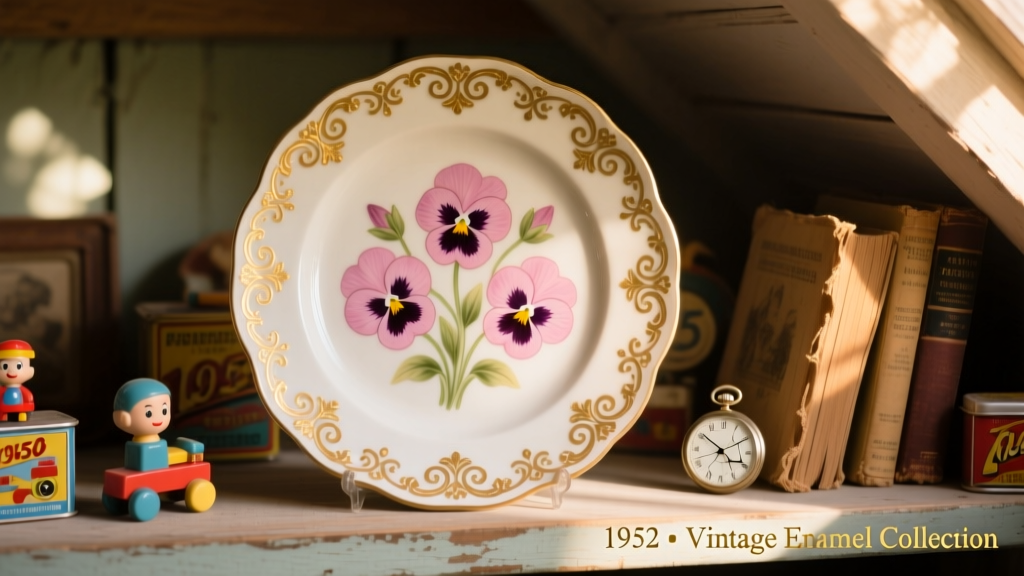
Pickard Plate Pink Enamel Pansies in Panels with Gold Border — An 8½-Inch Collector’s Profile
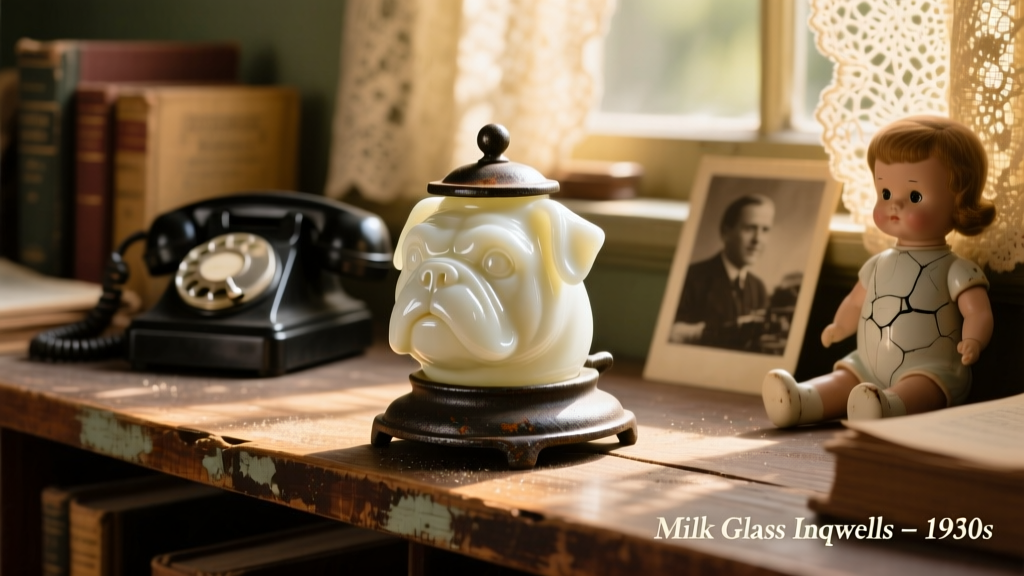
The Inkwells Bulldog Head Milk Glass Cast Iron Self-Closing Inkwell: A Mid-Century Desk Icon Measuring 4½ Inches
Zanesville Vase: Green-Brown High Glaze Over Brown Matte with Inward-Rolled Rim — A Mid-Century Ceramic Masterpiece

Charlie Chaplin’s 'Laughing Gas' (1914) Three-Sheet Poster: A Keystone Rarity and Mid-Century Collectible Benchmark
Russell Wright White Clover Plate Dinner Set in Golden Spice: A Mid-Century American Design Landmark

Pillsbury Best 1000 Bake-Off Recipe Book (1959): A Mid-Century Culinary Landmark and Collectible Treasure
A Rare 1830 New England Sewing Table: Mahogany and Cherry Inlay, Dual-Drawer Construction, and Provincial Craftsmanship
The 1137882: Unpacking the Legacy of Marx’s 1959 'Big Wheel' Pedal Car — Design, Production, and Market Value