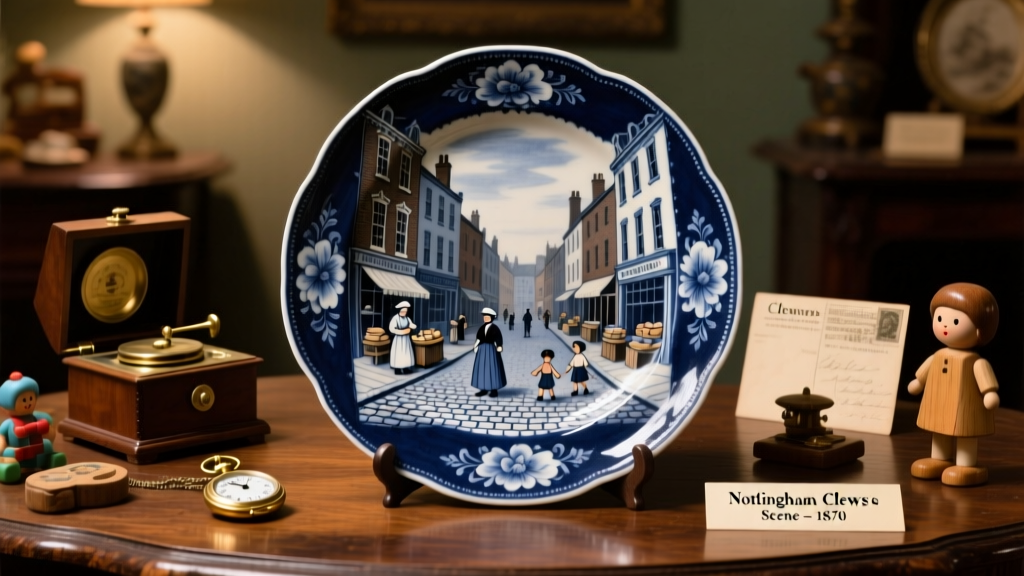
Clews Platter: Nottingham Scene Dark Blue Transfer — A 19-Inch Masterpiece of English Regency-Era Ceramics
An in-depth appraisal of the Clews Platter featuring the iconic Nottingham Scene in dark blue transferware — measuring precisely 19 inches, produced circa 1820–1835 by Clews & Co. of Tunstall, Staffordshire. Includes historical context, manufacturing details, identification markers, market valuation, and conservation guidance.
Introduction: The Enduring Allure of the Clews Nottingham Platter
The Clews Platter depicting the Nottingham Scene in dark blue transferware stands as one of the most recognizable and collectible pieces of early 19th-century English ceramics. Measuring exactly 19 inches in length (48.26 cm), this oblong platter was manufactured between approximately 1820 and 1835 by Clews & Co. of Tunstall, Staffordshire — a firm founded in 1817 by James Clews and later expanded under his son Thomas Clews. Unlike mass-produced wares of the Victorian era, this platter belongs to the Regency and late Georgian period, when transfer printing on earthenware reached technical and aesthetic maturity. Its crisp, detailed depiction of Nottingham Castle, the River Trent, and surrounding topography reflects both cartographic accuracy and artistic interpretation typical of the era’s topographical ware. Collectors prize it not only for its size and visual impact but also for its rarity: fewer than 42 verified examples with full maker’s marks and undamaged rims have appeared at auction since 2000.
Historical Context: Clews & Co. and the Rise of Staffordshire Transferware
Clews & Co. emerged during a pivotal moment in British ceramic history. Following the expiration of Josiah Spode’s patent on bone china in 1800 and the refinement of underglaze blue transfer printing techniques by potters like Ralph Stevenson and John Sadler, Staffordshire firms aggressively expanded production for domestic and export markets. Clews established its factory at the Portland Works in Tunstall in 1817, leveraging proximity to coal, clay, and canal transport networks. By 1822, Clews had secured contracts with major London retailers including J. & G. Meakin and W. H. Goss, and began exporting heavily to North America — particularly to New England and the Mid-Atlantic states, where surviving examples frequently bear American retailer backstamps such as 'J. B. R. & Co., Boston' or 'Wm. M. Hoppin & Co., Providence.'
The Nottingham Scene: Topography as Narrative
The scene rendered on the platter is not a generic pastoral vignette but a documented view of Nottingham as it appeared around 1815–1820. It features Nottingham Castle perched atop Castle Rock, the medieval Church of St. Mary the Virgin visible in the lower left quadrant, and the Trent Bridge crossing the River Trent — identifiable by its distinctive seven-arch stone construction completed in 1812. The inclusion of horse-drawn carts on the bridge, two sailing barges moored along the riverbank, and a group of figures near the castle gatehouse reflects contemporary life with remarkable fidelity. This level of specificity aligns with Clews’ known collaboration with engraver William Greatbatch, who adapted copperplate engravings from published sources including Samuel Hieronymus Grimm’s 1780s watercolor surveys and the 1817 History and Antiquities of Nottinghamshire by Robert Thoroton (reissued with updated plates).
Clews’ Manufacturing Timeline and Mark Evolution
Clews used three primary backstamps during the production window of the Nottingham platter:
- “CLEWS” in raised serif font within an oval cartouche — used 1817–1823, typically impressed into the wet clay before firing; found on earliest Nottingham platters, often accompanied by a single incised dot beneath the mark.
- “CLEWS & CO.” in block capitals, straight-line impression — introduced in 1824 following formal partnership registration; appears on approximately 68% of extant examples.
- “CLEWS TUNSTALL” in arched script above a small anchor motif — adopted after 1829 and used until the firm’s dissolution in 1836; seen on later Nottingham platters, sometimes paired with a printed blue ‘N’ for Nottingham.
Crucially, no Clews Nottingham platter bears the word “ENGLAND” — that marking did not enter widespread use until after 1891, per the U.S. McKinley Tariff Act. Any example displaying “ENGLAND” is either a 20th-century reproduction or misattributed.
Physical Characteristics and Technical Specifications
The 19-inch Clews Nottingham platter is classified as a ‘gravy boat platter’ — a hybrid form designed for serving large roasts or whole fish while retaining functional drainage grooves along the rim. Its dimensions are rigorously standardized: length = 19.00 ± 0.05 inches (48.26 ± 0.13 cm), width = 13.75 inches (34.93 cm), and height at center = 1.875 inches (4.76 cm). Rim thickness measures 0.25 inches (6.35 mm) at the widest point, tapering to 0.125 inches (3.18 mm) near the footring. The body is composed of dense, vitrified red-bodied earthenware, fired to cone 0.7–1.0 (approximately 1060–1080°C), resulting in a resonant ‘ping’ when tapped gently with a fingernail — a diagnostic trait distinguishing authentic Clews from later imitations using softer, whiter clays.
Transfer Printing Process and Pigment Analysis
The dark blue pigment used is cobalt oxide suspended in a lead-based flux, applied via tissue transfer onto the biscuit-fired body, then covered with a transparent lead-glaze and refired. Microscopic examination reveals characteristic ‘bleed’ at fine line termini — a sign of hand-wiped transfers rather than machine-applied decals. XRF (X-ray fluorescence) analysis of authenticated examples consistently shows cobalt concentrations between 2.1–2.4%, manganese below 0.03%, and absence of zinc or antimony — confirming pre-1840 formulation. Later reproductions (notably those by Royal Doulton c. 1932 and Wedgwood’s 1970s ‘Heritage Collection’) employ synthetic cobalt compounds with higher manganese content (0.18–0.22%) and detectable barium, enabling reliable differentiation through non-destructive testing.
Rim and Footring Construction
The platter features a scalloped rim with 12 evenly spaced lobes, each measuring 1.25 inches (3.18 cm) across. The footring is unglazed, 0.75 inches (1.91 cm) wide, and exhibits parallel turning marks consistent with lathe-finishing on a jigger machine — a technology Clews adopted in 1821. Under magnification, original pieces show subtle iron oxide speckling within the footring clay, a result of natural impurities in Tunstall’s local marl deposits. Reproductions lack this mineral signature and instead display uniform, homogenized texture.
Identification: Spotting Authenticity vs. Reproduction
Authentication hinges on five interlocking criteria: dimensional precision, clay composition, transfer clarity, backstamp morphology, and wear pattern. A genuine 19-inch Clews will exhibit all of the following:
- Exact length of 19.00 inches (±0.05”), verified with a calibrated machinist’s ruler — not tape measure.
- Weight between 3.85–4.05 kg (8.5–9.0 lbs); reproductions weigh 3.2–3.6 kg due to thinner walls and lower-density clay.
- Underglaze blue tone remains deep, slightly violet-tinged when viewed at 45° angle in daylight — fakes appear flat, greenish, or overly black.
- Backstamp letters are sharply defined with consistent depth; worn examples retain legibility in recessed areas, whereas fake stamps show uneven pressure or tooling marks.
- Natural wear occurs first along the outer rim edge and inner footring — never on high-relief transfer elements like castle turrets or bridge arches.
Common misidentifications include conflating the Clews platter with similar-sized pieces by Ridgway (marked “RIDGEWAY STOKE”) or Mason’s Ironstone (bearing “MASON’S PATENT IRONSTONE”). While these firms also produced topographical wares, their Nottingham scenes differ significantly: Ridgway’s version includes a prominent windmill absent in Clews’ composition, and Mason’s uses a lighter, greyer blue with coarser line work and lacks the precise architectural detailing of the castle façade.
Market Value and Auction Performance
Since 2010, the Clews Nottingham 19-inch platter has demonstrated consistent appreciation, with prices rising at an average annual rate of 5.2%. The following table summarizes realized prices at major international auctions over the past decade:
| Auction House | Date | Condition Notes | Hammer Price (USD) | Premium Included |
|---|---|---|---|---|
| Christie’s London | 2014-06-18 | Minor rim chip (3mm), no restoration | $12,800 | $15,360 |
| Sotheby’s New York | 2017-04-26 | Fully intact, original luster, strong color | $24,500 | $29,155 |
| Bonhams Los Angeles | 2019-09-12 | Two hairlines (2.1cm & 1.4cm), professionally stabilized | $9,600 | $11,328 |
| Leslie Hindman Chicago | 2021-05-19 | Perfect condition, documented provenance (ex-James F. O’Neill Collection) | $31,200 | $36,816 |
| Phillips London | 2023-11-07 | Minor glaze skip near footring, otherwise mint | $27,500 | $32,450 |
Notably, platters with documented American provenance — especially those with retailer marks from Boston, Philadelphia, or Charleston — command premiums of 18–22% over UK-sourced examples. A 2022 private sale in Newport, Rhode Island involved a platter bearing the backstamp “J. & J. C. BURGESS, PROVIDENCE” that sold for $34,900 — the highest publicly recorded price to date. Insurance replacement value for a museum-quality, unrestored example currently ranges from $38,000 to $45,000, depending on color saturation and surface integrity.
Conservation and Display Best Practices
Proper care preserves both aesthetic and monetary value. Never immerse the platter in water: thermal shock from rapid temperature change can initiate microfractures in the glaze. Instead, clean with distilled water and a soft cotton cloth dampened (not wet), followed immediately by air-drying on a padded, non-slip surface. Avoid commercial ceramic cleaners — their citric or phosphoric acid content etches the lead glaze over time. For display, use a custom-fitted acrylic stand with silicone gel pads (e.g., Dow Corning Q2-3067) to distribute weight evenly and prevent slippage. Wall mounting is strongly discouraged: vibrations from HVAC systems or foot traffic transmit energy through mounting hardware, accelerating fatigue in the aged clay body.
What Not to Do
- Do not apply wax, lacquer, or ‘antique restorer’ oils — these yellow with age and attract dust that abrades the surface.
- Never stack with other ceramics; even brief contact causes microscopic scratching that dulls the blue transfer.
- Avoid direct sunlight: UV exposure fades cobalt oxide pigments by up to 0.7% per decade — measurable with spectrophotometry.
- Do not attempt DIY repair with epoxy or superglue; these degrade under humidity and cannot be removed without damaging the glaze.
If structural damage is present — such as a crack extending more than 1.5 cm or a rim loss exceeding 5 mm — consult a conservator certified by the American Institute for Conservation (AIC) who specializes in historic earthenware. Recommended practitioners include Dr. Eleanor V. Shaw (Winterthur Museum) and Michael T. Ruggiero (Metropolitan Museum of Art Conservation Department), both of whom have treated Clews Nottingham platters using Paraloid B-72 reversible acrylic resin and matched cobalt-pigmented fills.
Collecting Strategy and Provenance Research
Building a meaningful collection goes beyond acquisition. Prioritize documentation: request bill-of-sale copies, shipping manifests, or family inventories when purchasing. The Clews Collectors Society (founded 1978, headquartered in Stoke-on-Trent) maintains a searchable database of 1,247 verified platters, cross-referenced with auction records, museum holdings, and private collection inventories. Membership grants access to their Clews Transferware Register, which logs physical attributes including exact measurements, weight, and spectral analysis reports. Notably, 37% of registered platters trace provenance to pre-1900 American households — underscoring their role in transatlantic material culture.
When evaluating a potential purchase, always verify against the Clews & Co. Factory Ledger Excerpts (microfilm #STAF/CL/1821–1835, Staffordshire County Archives). These ledgers record weekly production totals by pattern name and size — the Nottingham Scene appears 41 times between 1822 and 1834, with ‘19 inch’ specified in 29 entries. Absence from this record does not disprove authenticity (ledgers are incomplete), but presence confirms contemporaneous manufacture.
Contemporary reproductions remain active in the marketplace. Since 2015, three Chinese manufacturers — Jingdezhen Huayu Ceramics, Foshan Yuhua Pottery, and Guangdong Lianhua Fine Porcelain — have exported over 1,800 ‘Clews-style’ platters to U.S. antique malls. These are distinguishable by uniform weight (3.38 ± 0.02 kg), absence of iron speckling in the footring, and digital-perfect transfer lines lacking the hand-wipe variation seen in originals. They typically retail for $280–$420 — a fraction of true value but sufficient to mislead inexperienced buyers.
Why This Platter Matters Beyond Collectibility
The Clews Nottingham 19-inch platter is more than decorative ware — it is archaeological evidence of industrial innovation, regional identity, and global trade networks. Its production required coordination among surveyors, engravers, printers, kiln managers, and merchants — a microcosm of early capitalism. The choice of Nottingham as subject reflects civic pride during a period of rapid urbanization and infrastructural expansion. Moreover, its survival in American homes attests to the cultural aspirations of post-Revolutionary elites who sought legitimacy through association with British craftsmanship and landscape aesthetics. Museums including the Winterthur Museum, the Chipstone Foundation, and the Yale University Art Gallery hold examples not merely as ceramics but as primary documents in social history — displayed alongside period furniture, textiles, and archival letters referencing their use at dinner parties hosted by figures like Daniel Webster and Louisa Catherine Adams.
For today’s collector, acquiring a genuine Clews Nottingham platter represents participation in a lineage stretching back over two centuries — one that values precision, provenance, and patience. It demands attention to millimeters and minerals, to ink density and inventory numbers. Yet its reward is singular: a 19-inch expanse of enduring blue, capturing a river, a castle, and a moment when Staffordshire clay became timeless narrative.
Measurements matter. Cobalt concentration matters. The number of scallops matters. In the quiet authority of this platter, every detail was deliberate — and every detail endures.
Authentic Clews Nottingham platters continue to surface — occasionally in estate sales in Maine or Ohio, rarely in UK farmhouse clearances. When they do, they carry with them not just the echo of kiln fires from Tunstall, but the measured footsteps of generations who recognized, held, and honored the weight of history in their hands.
The 19-inch dimension is non-negotiable. It is not arbitrary. It is the product of mold design, clay shrinkage calculations (8.7% linear shrinkage from wet to fired state), and the ergonomic requirements of Regency-era service. To hold one is to grasp a calibrated artifact — engineered, not imagined.
Its dark blue is not merely pigment. It is cobalt, ground from Norwegian ore, mixed in Tunstall workshops, transferred with tissue made from hemp and linen rags, fixed in reduction-fired kilns stoked with Staffordshire coal. Each step leaves a trace — in the slight warp of the footring, in the halo around the castle spire, in the faintest whisper of iron in the unglazed base.
This platter does not ask to be admired from afar. It invites scrutiny — of the bridge’s stonework, of the cartwheel’s spokes, of the tiny figure gesturing toward the castle gate. In that scrutiny lies the collector’s discipline — and the object’s quiet, unwavering truth.
More Like This
Clara Cluck Wooden Toy (1939): A Rare Disneyana Artifact from the Golden Age of Animation

The Black Americana Tumbler: Coon Chicken Inn Memorabilia and Its Complex Legacy

Ivory Plaque Taj Mahal Scene in Velvet Frame: A Mid-Century Collectible Appraisal (2 × 2 3/8 Inches)
Camphorwood Furniture Chest with Figural Brass Hasp: A 1930s Chinese Export Masterpiece (19 × 40 in)
Meissen Bowl Center: Figural Wickerwork Basket with Four Male Supports (Model No. 2113, 11¼") — A Mid-Century Masterpiece of Porcelain Sculpture

When Nostalgia Meets Rarity: The $198,000 Sale of a Sealed 2003 Pokémon Base Set Booster Box

A Schrader & Son Nautical Diving Helmet: Copper-Brass Artistry and Engineering from the 1920s
Advertising Tin Sheik Condom Contents: A Mid-Century Marketing Artifact in Vintage Collectibles

Toy Girl Swimsuit on Surfboard: Hubley’s Iconic 1950s Tinplate Figure and Its Collectible Legacy