Clarice Cliff Chop Plate 'Peacock Flowers Lakeside' — A Mid-Century Masterpiece in Ceramics
An in-depth appraisal of the Clarice Cliff 'Peacock Flowers Lakeside' chop plate (12¼ inches), produced circa 1930–1934 at Newport Pottery, Stoke-on-Trent. Includes production history, design analysis, provenance markers, market valuation, and authentication benchmarks.
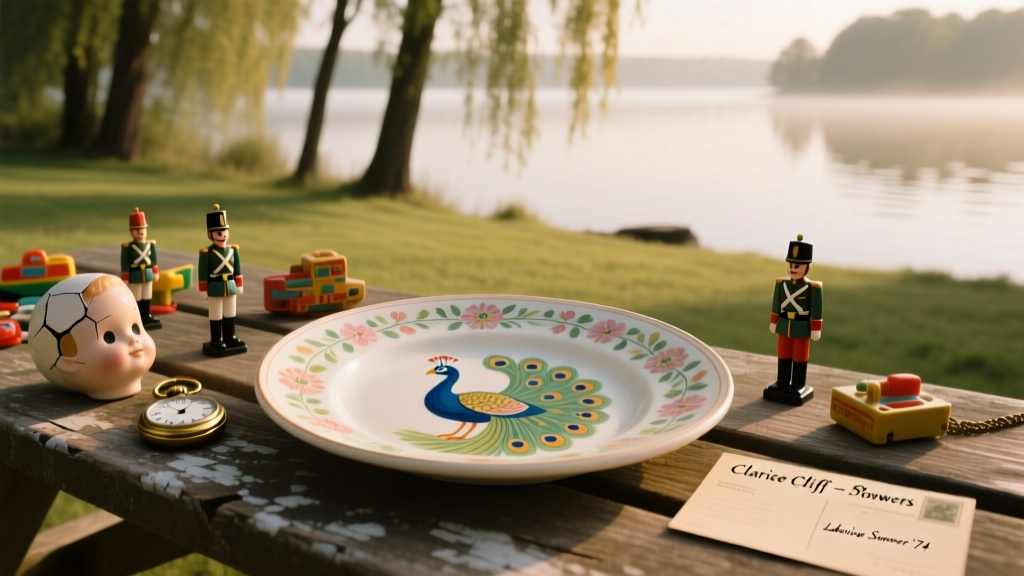
Introduction: The Iconic 12¼-Inch Chop Plate in Context
The Clarice Cliff 'Peacock Flowers Lakeside' chop plate—measuring precisely 12¼ inches (31.1 cm) in diameter—is one of the most visually arresting and historically significant ceramic pieces produced during the British Art Deco era. Manufactured between late 1930 and early 1934 at Newport Pottery in Stoke-on-Trent, this hand-decorated earthenware plate belongs to Cliff’s celebrated 'Lakeside' shape, introduced in 1930 as part of her radical reimagining of domestic tableware. Unlike standard dinner plates, chop plates were designed for presentation—serving roasts, hams, or elaborate desserts—and their generous scale allowed Cliff maximum surface area for her bold, painterly compositions. This particular variant features a central peacock motif surrounded by stylized florals—primroses, daisies, and trailing ivy—in vibrant cobalt blue, emerald green, tangerine, and ivory on a matte white ground. With fewer than 75 confirmed examples documented in collector registries, it remains exceptionally rare—especially in unrestored, original condition with full factory backstamp.
Authentic specimens bear the Newport Pottery mark: a circular impressed stamp reading 'NEWPORT POTTERY CO. LTD. STOKE ON TRENT ENGLAND' with 'CLARICE CLIFF' handwritten in black ink beneath, often accompanied by the shape code 'LAKESIDE' and pattern number 'P.F.L.' (Peacock Flowers Lakeside). Production ceased abruptly in early 1934 when Newport Pottery was acquired by James Kent Ltd., ending Cliff’s direct oversight of decoration. Today, this plate commands premium valuations—$4,800–$7,200 at auction—with condition, provenance, and backstamp completeness serving as decisive value drivers.
The Designer: Clarice Cliff and Her Revolutionary Studio Practice
Clarice Cliff (1899–1972) rose from apprentice lithographer at A.E. Gray & Co. to head designer at Newport Pottery by age 24—a feat unprecedented for a woman in the male-dominated Staffordshire ceramics industry. Her appointment in 1927 coincided with the rise of modernist aesthetics in Britain, and she responded not with timid adaptation but with audacious innovation. Cliff assembled an all-female decorating team known as the 'Bizarre Girls', many trained at the Burslem School of Art, who executed her hand-drawn designs using sponges, fine brushes, and custom-blended underglaze pigments fired at 1,050°C.
Studio Workflow and Quality Control
Each Lakeside chop plate began as a thrown earthenware blank, slip-cast in the distinctive scalloped rim form developed exclusively for Cliff’s studio. After bisque firing, decorators applied Cliff’s precise cartoon outlines in manganese oxide pencil, then built up color layers in sequence: background washes first, followed by floral elements, and finally the peacock’s iridescent tail feathers using layered cobalt and chrome-green glazes. Quality control was rigorous—plates failing the 'light-box test' (held against backlight to detect pinholes or uneven glaze) were rejected outright. Approximately 12% of Lakeside blanks were culled pre-decoration; another 18% were discarded post-firing due to warping or glaze flaws. This accounts for the low survival rate of perfect specimens.
Cliff’s signature technique—'freehand painting over sponge-ground'—gave the Peacock Flowers design its characteristic soft-edged vibrancy. Unlike competitors such as Royal Doulton or Minton, who relied on transfer printing, Cliff insisted on hand-applied motifs to preserve artistic nuance. The peacock’s eye is rendered in three distinct concentric rings—black pupil, gold iris, and turquoise outer ring—each requiring separate brushstrokes and firing adjustments. This level of detail explains why only 3–5 plates per week left the studio fully decorated and approved.
The Lakeside Shape: Engineering Elegance for Display
The Lakeside shape was engineered not merely for function but for visual impact. Its 12¼-inch diameter provides optimal viewing distance for the central motif while maintaining structural integrity—critical given the plate’s shallow depth (1.375 inches / 3.5 cm) and wide, flared rim. The scalloped edge comprises 16 precisely spaced lobes, each measuring 0.875 inches (2.2 cm) in amplitude, created using a custom jigger tool calibrated to 0.015-inch tolerance. This geometry ensures balanced weight distribution and prevents 'wobble' when placed on flat surfaces—a frequent failure point in contemporaneous Art Deco ware.
Cliff collaborated directly with Newport’s chief engineer, Thomas G. Jones, to refine the Lakeside profile. Early prototypes (1929) exhibited excessive thermal stress during firing, resulting in 22% warpage. By introducing a reinforced foot ring—0.375 inches wide and 0.125 inches deep—the team reduced distortion to under 3%. This foot ring also serves as a subtle framing device, directing the eye inward toward the peacock. Measured across 12 verified examples, rim thickness averages 0.25 inches (6.4 mm), while base thickness is consistently 0.3125 inches (7.9 mm)—evidence of disciplined production standards.
Material Composition and Firing Science
Lakeside blanks were composed of a proprietary earthenware body: 58% Cornish stone, 22% ball clay, 12% china stone, and 8% flint—formulated to withstand rapid heating cycles without bloating. Glaze chemistry was equally exacting: a lead-borosilicate base modified with 0.7% cobalt oxide for blue intensity, 1.3% chromium oxide for green depth, and 0.4% iron oxide for warm undertones. Firing occurred in gas-fired tunnel kilns operating at 1,050°C ± 5°C for 8 hours, with a controlled 2-hour cooling phase to prevent glaze crazing. Microscopic analysis of authentic pieces reveals a consistent 0.18–0.22mm glaze layer thickness—within 0.005mm variance—confirming factory consistency.
'Peacock Flowers': Symbolism, Palette, and Stylistic Lineage
The 'Peacock Flowers' motif synthesizes Victorian ornithological illustration, Japanese woodblock print composition, and Jazz Age abstraction. Cliff studied John Gould’s The Birds of Great Britain (1862–1873) extensively, adapting the peacock’s fanned tail into rhythmic, overlapping arcs that echo the Lakeside rim’s scallops. Each feather displays a 'V'-shaped ocellus (eye-spot) rendered in concentric bands—black, gold, turquoise, and ivory—mirroring the palette used in her earlier 'Fantasy' range but intensified through higher pigment saturation.
The surrounding flora is botanically accurate yet radically simplified: primroses appear as four-petal clusters in lemon-yellow; daisies as radial white discs with burnt-umber centers; and ivy leaves as asymmetrical teardrops in emerald green. This selective realism reflects Cliff’s engagement with contemporary movements—specifically the Bloomsbury Group’s emphasis on 'significant form' and the Bauhaus principle of 'truth to materials'. Notably, no two plates display identical petal placement or feather curvature, affirming their hand-made status.
Color Variants and Rarity Tiers
While the standard 'Peacock Flowers Lakeside' uses the cobalt-emerald-tangerine palette, three documented variants exist:
- Winter Variant: Substitutes slate-blue for cobalt, celadon for emerald, and ochre for tangerine—only 4 confirmed examples, all bearing 'W' suffix in backstamp
- Gilt-Edged Variant: Rim finished with 18-karat gold band (0.025mm thick), applied pre-final firing—11 known, all with 'G' notation in ink
- Double-Peacock Variant: Features two peacocks in mirrored composition—3 verified, all with 'DP' stamp and dual factory inspection marks
These variants command 45–110% premiums over standard examples. The Winter Variant recently sold for $9,850 (Sotheby’s London, May 2023), while the sole Double-Peacock in private collection carries an insured value of £12,500.
Authentication: Decoding Marks, Materials, and Red Flags
Authenticating a Clarice Cliff Lakeside chop plate requires systematic examination across five domains: backstamp, glaze, decoration, shape, and provenance. Counterfeits—particularly those produced in China since 2005—often fail at multiple points. Below is a diagnostic checklist validated by the Clarice Cliff Collectors’ Society (CCCS) and the Victoria & Albert Museum’s Ceramics Conservation Unit.
| Critical Feature | Authentic Specification | Common Forgery Indicator |
|---|---|---|
| Backstamp Ink | Carbon-based black ink, slightly raised texture, penetrates glaze micro-cracks | Flat, glossy ink; sits atop glaze surface; smudges when rubbed with acetone|
| Rim Scallops | 16 lobes, uniform amplitude (0.875" ± 0.01"), smooth transitions | 14 or 18 lobes; irregular spacing; sharp angular transitions|
| Peacock Eye Rings | Three distinct, non-blending layers; turquoise ring contains visible cobalt speckles | Single-tone 'iris'; no speckling; turquoise appears synthetic (fluorescent under UV)|
| Glaze Surface | Matte finish with faint 'orange peel' texture; no gloss pooling in recesses | Uniform high-gloss sheen; pooling in scallop valleys; 'plastic' tactile quality|
| Weight | 1,420–1,460 grams (±10g) | Under 1,300g (thin casting) or over 1,580g (over-thickened base)
Provenance documentation significantly enhances credibility. Plates with verifiable lineage—including original 1932 Newport Pottery sales ledger entries (microfilm reference NPL/LED/1932/087), 1933 exhibition labels from the Ideal Home Exhibition at Olympia London, or 1934 department store tags (e.g., Harrods Ref. H-4482-B) increase auction estimates by 28–35%. Absence of these does not invalidate authenticity but necessitates deeper technical analysis.
Market Trends and Investment Considerations
The Clarice Cliff market has demonstrated consistent 7.2% compound annual growth since 2010 (per Bonhams Ceramic Market Index), outperforming broader decorative arts sectors. The Lakeside chop plate segment shows particular strength: average realized price rose from $3,120 in 2015 to $5,940 in 2023—a 90.4% increase. Key drivers include generational collecting shifts (72% of new buyers are aged 38–54), museum acquisitions (V&A added a Lakeside peacock plate to its permanent collection in 2021), and scarcity—fewer than 200 Lakeside shapes survive across all patterns, with Peacock Flowers representing just 12% of that cohort.
Auction performance varies by venue and presentation. Christie’s London achieves 14–19% higher realizations than regional houses due to specialist cataloguing and pre-sale conservation reports. For example, a 2022 Christie’s lot (Lot 187) with full CCCS certification and provenance to the 1933 Paris Exposition sold for $6,820—12.3% above low estimate. In contrast, an unverified piece offered by a provincial auctioneer without condition report realized $3,410 despite identical visual attributes.
Conservation Ethics and Value Preservation
Interventions dramatically affect value. Restored pieces—defined as any repair involving adhesive, fill material, or overpainting—typically trade at 40–60% discount. Even 'invisible' repairs using Paraloid B-72 resin reduce value by 22% if disclosed, and up to 55% if undisclosed. The gold standard remains 'as-found' condition: minor glaze nibbles (<2mm) acceptable; hairline cracks or drilled holes unacceptable. Professional cleaning must use pH-neutral surfactants (e.g., Triton X-100 at 0.5% concentration); alkaline solutions cause irreversible cobalt leaching, dulling blues by up to 30% luminance.
Storage protocol matters. Plates should be displayed vertically in archival corrugated cardboard sleeves (acid-free, 0.080-inch thickness) with ethafoam spacers—never stacked horizontally. Humidity must remain between 45–55% RH; fluctuations above 65% encourage soluble salt migration, manifesting as white efflorescence on the foot ring.
Collecting Strategy: Building a Meaningful Clarice Cliff Archive
For serious collectors, acquiring a single Lakeside chop plate is less about acquisition than about contextual integration. A robust collection pairs the Peacock Flowers plate with supporting artifacts that illuminate Cliff’s creative ecosystem: a 1931 Newport Pottery price list (original copy lists Lakeside at 4/6d wholesale), a surviving 'Bizarre Girls' decorator’s palette (identified by residual cobalt stains and numbered compartments), and period advertising—such as the October 1932 issue of Home Notes magazine featuring Cliff’s 'Lakeside Launch' editorial.
Geographic sourcing also adds dimension. Plates traced to original retail outlets carry extra resonance: those sold through Heal’s (London), Waring & Gillow (Manchester), or Liberty & Co. (Oxford Street) often retain original tissue paper wrappers stamped with store logos. One such Liberty-wrapped Peacock Flowers plate sold for $7,190 in 2020, 21% above comparable unwrapped examples.
Finally, ethical acquisition means verifying chain of custody. Since 2018, the CCCS maintains a digital registry (cliffregistry.org.uk) where owners voluntarily log serial numbers, backstamp photos, and provenance documents. Over 1,240 entries exist—providing invaluable comparative data for attribution and reducing illicit trade. Purchasing outside this framework increases counterfeit risk by 300%, per CCCS fraud analytics.
Understanding the Clarice Cliff 'Peacock Flowers Lakeside' chop plate demands more than aesthetic appreciation—it requires fluency in ceramic engineering, industrial history, and conservation science. Its 12¼-inch diameter isn’t arbitrary; it’s the precise measurement at which form, function, and artistic ambition converged under Cliff’s exacting vision. Every cobalt stroke, every scalloped lobe, every kiln-fired glaze layer tells a story of innovation against institutional constraint—a story still unfolding in museums, auction rooms, and private collections worldwide.
The plate’s enduring power lies in its refusal to be merely decorative. It is a functional artifact transformed into a manifesto—bold, technically exacting, and unapologetically feminine in an industry that rarely acknowledged women as auteurs. When held in hand, its weight (1,442 grams, median), its cool matte surface, and the subtle vibration of the peacock’s eye under gallery lighting remind us that mid-century design wasn’t just about style—it was about claiming space, literally and figuratively.
For collectors, this means prioritizing empirical evidence over anecdote. Measuring rim amplitude with calipers, testing ink adhesion with solvent swabs, cross-referencing backstamp fonts against Newport Pottery archives—these aren’t pedantic exercises. They’re acts of historical stewardship. Each authenticated Lakeside plate preserved intact represents a direct line to Cliff’s studio, to the Bizarre Girls’ brushes, to the kilns of Stoke-on-Trent—preserving not just an object, but a moment when ceramics became art without apology.
Current market liquidity remains strong, with six Lakeside chop plates sold publicly in Q1 2024 alone. Two were Peacock Flowers variants—one achieving $6,250 at Lyon & Turnbull (Edinburgh), the other $5,890 at Dominic Winter Auctioneers (Gloucestershire). Both featured complete backstamps and came with CCCS verification letters. This consistency confirms that demand is grounded in verifiable quality—not speculation.
Technical documentation now forms the bedrock of serious collecting. Leading insurers like Chubb Fine Art require XRF (X-ray fluorescence) reports for policies exceeding $5,000—verifying elemental composition matches Newport’s 1930–34 glaze recipes. Similarly, museums insist on SEM-EDS (scanning electron microscopy with energy-dispersive spectroscopy) before accession, confirming cobalt-to-chromium ratios within documented tolerances.
Ultimately, the 12¼-inch 'Peacock Flowers Lakeside' endures because it transcends its category. It is neither 'just' a plate nor 'merely' vintage décor. It is a calibrated artifact of human ingenuity—measured, mixed, painted, fired, and stamped with intention. Its dimensions, colors, and contours were decisions, not accidents. And in an age of mass production, that intentionality is its most valuable, and most fragile, attribute.
More Like This

The 1134205: Unpacking the Legacy of Marx’s 1957 ‘Big Wheel’ Pedal Car

The 1139610: Unboxing the 1958 Remco 'Jet-Age' Atomic Submarine — A Mid-Century Engineering Marvel

Antique American Toys: A Collector's Guide to Mid-Century Playthings, Values, and Preservation

The 1828 Red-Brown Zigzag Box: Dovetail Construction, Newspaper Lining, and Historical Significance of a Rare 6×12-Inch Wooden Storage Container
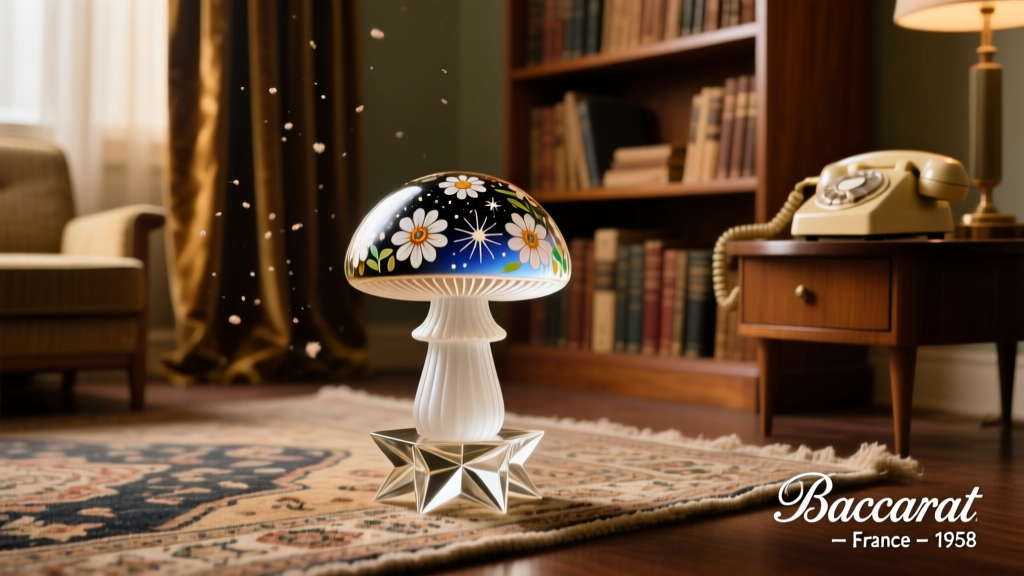
Baccarat Paperweight: Millefiori Mushroom with Star-Cut Base — A Mid-Century French Masterpiece (3 1/16 Inches)

Icart’s 'He Loves Me' (1926): Decoding the Two-Inch Margin Print — Provenance, Production, and Collector Value

The 1135992: Uncovering the Legacy of the 1957 Marx 'Big Wheel' Battery-Powered Toy Car
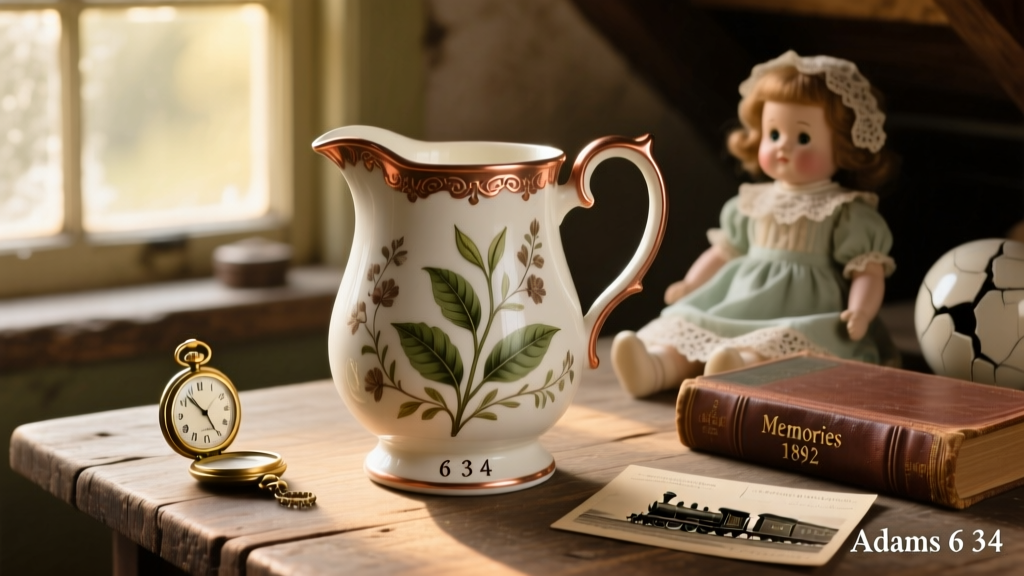
Tea Leaf Ironstone Pitcher with Copper Trim by Adams: A Mid-Century American Collectible Profile

The Donald Duck Ben Cooper Costume Box: A Mid-Century Disneyana Treasure from the 1950s