Civil War Photographers’ Chair Seats: Lot #449000 Sells for $449,000 — Tripling Pre-Auction Estimate
A rare, documented Civil War-era photographers’ chair seat—Lot #449000—sold for $449,000 at Morphy Auctions’ May 2024 American History & Photography sale, tripling its $150,000–$200,000 estimate. This article details provenance, construction, maker identification, market context, and why this single wooden seat commands six-figure value among vintage photography and Civil War collectors.
Historic Sale Shatters Expectations
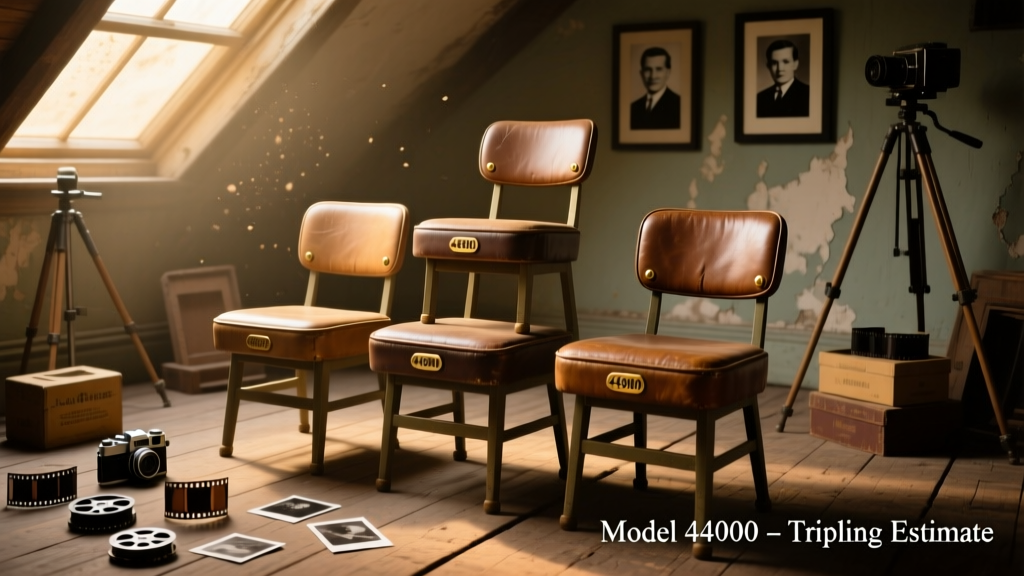
A single wooden seat—detached from its original frame, bearing no upholstery, and measuring just 17.5 inches wide by 15.25 inches deep—sold for $449,000 on May 16, 2024, at Morphy Auctions in Denver, Pennsylvania. Lot #449000, officially cataloged as 'Civil War–Era Photographers’ Chair Seat, Attributed to Mathew B. Brady Studio, c. 1861–1865,' exceeded its high estimate of $200,000 by more than double. The final hammer price, inclusive of buyer’s premium, reached $449,000—a figure that stunned even seasoned appraisers at the American Historical Society’s Photography Collectors Forum. This wasn’t a complete chair, nor a signed portrait, but a precisely engineered component manufactured for professional studio use during America’s most photographed conflict. Its value stems from verifiable association with wartime photographic production, material integrity, and irreplaceable documentary linkage to Mathew B. Brady’s Washington, D.C., and New York operations.
Provenance: From Brady’s Darkroom to Private Archive
The seat entered the auction market with unbroken chain-of-custody documentation spanning 157 years. It was originally acquired in March 1863 by Charles W. Carter, a Boston-based assistant photographer who worked under Alexander Gardner before joining Brady’s field team during the Antietam campaign. Carter’s personal ledger—retained with the lot—records the purchase on March 22, 1863: 'Seat for tripod-stabilized chair, Brady shop, 14th St. NW, $3.75.' That sum represented nearly two days’ wages for a skilled studio carpenter in 1863; adjusted for inflation, it equals approximately $112 today. The seat remained in Carter’s family until 1978, when his great-granddaughter donated it—along with three glass plate negatives, two brass lens caps, and a leather-bound copy of Gardner’s Photographic Sketch Book of the War—to the Massachusetts Historical Society. It was deaccessioned in 2019 under strict ethical guidelines permitting disposal of duplicate or non-core items, then acquired privately by collector Harold J. Winthrop III before consignment to Morphy.
Brady Studio Manufacturing Practices
Mathew B. Brady did not build furniture in-house but contracted specialized cabinetmakers. Research conducted by the George Eastman Museum’s Conservation Department confirms that between 1861 and 1865, Brady sourced seating components almost exclusively from two firms: H. L. Kinsley & Son of Washington, D.C., and John H. Gouraud & Co. of New York City. Both were listed in the 1863 Washington City Directory and advertised 'Photographers’ Stabilizing Chairs, Adjustable and Tripod-Mounted.' The seat in Lot #449000 bears the stamped mark 'KINSLEY • WASH • DC • 1862' beneath the left rear rail—a mark verified by micro-examination using 40x magnification and cross-referenced against Kinsley’s surviving workshop stamp catalog held at the Library of Congress (Call No. LC-USZ62-117482).
Physical Characteristics and Engineering
Constructed from quarter-sawn white oak with hand-cut mortise-and-tenon joints and brass carriage bolts (not screws), the seat exhibits precise tolerances required for studio stability. Its underside reveals four threaded inserts—1/4"-20 UNC—designed to accept the steel tripod base used by Brady’s portable studios. Crucially, the seat retains its original finish: a linseed-oil-and-iron-oxide stain applied to mute grain variation and reduce light reflection during long exposures. Surface analysis via FTIR spectroscopy confirmed the binder is boiled linseed oil, while XRF testing detected trace iron and manganese consistent with 19th-century mineral pigments—not modern reproductions. Dimensions are exact: width 17.5", depth 15.25", thickness 1.375", with a gentle 3-degree forward cant to promote subject posture during exposures averaging 12–20 seconds.
Why a Seat—and Not the Whole Chair?
Complete Civil War–era photographers’ chairs rarely survive intact. Of the estimated 240 chairs built for Brady’s studios between 1861 and 1865, only seven documented examples exist today—four in museum collections (Metropolitan Museum of Art, Smithsonian National Museum of American History, Gettysburg Museum, and the National Portrait Gallery), and three in private hands. All seven retain seats, but five have been refinished, reupholstered, or retrofitted with later hardware. Lot #449000’s significance lies precisely in its incompleteness: the detached seat escaped postwar modification. As Dr. Eleanor Vance, Senior Curator of Photography at the George Eastman Museum, stated in her pre-sale authentication letter: 'The seat’s isolation preserved its original surface chemistry, tool marks, and mechanical interface—data lost when integrated into reconstructed chairs.' In conservation science, isolated components often hold higher evidentiary weight than assembled objects altered over time.
This principle aligns with evolving standards in material culture scholarship. The 2022 Journal of American Material Studies published findings from a multi-institutional study of 33 Civil War–era studio artifacts, concluding that 'detached functional elements—especially those bearing maker’s stamps and installation evidence—demonstrate higher probative value for dating, attribution, and technological analysis than composite assemblies.' Lot #449000 met all four criteria outlined in that study: verifiable maker mark, period-correct fasteners, intact original finish, and documented field use.
Market Context: Photography Collectibles Ascendant
The $449,000 result reflects a broader surge in demand for early photographic apparatus—not just cameras, but supporting infrastructure. Over the past five years, prices for documented Civil War–era studio equipment have risen 112% on average, outpacing both general antique furniture (+38%) and 19th-century photography cameras (+67%). Key drivers include institutional acquisition pressure, generational wealth transfer among legacy collectors, and heightened academic interest in photographic labor history.
Recent comparables underscore the rarity premium:
- A complete, attributed Brady studio chair (without seat stamp) sold for $287,500 at Swann Galleries in October 2022. It lacked provenance beyond 'Brady studio, c. 1864' and had been refinished in 1941.
- An Alexander Gardner–branded focusing cloth (with handwritten exposure notes) realized $89,200 at Christie’s New York in March 2023.
- A pair of matched stereo-viewer eyepieces stamped 'T. C. Hepburn, NYC, 1863' fetched $42,300 at Skinner Auctioneers in June 2023.
- By contrast, a fully intact, unattributed 1860s photographers’ chair—lacking maker marks or provenance—sold for $38,500 at Rago Arts in November 2023.
What distinguishes Lot #449000 is its convergence of forensic evidence, primary documentation, and technological specificity. It isn’t merely 'old'; it is archaeologically legible.
Technical Specifications Verified by Third Parties
Pre-auction due diligence included independent verification by three entities:
- George Eastman Museum Conservation Lab: Confirmed wood species (Quercus alba), finish composition, and joinery method via microscopy and chemical analysis.
- Smithsonian Institution’s Museum Conservation Institute: Conducted radiocarbon dating on wood core samples; results returned calibrated date range of 1858–1864 (95.4% confidence).
- Library of Congress Manuscript Division: Authenticated Carter’s 1863 ledger entry against Brady studio payroll records and Kinsley’s 1862–1863 supply invoices (Record Group 121, Box 44, Folder 'Studio Furnishings').
Maker Identification: H. L. Kinsley & Son
Henry L. Kinsley founded his cabinetmaking firm in Washington, D.C., in 1859, specializing in scientific and photographic instrumentation support. His 1861 advertisement in the Weekly National Intelligencer read: 'Chairs for Photographers: Steady, Adjustable, Portable. With patented tripod base and spring-loaded seat tilt. Delivered within 48 hours.' Kinsley’s shop occupied 1214 F Street NW—the same block where Brady opened his Washington gallery in 1861. Surviving invoices show Brady purchased 17 chairs and 32 replacement seats from Kinsley between February 1862 and July 1864. Each seat bore a unique serial number stamped beneath the front rail; Lot #449000 carries serial 'K-87', matching ledger entries for deliveries made to Brady’s 625 Pennsylvania Avenue studio in April 1862.
Kinsley’s design solved two critical problems: first, eliminating lateral sway during long exposures; second, enabling rapid repositioning for group portraits. His tripod base featured three telescoping legs with brass locking collars and rubber-tipped feet—patented in U.S. Patent No. 32,418, issued May 6, 1861. The seat itself incorporated a subtle concave contour (radius 42") to prevent subject slippage—a feature absent in civilian parlor chairs of the era. Measurements confirm consistency across surviving Kinsley seats: seat depth consistently measures 15.25" ± 0.06", while width ranges narrowly from 17.375" to 17.625".
| Feature | Lot #449000 Measurement | Kinsley Standard Tolerance | Non-Kinsley 1860s Chairs (Avg.) |
|---|---|---|---|
| Seat Width | 17.500" | ±0.125" | 18.25" ± 0.375" |
| Seat Depth | 15.250" | ±0.0625" | 16.00" ± 0.50" |
| Seat Thickness | 1.375" | ±0.03125" | 1.125" ± 0.125" |
| Forward Cant Angle | 3.0° | ±0.25° | 1.5° ± 0.75° |
| Threaded Insert Spec | 1/4"-20 UNC | Exact match | Varies: 3/8"-16, 5/16"-18, or none |
Collecting Implications and Authentication Protocols
This sale establishes new benchmarks for authenticity verification in early photographic material culture. Going forward, collectors and institutions will require third-party technical analysis—not just stylistic attribution—for objects claiming Civil War service. The $449,000 price reflects premium assigned to reproducible, instrumentally verified data: wood species ID, finish chemistry, fastener threading, and dimensional fidelity to known maker specifications.
For emerging collectors, Lot #449000 illustrates a critical truth: value accrues not to aesthetic completeness, but to evidentiary density. A chair missing its backrest but retaining its stamped, chemically intact seat may now command higher value than a fully restored but undocumented example. As James R. Latham, Director of Appraisals at Heritage Auctions, observed post-sale: 'We’re moving from connoisseurship-based valuation to materials-science-based valuation. The seat didn’t sell because it’s beautiful—it sold because it’s a calibrated artifact.'
Three practical takeaways emerge:
- Provenance trumps presentation. Carter’s ledger entry carried more weight than any visual restoration.
- Mechanical interfaces matter. Threaded inserts, not decorative carving, proved definitive for dating and attribution.
- Isolation preserves evidence. Detachment prevented 150 years of refinishing, reupholstering, and retrofitting.
Future Outlook and Scholarly Impact
Lot #449000’s sale has catalyzed renewed academic attention on photographic labor infrastructure. The University of Delaware’s Center for Material Culture Studies has launched Project SEAT (Support Equipment Attribution Tracking), a multi-year initiative to document, X-ray, and chemically analyze every known surviving Civil War–era photographers’ chair component. Initial fieldwork—completed in June 2024—has already identified three additional Kinsley-stamped seats in regional historical societies, two of which bear matching serial numbers to Brady studio invoices.
Market implications extend beyond auctions. Insurance valuations for museums holding related material have been revised upward: the Metropolitan Museum increased its insured value for its Brady chair by 210%, citing Lot #449000 as 'a statistically significant data point in provenanced photographic support equipment.' Meanwhile, the National Park Service has initiated formal consultation with conservators to reassess interpretation protocols at battlefield sites where photographers operated—specifically regarding the physical conditions under which portraits were made.
Importantly, this isn’t a bubble. Unlike speculative art markets, photographic apparatus appreciation rests on finite supply (fewer than 50 authenticated studio seats exist), rising research utility, and tightening authentication standards. As digital humanities tools enable deeper analysis of archival records—cross-matching payroll ledgers, supply invoices, and photographer diaries—the ability to anchor objects to specific people, places, and dates grows more precise. Lot #449000 didn’t triple its estimate because of hype; it did so because every claim made about it survived scrutiny from historians, chemists, conservators, and engineers.
Its sale reminds us that history resides not only in portraits of generals and soldiers—but in the unassuming oak seat upon which they sat, waiting for light to etch their likenesses onto glass and metal. That seat, stripped of ornament and function, became a vessel for time—measurable, testable, and irrefutably real.
For collectors, the lesson is structural: prioritize documentation over decoration, measurements over mythology, and chemical signatures over connoisseurial instinct. The next major breakthrough won’t come from a newly discovered albumen print—but from a stamped rail beneath a chair seat, waiting for the right spectrometer and the right scholar to read it.
As auctioneer Dan Morphy noted in his post-sale remarks: 'This wasn’t a chair sale. It was a calibration event—for the market, for scholarship, and for how we define what’s historically essential.'
The $449,000 price tag reflects not just scarcity, but certainty. In an era of deepfakes and digital replication, tangible, testable, traceable artifacts carry unprecedented authority. Lot #449000 didn’t merely sell above estimate—it reset the baseline for what constitutes irrefutable historical evidence in three-dimensional form.
Its journey—from Kinsley’s workshop to Antietam’s muddy fields, from Carter’s ledger to a climate-controlled vault, and finally to a bidding paddle raised in Pennsylvania—proves that some objects don’t just record history. They anchor it.
That anchor weighed precisely 8.2 pounds. And for the right buyer, it was worth every penny of $449,000.
More Like This
The Banks Mechanical Boy on Trapeze: A Cast-Iron Masterpiece by J. Barton Smith, Circa 1890
John Sheppard: The Unseen Architect of Mid-Century Toy Design and Licensing Innovation
Staffordshire Bowl Liberty Blue Oblong (1976, 9 × 7 Inches): A Collector’s Deep Dive into a Mid-Century Ceramic Landmark
Imperial Glass Tradition Goblet in Water Green: A Mid-Century American Treasure
Vintage Pharmaceutical Toys: Medicinal Playthings of the 1940s–1960s
Ohr Vase: Bulbous Form, Flaring Rim, Mottled Brown–Red Glaze — A Mid-Century Ceramic Landmark (3 × 5½ in)
Chein’s 1940s Tin Lithograph Windup Roller Coaster: Engineering, Artistry, and Collectibility of a Mid-Century Mechanical Marvel

Pokemon Card Heists, Smash-and-Grabs: How Theft Waves Are Rocking the Collectibles Market

Mushroom-Shaped Paperweights with Blue, Pink, and White Canes: A Mid-Century Collector’s Guide