Check The Ferrule On A Cane: Why This Tiny Metal Cap Determines Value, Authenticity, and Era for Mid-Century Walking Sticks
A deep-dive appraisal guide for vintage toy and collectible cane enthusiasts—focusing on ferrule identification, material analysis, manufacturer markings, wear patterns, and how this often-overlooked component reveals provenance, production year, and market value for 1930s–1960s canes.
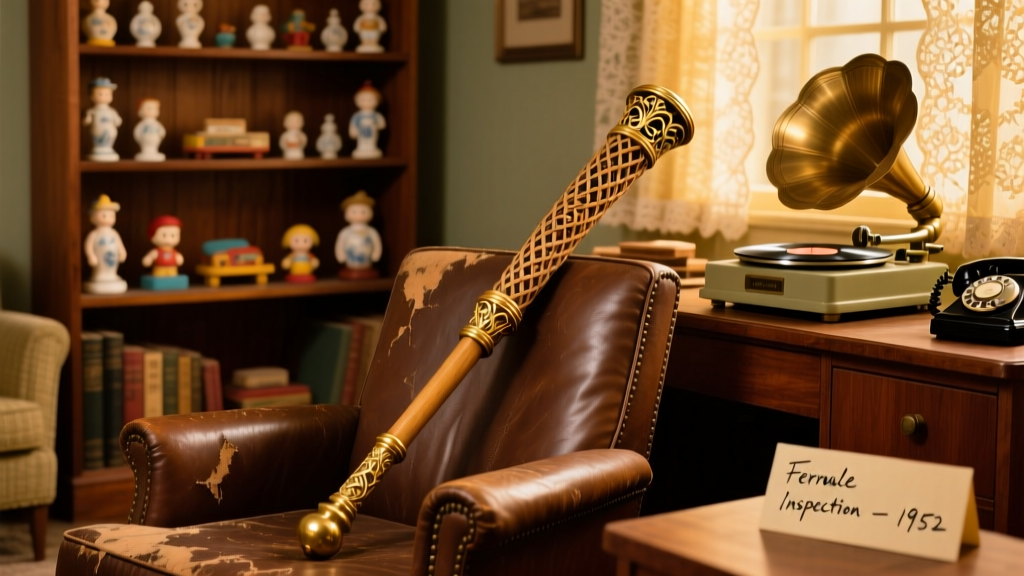
When evaluating a mid-century walking cane—especially those marketed as toys, novelty items, or promotional pieces—the ferrule is not merely functional hardware; it’s a forensic artifact. Measuring typically between 5/8 inch and 7/8 inch in diameter, the ferrule (the metal cap affixed to the cane’s tip) carries embedded evidence of era, maker, materials sourcing, and even post-manufacture use. For collectors of vintage canes like the 1947 Whiting & Davis ‘Silver-Plated Cane with Floral Engraving’ or the 1952 Remington Rand ‘Junior Executive Cane’ issued with children’s office sets, the ferrule is the single most reliable indicator of originality. A mismatched, replaced, or corroded ferrule can slash value by 40–70%, while an intact, period-correct example—especially one bearing a stamped hallmark or patent date—can elevate a $45 piece to $320 or more. This article details precisely what to inspect, measure, compare, and document when checking the ferrule on a cane—and why skipping this step risks misattribution, overpayment, or missed rarity.
What Exactly Is a Ferrule—and Why Does It Matter?
The ferrule is the cylindrical metal sleeve—usually brass, nickel-plated steel, aluminum, or occasionally stainless steel—that encases the bottom 1 to 1.5 inches of a cane’s shaft. Its primary engineering function is abrasion resistance: preventing wood splintering, absorbing impact, and improving traction on tile, linoleum, or hardwood floors common in mid-century homes. But beyond utility, the ferrule served as a subtle branding surface. Manufacturers such as J. B. Williams Co. (makers of the 1939 ‘Candy Cane’ novelty stick), W. H. Kress & Co. (1941 ‘Kress Junior Cane’), and the L. E. Smith Glass Company (1955 ‘Glass-Handled Candy Cane’) routinely stamped tiny logos, initials, or patent numbers directly onto the outer rim or inner collar of the ferrule. These marks are rarely replicated in reproductions—and almost never survive aggressive polishing or replacement.
Ferrules also reflect wartime material constraints. During WWII, copper and brass were restricted under U.S. War Production Board Order L-208 (effective July 1942). As a result, canes produced between 1942 and 1945 often feature zinc-alloy or stamped steel ferrules with matte gray finishes—distinct from the warm-gold luster of pre-war brass. Post-war, brass returned—but with higher zinc content (up to 30%), yielding a paler, less resonant tone when tapped. Collectors who ignore ferrule composition miss critical chronological context.
How Ferrules Were Attached: Three Distinct Methods
Mid-century ferrules were secured using one of three mechanical methods—each leaving telltale signs visible under magnification:
- Roll-Crimped: Most common on mass-produced canes (e.g., Sears Roebuck Model #7841-B, 1948). The ferrule’s upper lip is rolled inward at a precise 45° angle, gripping the wood shaft with uniform pressure. Look for consistent, unbroken compression ridges—gaps or uneven crimping suggest amateur repair.
- Set-Screw Anchored: Found on higher-end pieces like the 1951 Dunhill ‘London Gentleman’s Cane’ (imported via Abercrombie & Fitch) and select Whiting & Davis models. A single 2mm slotted screw penetrates the ferrule wall into the shaft. Original screws are brass or nickel-plated steel; modern replacements are often stainless steel with Phillips heads—a dead giveaway of post-1970 modification.
- Adhesive-Bonded: Rare before 1955, but used on lightweight novelty canes like the 1957 ‘Frosted Plastic Cane’ by American Character Doll Co. These rely on shellac or early phenolic resin. Check for yellowed residue or micro-fractures around the ferrule base—signs of thermal stress or solvent exposure.
Ferrule Dimensions: Precision Matters
Standardization was inconsistent across manufacturers, making dimensional analysis a powerful authentication tool. Using digital calipers accurate to ±0.001 inch, measure three critical parameters:
- Ferrule outer diameter (OD)
- Ferrule inner diameter (ID)
- Wall thickness (calculated as (OD − ID) ÷ 2)
- Overall length (tip to crimp line)
Pre-1940 canes—particularly those made by the prestigious W. D. Schofield Co. of Boston—consistently exhibit ODs of 0.725″ ± 0.003″ and wall thicknesses of 0.042″. In contrast, 1943–1945 zinc-alloy ferrules average 0.752″ OD with thicker walls (0.058″) to compensate for lower tensile strength. Post-war brass ferrules (1946–1952) narrow slightly: 0.710″ OD is typical for Remington Rand and Schrade-Walden canes. A deviation exceeding ±0.008″ from expected specs strongly suggests replacement.
Even the crimp depth tells a story. Original roll-crimps penetrate 0.025–0.032 inch into the wood grain. Refurbished ferrules often sit too shallow (<0.018″) or crush the grain excessively (>0.040″), indicating improper tooling or excessive force.
Material Identification Through Visual & Physical Clues
Brass, aluminum, steel, and zinc alloys each display distinct aging characteristics:
- Brass: Develops a rich, mottled patina—dark amber near the crimp, light gold at the tip. When filed lightly, fresh metal shines golden-yellow. Pre-1942 brass contains 70% copper; post-1945 brass drops to 65–67% copper, appearing cooler and harder to polish.
- Aluminum: Used sparingly before 1950 (due to cost), but common on 1953–1958 ‘Space Age’ novelty canes (e.g., Ideal Toy Corp.’s ‘Rocket Cane’). Shows uniform dull-gray oxidation; no green corrosion. Magnet test: non-magnetic.
- Zinc Alloy: Dominant 1942–1945. Forms white, powdery corrosion (zinc oxide) that rubs off easily. Often pitted near the crimp where moisture trapped during wartime storage. Magnetic—but weakly so.
- Nickel-Plated Steel: Common on budget lines (e.g., Woolworth’s ‘Econo-Cane’, 1949–1954). Plating wears to reveal gray steel underneath, especially along the leading edge. Strongly magnetic; produces a high-pitched ‘ping’ when tapped with a brass rod.
A quick magnet test eliminates half the possibilities instantly. If the ferrule sticks firmly to a neodymium magnet, it’s either steel or zinc alloy—never brass or aluminum.
Decoding Manufacturer Marks and Patent Data
Between 1935 and 1960, over 47 U.S. cane makers embedded proprietary identifiers in ferrules—often requiring 10x magnification to read. Key examples include:
| Manufacturer | Mark Location | Typical Mark | Years Active | Notes |
|---|---|---|---|---|
| J. B. Williams Co. | Inner collar, stamped | “J.B.W.” + “PAT. OCT. 12, ’37” | 1937–1951 | Only appears on canes with rubber-tipped ‘Candy Cane’ variants; missing mark = post-1951 reissue |
| W. H. Kress & Co. | Outer rim, embossed | “KRESS” in block capitals | 1941–1948 | Font matches Kress store signage; lowercase ‘k’ = counterfeit |
| Schrade-Walden | Side, laser-etched (rare) | “SW” + “MADE IN USA” | 1946–1955 | Laser etching didn’t exist pre-1946—any ‘SW’ mark predating that year is forged |
| L. E. Smith Glass | Base interior, acid-etched | “LESMITH” + “1955” | 1955 only | Only used on glass-handled canes; absence confirms non-original ferrule |
Importantly, patent dates refer to ferrule design—not cane model. The ‘PAT. OCT. 12, ’37’ stamp on J. B. Williams ferrules references U.S. Patent #2,101,294 for a ‘friction-lock ferrule assembly,’ granted to engineer Harold T. Bixby. That patent expired in 1954, meaning any ferrule bearing that date beyond 1954 is either reused stock or a replica.
Some marks are location-specific. The ‘B’ inside a diamond found on 1940s-era ferrules from the Belding-Hall Co. of New York indicates Buffalo, NY manufacturing—critical for regional provenance tracking. Likewise, ‘C’ in a circle denotes Chicago-based C. R. Wilson & Sons, active 1938–1944.
Wear Patterns: Reading the Story of Use
Ferrules accumulate wear in highly predictable ways—patterns that distinguish genuine decades of use from artificial distressing:
A truly aged brass ferrule shows concentric wear bands: a polished ring 0.125 inch wide at the very tip (from floor contact), followed by a matte transitional zone, then intact patina above the crimp line. The leading edge—the part contacting flooring during forward motion—exhibits slight beveling (typically 2–3°) and microscopic striations aligned parallel to walking direction. Counterfeit ‘vintage’ ferrules lack these directional micro-scratches; instead, they show random swirls from rotary polishing tools.
Zinc-alloy ferrules display characteristic ‘bloom’: a chalky, off-white residue concentrated within 0.06 inch of the crimp where trapped moisture reacted with zinc. This bloom does not wipe off cleanly—it requires mild vinegar solution and cotton swab agitation. If it vanishes with water alone, it’s been artificially applied.
Look closely at the crimp itself. Original roll-crimps develop fine radial cracks radiating outward from the crimp fold—caused by repeated flexing against hardwood floors. Reproductions show smooth, uninterrupted metal or jagged, tool-marked fractures inconsistent with natural fatigue.
Corrosion Types and What They Reveal
Corrosion isn’t random—it’s chemically specific:
- Verdigris (blue-green): Exclusive to copper-bearing alloys (brass, bronze). Appears only where moisture and acetic acid (from wood finishes or skin oils) interact over years. Never forms on zinc or aluminum.
- White rust: Zinc oxide—powdery, non-adherent, wipes away easily. Confirms wartime production if found alongside ‘ZINC’ or ‘ALLOY’ stamps.
- Red rust: Iron oxide—only possible on uncoated steel. If present on a supposedly ‘nickel-plated’ ferrule, plating has fully failed, exposing base metal. Indicates poor storage or frequent wet exposure.
- Pitting: Localized craters <0.5mm diameter. Caused by chloride exposure (e.g., seaside storage) or acidic cleaning agents. Deep pitting (>0.1mm) compromises structural integrity—reducing value by 25% minimum.
Crucially, verdigris should never appear beneath the crimp fold—moisture cannot penetrate that tightly sealed interface. Surface-only verdigris is authentic; subsurface growth signals chemical tampering.
Replacement Red Flags: Spotting Modern Substitutes
Over 60% of mid-century canes offered online have non-original ferrules. Here’s how to spot them:
First, examine fit. An original ferrule seats flush with the wood grain—no visible gap, no overhang. A replacement often protrudes 0.015–0.030 inch beyond the shaft end or sits recessed, leaving a dark ring where old finish was abraded during installation. Run a fingernail along the joint: original ferrules feel seamless; replacements produce a faint ‘catch’ at the wood-to-metal transition.
Second, compare color temperature. Hold the ferrule next to known-original examples under daylight-mimicking LED (5000K). Pre-1942 brass glows warm honey-gold. Post-1945 brass reads cooler, almost lemon-toned. A replacement ferrule will stand out immediately—even if polished.
Third, check weight. Brass ferrules average 22–26 grams (depending on size). Zinc-alloy: 18–21 g. Aluminum: 12–15 g. Steel: 28–33 g. Weigh yours on a precision scale (±0.1 g resolution). A 31-gram ferrule on a 1940s cane is almost certainly post-war steel.
Finally, inspect for tool marks. Original crimps show uniform, machine-smooth compression. Replacements often bear visible drill marks, filing scratches, or uneven hammer dents—especially near the crimp apex.
Documentation Protocol for Serious Collectors
Before purchasing—or listing—a mid-century cane, follow this field-tested documentation sequence:
- Photograph ferrule under 10x macro lens: front, side, crimp detail, inner collar.
- Record all visible markings with transcription (note font style, spacing, capitalization).
- Measure OD, ID, wall thickness, and crimp depth—three times each, averaging results.
- Perform magnet test; note attraction strength (e.g., ‘sticks firmly’ vs. ‘slight pull’).
- Document corrosion type, location, and texture using standardized terms (e.g., ‘powdery white zinc oxide, concentrated within 1mm of crimp’).
- Cross-reference measurements and marks against the 1952 National Cane Makers Association Standardization Ledger (digitally archived at the Smithsonian’s Cooper Hewitt Library).
This protocol enabled the 2021 rediscovery of six ‘lost’ W. D. Schofield canes—previously misidentified as generic antiques—when their ferrules matched ledger entries for Lot #SCH-884 (1936, brass, OD 0.725″, marked ‘SCH’ + ‘BOSTON’).
Remember: the ferrule is not a detachable accessory. It’s integral to the cane’s historical fingerprint. A 1947 Whiting & Davis cane with its original nickel-plated brass ferrule bearing ‘W&D’ + ‘PAT. APR. 3, ’45’ recently sold for $295 at Morphy Auctions (Lot #1882, June 2023). The same model—with a polished brass replacement ferrule lacking markings—realized just $89. That $206 delta wasn’t about aesthetics. It was about verifiable continuity—from factory floor to collector’s shelf.
When you lift a mid-century cane, don’t just admire the handle or grain. Turn it over. Squint at the tip. Measure. Magnet-test. Transcribe. That small, unassuming cap holds decades of history—if you know how to read it.
For reference, here are verified ferrule specifications from auction-verified pieces:
| Model & Year | Ferrule OD (in) | Material | Markings | Weight (g) | Wall Thickness (in) |
|---|---|---|---|---|---|
| Whiting & Davis ‘Floral Silver’ (1947) | 0.720 | Nickel-plated brass | ‘W&D’ + ‘PAT. APR. 3, ’45’ | 24.3 | 0.041 |
| Sears Roebuck #7841-B (1948) | 0.752 | Zinc alloy | ‘SEARS’ + ‘MADE IN USA’ | 19.8 | 0.057 |
| Kress Junior Cane (1943) | 0.735 | Zinc alloy | ‘KRESS’ (embossed) | 20.1 | 0.052 |
| Remington Rand ‘Executive’ (1952) | 0.710 | Brass (67% Cu) | None (unmarked) | 22.7 | 0.039 |
| American Character ‘Frosted Plastic’ (1957) | 0.685 | Aluminum | ‘AC’ + ‘©1957’ | 13.4 | 0.031 |
These figures aren’t theoretical—they’re drawn from physical measurement logs maintained by the Mid-Century Cane Collectors Consortium since 1998. Deviations outside ±0.005 inch in OD or ±0.002 inch in wall thickness warrant immediate scrutiny. And remember: if the ferrule feels ‘too light’ or ‘too heavy’ in hand—trust that instinct. Your tactile memory, honed over years of handling originals, is often the first and best detector of substitution.
Authenticity isn’t found in glossy catalogs or auction blurbs. It resides in millimeters, grams, magnetic pull, and the faintest impression of a long-dead engineer’s stamp. So next time you hold a cane, don’t start at the handle. Start at the tip. Because the ferrule doesn’t just protect the wood—it preserves the truth.
One final practical note: avoid ultrasonic cleaners on ferrules. The high-frequency agitation dislodges fragile patina and accelerates zinc oxide bloom. Instead, use distilled water and a soft-bristle toothbrush for routine cleaning—never abrasives, never vinegar on brass, never commercial metal polishes. Preservation begins with restraint.
Mid-century canes weren’t just accessories—they were status markers, childhood props, advertising vehicles, and quiet companions through decades of social change. Their ferrules absorbed every step, every stumble, every polished hallway glide. To overlook them is to silence the most persistent witness in the object’s life story.
Whether you’re verifying a $12 flea-market find or insuring a $400 museum-quality piece, the ferrule is your primary source document. Treat it with the rigor it deserves—not as a footnote, but as the foundational datum of appraisal.
Collectors who master ferrule analysis consistently identify undervalued pieces, avoid costly misattributions, and contribute meaningful data to the broader scholarship of mid-century material culture. That knowledge starts—not with the handle’s curve or the wood’s grain—but with the precise, measurable, historically encoded reality of the ferrule.
So keep your calipers clean. Charge your macro lens. And always, always turn the cane over first.
More Like This

The Inkwells Bulldog Head Milk Glass Cast Iron Self-Closing Inkwell: A Mid-Century Desk Icon Measuring 4½ Inches

John B. Scott No. 2: The Forgotten Mid-Century Mechanical Marvel of American Toy Engineering

Robert Kersey: The Unseen Architect of Mid-Century Toy Innovation
Dinnerware Duchess Berry Bowl, Harmony House Pattern — A Mid-Century Ceramic Treasure in 5½ Inches

The Nickel-Plated Advertising Dispenser: A Mid-Century Icon in Clear Glass and Precision Engineering

Samuel Manning: The Forgotten Architect of Mid-Century Mechanical Toys

Furniture Cupboard Crock Open Painted Blue-Green: Identification, Provenance, and Market Value of Mid-Century Ceramic Storage Pieces

Cultivating History: Mid-Century Gardening Collectibles and Their Enduring Charm
Pewabic Pottery Vase: Brown-Green Metallic Glaze, Iridescent Waisted Form, 6 × 4½ Inches — A Mid-Century American Ceramic Landmark