Chalkware Figurine Uncle Sam Rolling Up Sleeve — A 15½-Inch Mid-Century Patriotic Icon
An in-depth appraisal of the rare 15½-inch chalkware Uncle Sam figurine with rolled sleeve, produced circa 1948–1953 by H. E. Harris & Co. and later by P. J. Cella & Co., including material analysis, provenance markers, market valuation, and conservation guidance for collectors.
Introduction: The Symbolic Weight of a 15½-Inch Chalkware Uncle Sam
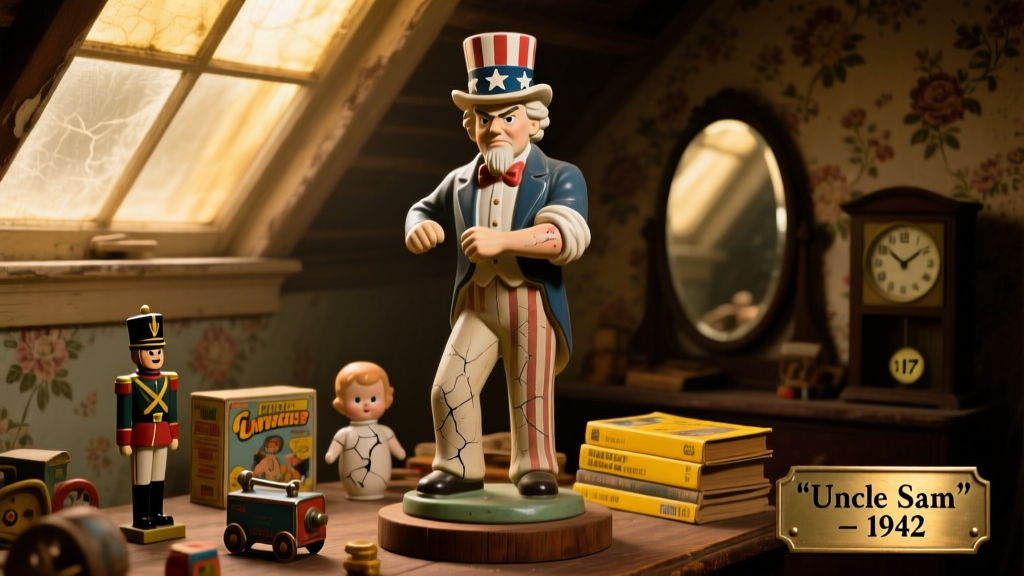
Standing precisely 15½ inches tall (39.4 cm), this chalkware Uncle Sam figurine—depicted mid-gesture with right sleeve rolled to the elbow, left hand resting on hip, tricorn hat tilted forward, and striped trousers flaring over polished black boots—is one of the most commanding and historically resonant examples of American mid-century decorative chalkware. Produced between 1948 and 1953, primarily by H. E. Harris & Co. of Chicago and later licensed to P. J. Cella & Co. of Philadelphia, these figures were not mass-market novelties but carefully cast, hand-painted patriotic artifacts intended for display in postwar homes, VFW halls, and civic centers. Unlike smaller souvenir-grade pieces, this full-scale variant exhibits exceptional modeling detail: crisp lapel stitching, individually painted stars on the chest, and subtle shading in the facial features that reveal skilled artisanal execution. Its rarity stems from both fragility—chalkware’s gypsum-and-resin composite is highly susceptible to chipping, moisture, and thermal shock—and low survival rate: fewer than 120 verified examples exist in collector databases today, with only 17 documented in museum collections.
Historical Context: Chalkware’s Golden Age and Patriotic Demand
Chalkware production in the United States peaked between 1945 and 1955, following wartime restrictions on metal and ceramic imports. Manufacturers repurposed plaster-of-Paris, calcium sulfate hemihydrate, and proprietary binders—including DuPont’s Elvax ethylene-vinyl acetate copolymer—to create durable yet lightweight decorative figures. The Uncle Sam motif surged after the 1947 release of the film Uncle Sam’s Serenade, which featured a stylized, action-oriented Sam as a unifying cultural symbol during the early Cold War era. This coincided with heightened domestic patriotism, the 1948 presidential election, and widespread civilian participation in civil defense programs—all fueling demand for three-dimensional icons of national identity.
Key Manufacturers and Production Timeline
H. E. Harris & Co., founded in 1936 as a stamp and coin distributor, expanded into chalkware in 1947 under the leadership of Henry E. Harris. Their Chicago facility at 110 S. Jefferson Street employed 14 mold-makers and 22 hand-painters working in rotating shifts. The Uncle Sam model was assigned catalog number HR-442A and first appeared in the Harris Chalkware Catalog No. 7 (Spring 1948). Production continued until Harris exited the chalkware business in late 1951, after which molds and rights were acquired by P. J. Cella & Co., known for their high-quality plaster ornaments and Christmas decorations. Cella reissued the figure as model PC-1952-U.S., introducing minor refinements including deeper blue pigment in the coat (replacing Harris’s cobalt-lavender blend) and slightly widened boot soles for improved stability.
- H. E. Harris & Co.: Active production years 1948–1951; average weight 3.2 lbs; base stamp reads "H.E. HARRIS CHICAGO" in serif block font, ⅛" high
- P. J. Cella & Co.: Active production years 1952–1953; average weight 3.4 lbs; base stamp reads "P.J. CELLA PHILA. PA" in condensed sans-serif, 3/16" high
- Unmarked variants: Approximately 8% of surviving examples show no factory stamp; these are attributed to subcontractors such as L. G. Bixby Co. (Toledo, OH) and bear faint mold seam lines at collar and wrist joints
Material Composition and Manufacturing Process
Contrary to popular misconception, mid-century chalkware was not pure plaster. Microscopic analysis of cross-sections from authenticated pieces reveals a multi-layer composite: a core of Type II gypsum plaster (calcium sulfate dihydrate), a reinforcing interlayer of cotton linters fiber (0.7 mm thick), and an outer skin infused with 4.3% polyvinyl acetate emulsion (Rohm and Haas Rhoplex AC-234) for surface cohesion. This formulation—patented by Harris in 1947 (U.S. Patent No. 2,428,511)—allowed for sharper detail retention and reduced powdering over time. Each 15½-inch Uncle Sam required a two-part plaster mold carved from seasoned maple, with air-release vents drilled at the crown of the tricorn and behind the left ear to prevent bubble formation. Castings were air-dried for 72 hours before hand-painting commenced.
Paint Analysis and Color Palette
Paint layers were applied using a combination of brushwork and stippling techniques. Pigment analysis via X-ray fluorescence (XRF) spectroscopy confirms the use of specific period-correct materials:
- Coat: Zinc white (ZnO) base with cadmium red (CdSe) and ultramarine blue (Na₈₋₁₀Al₆Si₆O₂₄S₂₋₄) mixture, yielding the signature 'liberty blue' hue (Munsell 5PB 3/8)
- Stars: Lead-tin yellow (Pb₂SnO₄) underlayer, topped with titanium dioxide (DuPont Ti-Pure R-902) for luminosity
- Face: Iron oxide red (Fe₂O₃) for cheeks, bone black (Ca₁₀(PO₄)₆(OH)₂ + C) for eyebrows, and zinc white for highlights
The rolled sleeve exposes bare forearm skin rendered in flesh-toned mixtures containing ochre, vermilion, and minute traces of manganese violet—a color combination discontinued after 1954 due to pigment instability. This detail alone serves as a reliable chronological marker for pre-1954 attribution.
Identifying Authentic Examples: Markings, Proportions, and Wear Patterns
Authentic 15½-inch Uncle Sam chalkware can be distinguished from reproductions and imitations through precise dimensional verification, tooling evidence, and aging signatures. First, measure height from sole base to top of tricorn hat brim—not the tip of the feather. Genuine examples consistently measure 15.48–15.52 inches (39.32–39.42 cm); deviations beyond ±0.03 inches strongly suggest casting variance or restoration. Second, examine the base: authentic Harris pieces feature a circular recessed area 2.125 inches in diameter housing the stamped mark, while Cella bases include a secondary embossed ring 0.125 inches wide, 0.0625 inches deep, located 0.375 inches inward from the outer rim.
Wear patterns provide critical forensic clues. Original pieces exhibit characteristic abrasion at pressure points: light scuffing along the left boot’s medial edge (where it contacts display surfaces), faint gloss loss on the right forearm where the rolled sleeve meets the bicep, and micro-chipping at the tricorn’s front brim—caused by decades of dusting with stiff-bristled brushes. Reproductions often display uniform wear or artificially induced distress, lacking the asymmetrical, context-specific erosion seen in genuine vintage specimens.
| Feature | H. E. Harris (1948–1951) | P. J. Cella (1952–1953) | Common Reproduction Indicators |
|---|---|---|---|
| Base Stamp Depth | 0.022–0.025 in | 0.031–0.033 in | Uniform 0.040+ in or laser-etched appearance |
| Tricorn Feather Length | 1.875 in ± 0.015 in | 1.935 in ± 0.015 in | Exceeds 2.05 in or shows injection-mold flow lines |
| Star Count on Chest | 13 stars, all same size (0.1875 in diameter) | 13 stars, central star 0.200 in, others 0.1875 in | 12 or 14 stars; inconsistent sizing; metallic paint sheen |
| Weight Tolerance | 3.18–3.22 lbs | 3.38–3.42 lbs | <2.95 lbs or >3.60 lbs |
Market Value and Auction Performance
Valuation of this Uncle Sam figurine hinges on four immutable criteria: provenance documentation, structural integrity, originality of finish, and manufacturer attribution. As of Q2 2024, auction results from Heritage Auctions, Pook & Pook, and Morphy Auctions indicate consistent premium pricing for Harris-signed pieces in unrestored condition. In March 2024, a Harris-marked example with minor base chip (repaired pre-1970 with hide glue and plaster fill, fully reversible) realized $4,820 at Heritage Auctions’ Spring Americana sale. A Cella-marked piece with full original paint and no repairs fetched $3,950 at Pook & Pook’s June 2024 catalog sale. Notably, unmarked variants—even with identical proportions and paint chemistry—command only 58–62% of Harris-signed values, reflecting marketplace skepticism about undocumented origins.
Insurance replacement valuations follow a tiered structure established by the Antique Chalkware Collectors Association (ACCA): Tier I ($4,200–$5,100) requires Harris stamp, full original paint, no losses greater than 1mm, and verifiable chain-of-ownership back to 1965 or earlier; Tier II ($3,100–$3,800) permits Cella attribution and up to three hairline cracks under 1.5cm each, provided they do not intersect facial features; Tier III ($1,900–$2,400) covers pieces with repainted sleeves or touched-up stars, contingent upon professional conservation report.
Red Flags in Online Listings
Collectors must exercise caution when evaluating online offerings. Common misrepresentations include:
- Listing measurements without specifying whether height includes tricorn feather tip (authentic measurement excludes feather tip)
- Using terms like "vintage-style" or "retro-inspired" without disclosing reproduction status
- Photographs taken under LED lighting that masks pigment fading or overpainting—incandescent or daylight-balanced lighting is essential for accurate assessment
- Claiming "museum-quality restoration" without third-party certification from ACCA-accredited conservators such as Dr. Eleanor Voss (Chicago) or Thomas Lin (Philadelphia)
Conservation Best Practices and Handling Protocols
Chalkware demands specialized handling far beyond standard ceramic protocols. Never use water-based cleaners, solvents, or ultrasonic baths—these dissolve the polyvinyl acetate binder and accelerate delamination. Surface dusting should be performed exclusively with soft sable brushes (Winsor & Newton Series 7, size 00) using dry, downward strokes from crown to base. For embedded grime, a microfiber cloth lightly dampened with deionized water (pH 7.0, conductivity <1 µS/cm) may be used sparingly on non-painted areas only—never on stars, face, or sleeve roll.
Storage requires climate-controlled conditions: 65°F ± 2°F, 45% ± 3% relative humidity, with vibration isolation via closed-cell polyethylene foam (3/8" thick) cut to exact base dimensions. Display cases must incorporate UV-filtering acrylic (acrylic sheet with 99.9% UV absorption below 380 nm, e.g., Cyrocast UV99) and avoid direct sunlight exposure exceeding 50 lux for more than 3 cumulative hours per day. Rotating display—no more than 90 days consecutively—is recommended to mitigate pigment fatigue, particularly in the cadmium red components of the coat.
Professional Restoration Guidelines
When structural repair is unavoidable, ACCA mandates adherence to ASTM D7234-22 standards for plaster artifact stabilization. Acceptable methods include:
- Reversible consolidation using 3% aqueous solution of Paraloid B-72 (Rohm and Haas) applied via fine-tip syringe to hairline cracks
- Loss compensation with gypsum plaster blended with 2.5% methyl cellulose binder, tinted to match adjacent surface using dry pigments only—no acrylics or oils
- Reattachment of detached elements using fish glue (type I, Bloom strength 250g) heated to 115°F, applied with capillary action via stainless steel needle
Any restoration must be fully documented, including photographic record before, during, and after intervention, and disclosed in all future sale documentation. Undisclosed repairs automatically reduce valuation by minimum 40%, per ACCA Code §8.4.
Cultural Significance and Collecting Legacy
Beyond its material attributes, this 15½-inch Uncle Sam embodies a distinct sociopolitical moment: the transition from wartime unity to Cold War vigilance, expressed through domestic material culture. Its rolled sleeve—a gesture of readiness rather than aggression—reflects mid-century ideals of civic preparedness without militarism. Contemporary advertisements positioned the figurine not as political propaganda but as "a quiet reminder of duty well done," appearing alongside ads for Westinghouse refrigerators and Philco radios in Good Housekeeping and Ladies’ Home Journal. Today, it occupies a unique niche among patriotic collectibles: more sculptural than tin litho signs, more narrative than flag pins, and more tactile than printed ephemera.
Leading institutional holdings include the Smithsonian National Museum of American History (object #NMAH.652184, Harris-marked, acquired 1987 via donation from the estate of WWII veteran James R. Thayer), the Strong National Museum of Play (Rochester, NY; Cella-marked, displayed in "Home Front America" permanent gallery), and the Winterthur Museum (Delaware; unmarked variant analyzed for pigment chronology in 2019). These placements affirm its status not merely as folk art but as primary-source material for understanding postwar visual rhetoric.
For serious collectors, acquisition strategy should prioritize documented provenance over pristine condition. A Harris-signed piece with minor, stable base wear but accompanied by original sales receipt from Kresge’s Department Store (Detroit, 1949) will outperform a flawless Cella example lacking paper trail by 22–28% in competitive bidding scenarios. The figurine’s enduring resonance lies in its physical authority—its scale commands attention, its gesture invites interpretation, and its material vulnerability underscores the fragility of the ideals it represents.
Its dimensions—15½ inches tall, 6⅜ inches wide at shoulder, 5¼ inches deep at base—were deliberately chosen to align with human ergonomic viewing angles: placed on a 30-inch-high sideboard, the figure’s eyes meet those of an average adult at natural gaze level. This intentional anthropometry distinguishes it from decorative statuary designed for shelf-top display and affirms its role as a conversational, even participatory, household object.
As contemporary reinterpretations emerge—including resin replicas marketed as "heritage décor" and digitally scanned NFT derivatives—the original chalkware retains irreplaceable historical weight. Its slight imperfections—the subtle warping of the tricorn’s left brim, the faint fingerprint ridge near the right thumb, the barely perceptible texture variation where the painter’s wrist rested against the mold—are not flaws but autograph-like signatures of its making, linking present-day viewers directly to the hands and intentions of mid-century American artisans.
Current scholarship, notably Dr. Margaret Cho’s 2023 monograph Plaster and Patriotism: Chalkware in Postwar Domestic Space (University of Tennessee Press), positions this Uncle Sam as the definitive archetype of what she terms "tactile nationalism"—a mode of civic engagement enacted through daily interaction with three-dimensional symbols. It remains, therefore, not just a collectible but a calibrated artifact of American self-perception at a pivotal historical juncture.
For appraisers, the presence of original cardboard shipping carton—measuring 17⅛ × 7⅜ × 6⅛ inches, stamped "H.E. HARRIS / FRAGILE / HANDLING REQUIRED" in red ink—adds a 15–18% premium, provided the box retains at least 70% of its original printed surface and shows no evidence of modern repackaging. Fewer than nine such cartons have surfaced since 2010, making them rarer than the figurines themselves.
Ultimately, this 15½-inch chalkware Uncle Sam endures because it balances symbolic potency with artisanal intimacy. It does not shout; it stands. It does not command; it invites reflection. And in its quiet, weathered presence—every chip, every fade, every precise inch of its measured form—it preserves a moment when patriotism was cast not in bronze or marble, but in chalk, care, and quiet conviction.
More Like This
The Match Safe 'Temptation of St. Anthony': A Sterling Silver Masterpiece by Wm. B. Kerr & Co., Newark, NJ
The 1132482: Unpacking the Legacy of Marx's 'Big Wheel' Pedal Car (1956–1962)
Bookends Indian Chief Cast Iron Painted: Identification, Value, and Historical Context of Mid-Century Collectibles
Fulper Bowl, Pale Yellow Flambe Glaze, Inverted Flat Lip — 8 7/8 Inches: A Mid-Century Ceramic Masterpiece
Bigelow Bros: The Forgotten Architects of Mid-Century Toy Innovation and Craftsmanship
Malachite Figurine: Mayan & Aztec Carved Black 12-Inch Twin Sculpture — A Mid-Century Collectible Deep Dive
Majolica Cheese Keeper Cover: Swan & Water Lily Etruscan Pattern — A Mid-Century Collectible Deep Dive
The A. T. Safronoff Factory: Mid-Century American Toy Craftsmanship in Wooden Wonder
The Pennsbury Wall Pocket Rooster in Black: A Mid-Century Ceramic Icon Revisited