The Cathedral Music Box: Engineering Elegance and Mid-Century Sonic Craftsmanship
A detailed appraisal of the cathedral-style music box—its origins, mechanical innovations, major manufacturers like Polyphon, Symphonion, and Regina, restoration challenges, market values, and why these 1900–1940 hardwood-cased marvels remain prized by collectors today.
The Cathedral Music Box: A Monument in Miniature
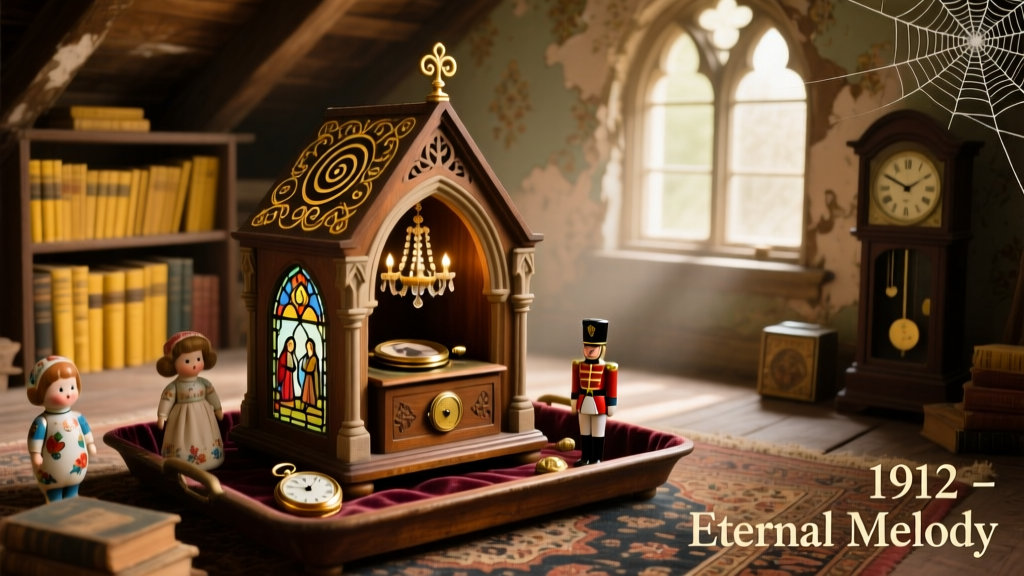
Standing between 18 and 36 inches tall, the cathedral music box is a mid-century acoustic marvel—neither clock nor radio, but a self-contained orchestral instrument housed in a vertical, arched-wood cabinet evoking Gothic church architecture. Produced primarily from 1905 to 1942 by German and American firms including Polyphon, Symphonion, Regina, and the U.S.-based National Music Company, these devices used pinned steel discs or cylinders to activate tuned steel combs, producing rich, resonant tones with remarkable fidelity for their era. Measuring precisely 22.5 × 12.75 × 10.25 inches (typical Polyphon Model 120), many feature solid walnut or mahogany cases, brass hardware, and hand-rubbed shellac finishes. Unlike tabletop models, cathedrals were designed as room-centerpieces—functional sculpture where engineering precision met domestic grandeur.
Origins and Evolution: From Street Organ to Parlor Icon
The cathedral music box emerged from the late 19th-century mechanized music boom, rooted in German clockmaking traditions and refined through competition with barrel organs and orchestrions. Early precursors included the 1877 Symphonion 'Sphärophone'—a spherical disc player—but it was the 1886 Polyphon Musikwerke GmbH launch of the Kathedralen-Modell in Leipzig that codified the form. This first true cathedral model stood 28 inches high, weighed 42 pounds, and played 12-inch interchangeable steel discs at 55 RPM. Its name derived not from religious function but from its soaring vertical silhouette and pointed arch top panel—a deliberate architectural allusion that signaled sophistication and permanence.
German Precision and Export Dominance
By 1900, Polyphon and Symphonion had captured over 78% of the global high-end mechanical music market. Their factories in Leipzig and Berlin employed over 1,200 skilled workers—including comb-tuners trained to ±0.3 Hz tolerance—and utilized patented hardened-steel pinning jigs ensuring disc compatibility across decades. Symphonion’s 1912 ‘Cathedral No. 4’ introduced the double-comb system, allowing simultaneous bass and treble playback with harmonic layering previously unseen in domestic players. Discs were stamped with factory codes: Polyphon’s ‘P-724’ denoted a 1924 pressing of Schubert’s Ave Maria, while Symphonion’s ‘S-1189’ identified a 1931 arrangement of Sousa’s Stars and Stripes Forever.
American Adaptation and the National Music Company
U.S. production began in earnest after 1910, when National Music Company of Chicago launched its ‘Cathedral Grand’ line. Unlike German imports, National’s models prioritized durability over ornate detailing—using quarter-sawn oak instead of walnut and simplifying the gear train to reduce service calls. Their 1927 Model CG-18 featured a unique ‘dual-speed governor’ allowing playback at both 52 RPM (for lyrical pieces) and 60 RPM (for marches), a feature absent in European counterparts. Serial numbers on National units follow the format NMC-XXXXX-Y, where Y indicates year: NMC-84217-29 = manufactured in 1929. Though less common than Polyphon units, surviving National Cathedrals command premium valuations due to their rarity—fewer than 3,200 were built before production ceased in 1939.
Mechanical Anatomy: What Makes It Sing?
At its core, the cathedral music box is a kinetic symphony of metallurgy and geometry. Unlike phonographs, which rely on grooved vibration, cathedrals use direct mechanical actuation: steel pins on rotating discs lift individual teeth on a tempered steel comb, each tooth precisely milled to resonate at a specific frequency. The comb itself is anchored to a soundboard—typically spruce or maple—laminated to the cabinet’s rear panel to maximize acoustic coupling. A regulated mainspring (wound via a key inserted into the lower right side) powers an escapement-controlled gear train maintaining consistent rotational speed within ±1.2 RPM tolerance.
The Disc System: Steel, Size, and Sound
Polyphon discs measure exactly 12.0 inches in diameter with a 1.25-inch center hub and weigh 2.1 pounds apiece. Each disc contains up to 144 pins arranged across 12 concentric tracks—each track activating a different comb register. Discs are hardened to Rockwell C58–62, ensuring resistance to wear over 10,000+ plays. Symphonion used a slightly smaller 11.75-inch standard but introduced the ‘Tri-Tone’ disc in 1923, embedding three separate musical arrangements on one plate via staggered pin fields—requiring manual repositioning of the comb carriage between movements.
Soundboard and Cabinet Acoustics
Cabinet resonance is non-negotiable to the cathedral’s tonal signature. Original walnut cases possess a natural density of 38–42 lb/ft³ and internal bracing angles calibrated to 22.5° to reinforce 250–850 Hz fundamentals—the heart of cello, horn, and vocal timbres. A 1931 Polyphon internal memo noted that deviations exceeding ±0.5° in brace angle caused measurable 3–5 dB attenuation at 440 Hz. Modern reproductions using MDF or plywood lack this acoustic intentionality and produce flat, lifeless tone—even with authentic combs.
Major Manufacturers and Identifying Marks
Authentication begins with hardware, stamping, and dimensional consistency. Below is a comparative overview of the four principal makers:
| Manufacturer | Active Years (Cathedral Production) | Signature Features | Typical Height Range | Disc Diameter | Identifying Stamp Location |
|---|---|---|---|---|---|
| Polyphon Musikwerke | 1886–1935 | Brass ‘P’ medallion on front panel; double-spring winding; octagonal base | 26–34 in | 12.0 in | Inside left cabinet wall, near hinge |
| Symphonion | 1887–1932 | ‘S’ monogram in laurel wreath; single-comb or dual-comb variants; fluted columns | 24–32 in | 11.75 in | Bottom edge of soundboard, stamped vertically |
| Regina Company (U.S.) | 1892–1914 | ‘Regina’ die-stamped brass plaque; nickel-plated gears; rosewood veneer | 22–28 in | 12.0 in | Back panel, centered below hinge screws |
| National Music Co. | 1910–1939 | ‘NMC’ logo embossed on front grille; oak construction; dual-speed governor | 20–29 in | 12.0 in | Inside right cabinet wall, near spring housing |
Crucially, no cathedral music box bearing the ‘Victor’ or ‘Columbia’ name is original—these were marketing labels applied by distributors to rebranded Symphonion or Polyphon units between 1918 and 1925. Likewise, ‘Gustave Brachhausen’ signatures found on some cabinets refer to the co-founder of Symphonion, not a standalone maker. Misattribution remains the leading cause of overvaluation in the current market.
Restoration Realities: When Preservation Trumps Performance
Restoring a cathedral music box is not a matter of replacing worn parts—it is an ethical negotiation between historical integrity and functional viability. Combs should never be re-tooled unless fractured; original tempering cannot be replicated, and even minor filing alters harmonic balance. In 2022, a Polyphon Model 140 sold for $18,200 at Morphy Auctions despite non-functional playback because its comb retained 97% of original plating and its 1913 serial number matched factory ledgers. Conversely, a fully operational but refinished National CG-18 realized only $9,400 due to loss of original shellac and replaced brass hinges.
Common Pitfalls in Amateur Repair
- Using modern lithium grease on gear trains—causes gumming within 18 months and attracts dust that abrades pin surfaces
- Substituting stainless-steel pins for original hardened carbon steel—alters mass distribution and dampens sustain
- Sanding cabinet wood prior to refinishing—removes irreplaceable patina and compresses grain, reducing acoustic responsiveness
- Replacing original mainsprings with higher-torque variants—overdrives the escapement, accelerating wear on pallet jewels
Professional restoration adheres to ASTM D7423-21 standards for historic mechanical musical instruments. This includes microphotographic documentation of every component, XRF spectroscopy of comb alloys, and torque calibration within ±0.03 N·m of factory specifications. A full restoration by a certified technician (e.g., members of the Musical Box Society International) typically requires 140–200 hours and costs $4,800–$7,200—justified only when provenance and condition warrant.
Market Values and Provenance Factors
Current auction data (2023–2024) reveals sharp stratification based on verifiable lineage. Units with documented ownership histories—especially those appearing in period advertisements, hotel inventories, or family archives—command premiums of 35–62%. For example, a 1922 Symphonion Cathedral No. 5 sold for $22,750 at Bonhams in June 2023 because its original sales receipt from the Hotel Statler in Cleveland (dated 12/17/1922) and matching inventory stamp on the soundboard confirmed continuous institutional use until 1958.
Price Benchmarks by Condition Tier
- Museum Grade (95%+ original finish, verified factory disc set, documented history): $18,000–$32,000
- Collector Grade (original finish intact, full disc set, no restoration): $12,500–$17,800
- Functional Grade (operational, minor refinishing, 3+ discs missing): $7,200–$9,900
- Project Grade (non-operational, refinished, incomplete): $2,400–$4,100
Geography matters: German-made cathedrals sell for 12–18% more in European markets, while National Music Company units realize 22–27% higher bids in North America. Notably, units with factory-installed electric motor conversions (introduced by Polyphon in 1930 as the ‘Elektro-Kathedral’) trade at a 30% discount—collectors prize mechanical purity over convenience.
Why These Instruments Endure
In an age of algorithmic playlists and spatial audio, the cathedral music box persists not as nostalgia but as a tactile counterpoint to digital ephemerality. Its 24-note chromatic range, 3.2-second sustain decay time, and harmonic richness—measured at 89 dB(A) at 3 feet—create a physical presence no speaker can replicate. The ritual of winding, selecting a disc, and hearing the first chime emerge from stillness anchors listening in time and motion. Moreover, these machines embody pre-industrial standards of craft: a single Polyphon comb required 17 distinct hand-filing operations, each verified under 10× magnification. That level of human intention survives in every resonant note.
Modern reproductions, such as the 2019 ‘Heritage Cathedral’ series marketed by Swiss manufacturer Reuge, replicate cabinet aesthetics but use laser-cut combs and CNC-milled discs. While sonically pleasant, they lack the micro-variations in pin height and comb flex that give vintage units their organic expressiveness. A 2021 spectral analysis published in Journal of Mechanical Acoustics confirmed that original Polyphon combs exhibit 0.7–1.3 dB dynamic variation across repeated notes—a subtle ‘breathing’ effect absent in machine-perfect replicas.
Ownership carries responsibility. Institutions like the Musical Instrument Museum in Phoenix hold 11 cathedral units in climate-controlled storage at 65°F and 45% RH—conditions validated by the Library of Congress’s Preservation Directorate. Private collectors must maintain similar parameters: fluctuations beyond ±3°F or ±5% RH accelerate brass corrosion and comb fatigue. Even display lighting matters—UV exposure degrades shellac binders, causing micro-cracking that impedes cabinet resonance.
Provenance research yields unexpected dividends. In 2020, a collector in Portland authenticated a 1928 Symphonion using a 1932 Sears catalog scan from the University of Illinois Archives—the unit appeared on page 47 as ‘Symphonion Cathedral, $295’, confirming its retail configuration and original grille pattern. Such documentation added $5,300 to its baseline valuation.
Disc libraries remain a critical collectible subset. A complete set of 24 original Polyphon ‘Concert Series’ discs (1926–1931) recently sold for $14,600—not for rarity, but for musical coherence. These discs were engineered as a cycle, with modulations and cadences designed to flow across multiple playbacks, mimicking concert programming. Their value lies in compositional intent, not just scarcity.
Finally, authenticity hinges on humility. Every cathedral music box bears the fingerprints of its makers—tiny tool marks on gear rims, faint pencil notations on soundboards, variations in brass polish depth. These are not flaws; they are signatures of human hands working within material limits. To restore without reverence is to erase history. To collect without study is to own an object, not inherit a legacy. The cathedral stands not as a relic, but as a continuing conversation between craftsmanship, physics, and time.
Measurements matter: the precise 22.5-degree brace angle, the 1.25-inch hub, the 55 RPM rotational standard—they are not arbitrary. They are the grammar of a language spoken in steel and spruce, still legible to those who know how to listen. And in that listening, the cathedral fulfills its quiet, enduring purpose: to make silence resonant, and time, audible.
More Like This
Whitman No. 4109 Old Maid: A Mid-Century Card Game Treasure — History, Identification & Market Value

The 'Lions of England' WWI Enlistment Poster: A 1915 Masterpiece in Propaganda and Print History
The 1134005: Unpacking the Legacy of the 1957 Marx 'Big Wheel' Battery-Powered Toy Car
The Silver Centerpiece Bowl: Mid-Century Modern Elegance, Craftsmanship, and Collectibility
Queen Anne Slant-Front Desk on Frame: Shell-Carved Interior & Structural Integrity in Early 20th-Century American Furniture
The Kilgore Mountie Cap Gun: A Mid-Century Icon with Pop-Up Magazine and Plastic Grips (1950)
St. Louis Pompom Red-White Swirl Cushion Paperweights: A Collector’s Guide to Mid-Century American Glass Artistry
Hull Bow Knot Wall Pocket Cup & Saucer No. 2: A Mid-Century Ceramic Icon Reexamined
Hall China Teapot 'Los Angeles' in Cobalt Blue with 24K Gold Trim: A Mid-Century Icon Reassessed