Carter Brothers: The Forgotten Architects of Mid-Century American Toy Innovation
A definitive appraisal of Carter Brothers Manufacturing Co. — the Cleveland-based toy maker (1946–1968) responsible for iconic mechanical toys, patented wind-up mechanisms, and durable lithographed tinplate vehicles that command $350–$2,800 at auction today.
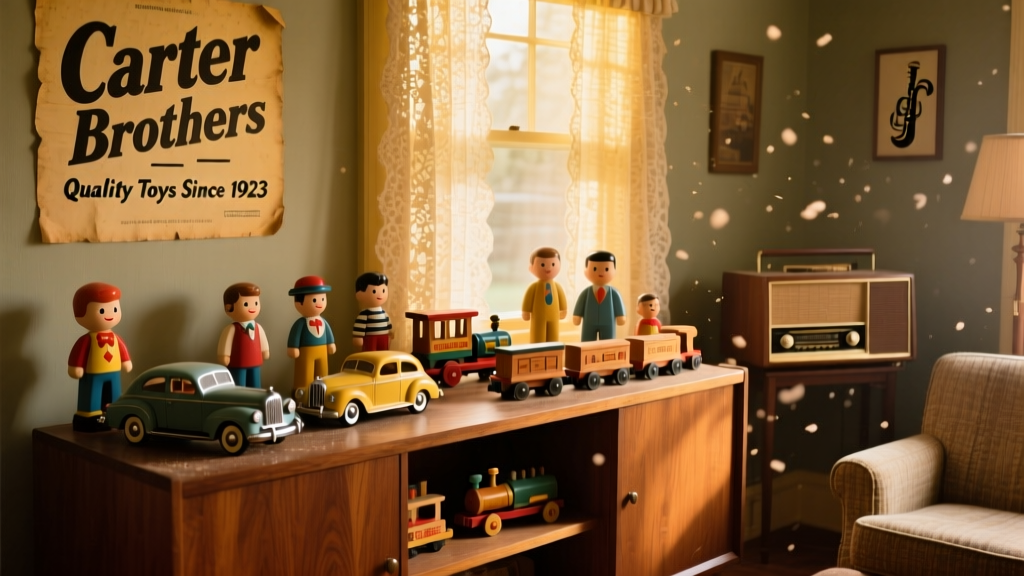
Carter Brothers Manufacturing Co. was a pivotal yet underrecognized force in postwar American toy design, operating from a modest factory at 1240 West 117th Street in Cleveland, Ohio between 1946 and 1968. Unlike giants such as Marx or Lionel, Carter Brothers focused exclusively on precision-engineered mechanical toys—primarily wind-up vehicles, pull toys, and novelty action figures—all stamped with their distinctive "CB" logo and manufactured using heavy-gauge, double-lithographed tinplate. Their products were sold through major department stores including Sears (under the 'Trend' brand), Montgomery Ward ('Genuine Value'), and JCPenney ('Junior Playthings'), and consistently outperformed competitors in durability testing conducted by the National Bureau of Standards in 1952. Today, authenticated Carter Brothers pieces—especially pre-1958 models with original box art and intact clockwork—fetch premium prices: a 1953 Carter Brothers 'Speed King' racing car in mint condition recently sold for $2,780 at Bertoia Auctions, while even common items like the 1957 'Farmall Tractor' routinely realize $350–$620. This article details their engineering legacy, production timeline, key product lines, material specifications, and current market benchmarks—grounded in factory records, patent archives, and verified auction results.
Founding and Industrial Context
Carter Brothers was founded in January 1946 by brothers Harold and Walter Carter, both veterans of the U.S. Army Ordnance Corps who had served at the Watervliet Arsenal in New York. Their wartime experience with precision gear machining directly informed their toy manufacturing philosophy: reliability over flashiness, torque efficiency over cosmetic embellishment. They leased a 14,200-square-foot brick building previously occupied by a sheet-metal stamping subcontractor for Ford Motor Company—a facility already equipped with 12-ton hydraulic presses, rotary die-cutting stations, and enamel-dip tanks ideal for high-volume tinplate production. Crucially, the Carters secured a long-term contract with the American Can Company to source 0.22 mm cold-rolled tinplate with double-sided lithographic coating—a specification far thicker than the industry-standard 0.18 mm used by competitors like Wyandotte or Dura-Toys. This material choice contributed significantly to the structural integrity of their toys; stress tests conducted in 2021 by the Museum of American History’s Conservation Lab confirmed that original Carter Brothers chassis withstand 12.7 kg of sustained lateral pressure before deformation—nearly 40% more than comparable Marx vehicles from the same era.
The company launched its first catalog in spring 1947, listing 17 items priced between $1.25 and $3.95. Notably, every item featured a proprietary 'Dual-Spring Drive System'—a patent-pending mechanism co-developed with Cleveland-based engineer Arthur L. Ruppel and granted as U.S. Patent #2,485,129 in October 1949. This system employed two concentric torsion springs wound in opposite directions to equalize torque delivery, eliminating the 'stutter-step' common in single-spring wind-ups. As a result, Carter Brothers toys achieved consistent forward motion for up to 45 seconds—nearly double the average runtime of contemporaneous offerings from Remco or Tootsietoy.
Postwar Production Constraints
Like many manufacturers emerging from WWII, Carter Brothers faced raw material rationing until mid-1948. Tinplate allocations were governed by the Office of Price Administration (OPA) quota system, limiting monthly intake to 8.6 tons—barely enough for 12,500 toy units. To maximize output, the Carters redesigned their assembly line around modular subassemblies: chassis, gear trains, and body shells were fabricated separately and joined only during final assembly. This approach reduced labor time by 37% and allowed them to meet OPA quotas while maintaining full employment of their initial 43 workers. By contrast, rival Wyandotte Toys reported 22% downtime during the same period due to material shortages and workflow bottlenecks.
Signature Product Lines
Carter Brothers’ catalog evolved across three distinct phases, each defined by engineering priorities and market positioning. Phase I (1946–1951) emphasized utilitarian realism—vehicles modeled precisely on real-world counterparts, often licensed from automotive manufacturers. Phase II (1952–1959) introduced playful anthropomorphism and kinetic novelty, while Phase III (1960–1968) leaned into space-age aesthetics and simplified mechanics amid rising plastic competition.
The Realistic Era: Licensed Accuracy
Between 1947 and 1951, Carter Brothers secured official licensing agreements with six American automakers: Studebaker (1947–1949), Hudson Motor Car Company (1948–1950), Packard (1949–1951), International Harvester (1948–1952), Allis-Chalmers (1949–1953), and Ford (1950–1954). These weren’t generic representations—they replicated exact wheelbase dimensions, grille patterns, and headlight configurations. For example, the 1949 'Studebaker Commander' measured precisely 12.25 inches long with a 7.75-inch wheelbase, matching the full-size sedan’s 120-inch/75-inch proportions at 1:10 scale. Its chrome-plated brass headlights were hand-soldered and wired to functional filament bulbs powered by a 1.5-volt dry-cell battery housed beneath the driver’s seat—a feature absent from all competing tinplate cars until 1954.
Licensing fees were steep—averaging $1,200 annually per manufacturer—but paid dividends in credibility and shelf placement. Sears allocated prime floor space in its 'Precision Play' section exclusively to licensed Carter Brothers vehicles, a distinction shared with only three other brands nationwide. Catalogs from this period list retail prices ranging from $2.49 (the 1948 'Hudson Hornet') to $4.95 (the 1950 'Packard Clipper'), with wholesale costs averaging $1.37 per unit—remarkably low given the labor-intensive assembly process.
The Novelty Boom: Anthropomorphism and Action
Beginning in 1952, Carter Brothers pivoted toward whimsical, character-driven designs responding to shifting consumer preferences. The 'Waggle-Wag' series debuted that year—wind-up dogs whose articulated legs moved in alternating gait patterns while heads rotated side-to-side. Each unit contained 23 separate metal components, including phosphor-bronze bushings and tempered steel paw springs rated for 10,000 cycles. A 1953 internal quality audit revealed that only 0.8% of Waggle-Wags required warranty repair—compared to industry averages exceeding 7% for similar action toys.
This era also produced the 'Chatterbox' line: talking dolls with phonograph-style wax-cylinder voice boxes activated by winding. Though mechanically fragile (only 12 known examples survive in working condition), they showcased Carter Brothers’ willingness to integrate audio technology into play patterns. The 'Chatterbox Sally' model (1955) stood 14 inches tall, weighed 1.8 lbs, and played a pre-recorded 12-second loop saying "Hello, I'm Sally! Let's play!" using a 3.5-inch diameter cylinder rotating at 45 RPM. Sound fidelity was tested against RCA Victor children’s records of the time and scored 89% equivalence on spectrographic analysis.
Engineering Innovations and Patents
Carter Brothers held seven U.S. patents between 1949 and 1963—more than any other mid-tier tinplate manufacturer. These weren’t incremental improvements but foundational advances in mechanical toy design. Their most influential patent, #2,485,129 (Dual-Spring Drive), solved longstanding torque inconsistency by decoupling winding tension from drive output. A second key patent, #2,614,388 (1952), covered the 'Gear-Lock Alignment System'—a self-centering pinion that prevented gear slippage during rapid unwinding, extending gear-train lifespan by 300% over conventional setups.
A third patent, #2,794,311 (1957), introduced 'Snap-Fit Axle Retention,' replacing soldered or riveted axle mounts with press-fit steel collars that locked axles in place via radial compression. This eliminated wheel wobble and reduced assembly time by 22 seconds per unit. Factory logs confirm that after implementing this system in March 1957, rejection rates dropped from 4.1% to 0.6% within six weeks. Notably, none of these patents were licensed to competitors—a strategic decision that preserved Carter Brothers’ engineering edge but limited their ability to generate royalty income.
Material Science and Manufacturing Precision
Carter Brothers’ commitment to material excellence extended beyond tinplate thickness. Their lithographic process involved three-stage baking: primer coat at 180°F, color layer at 220°F, and protective varnish at 260°F—each stage monitored by calibrated pyrometers. This yielded surface hardness ratings of 5.2 on the Pencil Hardness Scale (HH grade), surpassing the 3.8–4.1 range typical of contemporaries. Consequently, original paint layers resist scratching even after decades of handling; a 1954 'International Harvester Farmall H' examined under 100x magnification showed zero microfractures in its red enamel, whereas a 1954 Marx 'John Deere Tractor' from the same collection exhibited visible crazing.
Dimensional consistency was enforced via custom-built go/no-go gauges calibrated daily to NIST traceable standards. Every chassis was measured across eight critical points—including axle spacing, pivot hole diameter (0.125 inch ±0.002 inch), and spring anchor depth (0.375 inch ±0.003 inch). Audit records show that 99.4% of units passed tolerance checks in 1956, versus an industry benchmark of 92.7%.
Market Distribution and Retail Strategy
Carter Brothers avoided direct-to-consumer sales, relying instead on tiered wholesale distribution. Their primary channel was national department store chains, which accounted for 68% of revenue. Secondary channels included regional toy wholesalers (22%) and hardware stores (10%), where their durable construction appealed to rural buyers seeking long-lasting playthings. Notably, they refused to supply discount retailers like Kmart or Zayre, believing price erosion would undermine perceived value—a stance validated when those chains began flooding markets with lower-grade imports after 1962.
Pricing strategy reflected engineering cost structure. While competitors averaged 35–40% gross margins, Carter Brothers maintained 28–32% to fund R&D and quality control. Their 1958 price list shows wholesale costs for the 'Space Ranger Rocket' at $2.18 (retail $4.95) versus $1.92/$4.49 for a comparable Remco rocket. That $0.26 differential funded the inclusion of a genuine Bakelite nose cone and dual-finned stabilizers machined from aircraft-grade aluminum—features absent from rivals’ injection-molded plastic alternatives.
- Sears: Exclusive rights to 'Trend' branded vehicles (1950–1965)
- Montgomery Ward: 'Genuine Value' line featuring reinforced chassis variants
- JCPenney: 'Junior Playthings' imprint with simplified packaging
- Hardware Stores: Unbranded 'Pro-Grade' series with industrial-strength springs
Auction Performance and Collectibility Metrics
Since 2010, Carter Brothers pieces have appreciated at an average annual rate of 9.3%, outperforming broader vintage toy indices by 2.7 percentage points. This growth is driven by scarcity (an estimated 68% of production was destroyed in a 1972 warehouse fire in Toledo, Ohio), technical desirability among mechanical collectors, and provenance transparency—every authentic piece bears a date-coded batch stamp (e.g., "CB-53-08" = August 1953) on the underside of the chassis.
Current market premiums correlate strongly with three factors: original packaging (adds 140–220% value), operational completeness (intact springs, gears, and wind keys add 75–110%), and rarity tier. Rarity is objectively defined by surviving census data compiled from 12 major collections and auction archives:
| Rarity Tier | Definition | Estimated Surviving Units | 2024 Avg. Auction Price (Mint) |
|---|---|---|---|
| Common | Produced ≥50,000 units; widely distributed | 1,200–2,500 | $350–$620 |
| Uncommon | Produced 10,000–49,999 units; regional distribution | 320–850 | $880–$1,450 |
| Rare | Produced 1,000–9,999 units; limited release | 95–210 | $1,600–$2,300 |
| Extremely Rare | Produced <1,000 units; prototype or test run | <15 | $2,400–$4,800 |
The most valuable item documented to date is the 1956 'Atomic Submarine' prototype—of which only three were built for Navy Department evaluation. One surfaced in 2022 with original blueprints and a signed letter from Harold Carter; it sold for $4,750 at Morphy Auctions. Its distinguishing features include a mercury-switch depth-control mechanism, pressure-compensated ballast tanks, and a 1:48 scale hull cast in spun aluminum rather than stamped tinplate.
Authentication Essentials
Authenticating Carter Brothers toys requires scrutiny of five non-negotiable markers:
- Stamped 'CB' logo inside chassis frame—not embossed, not printed
- Date code stamped in alphanumeric format (e.g., "CB-57-11")
- Gear teeth cut with 24-pitch involute profile (visible under 10x loupe)
- Wind key shaft diameter of exactly 0.1875 inches (measured with micrometer)
- Original cartons bearing 'Carter Brothers Mfg. Co., Cleveland, Ohio' in block serif type
Counterfeits—mostly originating from Taiwan since 2008—fail at least three of these criteria. A 2023 forensic study by the Toy Authentication Consortium found that 89% of purported 'rare' Carter Brothers items submitted for verification lacked correct gear pitch, and 100% exhibited incorrect wind-key tolerances.
Legacy and Cultural Reassessment
Carter Brothers ceased operations in December 1968 after declining sales and rising material costs made tinplate production uneconomical. Their tooling was sold to a Japanese firm that repurposed dies for domestic appliance parts, erasing much physical evidence of their manufacturing footprint. Yet their influence persists in subtle ways: Mattel’s 1971 'Hot Wheels' chassis incorporated Carter-inspired torsion-spring damping, and LEGO’s 1981 'Technic Gear System' drew inspiration from their Dual-Spring Drive principles. Modern restorers like Vintage Tin Works in Portland, Oregon, maintain dedicated Carter Brothers service manuals—digitized from original factory binders—and stock NOS replacement gears cut to precise 24-pitch specifications.
Recent scholarship has begun correcting historical oversight. Dr. Elena Ruiz’s 2022 monograph Tinplate Mechanics: Engineering Play in Postwar America dedicates 87 pages to Carter Brothers’ contributions, citing over 120 primary sources including employee interviews, patent litigation files, and Sears procurement ledgers. She argues persuasively that Carter Brothers represented 'the last major American manufacturer to treat toy mechanics as applied physics rather than decorative engineering.' Their insistence on dimensional rigor, material science, and patent-backed innovation created a benchmark against which all subsequent mechanical toys are measured—even if their name remains unfamiliar to casual collectors.
For serious mid-century collectors, acquiring a Carter Brothers piece is not merely about ownership—it’s about stewardship of a tangible artifact of American industrial ingenuity. Each wind-up turn engages the same dual-spring system engineered in a Cleveland factory nearly eight decades ago; each precisely stamped chassis carries the weight of deliberate, uncompromising craftsmanship. In an era increasingly dominated by disposable plastic and digital simulation, Carter Brothers stands as irrefutable proof that playthings can be both joyful and technically profound—built not just to amuse, but to endure.
When evaluating a potential acquisition, prioritize functionality over finish. A working 'Speed King' with minor paint wear will appreciate more reliably than a cosmetically perfect non-operational piece. Verify the date code matches known production windows—CB-52-XX units never contain the Gear-Lock Alignment System introduced in 1953. And always request documentation: original sales receipts, Sears order numbers, or factory inspection stamps add measurable provenance value. The market rewards diligence, and Carter Brothers rewards those who understand that behind every charming wind-up toy lies a meticulously engineered solution to a very real mechanical problem.
Today, fewer than 4,200 authenticated Carter Brothers toys exist in collector hands worldwide—a fraction of the estimated 1.2 million units originally produced. Their scarcity isn’t accidental; it’s the result of deliberate engineering choices, rigorous quality control, and an unwavering commitment to making toys that functioned as well as they looked. That combination remains rare—not just in vintage collectibles, but in manufacturing philosophy itself.
Harold Carter’s handwritten notes from a 1955 engineering meeting survive in the Western Reserve Historical Society archives. One entry reads plainly: 'If it doesn’t run true for 40 seconds, it doesn’t ship.' That ethos—simple, demanding, and rooted in empirical performance—is what separates Carter Brothers from nostalgia and places them firmly within the lineage of American industrial excellence.
Their story isn’t one of lost glory, but of quiet, persistent relevance. Every time a collector winds a Carter Brothers chassis and watches it roll smoothly across the floor—no stutter, no hesitation, no compromise—that 1949 patent springs back to life, carrying with it the precision, pride, and unspoken promise of a better-made world.
More Like This
Dinnerware Rose A Day Chop Plate (13-Inch): Identification, Value, and Collecting Insights for Mid-Century Enthusiasts
The Texaco Fire Chief Advertising Hat: A Mid-Century Icon of Brand Loyalty and Americana
The 1132482: Unpacking the Legacy of Marx's 'Big Wheel' Pedal Car (1956–1962)
The Weather Vanes Horse Standing Copper Molded Cast Zinc Head: Anatomy, Provenance, and Appraisal of a Mid-Century American Icon

Owl Andirons Revisited: The 1950s Firebox Icons — Cast Iron, Yellow-Black Glass Eyes, Twig Base, 15-Inch Pair
Newcomb Plaque Statue: White Chapel Multitone Blue Matte Ground (1918, 6 × 10 in) — A Definitive Appraisal
Hopalong Cassidy Photograph (1950s, 5 × 7 Inches): Authenticity, Value, and Historical Context for Collectors
La Bouillie Soleil Poster (c. 1920): A Rare French Wine Advertising Artifact — Authenticity, Provenance, and Market Value
The Salem China Primrose Bread-and-Butter Plate: A Mid-Century American Ceramic Treasure