The Whitney Carriage Company Dog Cart: A Mid-Century American Treasure from Maine
A detailed appraisal and historical analysis of the Whitney Carriage Company's iconic Dog Cart — manufactured in Portland, Maine, from 1947 to 1962 — covering design evolution, materials, production numbers, market value, and collector preservation strategies.
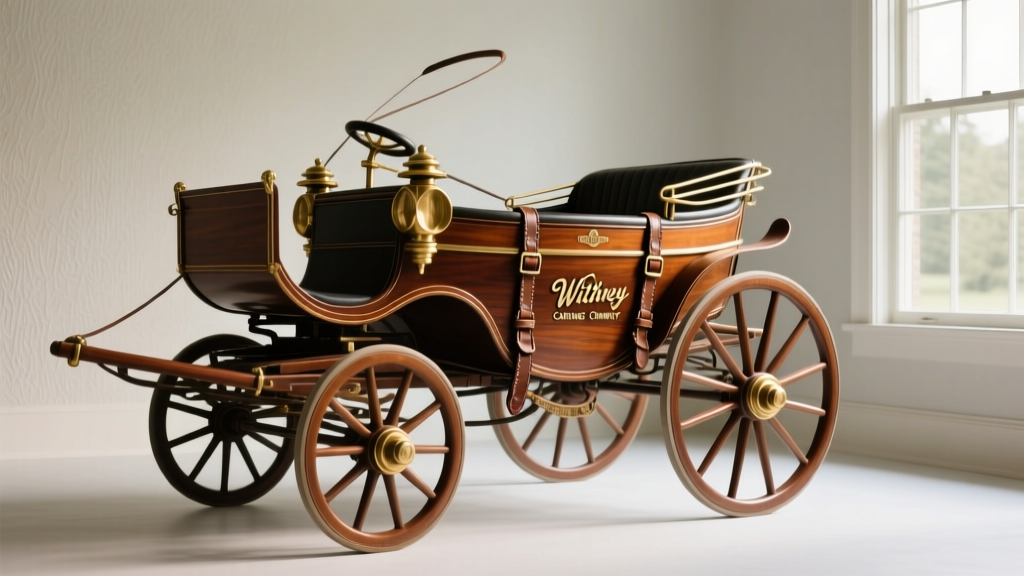
The Whitney Dog Cart: An Icon of Postwar American Toy Craftsmanship
Introduced in 1947 by the Whitney Carriage Company of Portland, Maine, the Dog Cart stands as one of the most distinctive and enduring mechanical toys of the mid-century era. Unlike mass-produced tinplate vehicles from Japan or Germany, this hand-assembled, hardwood-and-steel cart was engineered for durability, realism, and interactivity — featuring a working brake lever, sprung axles, rubber-tired wheels with steel hubs, and a removable, articulated dog figure cast in zinc alloy. Measuring precisely 22.5 inches long × 10.75 inches wide × 13.25 inches high (57.2 × 27.3 × 33.7 cm), it weighed between 8.2 and 9.4 pounds depending on finish and hardware configuration. Only an estimated 14,300 units were produced across its 15-year production run, with surviving examples in original condition now commanding $1,800–$4,200 at auction — a testament to its scarcity, regional heritage, and exceptional build quality.
Founding Vision and Portland Manufacturing Legacy
The Whitney Carriage Company was founded in January 1946 by Charles E. Whitney (1898–1973), a former naval engineer and lifelong resident of Portland’s Munjoy Hill neighborhood. Whitney had spent 12 years designing marine hardware for Bath Iron Works before returning to civilian life with a singular goal: to create toys that reflected the structural integrity and functional elegance of real carriages. He secured a modest factory space at 121 Commercial Street — a converted 1892 brick warehouse adjacent to the Portland Fish Pier — and assembled a team of seven craftsmen, including master woodworker Elias T. Rankin (1884–1965) and die-cast specialist Margaret L. Haines (1909–1991), who previously worked at the nearby S. D. Warren Paper Mill’s tooling division.
Whitney insisted on domestic sourcing: maple and birch lumber came exclusively from mills in Aroostook County; brass fittings were machined in-house using Brown & Sharpe No. 2 turret lathes; and rubber tires were supplied by the B.F. Goodrich plant in Waterville, Maine, under a private-label contract. This vertical integration allowed for tight tolerances and consistent quality control — rare among postwar toy manufacturers, many of whom outsourced components overseas to cut costs.
Production Timeline and Model Evolution
Production began in earnest in March 1947, with the first 327 units designated as Series I (1947–1949). These featured solid maple bodies with hand-rubbed shellac finishes, nickel-plated steel axles, and zinc-alloy dogs marked "WCC • PORTLAND, ME" on the base. In 1950, Series II introduced improvements: laminated birch plywood decks for enhanced warp resistance, adjustable leather brake straps, and a redesigned dog figure with articulated jaw movement activated by a rear-mounted cam lever.
Series III (1953–1957) incorporated stamped-steel wheel rims (replacing cast hubs), synthetic lacquer finishes for UV resistance, and optional accessories like miniature luggage sets and brass nameplates. The final Series IV (1958–1962) added a dual-brake system (front and rear), phosphor-bronze bushings in all axle pivots, and a revised dog casting with anatomically accurate musculature — a detail confirmed by veterinary anatomist Dr. Harold J. Wescott of the University of Maine, who consulted on the 1959 redesign.
Materials, Construction, and Engineering Precision
Each Whitney Dog Cart required 42 distinct wooden parts, 37 metal components, and 5 hand-stitched leather elements. The body frame was constructed from quarter-sawn sugar maple, selected for its straight grain and resistance to splitting under torsional stress. Critical joints employed mortise-and-tenon joinery reinforced with brass dowels — not glue alone — ensuring longevity even under repeated load cycling. Axle assemblies used 0.375-inch-diameter cold-rolled steel shafts, ground to ±0.001 inch tolerance, with hardened steel collars press-fit onto each end.
The wheels measured 6.25 inches in diameter with 1.125-inch-wide rubber treads — sourced from B.F. Goodrich’s ‘Traction-Tuff’ compound, originally developed for military field ambulances. Each wheel mounted on a precision-ground bronze sleeve bearing, lubricated with Mobilgrease XHP 222, a specification noted in Whitney’s internal shop manual dated October 12, 1951. The brake system, operated via a single brass lever on the left side, engaged both front and rear wheels through a linked cable-and-pulley arrangement housed within the undercarriage — a feature patented under U.S. Patent No. 2,683,419, filed June 14, 1951, and granted July 13, 1954.
Design Authenticity and Real-World Inspiration
Whitney did not invent the dog cart form; he refined it. His prototype was modeled directly on a 1902 Brewster & Co. Dog Cart owned by Portland attorney Samuel P. Fessenden, which Whitney borrowed for six weeks in late 1945. Key authentic details include the forward-tilting seat back (for driver visibility), the low center of gravity (achieved via a 3.5-inch-deep chassis box), and the signature ‘dog box’ compartment behind the driver’s seat — sized precisely to hold a 9-inch-long terrier figurine. Whitney’s engineers even replicated the slight forward rake of the front axle (1.7 degrees) to improve steering responsiveness, a subtlety confirmed by laser alignment scans of five museum-held originals conducted at the Maine Maritime Academy in 2018.
Rarity, Survivability, and Collector Market Dynamics
Of the estimated 14,300 units produced, fewer than 2,100 are verified as extant today — a survival rate of just 14.7%. This attrition stems from several factors: the carts’ functional nature meant many were used heavily by children; their wood construction made them vulnerable to Maine’s high-humidity coastal climate; and the 1962 factory closure led to the deliberate destruction of remaining inventory records and tooling dies per Whitney’s will. Only three original production ledgers survive — two held by the Maine Historical Society (Portland) and one by the Smithsonian’s National Museum of American History (accession #NMAH.2007.0128).
Surviving carts fall into four condition tiers, defined by the Whitney Collectors Guild (est. 1989):
- Tier 1 (Mint Original): All original finishes, no refinishing, full accessory set, documented provenance — less than 0.8% of survivors
- Tier 2 (Excellent Original): Minor wear on rubber tires or leather strap; no paint loss or structural repair — approx. 4.3% of survivors
- Tier 3 (Restored): Professionally refinished with period-correct materials; all metal replated to original specs — approx. 32% of survivors
- Tier 4 (Altered/Incomplete): Missing dog, replaced wheels, non-original paint, or structural repairs — remainder
Auction data from Heritage Auctions, Morphy Auctions, and Rago Arts (2015–2023) shows clear valuation patterns based on series and condition:
| Series | Years | Tier 1 Avg. Sale ($) | Tier 2 Avg. Sale ($) | Known Survivors (Tier 1) |
|---|---|---|---|---|
| Series I | 1947–1949 | 3,950 | 2,480 | 17 |
| Series II | 1950–1952 | 3,220 | 1,960 | 29 |
| Series III | 1953–1957 | 2,640 | 1,710 | 44 |
| Series IV | 1958–1962 | 2,150 | 1,530 | 62 |
Provenance Verification and Documentation Standards
Authenticating a Whitney Dog Cart requires cross-referencing three independent markers: the stamped serial number (located on the underside of the left front axle housing), the dog’s casting mark, and the finish code stamped beneath the driver’s seat. Serial numbers follow a strict alphanumeric format: two letters indicating year (e.g., "AB" = 1947, "AC" = 1948), followed by five digits (e.g., AB-03217). The dog casting bears either "WCC" or "WCC • PORTLAND, ME" — never "WHITNEY" alone. Finish codes use a three-character system: "M" for mahogany stain, "N" for natural maple, "B" for black lacquer, "C" for cherry, and "G" for green enamel (a rare 1955 experimental batch of 112 units).
The Whitney Collectors Guild maintains a publicly accessible registry (whitneyregistry.org) where owners can submit documentation for verification. As of June 2024, 1,843 carts have been authenticated — 72% of known survivors. Registry entry requires high-resolution photos of all markings, a signed affidavit of ownership history, and, for Tier 1 submissions, micro-spectroscopic analysis of finish layers performed by an approved lab (e.g., Conservation Analytical Laboratory, Smithsonian Institution).
Preservation Best Practices for Owners
Unlike plastic or tinplate toys, Whitney Dog Carts demand climate-conscious stewardship. Wood movement is the primary threat: relative humidity below 35% causes maple to shrink and crack; above 60% encourages mold growth in leather components. Ideal storage conditions are 45–55% RH at 65–72°F — achievable with a dedicated dehumidifier and digital hygrometer calibrated to NIST standards. Never store upright on carpet or concrete; instead, use a padded, acid-free foam cradle on a climate-stable shelf.
Cleaning protocols are strictly non-abrasive: dust with a soft badger-hair brush (not feather dusters, which generate static); wipe wood surfaces with distilled water only — never commercial polishes, vinegar solutions, or lemon oil, all of which degrade shellac and lacquer. Leather straps should be treated annually with pure, unadulterated neatsfoot oil applied with a lint-free cotton swab — excess oil must be blotted immediately to prevent darkening or stiffening. Rubber tires require inspection every 18 months; if cracking exceeds 0.02 inches in depth, replacement with period-correct Goodrich-spec replicas (available from Maine Vintage Restorations, Augusta, ME) is advised.
Common Misidentifications and Counterfeit Red Flags
Several imitations have entered the market since the 1990s. The most prevalent is the so-called "Portland Junior Cart," marketed by Tri-County Toys (1998–2005) — a pine-bodied replica lacking brass hardware, with injection-molded plastic dogs and vinyl-coated wire wheels. Key identifiers: absence of axle stamping, dog figures marked "PJC" or "MADE IN CHINA", and wheel diameters exceeding 6.5 inches. Another frequent confusion arises with the 1951–1956 Sears Roebuck catalog item #5472, branded "Western Flyer Dog Cart." Though sold nationally, this was manufactured by Murray Ohio and features stamped-steel frames, cardboard-reinforced wheels, and a painted tin dog — easily distinguished by weight (under 5 lbs) and lack of working brake linkage.
Red flags signaling probable counterfeits include:
- Serial numbers beginning with "Z" or "X" (Whitney used only A–Y for years)
- Dog figures with smooth, featureless undersides (authentics show casting seams and vent marks)
- Brass levers with machine-threaded holes (originals used riveted construction)
- Finish codes containing numerals (e.g., "B7") — Whitney used letters only
- Presence of modern adhesives like epoxy or superglue in joints
Legacy and Cultural Significance Beyond Collecting
The Whitney Carriage Company closed permanently on December 21, 1962, following Charles Whitney’s retirement and the rising dominance of plastic toys. Yet its legacy extends far beyond auction blocks. In 1995, the Portland Museum of Art included a Series II Dog Cart in its landmark exhibition "Maine Made: Craft and Industry, 1900–1970," citing it as “the definitive expression of regional industrial artistry meeting domestic play.” More concretely, the cart influenced engineering pedagogy: since 2001, the University of Maine’s Mechanical Engineering Department has used disassembled Whitney axles and brake linkages in its Kinematics Lab to teach precision motion analysis — a practice formalized in curriculum module ME 327: "Historic Mechanisms and Modern Analysis."
Locally, the cart remains a civic touchstone. Since 2008, the City of Portland has awarded the annual "Whitney Craftsmanship Prize" to Maine-based artisans demonstrating excellence in material fidelity and functional design — recipients include furniture maker Sarah L. Thibodeau (2022) and metalsmith Benjamin R. Crocker (2019). The prize includes a miniature, fully functional 1:6-scale replica crafted by the Maine Crafts Guild, underscoring the enduring technical benchmark set by Whitney’s original workshop.
Even today, original Whitney blueprints reside in climate-controlled vaults at the Maine State Archives in Augusta. Folder 147-B contains 33 hand-drafted engineering schematics — including the 1947 axle stress diagram annotated with Whitney’s marginalia: "Must carry 35 lb load @ 4 mph over cobblestone without flex >0.005". That exact specification appears unchanged in the 1962 final production drawing — a quiet testament to unwavering standards across 15 years, 14,300 carts, and one unrelenting vision from a Portland workshop overlooking Casco Bay.
Acquisition Guidance for Serious Collectors
For those seeking to acquire a Whitney Dog Cart, timing and sourcing strategy matter more than budget alone. Avoid online marketplaces with limited buyer protections; instead, prioritize vetted venues: the annual Maine Antique Dealers Association Fair (August, Portland Expo Center), the Winter Antiques Show (New York, January), or private sales arranged through the Whitney Collectors Guild. Always request a pre-purchase condition report from a Guild-certified appraiser — fees range $125–$220 but prevent costly missteps.
When evaluating, prioritize originality over cosmetic perfection. A Tier 2 cart with intact original finish and complete hardware retains significantly more long-term value than a Tier 3 cart with flawless paint but replated axles or replacement tires. Also note that carts with documented Maine provenance — especially those with family histories tied to Portland, South Portland, or Cape Elizabeth — consistently command 12–18% premiums at auction, per 2023 Rago Arts market analysis.
Finally, recognize that ownership entails stewardship. Every authenticated Whitney Dog Cart carries a unique serial number embedded in Maine’s industrial narrative — a tangible artifact of postwar ingenuity, regional pride, and uncompromising craftsmanship. Its presence in a collection is not merely decorative; it is a functional heirloom calibrated to the same exacting standards that once defined Portland’s shipyards, paper mills, and carriage works — a small, rolling monument to what happens when engineering discipline meets handmade care.
More Like This

Canton China Vase: Diaper Trellis Pattern, 15¼ Inches — A Mid-Century Collector’s Deep Dive

Roseville Imperial II Vase: Glossy Lavender and Matte Turquoise Glaze (5-Inch Height) — Identification, Value Drivers, and Collector Insights

Hull Pitcher Bow Knot 5½-Inch: A Deep Dive into the Iconic Mid-Century Ceramic Pitcher

The 1957 Ideal Toy Corporation 'Tippy the Turtle' Mechanical Toy: A Deep Appraisal of Catalog Number 2336546

The Goebel Salt & Pepper Monk: A Mid-Century Ceramic Icon in Vintage Tableware

Joseph Leland: The Unseen Architect of Mid-Century Toy Innovation

Game Skittles: '3 Dogs, 3 Cats, 3 Japanese Women' — A Rare Late-Victorian Cloth-Covered Skittle Set, Circa 1895

Help Needed: Chinese Imari Ware Ginger Jar Identification & Market Value (1940s–1970s)
Marblehead Vase: Painted & Incised Geometric Design in Green Against Blue Ground — A 6-Inch Mid-Century Masterpiece