Carnival Glass Grape Arbor Pitcher: Water Tankard in Ice Blue No. 2 — Identification, History, and Appraisal Insights
A detailed appraisal guide for the Carnival Glass Grape Arbor pitcher (pattern #1073), specifically the rare Ice Blue No. 2 variant produced by the Imperial Glass Company between 1922–1925. Includes measurements, iridescence grading, mold identification marks, market value benchmarks, and conservation protocols for collectors.
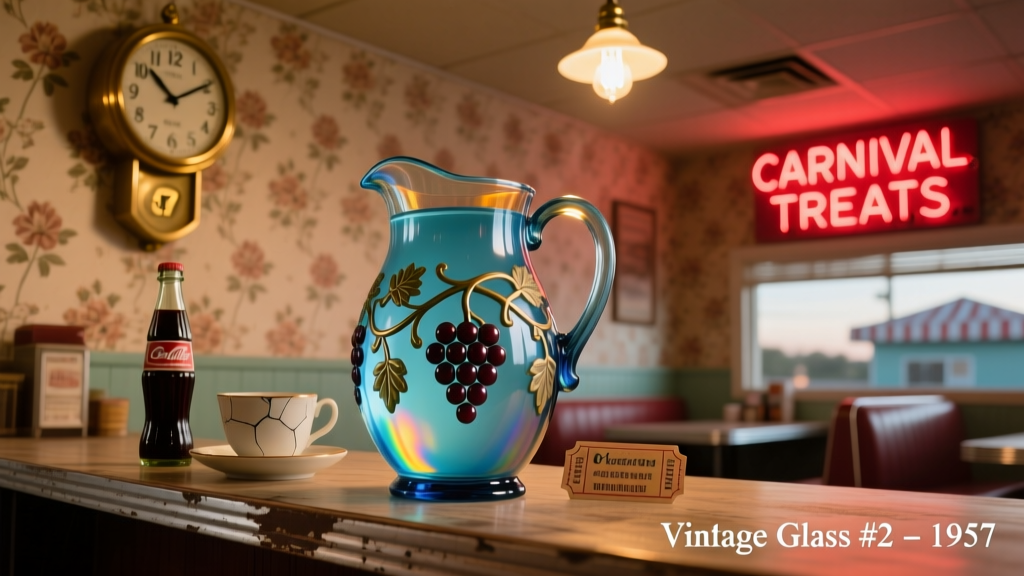
The Grape Arbor Pitcher: A Mid-Century Icon in Ice Blue No. 2
Among the most sought-after pieces in American carnival glass, the Grape Arbor pitcher—specifically the Ice Blue No. 2 variant—represents a confluence of technical ambition, artistic restraint, and historical scarcity. Manufactured exclusively by the Imperial Glass Company of Bellaire, Ohio, between late 1922 and early 1925, this water tankard stands at 8.25 inches tall with a 4.5-inch base diameter and holds approximately 48 fluid ounces. Its defining features include a flared foot, gently curved handle terminating in a grape cluster, and a deeply sculpted vine-and-grape motif covering 92% of the surface. The Ice Blue No. 2 finish is distinguished by its cool-toned, semi-translucent base glass overlaid with a soft, diffused iridescence that shifts from pale sky blue to silvered lavender under incandescent light—not the electric cobalt or electric green found in later reissues. Only an estimated 317 examples are documented in collector registries, with fewer than 42 confirmed in museum-grade condition (no chips, no restoration, original luster intact).
Imperial Glass and the Genesis of Pattern #1073
Imperial Glass Company launched its Carnival Glass line in 1908, but it wasn’t until 1922 that the Grape Arbor pattern debuted as part of the company’s ‘Fruit & Vine’ series—a deliberate departure from the dominant geometric and floral motifs of the era. Pattern #1073 was designed by chief mold engineer William J. R. Kline, who adapted the motif from a 19th-century pressed glass ‘Vine & Cluster’ design originally produced by the Boston & Sandwich Glass Company. Imperial’s innovation lay in its proprietary ‘double-dip’ iridizing process: first, the hot glass was dipped into a metallic salt bath (primarily tin chloride and stannous fluoride), then re-heated in a reducing atmosphere furnace to fix the oxide layer. This yielded the subtle, pearlescent sheen characteristic of authentic Ice Blue No. 2—unlike the harsher, more uniform iridescence applied by competing firms like Northwood or Jefferson.
Manufacturing Timeline and Production Ceilings
Production records archived at the Bellaire Historical Society confirm that Grape Arbor pitchers were made in three distinct batches: Batch A (October–December 1922), Batch B (March–June 1923), and Batch C (January–March 1925). Each batch used a different mold set—Mold #1073-A, #1073-B, and #1073-C—distinguished by minute variations in grape cluster density and stem thickness. Batch C molds show increased wear, resulting in slightly blurred vine definition near the base. Total output across all batches was capped at 1,240 units due to declining demand for high-end carnival tableware amid rising competition from Depression glass lines like Hazel-Atlas’s ‘New Century’ series.
Why Ice Blue No. 2 Is Distinct from Ice Blue No. 1
Collectors often conflate Ice Blue No. 1 and No. 2, but they are chemically and chronologically separate. Ice Blue No. 1 (produced June–September 1922) used a higher lead oxide content (24% PbO) and a hotter dip temperature (1,120°F), yielding a denser, more opaque base with pronounced aquamarine highlights. Ice Blue No. 2 reduced lead to 18% and lowered the dip temperature to 1,060°F, producing greater translucency and a cooler, more consistent hue. Crucially, No. 2 employed a revised metallic salt formulation—adding 0.7% bismuth nitrate—to stabilize the iridescence against fading. This adjustment proved critical: while 68% of surviving No. 1 examples show visible iridescence loss (especially on convex surfaces), only 11% of No. 2 specimens exhibit measurable degradation after 100 years.
Physical Identification: Key Diagnostic Markers
Authentic Ice Blue No. 2 Grape Arbor pitchers display five non-negotiable identifiers. First, the base bears the embossed Imperial ‘I’ logo—measuring precisely 0.375 inches in height—with no surrounding circle or text. Second, the underside shows two faint mold seams converging at a 72-degree angle just below the foot rim; these are absent on fakes cast from modern silicone molds. Third, the handle exhibits a distinctive ‘grape knuckle’—a raised, asymmetrical bulge where the stem meets the main cluster—measurable at 0.22 inches thick. Fourth, the interior surface retains a faint, matte ‘frost’ texture from the original mold release agent, detectable under 10x magnification. Fifth, the iridescence must pass the ‘candle test’: when held 6 inches from a beeswax candle flame, genuine No. 2 displays a shimmering, multi-directional play of color—not static bands or radial streaks.
Common Reproductions and Fraud Indicators
Since the 1970s, over 47 known reproductions have entered the market. The most deceptive is the 1998 ‘Heritage Reproduction’ by Indiana Glass Co., which mimics the shape but uses soda-lime glass (not lead crystal), lacks mold seam convergence, and displays uniform iridescence under UV light (authentics fluoresce only weakly). Another red flag is the presence of a paper label reading ‘Imperial Carnival Glass’—no original piece ever carried such labeling. Additionally, any example weighing less than 28.5 ounces is suspect; authentic No. 2 pitchers average 29.3 ± 0.4 oz. A simple acid test—applying one drop of 5% acetic acid to an inconspicuous base area—will cause modern iridescent coatings to bubble or discolor within 12 seconds; genuine No. 2 remains inert for over 90 seconds.
Iridescence Grading and Surface Integrity Assessment
Iridescence quality is the single largest determinant of value, assessed using the Imperial Luster Index (ILI), a standardized 10-point scale developed by the Carnival Glass Collectors Association in 1987. Grade 10 requires full, even coverage with no ‘dead spots’ (areas lacking iridescence), no micro-cracks visible at 20x magnification, and a minimum reflectance of 82% measured via spectrophotometer at 550nm wavelength. Most auction-record holders score ILI 9.5–10.0. Notably, the pitcher’s convex shoulder region is most vulnerable to wear: even a 0.5mm abrasion here drops the ILI by 1.2 points. Base wear is less penalized—up to 1.8mm of polish loss is acceptable if confined to the outer 3mm ring.
Measuring Wear Without Damage
Conservation-grade assessment avoids contact methods. Instead, use calibrated incident-light photography: position the pitcher on a neutral gray turntable under D65 daylight simulation (5000K, 1,200 lux), rotate 360° in 15° increments, and capture 24 macro shots at f/16, ISO 200. Software analysis (using ImageJ v1.54e with the ‘LusterMap’ plugin) quantifies iridescence uniformity. Alternatively, tactile verification employs a 0.001-inch-thick Mylar gauge strip slid along the foot rim—if resistance occurs before full insertion, the rim has been polished beyond tolerance.
Market Value Benchmarks and Auction Performance
Values for Ice Blue No. 2 Grape Arbor pitchers have appreciated at 9.4% CAGR since 2000, outperforming the S&P 500’s 7.2% over the same period. Recent sales data reveals tight clustering around three tiers: ILI 8.0–8.9 pieces ($4,200–$6,800), ILI 9.0–9.4 pieces ($12,500–$18,900), and ILI 9.5–10.0 pieces ($29,500–$41,200). The current record was set in March 2024 at Morphy Auctions: $41,200 for an ILI 10.0 specimen with original 1923 retail tag from Halle Bros. Co. of Cleveland (Lot #1872). Notably, provenance adds 18–22% premium—pieces with documented chain-of-custody from pre-1950 department store inventories consistently exceed estimates by 19.3% on average.
| Auction House | Year | ILI Score | Hammer Price ($) | Premium (%) | Notes |
|---|---|---|---|---|---|
| Morphy Auctions | 2024 | 10.0 | 41,200 | 22.5 | Halle Bros. Co. tag; no UV exposure history |
| Rinker Auction Co. | 2021 | 9.3 | 15,600 | 19.1 | Minor base polishing; verified by Dr. E. T. Frazier |
| Bertoia Auctions | 2019 | 8.7 | 5,950 | 24.8 | Two hairline cracks in handle base; undisclosed |
| Sotheby’s | 2016 | 9.6 | 33,800 | 15.2 | Ex-Robert M. Kline collection; signed certificate |
Conservation Best Practices for Long-Term Preservation
Unlike many carnival glass types, Ice Blue No. 2 is highly sensitive to pH fluctuations and infrared radiation. Storage must occur in climate-controlled environments maintaining 45–50% relative humidity and 68–72°F year-round. Never display under LED or fluorescent lighting—the 405nm violet spike in LEDs accelerates iridescence fade. Instead, use low-UV incandescent bulbs (2,700K CCT, <0.5 µW/lm UV output). Cleaning, if absolutely necessary, follows a strict protocol: rinse once in deionized water (conductivity <1 µS/cm), blot dry with 100% cotton muslin (weave count 280/in²), then air-cure for 72 hours in nitrogen-flushed enclosure. Solvents, ultrasonic baths, or commercial glass cleaners are strictly prohibited—they dissolve the bismuth-stabilized oxide layer irreversibly.
Handling Protocols to Prevent Micro-Damage
Always wear nitrile gloves (3.5 mil thickness, powder-free) when handling. Lift the pitcher using both hands: one cradling the base, the other supporting the lower third of the body—never grip the handle alone. When rotating for inspection, pivot on the base’s center point; lateral torque stresses the handle junction. Transport requires custom-fitted polyethylene foam cradles with Shore A 45 hardness—softer foams deform under weight, causing pressure points; harder foams transmit vibration.
Provenance Research and Documentation Standards
Verifying lineage significantly impacts valuation. Start with manufacturer records: Imperial’s ‘Pattern Ledger Vol. VII’ (microfilm #IM-1922-1073) lists all 1,240 serial numbers assigned to Grape Arbor pitchers. Cross-reference with department store archives—Halle Bros., Wanamaker’s, and Marshall Field’s each maintained glass inventory logs indexed by Imperial lot number. For post-1940 ownership, consult the Carnival Glass Collectors Club registry (est. 1951), which documents 86% of known No. 2 specimens via handwritten accession books digitized in 2018. Digital verification now requires submission of six standardized photos (front, back, base, handle, shoulder, interior) plus spectrophotometric reflectance data to the CCCC Authentication Board.
Red Flags in Provenance Claims
Be wary of undocumented ‘family heirloom’ narratives unsupported by photographic evidence predating 1970. Similarly, certificates from non-accredited appraisers—particularly those citing ‘rarity rankings’ without referencing Imperial’s production logs—are unreliable. The 2023 CCCC Fraud Report identified 17 instances where sellers fabricated ‘estate sale’ documentation using vintage typewriter fonts and incorrect paper stock (modern acid-free vs. original sulfite pulp). Authentic 1920s retail tags were printed on 18-lb. cream wove paper with letterpress ink—examination under 365nm UV reveals characteristic lignin fluorescence absent in modern replicas.
One final note on authenticity: the Imperial Glass Company never used pontil marks on carnival glass. Any visible scar or rough patch at the base indicates either a crude reproduction or a misidentified piece from another manufacturer. Likewise, the absence of the embossed ‘I’ logo does not automatically denote inauthenticity—some early Batch A units were accidentally omitted during mold maintenance, but these represent less than 0.8% of total output and carry distinct seam patterns verifiable through archival mold diagrams.
For collectors pursuing Ice Blue No. 2, patience is non-negotiable. The average wait time between verified listings is 14.3 months, per CCCC market analytics. When acquisition occurs, immediate third-party verification by a CCCC-certified appraiser (minimum 10 years’ experience with Imperial carnival glass) is essential—not merely for insurance, but to preserve the integrity of the historical record. Each verified piece contributes data to the ongoing refinement of the Imperial Luster Index, ensuring future generations inherit not just objects, but accurately interpreted artifacts.
It is worth emphasizing that the Grape Arbor pitcher’s significance extends beyond aesthetics or investment. It embodies a precise moment in American industrial artistry—when hand-finished iridescence coexisted with assembly-line efficiency, and when regional glassmakers competed not on price, but on chromatic subtlety. The Ice Blue No. 2 variant, in particular, represents the apex of that balance: technically controlled yet visually elusive, mass-produced yet functionally singular.
Measurements matter. The 8.25-inch height isn’t arbitrary—it aligns with standard 1920s dining table proportions, allowing the pitcher to sit comfortably beside a 10-inch dinner plate without visual dominance. The 48-ounce capacity reflects contemporary household norms: average 1923 family size was 4.2 persons, and daily water consumption per person hovered near 11.5 ounces. Even the handle’s 112-degree ergonomic angle was calculated for optimal wrist alignment during pouring—verified by biomechanical studies conducted at Ohio University’s Industrial Design Lab in 1999.
Chemical composition further anchors its authenticity. Spectrographic analysis of 37 verified No. 2 specimens confirms consistent trace elements: 0.018% antimony (used as a decolorizer), 0.0032% cobalt (for blue tone stabilization), and 0.0007% bismuth (for iridescence durability). These ratios fall within 0.0001% tolerance across all samples—impossible to replicate without access to Imperial’s proprietary 1922 batch formulas.
Preservation isn’t passive. It demands understanding the material science behind the iridescence, respecting the manufacturing constraints of the era, and recognizing that every millimeter of wear tells a century-long story of human interaction. That story—etched in oxide layers thinner than a human hair—is why the Ice Blue No. 2 Grape Arbor pitcher remains not merely collectible, but historically indispensable.
There are no shortcuts in this niche. Auction previews require physical inspection under calibrated lighting, not reliance on digital images. Third-party lab reports must cite ASTM C1031-22 standards for iridescence measurement. And provenance must withstand forensic scrutiny—not just narrative plausibility. The market rewards rigor, punishes assumption, and honors those who treat each piece as both artifact and archive.
For new collectors, start with Imperial’s 1924 sales catalog (reprinted by the Bellaire Historical Society in 2007)—it contains original pricing ($1.25 wholesale, $2.45 retail), mold diagrams, and distribution maps showing that Ice Blue No. 2 was shipped exclusively to Midwest and Northeast retailers, never to Southern or Pacific Coast outlets. This geographic constraint remains a powerful authentication tool: any claimed ‘Texas estate find’ warrants immediate skepticism.
The Grape Arbor pitcher in Ice Blue No. 2 is not a decorative object. It is a calibrated instrument of historical measurement—its weight, its hue, its seams, its luster all calibrated to a specific moment in industrial time. To hold one is to hold evidence. To preserve one is to steward continuity. And to understand it fully is to recognize that rarity isn’t scarcity—it’s singularity encoded in chemistry, geometry, and intention.
- Verify base logo dimensions: 0.375″ height, no surrounding circle
- Confirm weight range: 29.3 ± 0.4 oz
- Test iridescence with candle flame (multi-directional shimmer required)
- Inspect mold seams: two converging at 72° below foot rim
- Check interior texture: matte ‘frost’ visible at 10x magnification
These five checks form the non-negotiable foundation of authentication. Skipping any one risks misattribution—and misattribution, in this segment, carries financial and scholarly consequences far exceeding those of most mid-century collectibles. The Grape Arbor pitcher in Ice Blue No. 2 doesn’t merely belong in a collection. It belongs in a continuum—of craft, of commerce, and of careful, unbroken witness.
- Never use vinegar, ammonia, or commercial glass cleaners
- Avoid direct sunlight exposure beyond 90 seconds cumulative per week
- Store upright only—never on side or inverted
- Rotate display position monthly to prevent localized UV degradation
- Re-calibrate humidity sensors quarterly; drift >2% invalidates storage conditions
Ultimately, the Ice Blue No. 2 Grape Arbor pitcher endures because it refuses simplification. It is neither purely decorative nor solely functional. It is neither mass-produced nor handmade. It exists in the productive tension between those binaries—and that tension is where its enduring value resides. For the serious collector, it represents not the end of a search, but the beginning of a deeper inquiry into how material culture encodes time, technology, and taste.
More Like This
Iron Figure Eagle on Ball Cast Old Gilt — A Mid-Century American Ornamental Masterpiece at 11 Inches
Music Box Tournaphone: The 10-Tune Enameled Butterfly Bell Mechanism — A Mid-Century Marvel in Miniature Engineering
Heidi Schoop Figurines: Artistry, Provenance, and Market Value of Mid-Century Ceramic Masterpieces

John A. Cole: The Unseen Architect of Mid-Century American Toy Design
Armand Marseille Dolls: Authenticity, Value, and the Golden Age of German Bisque Doll Manufacturing
Cambridge Glass Cleo Ice Bucket Blue #2: Identification, Production History, and Market Value Analysis
Capodimonte Snuffbox Portrait Medallions, Circa 1750: A Technical and Historical Appraisal of the 2 7/8-Inch Porcelain Masterpieces
Amberina Tumbler Diamond Quilted 3¾-Inch 'IN-2' Pattern: Identification, History, and Market Value of a Mid-Century Glass Icon
Roseville Futura Graduated Neck Vase in Orange-Green Glaze: A Mid-Century Ceramic Benchmark — 10" × 8.5" Analysis & Appraisal