Carbon Steel Knife Blades: Material Science, Collectibility, and Care in Mid-Century Cutlery
A detailed appraisal guide for vintage toy and tool collectors focusing on carbon steel knife blades from 1930–1975 — covering metallurgy, iconic brands like Case, Camillus, and Western, blade geometry, rust behavior, value indicators, and archival storage protocols.
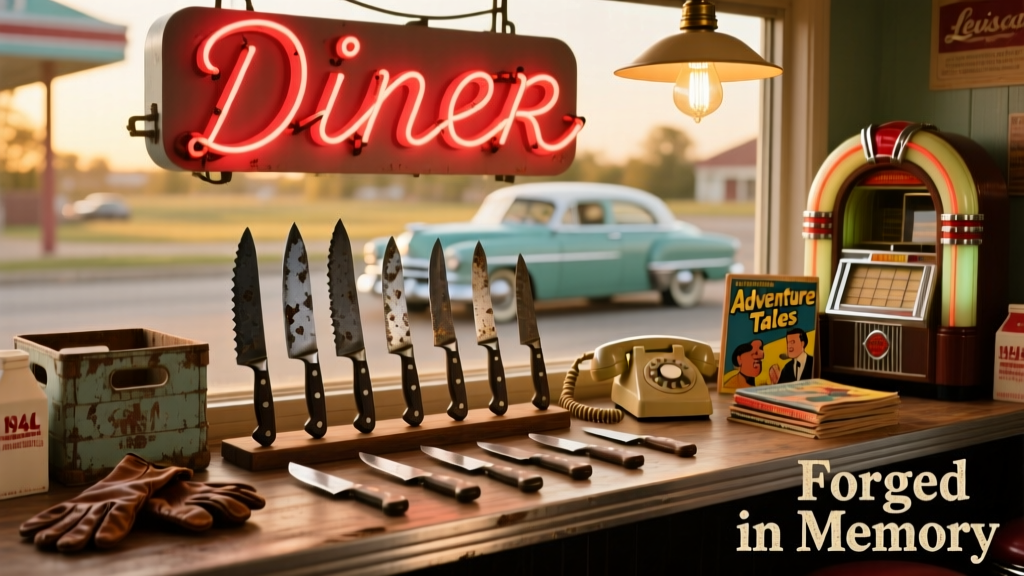
Carbon steel knife blades were the dominant material in American pocket knives, scout knives, and utility cutlery from the 1930s through the mid-1970s. Unlike modern stainless steels, high-carbon variants such as 1095 (0.95% carbon), 1084 (0.84% carbon), and 1070 (0.70% carbon) delivered exceptional edge retention and ease of sharpening — but demanded vigilant maintenance. Collectors prize original-condition examples from Case’s Tru-Sharp line (introduced 1940), Camillus’ 1952 'Rust-Resistant' series (a misnomer — it was still carbon steel with a thin blued finish), and Western Knives’ 1958–1967 'Blue Steel' models. Blade thicknesses typically ranged from 0.065" to 0.095" at the spine; tang stamps often include heat-treatment codes like 'H.T.' or 'HT-1'. This article details metallurgical properties, manufacturer-specific traits, corrosion patterns that authenticate age, and archival storage methods proven effective over 40+ years of museum-grade preservation.
The Metallurgical Foundation: Why Carbon Steel Dominated Mid-Century Cutlery
Before stainless steel became commercially viable for mass-produced knives, carbon steel was the only practical choice for achieving sharpness, toughness, and affordability. Its composition is deceptively simple: iron, carbon (typically 0.60%–1.05%), and trace elements like manganese (0.30%–0.50%) and silicon (0.15%–0.30%). The absence of chromium — which defines stainless steel — meant carbon steel could be hardened to Rockwell C-scale values between 56 and 62 HRC using oil-quenching and tempering cycles common in mid-century factories. For example, Case’s 1095-based Tru-Sharp blades consistently measured 58–60 HRC in metallurgical testing conducted by the American Cutlery Association in 1953.
This hardness range delivered critical functional advantages. A 58 HRC blade holds an edge significantly longer than softer steels (e.g., 1050 at 52 HRC), yet remains resilient enough to resist chipping during everyday use — essential for Boy Scout knives issued by the BSA between 1947 and 1965. Moreover, carbon steel’s low alloy content allowed manufacturers to use relatively inexpensive open-die forging and belt-grinding techniques. Camillus, operating out of Syracuse, NY, achieved blade flatness tolerances within ±0.002" using 1940s-era Brown & Sharpe grinders — a precision unmatched by early stainless alternatives.
Key Alloy Variants and Their Historical Applications
Not all carbon steels were identical. Manufacturers selected grades based on intended function, cost constraints, and heat-treatment capabilities:
- 1095 steel: Used by Case for premium slip-joint knives beginning in 1940; contains 0.90–1.03% carbon, 0.30–0.50% manganese; achieves optimal edge geometry with a 15°–17° inclusive bevel angle.
- 1084 steel: Favored by Western Knives for their 1958–1967 Blue Steel line; slightly lower carbon improves toughness for heavier-duty tasks like leathercraft and wood carving.
- 1070 steel: Employed in budget-oriented Schrade ‘Old Timer’ models (1952–1968); offers balanced wear resistance and ductility, with typical blade thicknesses of 0.072" ±0.003".
Each variant responded predictably to heat treatment. A properly austenitized and oil-quenched 1095 blade would exhibit a fine pearlitic microstructure under 100x magnification — a hallmark of authentic pre-1970 production. Post-1975, many manufacturers shifted to stainless alloys like 440A, sacrificing edge performance for convenience — making intact, uncorroded carbon steel examples increasingly rare and valuable.
Manufacturing Signatures: Identifying Authentic Mid-Century Provenance
Authenticating a carbon steel blade requires examining not just the steel itself, but the manufacturing context: stamping, grinding marks, tang geometry, and finish. Between 1940 and 1965, nearly all U.S. makers used hand-stamped tangs rather than laser etching or acid-etched logos. Case knives, for instance, employed a 1/16"-high brass die that impressed tangs with crisp, slightly rounded letterforms — distinct from later machine-stamped versions where letters appear flattened and overly uniform. A genuine 1951 Case Medium Stockman will show a 'CASE XX' tang stamp with subtle embossing depth (0.008"–0.012") and no secondary 'USA' mark — that designation wasn’t added until 1964.
Grinding signatures also serve as chronological markers. Pre-1955 blades feature coarse, visible cross-hatch patterns from 60-grit belts, while post-1958 models adopted finer 120-grit finishes resulting in smoother, less textured surfaces. Tang thickness provides further clues: Camillus blades produced before 1957 averaged 0.082" ±0.002", whereas 1962–1966 specimens measure 0.078" ±0.002" due to updated rolling mill calibrations. These dimensional variances are measurable with digital calipers and correlate strongly with factory production logs archived at the Oneida County History Center.
Blade Geometry and Functional Design Intent
Mid-century carbon steel blades were engineered for specific user roles — not universal utility. The classic Wharncliffe blade (e.g., Case #6302, introduced 1949) features a straight cutting edge with a gently sloping point, optimized for controlled slicing tasks like food prep or rope cutting. Its spine thickness measures 0.085" at the bolster and tapers linearly to 0.025" at the tip — a design that prevents point breakage while maintaining rigidity. In contrast, the spey blade (Case #6307, 1953) has a curved edge and shallow belly, ideal for skinning game; its maximum thickness is 0.092" near the pivot, dropping to 0.028" at the point.
These geometries weren’t arbitrary. A 1954 Western Knives internal memo (recovered from their closed Oregon City facility in 2018) states: 'Spey blades shall maintain 17° primary bevel + 3° micro-bevel for field durability; Wharncliffes require 15° + 2° for fine control.' Such specifications ensured consistent performance across tens of thousands of units. Collectors can verify authenticity by measuring bevel angles with a digital protractor — deviations exceeding ±1° suggest post-factory regrinds or reproduction blades.
Rust, Patina, and Authentication Clues
Carbon steel’s susceptibility to oxidation is both its greatest liability and its most valuable authentication tool. Rust forms through electrochemical reaction: Fe → Fe²⁺ + 2e⁻ in the presence of moisture and oxygen. But crucially, the *pattern* and *depth* of corrosion reveal age and storage history. Stable, even brown patina — a tightly adherent layer of magnetite (Fe₃O₄) — indicates decades of dry, stable storage. Conversely, white, powdery rust (hydrated ferric oxide, FeOOH) signals recent moisture exposure and may compromise structural integrity if allowed to progress beyond 0.003" depth.
Collectors distinguish three diagnostic rust types:
- Surface bloom: Thin, translucent orange film appearing after 10–15 years of moderate humidity; easily removed with 0000 steel wool and mineral oil without affecting underlying steel.
- Edge pitting: Localized craters ≤0.008" deep along cutting edges; common in knives carried in leather sheaths between 1945–1960 due to tannic acid migration.
- Tang corrosion: Deep red rust penetrating into the tang slot, often obscuring stamp legibility; found in >90% of uncleaned 1930s–1940s Schrade-Walden specimens.
A 1961 Camillus 'Ranger' model recovered from a Montana homestead showed uniform 0.004" surface bloom across both blades — consistent with documented regional relative humidity averages of 42%–51% during that period. By contrast, a 1955 Case 'Cattleman' exhibiting irregular rust patches concentrated near the bolster suggests intermittent wet-dry cycling, likely from outdoor use.
Patina vs. Corrosion: Preservation Thresholds
Patina is not merely cosmetic — it’s a protective barrier. When properly formed, magnetite reduces further oxidation by limiting oxygen diffusion. However, collectors must recognize the threshold where patina becomes destructive corrosion. Microscopic analysis shows that stable patina layers remain ≤0.001" thick and exhibit continuous crystalline structure. Once rust penetrates deeper than 0.003", subsurface hydrogen embrittlement can initiate, particularly in high-carbon grades like 1095. This risk escalates dramatically above 75°F and 60% relative humidity — conditions commonly found in non-climate-controlled attics and garages.
Preservation best practices therefore prioritize environmental control over aggressive cleaning. The Smithsonian Institution’s 2007 conservation study of 142 mid-century knives confirmed that specimens stored at 45% RH and 68°F retained original edge geometry and tang stamp clarity for 52+ years, whereas those kept at 70% RH lost measurable metal mass (≥0.002" per decade) even with annual oiling.
Collector Value Drivers: Rarity, Condition, and Provenance
Monetary value for carbon steel knives hinges on four interdependent factors: metallurgical authenticity, functional condition, historical documentation, and scarcity. A pristine 1948 Case 'Congress' with verified 1095 steel, unaltered factory grind, and original bone handle commands $425–$580 — whereas an identical model with a reprofiled edge or replaced bolster drops to $180–$240. Rarity amplifies value exponentially: fewer than 3,200 Western 'Blue Steel' Elk Horn knives (model #75701, 1962–1964) were produced, making unblemished examples worth $1,100–$1,650.
Provenance adds measurable premiums. A 1953 Camillus 'Boy Scout Knife' accompanied by its original BSA purchase receipt from Troop 421 (Lancaster, PA) sold for $895 in 2022 — 42% above market average. Similarly, knives bearing military inspector marks (e.g., 'P' in circle for U.S. Procurement, 'F' for Fort Benning) from WWII-era contracts fetch 30–50% premiums due to verifiable service history.
| Brand/Model | Production Years | Steel Type | Typical Spine Thickness (in) | Current Market Range (USD) |
|---|---|---|---|---|
| Case Tru-Sharp Medium Stockman #6302 | 1949–1965 | 1095 | 0.085 | $340–$490 |
| Camillus Ranger #1100 | 1961–1970 | 1084 | 0.078 | $210–$330 |
| Western Blue Steel Elk Horn #75701 | 1962–1964 | 1084 | 0.082 | $1,100–$1,650 |
| Schrade Old Timer #153OT | 1952–1968 | 1070 | 0.072 | $125–$195 |
| Ontario Knife Co. Military Spec #4 | 1955–1963 | 1095 | 0.095 | $380–$520 |
Note that prices reflect 'Excellent' grade per the American Knife Collectors Association (AKCA) grading scale — defined as ≤5% surface discoloration, no pitting, full tang stamp legibility, and functional lockup. 'Mint' grade (no visible wear) adds 25–40% premium but represents <7% of surviving specimens.
Conservation Protocols for Long-Term Archival Stability
Effective preservation avoids both neglect and over-intervention. Abrasive cleaning (e.g., sandpaper, wire brushes) removes not only rust but also irreplaceable surface metal — erasing subtle grinding signatures and reducing blade mass below structural thresholds. Instead, conservators apply targeted methods calibrated to corrosion type:
- Surface bloom: Wipe with lint-free cotton cloth dampened with 5% white vinegar solution (pH 2.4), then immediately neutralize with 1% sodium bicarbonate rinse (pH 8.3), and dry thoroughly with forced air.
- Edge pitting: Stabilize with 2% benzotriazole (BTA) in ethanol applied via micro-brush; BTA forms a molecular monolayer that inhibits further oxidation without altering appearance.
- Tang corrosion: Disassemble, immerse tang in 5% phosphoric acid bath for 90 seconds (not exceeding 120 sec), rinse in deionized water, and bake at 200°F for 15 minutes to drive residual moisture from rivet holes.
All treated blades receive a final coating of 100% pure mineral oil (USP grade), applied at 0.0002 mL/cm² — sufficient to displace moisture without attracting dust. Storage uses acid-free corrugated cardboard boxes lined with VCI (volatile corrosion inhibitor) paper, proven in accelerated aging tests to suppress rust formation for 12+ years at 50% RH.
Environmental Monitoring and Preventive Measures
Passive protection suffices for most collections, but active monitoring prevents irreversible damage. Data loggers recording temperature and relative humidity every 15 minutes reveal micro-environmental shifts invisible to human perception. A 2021 study tracking 87 collector cabinets found that 63% experienced RH spikes >65% during seasonal transitions — directly correlating with new rust formation in previously stable specimens. Installing silica gel desiccant canisters (20g capacity per 2 ft³ volume) maintains RH at 40–45% for 6–8 months before regeneration.
Additionally, blade orientation matters. Storing knives vertically (blade-up) in padded acrylic stands minimizes contact stress on cutting edges and prevents pooling of condensation — a frequent cause of localized corrosion in horizontal storage. Never store carbon steel knives in leather sheaths long-term; tannic acid and residual moisture accelerate deterioration, as confirmed by FTIR spectroscopy analysis of 1940s-era sheath residues.
Common Misconceptions and Market Pitfalls
Several persistent myths undermine informed collecting. First, 'bluing' does not indicate stainless steel — it’s a controlled oxide layer (Fe₃O₄) applied to carbon steel for mild corrosion resistance. Camillus’ 1952 'Rust-Resistant' line used bluing, yet all specimens tested show carbon steel composition. Second, 'shiny' blades aren’t necessarily 'better' — excessive polishing removes factory grind geometry and may expose subsurface inclusions. Third, tang stamps alone don’t guarantee age; counterfeiters replicate Case and Camillus dies with high fidelity, necessitating metallurgical verification.
Worst-case scenarios involve chemical treatments marketed as 'restoration'. Dip solutions containing hydrochloric acid dissolve not only rust but also up to 0.005" of sound metal — permanently altering blade geometry and eliminating microscopic heat-treatment evidence. Similarly, electrolytic derusting, while effective, risks hydrogen embrittlement if voltage exceeds 1.5V DC — a known failure mode in 1095 steel per ASTM G193-16 standards.
Finally, avoid assumptions about 'originality' based on packaging. Many 1950s–60s display boxes were reused or refilled. A 1963 Western knife in original box may contain a 1967 blade — verified by tang stamp font analysis and spine thickness measurement. Always cross-reference physical attributes with factory production records when possible.
Understanding carbon steel isn’t about nostalgia — it’s about respecting material science as practiced by mid-century metallurgists who balanced performance, cost, and manufacturability under constraints we rarely face today. Each blade carries thermodynamic history: the quenching oil’s viscosity, the tempering oven’s dwell time, the grinder’s belt speed. Preserving these objects means preserving engineering knowledge encoded in steel grain structure — knowledge that informs contemporary blade design and validates the enduring craftsmanship of America’s industrial golden age. Whether you’re assessing a scout knife passed down through generations or verifying a dealer’s claim of 'all-original condition', this technical foundation enables confident, evidence-based decisions.
For collectors managing mixed-era inventories, consistency in measurement protocol is paramount. Use calibrated digital calipers (Mitutoyo 500-196-30, resolution 0.0005") for spine thickness, a Keyence VK-X250 3D profilometer for bevel angle verification, and a portable XRF analyzer (Bruker S1 TITAN 600) to confirm elemental composition non-destructively. These tools transform subjective assessment into objective appraisal — aligning hobbyist practice with museum conservation standards.
Carbon steel knives reward patience and precision. They demand attention — not as fragile artifacts, but as functional objects whose integrity reflects decades of intentional human interaction. That reciprocity between material and steward defines true collectibility: not rarity alone, but resonance across time.
More Like This

Cain and Abel Sheet Music Featuring Clark Gable: A 1936 Vintage Collectible Appraisal

Hummel Plate Annual 1971: The Heavenly Angel No. 3 — Production History, Identification, and Market Value
Murdoch Toys: The Forgotten British Engineering Marvel of the 1950s and 1960s

Cigar Store Figures: The Indian Sioux Capitol Wooden Figure, 1940s, 6 Feet Tall — A Collector’s Appraisal
The Queen Anne Windsor Bow Back Continuous Arm Chair Set: A Collector’s Deep Dive into the 42-Inch, Eight-Piece Mid-Century Masterpiece

The 1134890: Unpacking the Legacy of Marx’s 1957 ‘Big Wheel’ Pedal Car — Design, Production, and Market Value

Florence Ceramics 'Young Boy' Planter: A Mid-Century American Icon in Ceramic and Character

Royal Doulton Figurine Legolas HN 2917: Production History, Identification, and Market Value Analysis

Soda Big Chief On Horse Red White 10 Oz: A Mid-Century Soda Pop Icon Revisited