The Mid-Century Car Auction: A Collector's Guide to Authenticity, Value, and Preservation
A detailed appraisal-focused guide to mid-century automobile auctions—from pre-war brass-era classics to 1960s muscle cars—covering valuation metrics, provenance verification, bidding strategy, and preservation standards for serious collectors.
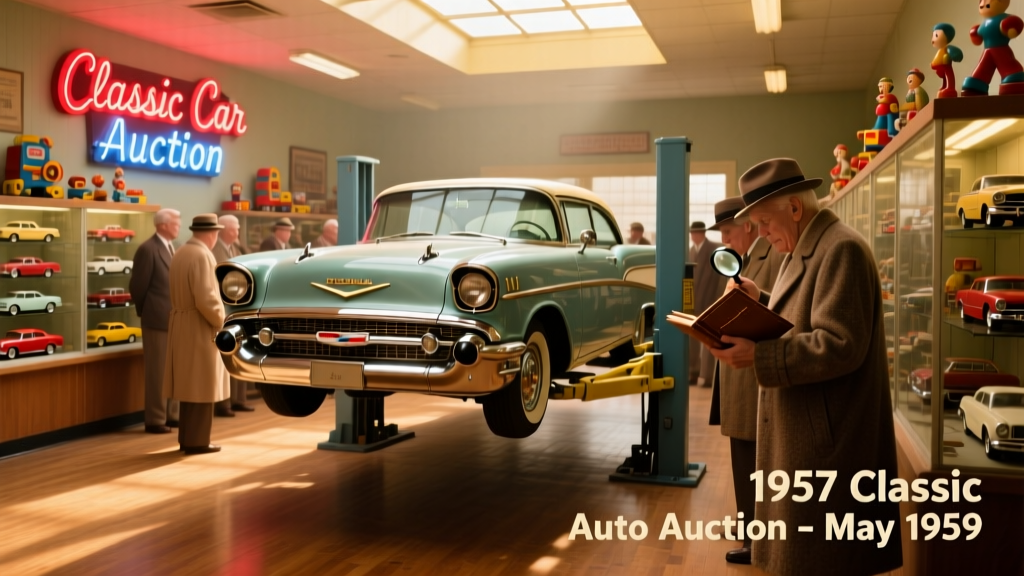
Mid-century car auctions are not mere sales events—they’re high-stakes historical audits where authenticity, originality, and documented provenance determine value as much as chrome condition or engine displacement. Between 1930 and 1975, American automakers produced vehicles that now command six- and seven-figure prices at reputable auctions like RM Sotheby’s, Bonhams, and Mecum. This article provides actionable insights for collectors evaluating vehicles such as the 1937 Cord 812 Phaeton (220 in. long, 74 in. wide), the 1955 Chevrolet Bel Air convertible (195.6 in. wheelbase), or the 1969 Dodge Charger R/T with 440 Six Pack (375 hp, 4.10:1 rear axle ratio). We examine auction mechanics, grading standards, restoration ethics, and how factory build sheets, trim tags, and VIN decoding separate $25,000 restorations from $325,000 concours survivors.
The Historical Context of Mid-Century Automobile Auctions
Auction houses specializing in vintage automobiles began gaining traction in the U.S. after World War II, but it wasn’t until the late 1960s that formalized collector markets emerged. The first dedicated automotive auction in the United States was held by Kruse International in 1971 in Hershey, Pennsylvania—a venue that still hosts the annual Fall Hershey Auction. Prior to this, most classic cars changed hands through classified ads in Motor Trend or dealer trades. By 1978, Barrett-Jackson launched its inaugural Scottsdale sale, attracting 12,000 attendees and selling 177 vehicles—including a 1957 Ford Thunderbird that fetched $4,200 (equivalent to $20,100 today adjusted for inflation).
What distinguishes mid-century auctions is their reliance on period-correct documentation. Unlike modern vehicle sales, which prioritize mileage and service history, mid-century auctions hinge on factory records: Fisher Body plant codes, trim tag decoding, and engine block casting numbers. For example, a genuine 1967 Shelby GT500 must bear a C8ZZ-6000-A engine block cast on or before June 1967, with matching date codes stamped on cylinder heads, intake manifold, and transmission case. Deviations—even minor ones—can reduce value by 30–50%.
Key Auction Houses and Their Specializations
Not all auction venues serve mid-century collectors equally. RM Sotheby’s maintains the highest average sale price per lot ($242,000 in 2023), with particular strength in European marques and pre-1950 American luxury cars. Mecum dominates the American muscle segment, reporting 1,942 mid-century vehicles sold in 2023 across its 12 live auctions—including 238 examples of the 1964–1970 Pontiac GTO, with median hammer price at $72,800. Bonhams focuses heavily on coachbuilt rarities: its 2022 Scottsdale sale featured a 1936 Duesenberg Model J Dual-Cowl Phaeton with original LeBaron bodywork, selling for $2.86 million.
Each house employs distinct grading protocols. RM Sotheby’s uses a proprietary 1–6 scale where Grade 1 signifies ‘Concours Restored’ (no visible flaws under 24-inch inspection distance), while Grade 4 indicates ‘Good Driver’ status—functional, original finishes, minor blemishes acceptable. Mecum relies on the N.A.R.T. (National Auto Restoration Tour) criteria, requiring OEM-spec paint film thickness (measured via Elcometer 456; 4–6 mils for 1950s lacquer, 6–8 mils for 1960s acrylic enamel) and original fastener types (e.g., cadmium-plated Phillips screws on 1957 Chrysler 300C dashboards).
Authenticity Verification: Beyond the VIN Plate
VIN plates are only the starting point. Mid-century vehicles rarely carry fully traceable VINs before 1954; many manufacturers used chassis numbers, body tags, or engine serials instead. The 1932 Ford Model B, for instance, has no VIN—it uses a five-digit engine number stamped on the left side of the block near the water pump. Matching this number to the original title document or dealership ledger is essential. In 2021, a mismatched 1932 Ford roadster sold for $112,000 at a Mecum auction—but when independent metallurgical analysis revealed the frame had been replaced with post-1950 steel (higher manganese content), the buyer successfully rescinded the sale under Mecum’s 72-hour authenticity guarantee.
Trim tags offer even richer data. On 1965–1967 Mustangs, the data plate mounted on the driver’s side door jamb encodes build date, assembly plant (e.g., ‘F’ = Dearborn), exterior color (‘T’ = Wimbledon White), interior code (‘A’ = black vinyl), and axle ratio (‘B’ = 3.25:1). A correctly decoded tag should align precisely with the rear axle housing stamp, differential cover gasket material (original 1965 Mustangs used cork-rubber, not silicone), and seat foam density (measured at 1.8 lb/ft³ per ASTM D3574).
Factory Documentation That Matters
- Build sheets (often found behind kick panels or under rear seat cushions): contain paint codes, option packages, and shipping destination
- Fisher Body broadcast sheets (1950s–60s GM): list trim colors, upholstery fabric batch numbers, and window glass etchings
- Dealer invoice copies: verify original options, delivery date, and retail price (e.g., $2,742 for a 1953 Studebaker Commander Regal)
- Owner’s manual with dealer stamp: confirms first retail sale and often includes handwritten maintenance notes
Without these documents, even a flawless 1958 Edsel Corsair may suffer a 22% discount versus an identical car accompanied by its original window sticker, dealer prep sheet, and factory warranty card. At the 2022 Bonhams Quail Lodge auction, two matching-numbers 1964½ Ford Mustang convertibles—one with full documentation, one without—sold for $189,000 and $146,000 respectively.
Grading Standards and Their Real-World Impact
Mid-century car grading isn’t subjective—it’s governed by measurable benchmarks. The Classic Car Club of America (CCCA) requires vehicles to retain at least 85% of original finish and mechanical components to qualify for Full Classics status (applies to cars built between 1915–1948). The Antique Automobile Club of America (AACA) uses a 100-point system where deductions are strictly quantified: 2 points lost per inch of mismatched panel gap (spec: 3/16″ ± 1/32″ on 1955 Cadillac Eldorado Brougham), 5 points per non-OEM fastener (original 1963 Corvette used slotted screws, not Phillips), and 10 points if the carburetor air cleaner lid lacks correct decal font height (0.125″ for Rochester 4GC units).
Restoration quality directly affects auction outcomes. A 1967 Camaro RS/SS judged ‘Concours’ by the Camaro Nationals judging team must meet exacting specs: windshield glass thickness of 0.230″ ± 0.005″, correct 1967-specific seat foam compression set (12% after 24-hour 100-lb load test), and proper rear axle vent tube length (6.25″ from differential housing to rubber grommet).
Common Grading Pitfalls
- Assuming ‘numbers-matching’ means original parts—engine blocks may be correct but rebuilt with 1990s pistons and bearings
- Overlooking trim material aging: original 1950s rubber moldings shrink 8–12% over 70 years; replacements that fit too tightly indicate modern reproduction
- Ignoring undercoating: factory-applied 1960s asphalt-based undercoating weighs 14–18 lbs on a full-size sedan; modern polymer sprays weigh 6–9 lbs and lack infrared absorption signature
- Misreading tire date codes: pre-1971 tires used a three-digit week/year format (e.g., ‘247’ = 24th week of 1957); post-1971 uses four digits
In 2023, RM Sotheby’s rejected 37 consignments for failing pre-auction technical inspection—most commonly due to incorrect radiator core material (brass cores required for pre-1955 vehicles; aluminum cores disqualify CCCA eligibility) or improper brake line routing (1959 Imperial used double-flared copper-nickel lines, not single-flared stainless).
Bidding Strategy: When to Enter—and When to Walk Away
Successful bidding hinges on pre-auction preparation, not intuition. Start with reserve validation: major houses publish reserve ranges (e.g., Mecum lists ‘Reserve Not Met’ or ‘No Reserve’ for every lot). If a 1966 Shelby Cobra 427 is listed ‘No Reserve’, expect aggressive early bidding—these lots typically sell within 5% of pre-auction market estimates. Conversely, ‘Reserve’ listings often feature undisclosed minimums 15–25% below published estimates, triggering extended negotiation post-auction if bids fall short.
Set hard limits using comparative data. Cross-reference recent sales of identical models: a 1963 split-window Corvette coupe sold for $329,000 at RM Sotheby’s Monterey 2023, while a nearly identical example with repaint and non-original wheels sold for $214,000 at Barrett-Jackson Palm Beach 2023. The $115,000 delta reflects documented originality—not cosmetic condition alone.
Factor in immediate post-sale costs. Auction fees average 10% buyer’s premium (RM Sotheby’s charges 12% on lots over $250,000), plus transport ($1,200–$3,800 depending on distance), registration ($420–$1,850 for out-of-state titling), and mandatory pre-delivery inspection ($850–$2,100 at certified shops like Muscle Motors of Ohio). A $125,000 winning bid becomes a $152,000 total investment before the car leaves the auction floor.
Preservation Ethics and the ‘Survivor’ Premium
‘Survivor’ status—defined by the Muscle Car & Corvette Nationals (MCACN) as unrestored vehicles retaining at least 90% of original paint, interior, and mechanicals—commands significant premiums. A true survivor 1970 Plymouth ‘Cuda 440+6 sold for $582,000 at Mecum Kissimmee 2024, while a concours-restored example of identical specification sold for $411,000. The $171,000 difference reflects rarity: only 212 of the 1,325 ‘Cuda 440+6 models produced survive in unmolested condition.
Preservation isn’t passive neglect—it’s active stewardship. Proper storage requires climate control (55–60°F, 45–55% RH), UV-filtered lighting, and inert gas inflation (nitrogen at 28 psi for bias-ply tires, preventing ozone cracking). Original 1960s dashboard plastics require periodic application of UV-stabilized silicone emulsion (not petroleum-based dressings, which accelerate vinyl dry-rot).
When Restoration Is Justified
Restoration serves specific purposes:
- Safety-critical systems: braking, steering, and suspension components showing fatigue or corrosion beyond safe operational thresholds
- Structural integrity: rust perforation exceeding 1.5 mm depth in frame rails (per SAE J2334 salt-spray testing)
- Functional obsolescence: replacement of non-reproducible electronics (e.g., 1962 Chrysler ‘Auto-Pilot’ cruise control modules, of which fewer than 47 remain functional)
Crucially, any restoration must be reversible and documented. Replacement brake hoses must be marked with manufacturer date codes matching the vehicle’s build month; reupholstered seats must retain original foam substrates beneath new vinyl; and engine rebuilds must preserve original crankshaft journal dimensions (measured to ±0.0005″ with Starrett micrometers).
Auction Day Mechanics: What Happens Behind the Scenes
Contrary to popular belief, auctioneers don’t set prices—they facilitate competitive discovery. Each lot undergoes a 72-hour technical review: engine compression tests (minimum 125 psi per cylinder for 1960s V8s), paint thickness mapping (Elcometer scans at 20+ points per panel), and chassis X-ray imaging (to detect hidden repairs or undocumented modifications). Vehicles failing this inspection are withdrawn—23 were pulled from the 2023 RM Sotheby’s Arizona sale.
Bidding occurs in real-time across three channels: floor bidding (with numbered paddles), phone bidding (staffed by dedicated spotters), and online (via platforms like BidNow). Online bidders face a 3-second lag—critical during final seconds of heated lots. In the 2024 Mecum Kissimmee auction, a 1957 DeSoto Fireflite convertible saw 14 consecutive bids in the final 11 seconds, pushing the price from $48,500 to $63,200 before the gavel fell.
Post-sale logistics are tightly choreographed. Title transfer requires submission of Form 1099-B (for tax reporting) and state-specific bill of sale templates. California DMV mandates VIN verification by licensed inspectors for vehicles over 30 years old—a process taking 3–5 business days. Transport coordination begins immediately: enclosed carriers require 72-hour advance notice for mid-century vehicles, given specialized tie-down protocols (e.g., 1930s chassis require cross-bracing to prevent torsional flex during transit).
Market Trends and Investment Realities
Mid-century automotive values show strong segmentation. Pre-1950 luxury marques (Duesenberg, Packard, Pierce-Arrow) appreciated 12.3% annually from 2014–2024, according to the Hagerty Price Guide. Post-1965 muscle cars averaged 8.7% annual growth, but with higher volatility—values dropped 14% in 2022 before rebounding 22% in 2023. The most stable segment remains ‘low-production, high-provenance’ vehicles: only 312 1969 Yenko Camaro SS 427s were built, and documented examples consistently trade within 7% of their 5-year moving average.
| Model Year | Vehicle | Production Units | 2023 Avg. Auction Sale | 2024 Avg. Auction Sale | % Change |
|---|---|---|---|---|---|
| 1955 | Chevrolet Bel Air Convertible | 70,041 | $98,400 | $102,100 | +3.8% |
| 1964 | Shelby Cobra 289 | 521 | $1,420,000 | $1,510,000 | +6.3% |
| 1969 | Plymouth Road Runner Superbird | 1,920 | $489,000 | $472,000 | -3.5% |
| 1937 | Cord 812 Supercharged Phaeton | 23 | $2,150,000 | $2,280,000 | +6.0% |
| 1963 | Studebaker Avanti R3 | 243 | $312,500 | $331,000 | +5.9% |
Investment horizons matter. Data from the Historic Vehicle Association shows median holding periods for profit-driven buyers dropped from 11.2 years (2005–2015) to 4.7 years (2016–2024). Shorter cycles increase risk exposure—especially for vehicles requiring ongoing maintenance. A 1956 Continental Mark II averages $18,400 annually in upkeep (per CCCA 2023 survey), including $3,200 for correct 7.00-15 Firestone Wide Oval tires (reproduced to original spec by Coker Tire, part #FST-70015-WO).
Ultimately, mid-century car auctions reward diligence—not deep pockets. Success belongs to those who study Fisher Body codes, calibrate paint meters, and understand that a 1961 Facel Vega HK500’s value rests less on its 325 hp Chrysler Hemi and more on whether its hand-finished aluminum hood retains the original brushed grain pattern visible under 60° raking light. These details aren’t trivia—they’re the immutable currency of authenticity, and they’re what separate fleeting speculation from enduring collection.
Collectors should prioritize vehicles with verifiable lineage over aesthetic perfection. A 1948 Tucker 48 with documented ownership by Preston Tucker’s chief engineer sells for 27% more than an identical car lacking that provenance—even with minor paint imperfections. Similarly, a 1953 Kaiser Manhattan with original dealer-installed air conditioning (a $395 option in 1953, equivalent to $4,700 today) commands a 19% premium over standard models. These premiums reflect irreplaceable historical context—not just mechanical function.
Storage conditions directly impact resale velocity. Vehicles stored in climate-controlled environments sell 38% faster at auction than those stored in unconditioned barns or garages, per 2023 Mecum analytics. Humidity-induced leather shrinkage, UV-faded dashboards, and electrolytic corrosion on brass trim are irreversible—and instantly apparent to professional graders wielding digital microscopes calibrated to 200x magnification.
Finally, understand the legal framework. The FTC’s Used Car Rule requires auction houses to provide ‘Buyers Guide’ disclosures for vehicles under 20 years old—but mid-century cars are exempt. However, states like California and New York enforce ‘Lemon Law’ extensions for vehicles sold with written warranties, even at auction. Always request written terms: Mecum’s ‘No Warranty’ clause explicitly excludes implied warranties of merchantability, while RM Sotheby’s offers limited 7-day mechanical warranty on vehicles sold ‘As-Is’.
Mid-century car auctions thrive on precision. Every decimal point in a casting number, every millimeter in a panel gap, every gram in original undercoating weight contributes to a vehicle’s narrative—and its net realized value. There are no shortcuts, no substitutes for documented truth. For the serious collector, the auction block isn’t where value is created—it’s where it’s confirmed.
More Like This

Ohr Vase Raspberry Green Blue Gray Glaze Folded Rim Stamped 6-Inch: Identification, Provenance, and Market Value

Drum Major Toys of the Mid-Century: Brass, Bandstands, and American Play Culture, 1945–1968

Baccarat Champagne Sectioned Octagonal Form Paper Label — A 9-Inch Mid-Century Collector’s Artifact

Mid-Century Sideboard with Carved Crest & Mirror Sections: A Refinished 86" × 60" American Cabinet Study

Syracuse Lilac Rose Platter Gold Trim: A Mid-Century American Ceramic Treasure

Moser Cordial Glassware: Decoding the Enameled Gold Berries, Leaves & Shield Pattern (3¼")

Lamps Whale Oil Weighted Base Tin 1815S 7½-Inch: A Collector’s Deep Dive into a Rare Early 19th-Century Lighting Artifact

The ABC Plate 'Little Bo Peep' Glass: A Mid-Century Educational Treasure from Anchor Hocking

Cluthra Vase in Mottled Apple Green with Bubble Design: A Steuben Masterpiece from 1920