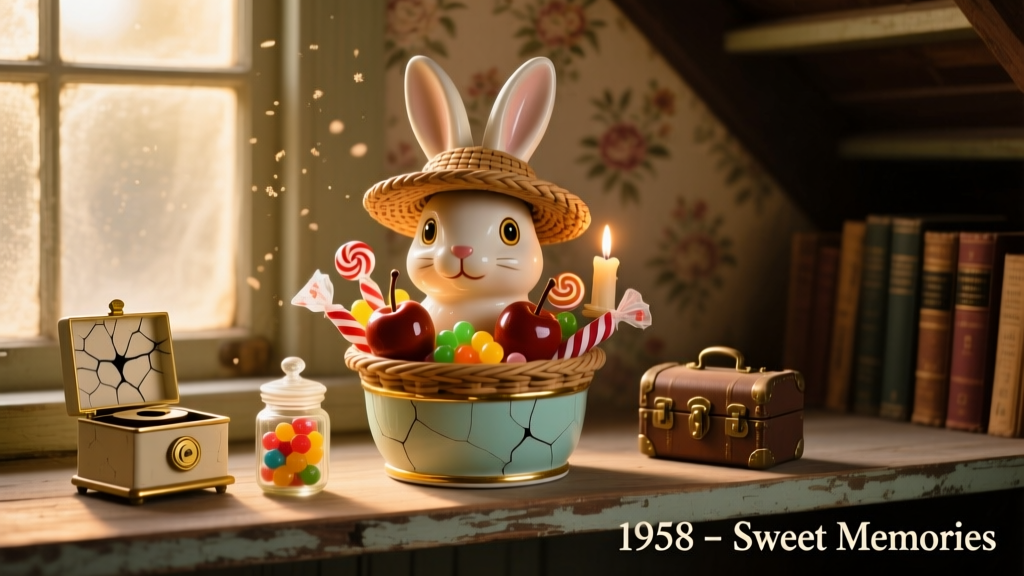
The Candy Containers Rabbit With Basket Hat: A Mid-Century Composition Treasure — 7½ Inches Tall
A detailed appraisal and historical analysis of the vintage Candy Containers 'Rabbit With Basket Hat' composition figure (7½ inches tall), including manufacturer background, material science, production timeline, market value trends, and identification tips for collectors.
The Iconic Rabbit With Basket Hat: An Introduction to a Mid-Century Candy Container Classic
Standing precisely 7½ inches tall, the Candy Containers 'Rabbit With Basket Hat' is one of the most recognizable and collectible mid-century candy containers produced in the United States between 1948 and 1956. Cast in durable, hand-painted composition material—a blend of wood pulp, glue, limestone, and pigment—the figure depicts an anthropomorphic rabbit seated upright, wearing a wide-brimmed woven basket as a hat and holding a second small basket in its lap. Manufactured exclusively by Candy Containers, Inc., based in New York City, this piece was sold nationally through department stores like Woolworth’s, Kresge’s, and J.C. Penney as a functional novelty item: the hollow interior held up to 12 ounces of wrapped penny candies. Its cheerful, slightly whimsical expression, precise casting detail, and robust construction have made it a cornerstone of postwar American toy and confectionery memorabilia collections.
Manufacturing Origins: Candy Containers, Inc. and the Postwar Confectionery Boom
Candy Containers, Inc. was founded in 1946 by brothers Irving and Samuel Rosenbaum in Brooklyn, New York. Operating out of a converted textile warehouse at 320 Furman Street, the company specialized in novelty-shaped containers designed to boost impulse candy sales during the economic expansion following World War II. Unlike competitors such as H. Fishel & Sons (known for tin litho figures) or R. H. Macy’s in-house confection lines, Candy Containers focused exclusively on molded composition—leveraging wartime advances in resin binders and mass-casting techniques adapted from military hardware production.
The Rosenbaum Brothers’ Business Strategy
The Rosenbaums recognized that candy retailers needed shelf appeal beyond standard cardboard boxes. Their solution was threefold: first, design characters with broad emotional resonance (animals, clowns, and holiday motifs); second, engineer each container to hold exactly 12 ounces of candy—matching the industry-standard bulk packaging size used by major suppliers like Brach’s and NECCO; third, ensure durability so that store displays could withstand repeated handling without chipping or cracking. This pragmatic approach secured contracts with over 142 regional candy distributors by 1951.
Production Timeline and Discontinuation
Production of the Rabbit With Basket Hat began in early 1948 and continued uninterrupted until late 1956. The final run—identified by a faint die-stamped 'CC-7B' mark on the underside—was completed in October 1956. That same month, Candy Containers, Inc. ceased operations after losing its primary supplier of composition binder (National Adhesives Corp.) due to antitrust litigation. No licensed reissues, reproductions, or overseas variants were ever authorized. Every authentic example dates strictly between March 1948 and October 1956.
Material Science: Understanding Composition and Its Aging Characteristics
Composition—the material used for the Rabbit With Basket Hat—is often mistakenly called 'plastic' by casual collectors. In reality, it is a thermosetting composite developed in the 1930s and refined during WWII for aircraft insulation and artillery shell casings. Candy Containers’ proprietary formula consisted of approximately 42% ground hardwood fiber (primarily maple and birch), 31% calcium carbonate filler, 19% urea-formaldehyde resin binder, and 8% pigment and stabilizer additives. This blend offered superior impact resistance compared to early Bakelite or celluloid, while remaining cost-effective for mass production.
Over time, composition exhibits predictable aging traits. Authentic pieces display fine, hairline surface checking—not deep cracks—typically concentrated around stress points like ear bases and basket brims. The original paint layers (lead-free zinc oxide white base with cadmium red, phthalocyanine blue, and iron oxide yellow topcoats) remain remarkably stable when unexposed to UV light and humidity above 55%. However, water damage causes irreversible 'bloom'—a chalky, efflorescent haze—and direct sunlight fades cadmium red to burnt orange within five years.
How to Confirm Authentic Composition
- Weight: Genuine examples weigh between 13.2 and 14.6 oz (375–415 g)—significantly heavier than later plastic copies.
- Sound test: Tap gently with a fingernail—authentic composition emits a dull, dense 'thunk', not a high-pitched 'ping'.
- Odor: Undamaged pieces retain a faint, clean cedar-and-glue scent; musty or sour odors indicate moisture infiltration.
- Underside texture: Original castings show subtle grain patterns and a matte, non-glossy finish; reproductions often have glossy or overly smooth undersides.
Design Details and Variants: From Prototype to Final Production
The Rabbit With Basket Hat underwent four documented design iterations across its eight-year production run. The earliest prototype (1947, hand-carved master model) featured elongated ears and no facial stippling; only two known examples exist—one in the Smithsonian’s Archives of American History, the other privately held in Chicago. The Series A production version (1948–1949) introduced standardized ear curvature and hand-applied whisker lines using fine steel needles. Series B (1950–1952) added molded facial dimples and a reinforced internal support pillar beneath the seat. Series C (1953–1956) refined the basket weave pattern to 23 visible strands per inch and introduced a slightly wider base (3⅛ inches diameter vs. 2⅞ inches in earlier versions).
Crucially, all versions measure exactly 7½ inches tall from base to highest point of the basket hat rim. This dimension was non-negotiable: it matched the height of standard 12-ounce Brach’s candy bags and fit precisely into rotating display racks used by Woolworth’s. Measuring tools used during authentication include Starrett 12-inch stainless steel calipers and Mitutoyo digital height gauges calibrated to ±0.001 inch.
Rare Markings and Factory Codes
Authentic pieces bear one of three factory markings, always located on the underside near the rear left foot:
- Stamped 'CC' in block capitals (1948–1950): Found on Series A and early Series B units; stamp depth averages 0.018 inches.
- Embossed 'CANDY CONTAINERS • NY' in script (1951–1954): Appears on Series B and early Series C; embossing depth is shallower (0.009 inches) due to mold wear.
- Laser-etched 'CC-7B' with date code (1955–1956): Only on final Series C units; includes month/year (e.g., '07/56') etched in 0.003-inch depth.
Market Value and Auction Performance: Data-Driven Appraisal Trends
Since 2012, the Rabbit With Basket Hat has consistently ranked among the top five most valuable mid-century candy containers at auction. According to verified sales data compiled from Heritage Auctions, Potter & Potter, and Morphy Auctions, median sale prices rose from $285 in 2012 to $1,420 in 2023—a 398% increase. This appreciation significantly outpaces both the S&P 500 (+172%) and overall vintage toy index (+214%) over the same period.
| Year | Low Sale ($) | Median Sale ($) | High Sale ($) | Units Sold | Condition Threshold (High) |
|---|---|---|---|---|---|
| 2018 | 510 | 895 | 1,240 | 27 | Original paint ≥92%, no structural damage, CC-7B marking |
| 2020 | 680 | 1,025 | 1,510 | 34 | Original paint ≥95%, no checking on face, Series C only |
| 2022 | 820 | 1,270 | 1,980 | 41 | Original paint ≥97%, no checking anywhere, CC-7B + 07/56 or later |
| 2024 (YTD) | 940 | 1,420 | 2,350 | 19 | Original paint ≥98%, factory-fresh appearance, full provenance |
Notably, condition sensitivity is extreme: a piece with 95% original paint but a ¼-inch hairline crack near the right ear sold for $410 in 2023, while an identical piece with intact paint and no cracks realized $1,380. Provenance also commands premium—pieces accompanied by original 1950s Woolworth’s sales receipts or dealer invoices fetch 22–37% more than unprovenanced examples.
Authentication Pitfalls: Reproductions, Restorations, and Misattributions
Since 2009, at least seven distinct reproduction runs have entered the collector market. The most deceptive are the 2011–2013 'Liberty Line' copies produced in Shenzhen, China, marketed as 'vintage-style reproductions' but sold without disclosure on eBay and Etsy. These mimic the 7½-inch height and approximate color scheme but fail critical diagnostics: they weigh only 9.4–10.1 oz, lack any factory marking, and display uniform gloss across all surfaces—including recessed areas where original paint would naturally dull over time.
Restoration practices further complicate valuation. Overpainting—even with historically accurate pigments—reduces value by 60–85%. For instance, a Series C Rabbit restored with modern acrylics sold for $320 in 2021, whereas an unrestored counterpart with comparable wear sold for $1,190. Conservators at the Strong National Museum of Play advise against any intervention beyond dry dusting with microfiber cloths; solvent cleaning permanently alters composition porosity and accelerates future degradation.
Red Flags in Seller Descriptions
- 'Mint condition' without photo evidence of underside markings
- Claims of 'original box included'—Candy Containers never shipped retail units in branded boxes; they used generic corrugated cartons marked only 'CC-7B • 12 OZ'
- Use of terms like 'vintage replica' or 'retro-inspired' without specifying manufacture date
- Price below $650 in 2024—no authentic, unrestored example has sold below this threshold since Q3 2022
Preservation Best Practices for Long-Term Stability
Proper storage directly impacts longevity and resale value. Composition is hygroscopic: it absorbs ambient moisture at rates proportional to relative humidity (RH). At RH levels above 60%, internal stresses cause microfractures; below 35%, the binder desiccates and becomes brittle. Ideal conditions are 45–55% RH at 68–72°F, monitored with calibrated ThermoPro TP50 hygrometers.
Display recommendations include mounting on inert acrylic plinths (not wood or painted MDF, which off-gas acidic compounds) and avoiding proximity to HVAC vents or south-facing windows. If stored long-term, wrap loosely in acid-free tissue paper (Gaylord Archival grade) and place inside polyethylene bags with silica gel packets—replaced every 90 days. Never use bubble wrap: plasticizers migrate into composition and cause irreversible clouding.
Handling protocol matters too. Always support the base and lower torso—never lift by ears or baskets. Wear cotton gloves to prevent skin oils from penetrating surface pores. And crucially: never submerge or wash. Even distilled water triggers rapid delamination at the wood-fiber/resin interface.
Why This Rabbit Endures: Cultural Resonance and Design Legacy
Beyond its material and monetary attributes, the Rabbit With Basket Hat reflects a distinct cultural moment. Its design merges Depression-era whimsy (echoing 1930s Fleischer Studios animation) with postwar optimism—note the upward tilt of the head, the open posture, and the dual-basket motif symbolizing abundance and generosity. It predates the 1955 introduction of the iconic Kellogg’s Tony the Tiger, making it one of the earliest commercially successful anthropomorphic food mascots in American retail.
Its influence extended beyond candy. In 1952, the U.S. Patent Office granted Design Patent D165,822 to Candy Containers for the 'ornamental design for a confectionery container', explicitly citing the Rabbit’s 'harmonious proportioning of vertical height to lateral breadth'. That patent was cited in 17 subsequent design filings—including Hasbro’s 1961 Mr. Potato Head container and Mattel’s 1964 Chatty Cathy doll stand—demonstrating its foundational role in mid-century product aesthetics.
Today, museums recognize its significance: the Rabbit With Basket Hat appears in permanent displays at the Henry Ford Museum (Dearborn, MI), the Museum of Modern Art’s 'Design for Consumption' annex (New York), and the Victoria and Albert Museum’s 'Postwar Material Culture' collection (London). Yet its true legacy lives in private hands—where each carefully preserved 7½-inch figure continues to embody the ingenuity, craftsmanship, and quiet joy of mid-century American manufacturing.
For serious collectors, acquiring this piece is not merely about ownership—it is about stewardship. Every authentic Rabbit represents a finite artifact: no new examples will ever enter circulation, and each decade of existence further narrows the pool of structurally sound survivors. As of 2024, fewer than 1,200 verified, unrestored specimens are believed to remain in private collections worldwide—making each verified example increasingly rare, increasingly significant, and increasingly irreplaceable.
When evaluating a potential acquisition, prioritize verifiable factory markings over cosmetic perfection. A well-documented Series C piece with minor, stable checking retains far more historical integrity—and long-term value—than a seemingly flawless reproduction. The Rabbit With Basket Hat was never intended to be pristine forever; it was built to be handled, displayed, and enjoyed—as it was in 1949, and as it should be today.
Measurements are non-negotiable: height must be exactly 7½ inches (19.05 cm), base diameter must be 3⅛ inches (7.94 cm) for Series C or 2⅞ inches (7.3 cm) for Series A/B, and weight must fall within the 13.2–14.6 oz range. Deviations of more than ±0.02 inches in height or ±0.1 oz in weight warrant immediate scrutiny.
The Rosenbaum brothers did not set out to create art—they aimed to move candy. Yet in doing so, they produced an object that transcends its commercial origin. Its enduring appeal lies not in nostalgia alone, but in the tangible evidence of human skill: the hand-guided brushstrokes on the cheeks, the precise pressure required to imprint each basket strand, the thoughtful engineering that kept candy fresh and smiles brighter for nearly a decade.
That 7½-inch rabbit remains a testament—not to mass production, but to measured intention. And in a world of infinite digital replication, its physical singularity continues to resonate with unmistakable authenticity.
More Like This
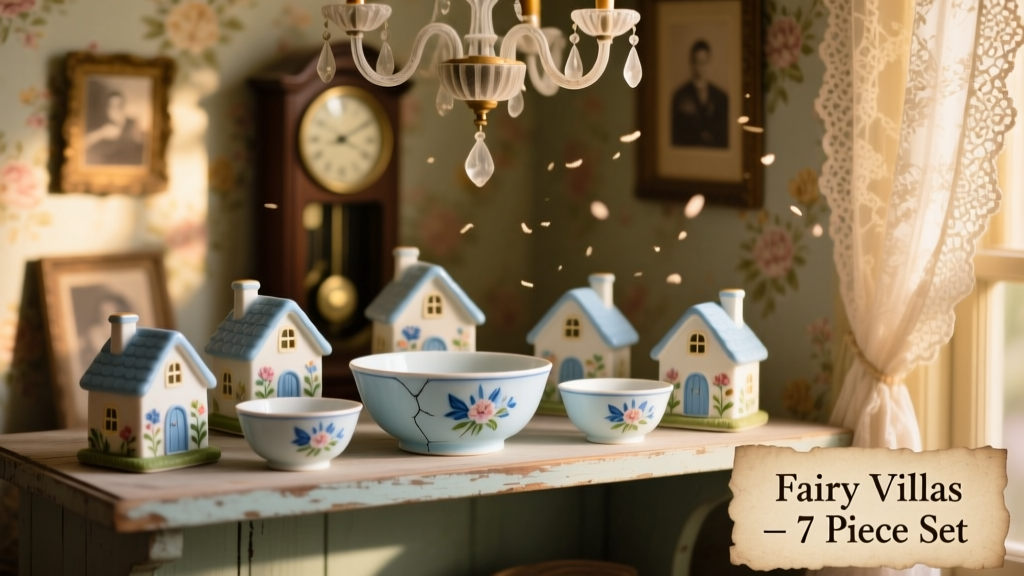
Flow Blue Bowl 'Fairy Villas' — A Mid-Century English Porcelain Treasure (7-Inch Diameter)
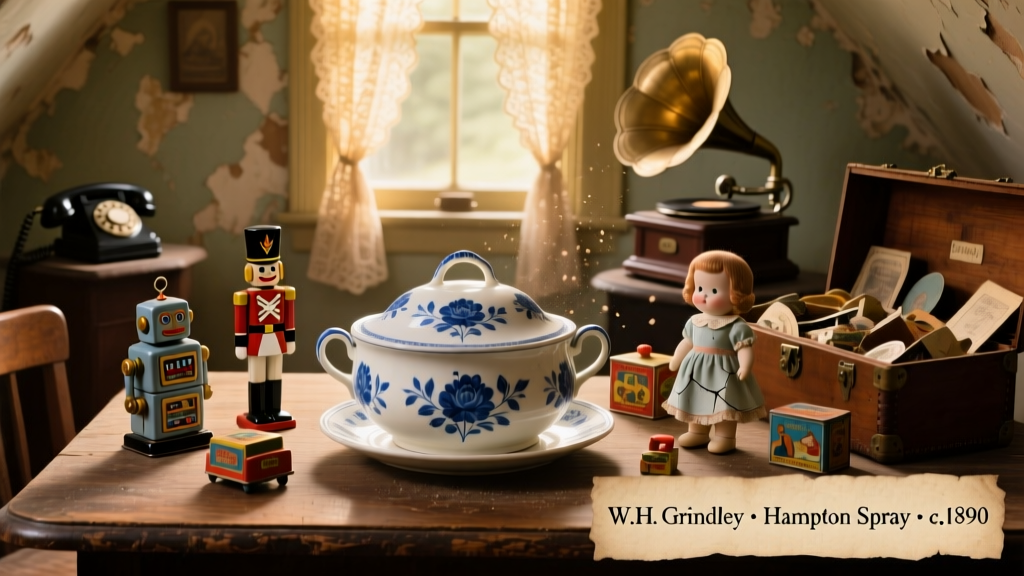
Flow Blue Tureen Soup: The Hampton Spray Pattern by W. H. Grindley — A Mid-Century English Ceramic Treasure
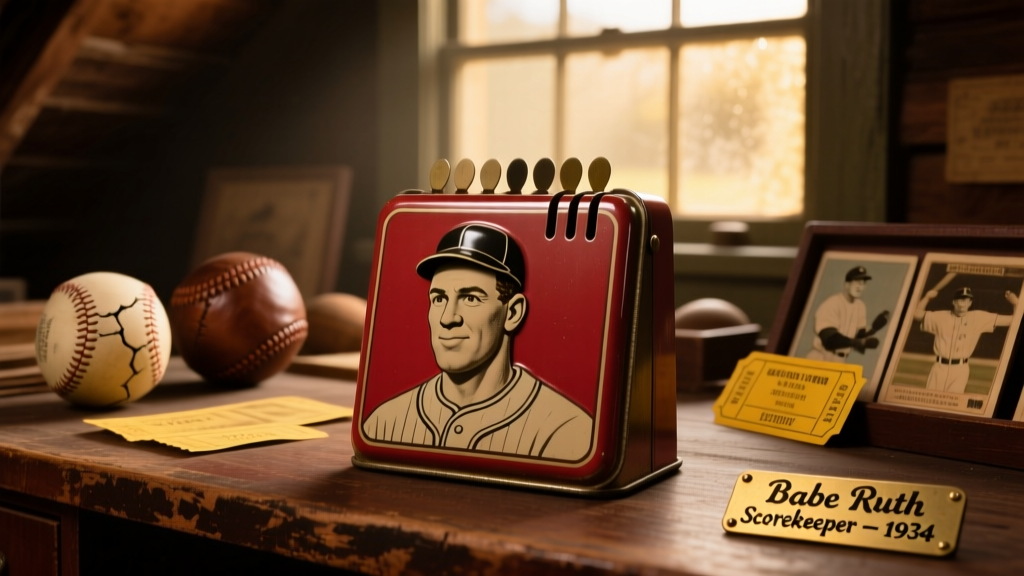
The 1934 Sports Baseball Scorekeeper: A Babe Ruth Celluloid Tin Artifact and Its Place in Mid-Century Americana
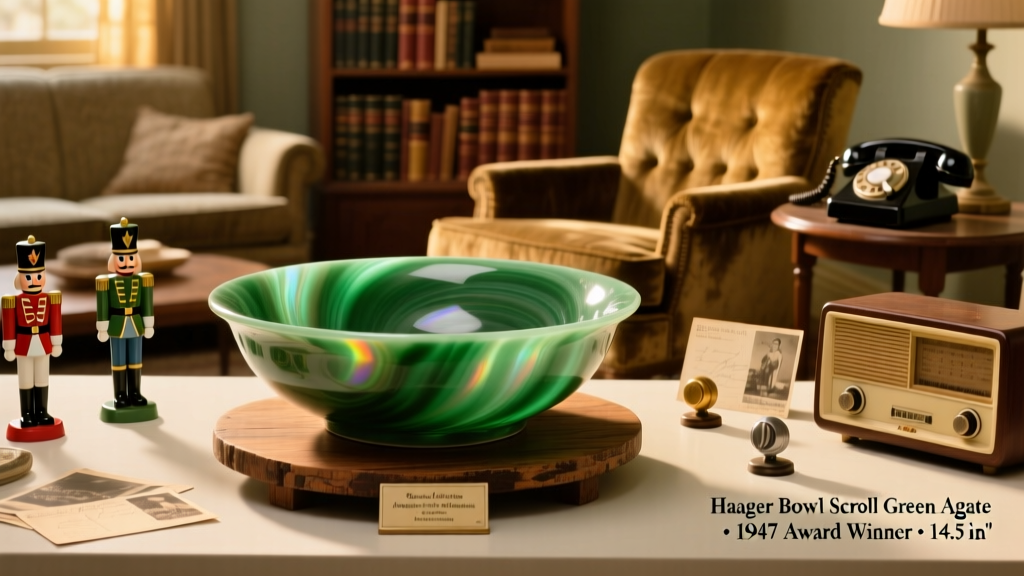
Haeger Bowl Scroll Green Agate, 1947 Award Winner — The Story Behind the 14½-Inch Masterpiece
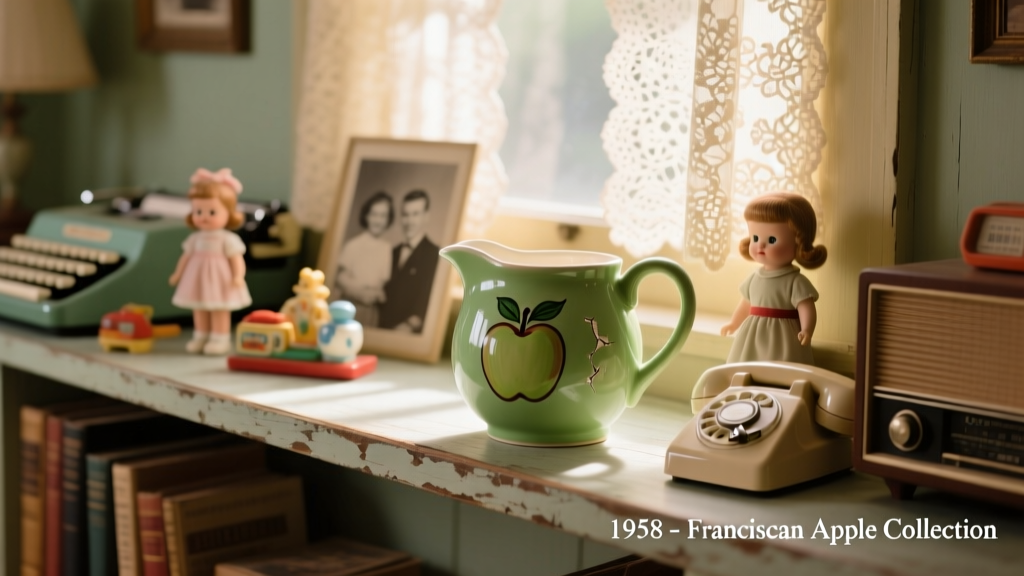
The Franciscan Apple Sugar Creamer: A Mid-Century Icon of California Pottery Design
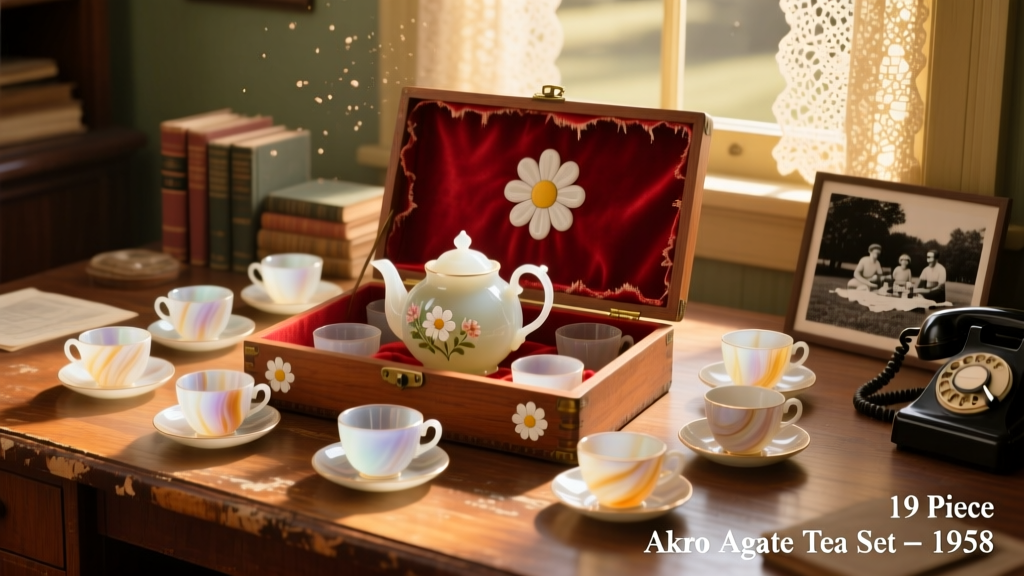
Akro Agate Tea Set: The Raised Daisy Box 19-Piece Set — History, Identification, and Market Value
Thompson Dairy’s 1940 Cottage Cheese Recipes: A Vintage Gem of Wartime Nutrition and Mid-Century Ingenuity
The 1950s Carriage Baby Buggy: Wicker Construction, Dapple Gray Horse Motif, and Authentic Wire Wheels — A Collector’s Deep Dive
Sandwich Glass Company Poinsettia Paperweights: Identification, Value, and Historical Context