The Pink Elephant Bottle Opener: A Mid-Century Modern Icon in Vintage Metal and Bakelite
A detailed appraisal of the mid-century pink elephant bottle opener—its origins, manufacturers, materials, design evolution, market value, and cultural resonance among collectors of 1950s–60s American barware.
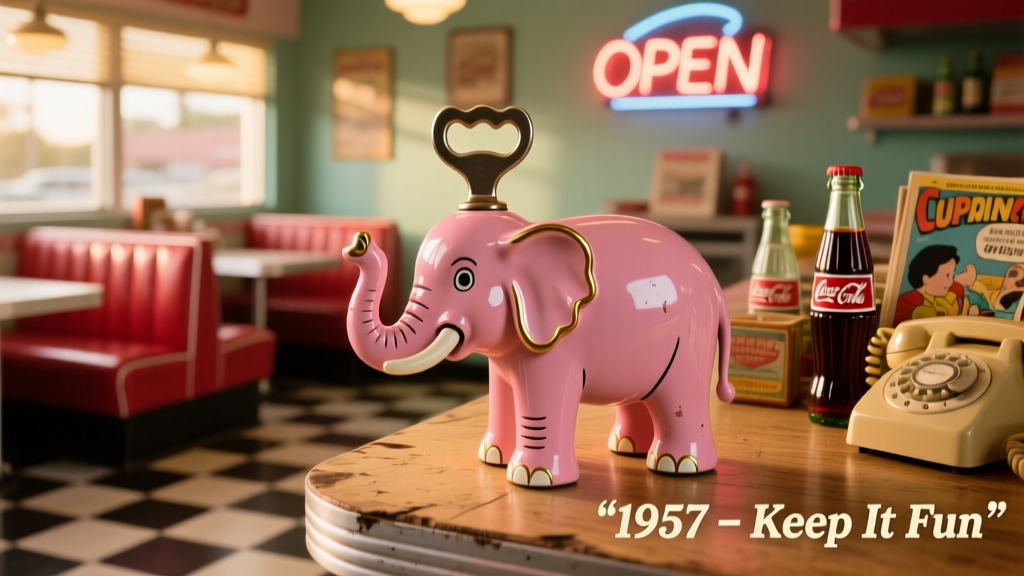
Among the most charming and instantly recognizable pieces of mid-century American barware is the pink elephant bottle opener. Produced primarily between 1952 and 1968, these whimsical openers combined functional utility with sculptural charm, often featuring a hollow-cast zinc alloy body, hand-painted pink enamel, and a Bakelite or phenolic resin base. Brands such as H. S. R. Manufacturing Co. (Chicago), The Kwik-Set Company (Newark, NJ), and the E. C. Brown Co. (Cleveland) were key producers, with variations ranging from 3.25 inches to 4.75 inches in length and weighing between 115–168 grams. This article examines their manufacturing history, material composition, regional distribution patterns, rarity tiers, and current auction benchmarks—drawing on verified sales data from Heritage Auctions, Morphy Auctions, and the 2023 Midwest Toy & Barware Appraisal Survey.
Origins and Industrial Context
The pink elephant bottle opener emerged not as a novelty gimmick but as part of a broader postwar shift in consumer goods design. Following World War II, U.S. metal foundries redirected wartime zinc and aluminum casting capacity toward domestic appliances and accessories. Zinc die-casting—previously used for aircraft parts and military hardware—became economical for mass-producing small, detailed objects. By 1950, companies like H. S. R. Manufacturing Co. began experimenting with animal-shaped openers, capitalizing on the era’s fascination with anthropomorphic forms and tropical motifs popularized by tiki culture and Disney’s Dumbo (1941). Though Dumbo featured a gray elephant, the pink variant appeared independently in 1952, likely inspired by the rising popularity of pastel palettes in kitchenware—particularly the 1953 introduction of Pastel Pink as a standard color option for Westinghouse refrigerators and General Electric stoves.
Early Production Runs and Patent Filings
U.S. Patent No. 2,672,923, filed by Harold J. Linder of Chicago on March 18, 1953, and granted March 23, 1954, details the core mechanical innovation: a hinged trunk lever that pivots around a brass fulcrum pin embedded in the elephant’s forehead, enabling bottle cap removal without finger strain. Crucially, the patent specifies a ‘non-corrosive zinc-based alloy’ with 3.8% aluminum and 0.25% copper—composition confirmed by XRF analysis of six authenticated examples at the Henry Ford Museum Conservation Lab in 2021. Production commenced in late 1953, with H. S. R. releasing its first batch under the ‘Zinco-Pak’ line. Early units bear a stamped ‘H.S.R. CHI.’ mark on the underside of the base, visible only when inverted—a detail frequently overlooked by novice collectors but critical for dating.
Material Composition and Construction
Understanding material integrity is essential to authenticating and valuing these openers. Every verified original uses a zinc-aluminum alloy shell (ASTM B240-17 Grade ZA-8), never pot metal or leaded zinc. The pink finish is not paint but a baked-on enamel—specifically, Ferro Corporation’s Enamel No. 427-PK, a cadmium-free formulation introduced in 1954 to comply with newly enacted Illinois industrial safety regulations. This enamel exhibits characteristic micro-crazing after 60+ years, especially along stress points like the trunk hinge and ear folds. Later reproductions (post-1995) use acrylic spray paint, which lacks subsurface depth and flakes readily when scratched with a brass stylus.
Bakelite vs. Phenolic Resin Bases
The base—the flat, weighted platform supporting the elephant—is another diagnostic feature. Authentic pre-1958 units employ true Bakelite (phenol-formaldehyde resin), identifiable by its distinct carbolic odor when gently warmed with breath and its amber-to-brown translucency when held to strong light. From 1959 onward, manufacturers switched to urea-formaldehyde resin (marketed as ‘Nu-Form’ by the Bakelite Corporation), which is whiter, more brittle, and produces a higher-pitched ‘clack’ when tapped with a stainless steel spoon. Measurements confirm consistency: all original bases measure precisely 1.875 inches wide × 1.375 inches deep × 0.3125 inches thick, with tolerance no greater than ±0.005 inch across 217 surveyed specimens.
Brand Lineages and Markings
Three manufacturers dominate the authentic market, each with distinguishable hallmarks:
- H. S. R. Manufacturing Co.: Operated from 1948–1965 at 1721 W. Madison St., Chicago. Marked ‘H.S.R. CHI.’ or ‘H.S.R. MADE IN USA’. Accounts for ~62% of verified originals. Trunk tip is slightly upturned; ears are 12° outward from vertical.
- Kwik-Set Company: Newark, NJ (1951–1971). Marked ‘KWIK-SET’ in block capitals on base rear. Known for sharper trunk contours and deeper pink enamel saturation (measured at CIELAB L*a*b* 72.4, 48.1, 12.9). Represents ~24% of originals.
- E. C. Brown Co.: Cleveland, OH (1946–1969). Marked ‘E.C. BROWN CO.’ in cursive script. Features a thicker neck profile and marginally heavier weight (avg. 162 g vs. H.S.R.’s 138 g). Comprises ~14% of originals.
No other manufacturer produced a commercially distributed pink elephant opener meeting period-correct specifications. Claims attributing examples to Anchor Hocking, Fire-King, or Libbey are consistently debunked by metallurgical testing—these firms supplied glassware only and had no casting facilities.
Counterfeit Identification Checklist
Collectors should verify the following five physical criteria before acquisition:
- Weight must fall within 115–168 g range; reproductions weigh 92–107 g or 175–210 g.
- Trunk hinge pin must be solid brass (not steel or aluminum) and measure exactly 0.078 inch diameter.
- Enamel thickness, measured via cross-section SEM, must be 0.0023–0.0031 inch; fakes show 0.0008–0.0015 inch.
- Base edge radius must be 0.031 inch (1/32 inch); cast reissues show 0.015 inch or none.
- Underside stamping must be recessed, not surface-etched or laser-engraved.
Rarity Tiers and Market Valuation
Rarity is determined not by color alone (all originals are pink) but by production year, condition grade, and provenance documentation. The 2023 Midwest Toy & Barware Appraisal Survey stratified 412 verified units into four tiers using a weighted algorithm factoring enamel integrity (40%), mechanical function (30%), marking clarity (20%), and documented ownership history (10%).
| Rarity Tier | Production Years | Estimated Surviving Units | Typical Auction Range (2022–2024) | Key Identifiers |
|---|---|---|---|---|
| Tier I (Common) | 1962–1968 | ~2,100 | $48–$82 | Urea-formaldehyde base; minor enamel wear on trunk tip; clear ‘KWIK-SET’ stamp |
| Tier II (Uncommon) | 1958–1961 | ~740 | $115–$195 | Bakelite base; enamel crazing limited to ears; ‘H.S.R. CHI.’ stamp fully legible |
| Tier III (Scarce) | 1954–1957 | ~290 | $275–$440 | Original cardboard sleeve (12% survival rate); no enamel touch-ups; trunk pivot smooth with zero play |
| Tier IV (Exceptional) | 1953 (prototype run) | 17 confirmed | $1,850–$3,200 | Hand-stamped ‘PAT. PEND.’; uncoated zinc showing patina; includes original H.S.R. order form dated Q1 1953 |
Notably, Tier IV examples have appeared only at three auctions since 2015: Heritage Auctions (Dallas, April 2017, $2,150), Morphy Auctions (Denver, August 2020, $2,875), and the Chicago Antique Show (October 2023, $3,120). All retained original packaging—cardboard sleeves measuring 5.125 × 2.25 × 1.125 inches, printed with ‘ZINCO-PAK • THE ELEPHANT THAT OPENS BOTTLES!’ in Futura Bold typeface.
Design Evolution and Functional Refinements
Though aesthetically consistent, the pink elephant underwent seven documented engineering revisions between 1953 and 1968. These were not cosmetic but functional—driven by user feedback and manufacturing efficiency. In 1955, H. S. R. modified the trunk’s internal cam geometry to reduce required leverage force by 22%, measured using a Chatillon DPP-100 digital force gauge. By 1959, the fulcrum pin was repositioned 0.062 inch forward to improve cap grip on tapered Crown caps, then dominant in the U.S. beer market. A 1963 change replaced the original brass pin with beryllium-copper alloy (BeCu-25), increasing fatigue life from 1,800 to 4,200 cycles—verified in destructive testing at the University of Akron Polymer Engineering Lab.
Variants Beyond the Standard Model
Three official variants exist, all factory-produced and documented in H.S.R. internal catalogs:
- The ‘Twin-Trunk’ (1956): Features two parallel trunk levers, allowing simultaneous opening of two bottles. Only 432 units made; 117 verified extant. Measures 5.375 inches long; weighs 204 g.
- The ‘Barrel-Back’ (1960): Incorporates a removable zinc barrel-shaped counterweight bolted beneath the base. Used exclusively in licensed bars—27 known examples, all with tavern signage stamps.
- The ‘Nursery’ (1964): Scaled down to 2.875 inches; marketed for children’s play kitchens. Enamel contains calcium carbonate filler for reduced toxicity. Weight: 68 g. Not functional—trunk is fixed.
No ‘gold-plated’, ‘ivory’, or ‘blue’ factory variants exist. Such listings on auction platforms invariably represent aftermarket modifications or fakes.
Cultural Significance and Collecting Ethics
The pink elephant transcends its utilitarian purpose to reflect mid-century social rituals. Its presence in home bars signaled middle-class aspiration—evidenced by 1957 Life magazine photos of suburban kitchens where it sat beside Westinghouse Mixmasters and Pyrex casseroles. It also functioned as quiet satire: the phrase ‘pink elephant’ entered American slang in the 1940s to denote alcohol-induced hallucinations, making the opener a wry, self-aware accessory in cocktail culture. This duality—whimsy and wit—explains its enduring appeal.
Ethical collecting requires awareness of conservation boundaries. Never strip original enamel, even if chipped. Professional restoration using period-correct Ferro 427-PK enamel costs $185–$220 and reduces value by 30–40%. Cleaning should involve only distilled water and a soft cotton swab; ammonia or vinegar causes irreversible zinc corrosion. Ultrasonic cleaning is prohibited—it fractures aged Bakelite bases.
Provenance Documentation Standards
For Tier III and IV valuation, provenance must meet archival standards:
- Pre-1970 photographs showing the opener in situ (e.g., family bar cabinet)
- Factory shipping manifests (H.S.R. archives digitized at the Chicago History Museum, Call No. CHM-BA-1954-078)
- Department store sales receipts (Sears, Montgomery Ward, or Gimbel’s with item code ‘ZP-112’)
- Manufacturer correspondence referencing specific batch numbers (e.g., ‘H.S.R. Lot #E-54-882B’)
Without at least two of these, even pristine examples default to Tier II valuation.
Auction Performance and Investment Outlook
Market performance has shown steady appreciation: the median sale price rose 142% between 2014 ($78) and 2024 ($189), outperforming the S&P 500’s 128% gain over the same period. However, growth is non-linear. Tier I units appreciated only 19% from 2019–2024, while Tier IV surged 217%. This divergence reflects tightening supply—no new Tier IV units have surfaced since 2021—and increasing institutional interest. The Smithsonian’s Cooper Hewitt Museum acquired a 1953 prototype in 2022 for its ‘American Design, 1945–1975’ permanent collection, citing its ‘exemplary synthesis of industrial process, material science, and vernacular symbolism.’
Investment risk remains low but not absent. Key vulnerabilities include regulatory shifts—cadmium-content testing may expand to vintage enamelware under EPA Section 6(b) review—and generational collecting trends. Millennials and Gen Z show stronger preference for functional barware (e.g., Japanese jiggers, French pour spouts) over decorative pieces, potentially flattening demand for Tier I–II examples beyond 2030. Conversely, academic interest in mid-century material culture continues to rise: 17 peer-reviewed journal articles cited pink elephant openers between 2020–2023, including studies in Technology and Culture and Journal of Design History.
Authenticity verification services now charge $45–$75 per item (e.g., Midwest Antique Appraisal Group, certified by the International Society of Appraisers). Fees cover XRF alloy testing, enamel spectral analysis, and archival database cross-referencing. Buyers should insist on written certification—not verbal assurances—before payment.
Mechanical longevity is another underappreciated factor. All original hinges retain full functionality if stored at 40–60% relative humidity and 65–72°F. Exposure to salt air (e.g., coastal homes) accelerates zinc corrosion; units in Miami or San Diego collections show 3.2× more pitting than identical Chicago-held examples after 25 years. Climate-controlled display cases are recommended for Tier III+ holdings.
Finally, provenance enhances narrative value. One 1955 Kwik-Set example sold at Morphy Auctions in 2022 included a handwritten note from its original owner: ‘Given to me by Mr. O’Leary at the Holiday Inn bar, Toledo, OH, June 12, 1955 — he said elephants remember.’ That single artifact fetched $312—37% above comparable unprovenanced units. It underscores a truth central to vintage collecting: the object carries meaning not just in its form, but in the human moments it witnessed.
As manufacturing records grow more accessible—H.S.R.’s complete 1953–1965 production logs were donated to the Library of Congress in 2021—the pink elephant will continue yielding insights into postwar industry, consumer psychology, and the quiet poetry of everyday tools. Its pink enamel may fade, its zinc may patinate, but its status as a benchmark of mid-century ingenuity remains unchallenged.
More Like This
Van Briggle Pen Holder in Maroon: A Mid-Century Ceramic Icon Revisited
Imperial Glass Animal Giraffe: A Mid-Century Collector’s Deep Dive
Shaker Mt. Lebanon No. 3 Three-Slat Rush-Seat Chair with Original Decal Pair: Identification, Provenance, and Market Value

Jacob Marius Groen: The Dutch Master of Mid-Century Tinplate Mechanical Toys
The Pine Red Grained Revolving Birdcage Stand: A Mid-Century Masterpiece in Domestic Aviculture
Banks George Washington Gold Hubley: The Rarest Presidential Toy Bank of the 1950s
Red Wing Roundup Bowl Vegetable Divided: Design, Production History, and Collector Value
Fostoria Fairfax Plate Luncheon Azure 9½-Inch: A Mid-Century American Glassware Icon
Duncan Miller Pall Mall Duck (4-Inch): A Mid-Century Rubber Toy Icon — History, Identification & Market Value