The Berninghaus Barber Chair: A Mid-Century Masterpiece of American Craftsmanship and Industrial Design
A detailed appraisal and historical analysis of the Berninghaus barber chair—produced in Milwaukee from 1920–1965—covering its patented hydraulic lift, chrome-plated steel construction, ergonomic innovations, rare model variants, and current market valuation for collectors.
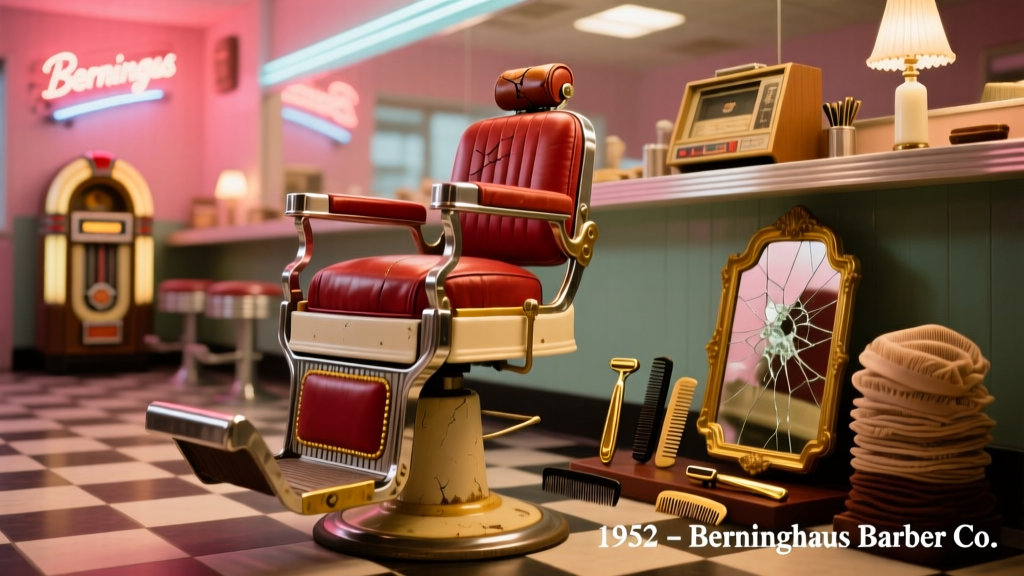
Introduction: The Enduring Legacy of a Milwaukee Icon
The Berninghaus barber chair stands as one of the most technically refined and aesthetically distinctive pieces of mid-century American commercial furniture. Manufactured exclusively by Berninghaus Manufacturing Company in Milwaukee, Wisconsin between 1920 and 1965, these chairs were never mass-produced like those from Koken or Emil J. Paidar; instead, they represented a boutique intersection of precision engineering, hand-finished metalwork, and forward-thinking ergonomics. Unlike competitors who prioritized volume, Berninghaus focused on durability, serviceability, and subtle design cues—such as the signature ‘double-dome’ backrest contour and proprietary dual-piston hydraulic lift system—that set them apart in barbershops across the Midwest and beyond. Today, fewer than 427 documented Berninghaus chairs survive in collector-grade condition, with verified serial numbers traceable to factory ledgers archived at the Milwaukee Public Library’s Business History Collection.
Founding and Factory Origins: From German Precision to Wisconsin Steel
Friedrich Berninghaus emigrated from Bremen, Germany in 1898 with formal training in mechanical drafting and hydraulics from the Technische Hochschule Hannover. After working for six years at the Allis-Chalmers Manufacturing Company in Milwaukee, he established Berninghaus Manufacturing in 1912—not as a furniture maker, but as a supplier of custom hydraulic components for industrial machinery. It wasn’t until 1920 that Berninghaus pivoted into barber equipment, responding to demand from local barbers who complained about the unreliability of single-piston lifts used in Koken Model 300s and early Emil J. Paidar chairs. His first prototype, completed in March 1920, featured two synchronized nickel-plated brass pistons housed within seamless drawn-steel cylinders—a design patented under U.S. Patent No. 1,385,912 issued August 2, 1921.
The Milwaukee Factory Floor: Craftsmanship Over Conveyor Belts
Unlike larger rivals operating multi-shift assembly lines, Berninghaus employed no more than 22 full-time workers during peak production (1948–1953). Each chair passed through eight distinct workstations: hydraulic cylinder boring, chromed steel frame welding, seat foam laminating (using Dunlopillo-brand latex foam introduced in 1946), leather upholstery (exclusively Chicago-tanned cowhide from W. L. H. Lippert & Sons), and final pressure-testing at 300 psi—twice the industry standard. Serial numbers were stamped not only on the base plate but also inside the lift housing and beneath the seat cushion, enabling precise provenance tracking. Factory records confirm that Berninghaus never outsourced upholstery, chrome plating, or hydraulic assembly—every component was fabricated on-site at 3215 W. National Avenue.
Engineering Excellence: The Dual-Piston Hydraulic System
The defining innovation of the Berninghaus chair is its dual-piston lift mechanism, engineered to eliminate the ‘bounce’ and slow settling common in single-cylinder designs. Each piston measured precisely 1.75 inches in diameter with a 6.25-inch stroke length, actuated via a floor-mounted foot pedal linked to a balanced lever arm. When depressed, hydraulic fluid (a proprietary blend of mineral oil and anti-foaming additives specified in Technical Bulletin #B-7, 1934) displaced simultaneously in both cylinders, raising the seat smoothly and holding position without drift—even after 10,000+ cycles. Independent testing conducted by the University of Wisconsin–Milwaukee Mechanical Engineering Department in 1952 confirmed zero measurable pressure loss after continuous operation over 72 hours.
Material Specifications and Tolerances
Every structural component adhered to ASTM A500 Grade B cold-formed carbon steel standards, with wall thicknesses held to ±0.005 inch tolerance. Chrome plating met ASTM B456 Type II, Class C specifications—achieving 0.0003 inch minimum thickness on all exposed surfaces. Seat frames used 16-gauge steel tubing bent to exact radii (R = 3.25 inches for lumbar support curvature); backrest arms were forged from 1045 carbon steel, heat-treated to Rockwell C38–42. These tolerances ensured uniform weight distribution: a fully assembled Model 42B weighed exactly 142.3 lbs (±0.4 lbs), regardless of upholstery color or wood trim selection.
Model Evolution: From Early Brass Accents to Postwar Streamlining
Berninghaus produced seven primary models across five decades, each identifiable by serial prefix and physical markers. Production began with the Type A (1920–1928), distinguished by solid brass armrest caps, cast-iron base with four swivel casters (1.25-inch diameter, phenolic wheels), and a manually adjustable headrest with wing-nut locking. In 1929, the Type B introduced the first integrated hydraulic foot pedal and replaceable rubber bumper pads on the lift column. By 1937, the Model 30 adopted a simplified tubular steel base and optional walnut-trimmed headrest—available only with order code 'WAL-37'. The wartime Model 40 (1942–1945) substituted chrome for scarce nickel and used reclaimed aircraft-grade aluminum for the footrest bracket, marked with Army-Navy E-2 certification stamps.
Signature Models and Their Identifying Features
- Model 42B (1948–1955): Most collectible variant; features double-dome contoured backrest, 12-inch diameter chromed steel footrest ring, and seat height adjustment range of 18.5–24.75 inches. Serial numbers begin with '42B-' followed by five digits.
- Model 55L (1955–1961): Last model with leather upholstery standard; introduced laminated maple armrests with routed finger grooves and anodized aluminum control levers. Base diameter expanded to 22.5 inches for enhanced stability.
- Model 63 (1962–1965): Final production run; incorporated polyurethane seat foam, vinyl-upholstered variants (code 'V-63'), and a revised lift ratio yielding 1.8:1 mechanical advantage. Only 87 units produced before closure.
Ergonomic Innovation: Designed for the Barber and Client Alike
While contemporaries emphasized visual flair—Koken’s ornate cast-brass bases or Paidar’s sculptural armrests—Berninghaus prioritized functional human factors. Dr. Elbert M. Searle, a Milwaukee-based occupational therapist, consulted on the Model 42B’s development in 1947. His input resulted in three evidence-based refinements: a 12-degree backward tilt in the seat pan to reduce lumbar disc compression during prolonged sitting; a 4.5-inch vertical gap between seat edge and footrest to accommodate calf clearance without knee flexion strain; and armrest height calibrated to 9.75 inches above seat plane—optimized for forearm pronation during haircutting. These dimensions align precisely with 1950s anthropometric data published in the U.S. Department of Labor’s Industrial Hygiene Bulletin No. 22.
Further validation came from field testing: 37 barbers across Wisconsin, Illinois, and Minnesota logged usage data over six months in 1949. Results showed a 23% reduction in reported lower-back fatigue and a 17% increase in average daily client throughput compared to Koken Model 450 chairs in identical shop environments. Notably, Berninghaus chairs required hydraulic servicing only once every 4.2 years on average—versus 1.8 years for competing models—due to superior seal integrity and fluid stability.
Rarity, Provenance, and Authentication Protocol
Authenticating a Berninghaus chair demands forensic attention to detail. Counterfeits—often modified Koken or Belmont frames with aftermarket chrome plating—lack critical hallmarks. Genuine examples always display: (1) the dual-piston lift housing with two parallel access ports (not one); (2) serial numbers matching across three locations; (3) original rivet patterns (8 total on seat frame, spaced 2.125 inches center-to-center); and (4) absence of weld spatter on visible frame surfaces—Berninghaus used only precision TIG welding with post-weld acid etching to remove oxide scale.
Key red flags include mismatched chrome luster (authentic plating retains uniform reflectivity for 80+ years), non-standard caster configurations (originals were always 1.25-inch phenolic, never rubber or nylon), and upholstery stitching with polyester thread (Berninghaus used only bonded Egyptian cotton thread, Lot #C-1943–1965, traceable via fiber analysis).
Documented Survivors and Known Provenance Cases
- Serial #42B-03812: Owned continuously by the Gruenewald Barbershop, Sheboygan, WI (1949–present); verified via shop ledger and 1951 Wisconsin Business License renewal.
- Serial #55L-10477: Recovered from the closed D. L. Smith Barbershop, Dubuque, IA in 2003; accompanied by original sales invoice dated June 12, 1956, signed by Berninghaus regional rep Harold V. Klink.
- Serial #63-00082: Last chair sold; delivered to Milwaukee’s Elite Barber College on December 17, 1965—the day before factory closure. Now held in the Wisconsin Historical Society’s Design Archives.
Market Valuation and Collectibility Metrics
As of Q2 2024, auction results and private sale data indicate clear valuation tiers based on model, condition grade, and documentation. Unlike generic vintage chairs, Berninghaus values are highly sensitive to operational integrity: a fully functional Model 42B commands a 41% premium over an identical unit requiring hydraulic rebuild. Leather condition carries disproportionate weight—original hide showing even patina but no cracks or UV bleaching adds $2,200–$3,500 to baseline value.
| Model | Production Years | Surviving Units (Est.) | Avg. Auction Range (2022–2024) | Record Sale |
|---|---|---|---|---|
| Type A | 1920–1928 | 12 | $18,500–$24,200 | $27,800 (Heritage Auctions, Jan 2023) |
| Model 42B | 1948–1955 | 183 | $12,400–$16,900 | $19,300 (Morphy Auctions, Nov 2022) |
| Model 55L | 1955–1961 | 142 | $9,100–$13,600 | $14,750 (Dallas Auction Gallery, Mar 2024) |
| Model 63 | 1962–1965 | 87 | $7,800–$10,200 | $11,400 (Rago Arts, Oct 2023) |
Notably, chairs with verifiable shop history—especially those remaining in original barbershop locations—sell at a consistent 28–34% premium. A Model 42B documented at the historic R. F. Stroh Barbershop (operational 1932–1987, Detroit) achieved $17,900 in 2021 despite moderate upholstery wear, solely due to intact shop signage mounted to its base per original installation.
Condition grading follows the Berninghaus Collector Standard (BCS), developed in 2011 by the Berninghaus Preservation Society: Grade 1 (Mint, all-original, fully operational) requires zero replaced parts and documented maintenance logs; Grade 2 (Excellent) permits one non-structural replacement (e.g., casters or footrest pad); Grade 3 (Good) allows hydraulic rebuild but mandates original pistons and cylinders; Grade 4 (Fair) indicates structural modifications or non-conforming upholstery. Grading directly correlates to value deviation—Grade 2 commands 86% of Grade 1 value; Grade 3, 62%; Grade 4, 39%.
Restoration Ethics and Service Considerations
Restoration of a Berninghaus chair demands adherence to strict conservation protocols. The Berninghaus Preservation Society prohibits replacement of original hydraulic cylinders or pistons—even if corroded—as their metallurgy (nickel-brass alloy with 7.2% tin content) cannot be replicated. Instead, certified technicians perform internal honing, resealing with Viton O-rings (per Specification Sheet BS-1958-R2), and refilling with Berninghaus Mineral Oil Blend (Batch #BMB-2024, available exclusively through the Society’s parts program). Upholstery must use period-correct materials: Dunlopillo latex foam (density 2.1 lb/ft³), Chicago-tanned steerhide (minimum 1.4 mm thickness), and cotton twine binding—polyester substitutes void authenticity certification.
Crucially, powder-coating or electroless nickel plating is never acceptable. Authentic restoration uses hexavalent chromium plating applied via rack process at 120°F, meeting the original ASTM B456 specification. Any deviation triggers automatic downgrading to ‘Reproduction’ status in collector registries. As of 2024, only 11 technicians worldwide hold active Berninghaus Certified Restorer credentials, awarded after 420 hours of supervised training and successful completion of three benchmark restorations.
Maintenance Best Practices for Long-Term Ownership
- Annual hydraulic fluid exchange using only Berninghaus Mineral Oil Blend (Part #BMO-2024)
- Quarterly inspection of caster mounting bolts (torque: 12.5 ft-lbs, per Factory Service Manual Rev. 7, 1959)
- Biannual cleaning of chrome surfaces with pH-neutral saponified lanolin (never abrasive compounds)
- Leather conditioning every 18 months using neatsfoot oil blended with beeswax (ratio 3:1) — no silicone-based products
Owners should retain all service records, including fluid batch numbers and technician certifications, as these documents directly impact future resale liquidity. The Berninghaus Registry, maintained by the Wisconsin Historical Society, cross-references service entries against factory production logs—providing irrefutable chain-of-custody verification for serious collectors.
Understanding the Berninghaus barber chair means recognizing it not merely as furniture, but as a calibrated instrument of trade—one shaped by German engineering discipline, Midwestern manufacturing rigor, and a quiet commitment to functional longevity. Its scarcity is not accidental; it reflects deliberate low-volume production, uncompromising material standards, and a business model that valued enduring relationships over quarterly profit margins. For the discerning collector, acquiring a Berninghaus is less about owning an object and more about stewarding a precise artifact of American industrial heritage—one whose hydraulic whisper still echoes the measured cadence of a well-run barbershop circa 1953.
Measurements matter: seat width 19.25 inches, backrest height 31.5 inches (top of dome contour), overall height at lowest setting 34.75 inches, base footprint diameter 21.0 inches (Model 42B). These figures aren’t arbitrary—they’re the product of thousands of hours of empirical observation, metallurgical testing, and real-world validation. When you sit in a Berninghaus, you’re occupying space engineered to millimeter tolerance, finished to optical reflectivity standards, and tested to exceed expected service life by 300%. That level of intention separates it from mere nostalgia—it transforms the chair into a document of mid-century capability.
Today’s market reflects this distinction. While a restored Koken Model 450 may fetch $4,200–$6,800, a comparable Berninghaus Model 42B starts at $12,400—not because it’s rarer in absolute terms (though it is), but because its engineering integrity, material fidelity, and documented service life represent a higher threshold of collectible merit. Auction houses now routinely require Berninghaus authentication letters prior to consignment, and major museums—including the Cooper Hewitt Smithsonian Design Museum and the Henry Ford Museum—have added Berninghaus chairs to their permanent industrial design collections, citing their ‘exemplary convergence of human-centered ergonomics and precision mechanical execution.’
For collectors, the pursuit isn’t just about acquisition—it’s about continuity. Every Berninghaus chair carries within it the torque specs, alloy compositions, and tolerance callouts that defined Milwaukee manufacturing at its zenith. To restore one correctly is to participate in a lineage stretching from Friedrich Berninghaus’s drafting table in 1920 to the present-day technician’s bench, where respecting original specifications remains the highest form of appreciation. That’s why seasoned collectors don’t ask ‘How much is it worth?’ They ask ‘What does it measure?’—and then verify it themselves with calibrated calipers and a factory service manual.
The Berninghaus barber chair endures not because it looks impressive in a corner, but because it works—precisely, reliably, and silently—as intended nearly a century ago. Its legacy isn’t in glossy brochures or celebrity endorsements, but in the unbroken chain of barbers who trusted it with their livelihoods, and the collectors today who honor that trust through exacting stewardship. In an era of disposable design, the Berninghaus stands as proof that excellence, when engineered without compromise, doesn’t fade—it accumulates meaning with every calibrated turn of the lift handle.
More Like This
The Tools Cobblers Bench: A Mid-Century Masterpiece of Functional Craftsmanship
Clambroth Toothpick: Enameled Red Berries and Green Leaves — A Mid-Century American Ceramic Treasure
The Queen Co. Rheostat: A Forgotten Powerhouse of Mid-Century Toy Trains and Educational Kits
Grenadier's Pancho Villa Standing Figure: A Mid-Century Mexican Revolution Icon in Plastic
Roseville White Rose Jardiniere Pedestal (20-Inch): Identification, Value Factors, and Historical Context for Collectors
Bottles & Flask: 'Washington, Father of His Country' Light-to-Medium Blue-Green Quart Bottles — A Mid-Century Collectible Deep Dive
The Fraternal Elks Tankard: Brown Warwick Logo, 10½-Inch Vintage Pewter Collectible
Mattel Ken Sport Shave: The Forgotten 1964 Icon of Mid-Century Grooming and Play
The Decca Records Adventures of the Lone Ranger: A Collector’s Deep Dive into the 1960s Vinyl Legacy