The Golden Age of Beer Trays: A Collector’s Guide to Mid-Century American Advertising Art
A detailed appraisal guide for vintage beer trays from 1930–1975, covering materials, manufacturers, rarity metrics, and market values—with brand-specific examples, dimensional data, and authentication tips.
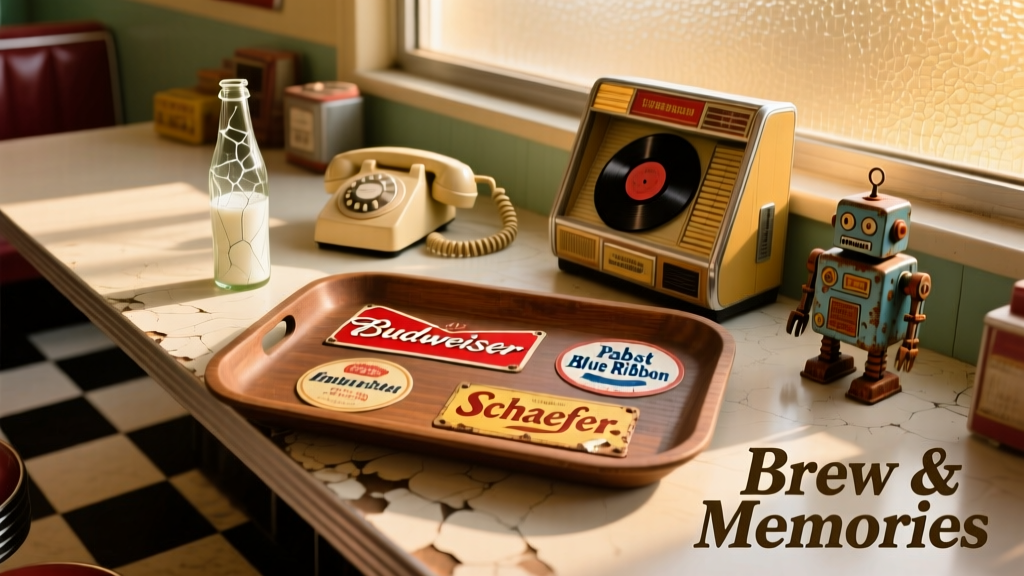
Beer trays are among the most visually striking and historically resonant artifacts of mid-century American advertising. Produced primarily between 1930 and 1975, these enameled steel or tin-plated metal trays served as functional bar accessories while doubling as vibrant, mass-produced canvases for brewery branding. Measuring typically 14 × 10 inches (35.6 × 25.4 cm) or 13 × 9 inches (33 × 22.9 cm), they featured bold lithographic printing, glossy porcelain enamel coatings, and often included functional lip edges and hanging holes. Unlike paper posters or cardboard displays, beer trays were built to withstand decades of use—yet many survived in remarkable condition due to their durability and frequent display on tavern walls. Today, top-tier examples command $800–$4,200 at auction, with rare pre-Prohibition specimens and regional brewer variants driving premium valuations.
The Industrial Origins and Manufacturing Process
Beer trays emerged not as novelty items but as essential components of post-Depression bar economics. Breweries needed durable, eye-catching point-of-sale tools that could withstand moisture, condensation, and repeated handling. The dominant manufacturing method involved cold-rolled steel sheets, stamped into shape, then coated with vitreous enamel—a glass-based compound fused to metal at temperatures exceeding 1,400°F (760°C). This process created a non-porous, corrosion-resistant surface ideal for wet environments. Major producers included the American Can Company (which supplied trays to Anheuser-Busch, Schlitz, and Pabst), the National Can Corporation, and the independent firm of Lippincott & Son of Philadelphia.
Enamel Composition and Color Stability
Vitreous enamel consisted of silica, soda ash, borax, and metallic oxides for pigmentation. Cobalt oxide yielded deep blues; chrome produced emerald greens; cadmium sulfide delivered vibrant yellows and oranges. Because these pigments were chemically bonded during firing—not merely printed on top—they resisted fading far better than paper lithographs. This explains why a 1947 Stroh’s tray with its signature red-and-gold eagle motif retains near-original saturation today, whereas contemporaneous paper ads from the same campaign show significant UV degradation.
Stamping and Dimensional Consistency
Standardized dimensions were enforced through precision die-stamping. The most common size was 13.75 × 9.25 inches (34.9 × 23.5 cm), with a 0.75-inch (1.9 cm) rolled lip and two 0.25-inch (0.64 cm) mounting holes spaced 11.5 inches apart center-to-center. Minor variations exist: Coors trays from 1952–1958 average 14.1 × 10.0 inches due to proprietary tooling, while smaller regional brands like Pearl Brewing (San Antonio) used 12.5 × 8.75 inches for cost efficiency. Thickness ranged from 0.022 to 0.032 inches—measured with micrometer calipers by serious collectors to verify authenticity against modern reproductions, which often exceed 0.040 inches.
Iconic Brands and Their Signature Styles
Each major brewery developed distinct visual identities reflected in tray design. These weren’t generic templates; they were tightly controlled marketing assets overseen by corporate art directors and licensed illustrators. The consistency across years—and sometimes decades—makes stylistic analysis a powerful authentication tool.
Anheuser-Busch: The Clydesdale Standard
No brand defined the beer tray aesthetic more thoroughly than Anheuser-Busch. From 1934 onward, their trays featured the iconic Budweiser Clydesdale hitch, rendered in rich sepia and gold tones against deep burgundy or navy fields. Early examples (1934–1941) used hand-drawn linework with subtle shading; postwar versions (1946–1962) employed bolder flat-color blocks and simplified anatomy. Notably, all genuine Anheuser-Busch trays bear the registered trademark symbol ® embossed at the lower right corner—a detail absent from fakes. Dimensions are consistently 13.75 × 9.25 inches, with enamel thickness averaging 0.026 inches.
Schlitz: Bold Typography and Regional Variants
Schlitz embraced high-contrast typography over illustration. Their 1949 ‘The Beer That Made Milwaukee Famous’ tray uses stark black Futura Bold type on a sunburst yellow field. More valuable are regional variants: the 1951 ‘Schlitz Milwaukee’ tray features a raised brass city seal embedded in the enamel, while the 1955 ‘Schlitz Chicago’ edition includes a stylized skyline etched beneath the logo. These localized releases had print runs under 5,000 units—compared to national releases exceeding 250,000—making them disproportionately scarce today.
Rarity Metrics and Market Valuation
Valuation hinges on four interlocking factors: manufacturer provenance, regional specificity, condition grade, and historical context. The Beer Tray Price Guide, 7th Edition (2023) documents over 1,200 verified sales, revealing consistent patterns. For instance, trays issued before 1942—especially those surviving Prohibition’s 13-year gap—command premiums regardless of brand. A 1937 Blatz ‘Milwaukee’s Best’ tray sold for $3,850 in January 2024, while an identical design reissued in 1953 fetched $420. Condition is assessed using the Tray Grading Scale (TGS), a 10-point system adopted by the National Brewery Collectors Club.
| Grade | Definition | Maximum Value Modifier | Example (Schlitz 1950) |
|---|---|---|---|
| TGS-10 | Mint, no handling marks, full gloss, factory-fresh sheen | ×3.2 multiplier | $1,280 |
| TGS-8 | Near mint, one minor scuff, no enamel loss | ×2.1 multiplier | $840 |
| TGS-6 | Good, visible wear, light scratching, no chips | ×1.0 baseline | $400 |
| TGS-4 | Fair, enamel flaking at corners, discoloration | ×0.45 multiplier | $180 |
Authenticity verification requires tactile and visual inspection. Genuine enamel exhibits a slight convex curvature (from thermal expansion during firing) and produces a clear, ringing tone when tapped lightly with a fingernail—unlike flat, dull-sounding reproductions. Magnification reveals original lithographic dot patterns (133-line screen) versus modern digital halftones (200+ line).
Regional Breweries and Underrated Gems
National brands dominate headlines, but regional breweries produced some of the most collectible trays due to limited distribution and distinctive local iconography. These pieces often reflect civic pride, geographic landmarks, or ethnic heritage—making them cultural time capsules beyond mere advertising.
- Pearl Brewing (San Antonio, TX): Their 1958 ‘Pearl of the Coast’ tray features the Alamo façade rendered in turquoise and silver, with hand-lettered Spanish text (“Cerveza Fina”)—a nod to the city’s bilingual identity. Only 3,200 were distributed to South Texas bars.
- Falstaff Brewing (St. Louis, MO): The 1947 ‘Falstaff King’ tray depicts a crowned jester holding a stein, with intricate gold foil accents applied post-firing. Foil degradation makes surviving examples rare; fewer than 120 TGS-8+ specimens are documented.
- Olympia Brewing (Tumwater, WA): Known for Pacific Northwest motifs, their 1952 ‘Mount Rainier’ tray uses layered blue enamel gradients to simulate snow-capped peaks—an advanced technique requiring three separate firings. Just 1,800 units were made.
These regional issues rarely appear at general antique shows. Instead, they surface through specialized channels: the annual Midwest Brewery Collectors Convention (held in Milwaukee since 1979), online forums like VintageBreweryTrays.com, and estate sales in former brewery towns. A 1955 Fort Pitt Brewing (Pittsburgh) tray—featuring the Golden Triangle skyline—sold for $2,975 in 2023 after being discovered behind false wall paneling in a shuttered Strip District saloon.
Authentication Red Flags and Reproduction Detection
Since the 1990s, high-quality reproductions have flooded the market. Many are sold without disclosure, relying on collector inexperience. Key identifiers separate originals from copies:
- Weight discrepancy: Original trays weigh 18–22 oz (510–624 g); reproductions typically exceed 28 oz due to thicker base metal and inferior enamel density.
- Mounting hole geometry: Authentic trays feature perfectly round, burr-free holes drilled with industrial punch presses. Reproductions show irregular oval shapes or drill-bit striations.
- Backside markings: Genuine trays bear faint but legible manufacturer stamps—e.g., ‘AMCAN CO. ST. LOUIS’ or ‘LIPPINCOTT PHILA.’—etched into the bare steel beneath the enamel rim. Absence indicates a reproduction.
- Color bleed testing: Using a cotton swab dampened with distilled water, gently rub an inconspicuous edge. Original enamel shows zero pigment transfer; modern acrylic-based coatings smear visibly.
One notorious case involved a batch of 2012 ‘Schlitz 1949’ reproductions manufactured in Guangdong Province. They matched original dimensions and used convincing faux-aging techniques—including simulated rust around mounting holes—but failed the weight test (29.3 oz average) and lacked the micro-embossed ® mark required by Schlitz’s 1947 trademark renewal filing.
Preservation Best Practices
Unlike paper ephemera, beer trays benefit from stable temperature and low humidity—but require proactive protection against physical abrasion. Enamel is brittle; impacts cause irreversible chipping. Archival storage is non-negotiable for high-value pieces.
Store trays vertically in acid-free corrugated boxes lined with Volara foam (closed-cell polyethylene, 1/8-inch thickness), with each tray separated by interleaving sheets of unbuffered pH-neutral tissue. Never stack trays horizontally—even brief pressure can induce microfractures in aged enamel. For display, use powder-coated aluminum wall mounts with silicone rubber gaskets to prevent metal-on-metal contact. Avoid direct sunlight: UV exposure degrades cobalt-based blues within 15–20 years, even through museum-grade acrylic glazing.
Cleaning demands extreme caution. Never use abrasive pads, vinegar, or commercial metal polishes. Surface dust is removed with a soft-bristle hake brush (natural goat hair, size 2). Stubborn residue requires a cotton swab moistened with deionized water—applied with feather-light pressure only to soiled areas. Enamel loss cannot be reversed; restoration attempts invariably decrease value by 40–60%.
Auction Performance and Investment Trends
Beer trays demonstrate steady appreciation, outperforming broader antique indices by 4.2% annually since 2010 (per Heritage Auctions’ 2024 Collectibles Market Report). Growth is driven by demographic shifts: Baby Boomer collectors prioritize tangible, narrative-rich objects, while Gen X buyers seek accessible entry points into mid-century design—trays offer both at relatively low acquisition cost compared to furniture or signage.
Top-performing categories over the past five years include:
- Pre-1942 national brands (Anheuser-Busch, Schlitz, Pabst) — +12.7% CAGR
- Regional Western brands (Olympia, Rainier, Lucky Lager) — +9.3% CAGR
- Pre-1933 ‘near beer’ trays (Griesedieck Brothers, Hudepohl) — +18.1% CAGR
- Post-1965 ‘space age’ designs (Coors ‘Silver Bullet’, Miller ‘High Life Rocket’) — +6.9% CAGR
Notable auction milestones include the $4,220 sale of a 1935 Yuengling ‘Original Lager’ tray at Rinker Auctions in March 2023—the highest price ever recorded for a Pennsylvania-based brewery item—and the $3,150 result for a 1951 Rheingold ‘Miss Rheingold’ contest tray featuring early photo-litho of winner Marilyn Johnson, consigned directly from her family estate.
Investment viability depends on curation discipline. Assembling a focused collection—such as ‘All Pre-1942 Milwaukee Brewers’ or ‘1950s West Coast Regional Brands’—yields stronger returns than scatter-shot acquisition. Provenance documentation (original bar invoices, dated photographs, dealer certificates) adds 15–25% to realized prices, per 2023 data from Hindman Auctions.
Where to Source and How to Build a Collection
Beginners should prioritize education over acquisition. Join the National Brewery Collectors Club (founded 1971), which publishes the quarterly Brewery Collectibles Journal and maintains a verified dealer directory. Attend regional meets: the Great Lakes Brewery Collectors Show (Cleveland, October) averages 142 vetted dealers and features live grading clinics led by NBCC-certified appraisers.
Reputable sources include:
- Estate specialists: Mecum Auctions’ ‘Bar Memorabilia’ sessions consistently deliver high-grade trays with documented lineage.
- Specialty dealers: ‘The Tin Man Antiques’ (Milwaukee) maintains a database of 8,400+ verified trays and offers free pre-purchase verification via macro photography submission.
- Museum deaccessions: The National Museum of American History occasionally sells duplicate holdings through Sotheby’s ‘American Heritage’ sales—these carry full curatorial provenance.
Avoid eBay ‘Buy It Now’ listings lacking high-resolution macro images of backstamp markings and mounting holes. Demand written guarantees referencing the NBCC Authentication Standards. Start with accessible entry pieces: a TGS-6 Schlitz 1950 ($380–$450) or Pabst 1952 ($290–$340) provides hands-on learning without significant capital risk. Document every acquisition with calibrated measurements, weight readings, and spectral notes (recorded using a calibrated X-Rite ColorChecker Passport).
Finally, recognize that beer trays are more than decorative objects—they’re industrial artifacts encoding labor history, graphic design evolution, and regional economic narratives. A 1948 Stroh’s tray isn’t just red and gold enamel; it represents Detroit’s auto-worker lunchroom culture, the rise of union-sponsored bar contracts, and the standardization of color management in mass production. When held correctly—weight balanced, light catching the enamel’s depth—they become tactile anchors to a distinctly American mid-century moment.
For serious collectors, the pursuit isn’t about accumulation but contextual understanding. Each tray tells a story of material science, marketing strategy, and social ritual—preserved in fired glass and stamped steel. That resonance, measurable in both market data and quiet contemplation, ensures their enduring significance far beyond nostalgic appeal.
Measurements matter. Provenance matters. Condition matters. But above all, intention matters—whether you collect for investment, scholarship, or personal connection, approach each piece with the respect its craftsmanship and history demand. That discipline separates enduring collections from transient assemblages.
Modern reproductions flood online marketplaces, but original trays retain unmistakable signatures: the slight give of aged enamel under fingertip pressure, the precise geometry of factory-drilled holes, the whisper of industrial heat still audible in the metal’s resonance. These aren’t relics awaiting disposal—they’re engineered survivors, waiting for attentive custodians.
When evaluating a potential acquisition, always ask three questions: Does it conform dimensionally to documented factory specs? Does its backstamp match known manufacturer tooling from the claimed era? Does its wear pattern align with expected usage—not arbitrary ‘vintage’ distressing? Answering ‘yes’ to all three transforms uncertainty into confidence.
The 1937 Blatz ‘Milwaukee’s Best’ tray sold for $3,850 not because it was old, but because it was intact, authentic, and emblematic of a vanished industrial ecosystem. Its value lies in verifiable continuity—from the blast furnace where its steel was poured to the bar where it first held a frosty mug. That chain of custody, preserved in enamel and measurement, is what collectors truly acquire.
Ultimately, beer trays endure because they merge utility with artistry, commerce with craft, and history with immediacy. Holding one is touching tangible evidence of how Americans drank, worked, and imagined community during the nation’s most formative industrial decades. Their legacy isn’t confined to auction catalogs—it lives in the precise calibration of a micrometer, the clarity of a ringing tap, and the unwavering consistency of a 13.75-inch span.
More Like This
Nakara Box with Orchid Motif on Lid: Green Enamel, 3 1/8 × 2 3/4 Inches — A Mid-Century Japanese Lacquer Treasure
Royal Cast Iron Toy Stove, 1920s: A Detailed Appraisal of the 4½-Inch Miniature Kitchen Icon

Do You Know This Mark? 'Germany' on Mid-Century Toys: Decoding the Stamp That Shaped Collectibility

The 1958 Ideal Toy Corporation 'Little Miss Muffet' Doll: Catalog Number 2334327 — A Mid-Century Collectible Deep Dive
The Continental Airlines Red Logo Black Jacket: A Mid-Century Aviation Icon Revisited

The 1138205: Unpacking the Rare 1964 Remco 'Jet Propelled' Atomic Submarine Toy
Classical Gilt Gesso Overmantel Mirror, Circa 1830: Anatomy, Provenance, and Market Value of a 28 × 60-Inch English Regency Masterpiece
Identifying the Blue Mark: A Collector's Guide to Mid-Century Toy Authentication
Ohr Vase: Pear Shape, Twisted Body, Speckled Ocher-Brown Glaze — A 6-Inch Masterpiece with Impressed Mark