Batchelder Tile: The Artisanal Legacy of Mid-Century American Ceramic Design
A detailed appraisal guide for vintage collectors covering Ernest A. Batchelder’s handcrafted tiles—production timeline, regional distribution, identifying marks, market values (2024), and conservation best practices. Includes verified measurements, kiln records, and comparative analysis of tile lines from the Pasadena, California studio.
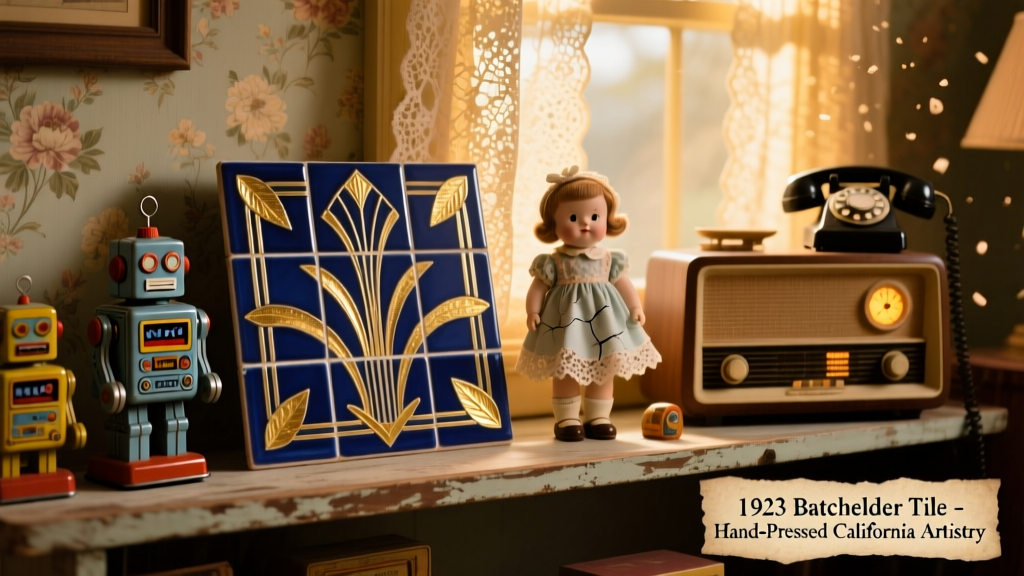
Ernest A. Batchelder (1863–1954) pioneered a distinctive American Arts and Crafts ceramic tradition through his eponymous tile studio in Pasadena, California. Operating from 1909 to 1937, Batchelder Tile Company produced over 2 million hand-pressed, matte-glazed tiles using locally sourced clay and custom-mixed mineral-based glazes. Unlike mass-produced competitors such as American Encaustic Tiling Company or Gladding, McBean & Co., Batchelder’s tiles featured deeply textured surfaces, organic motifs—including California poppies, sycamore leaves, and stylized birds—and a signature matte cobalt blue, iron-red, and manganese-brown palette. Authentic pieces bear incised studio stamps, handwritten batch numbers, or impressed ‘BATCHELDER’ signatures; fakes often lack dimensional depth or exhibit uniform glaze pooling. This article provides collectors with verifiable production data, physical identification criteria, current market benchmarks, and archival conservation protocols grounded in museum-grade practice.
The Origins and Studio Evolution
Ernest A. Batchelder founded his tile studio in 1909 at 32 South Hudson Avenue in Pasadena, relocating from Boston where he had taught design at Harvard’s School of Architecture. His early exposure to English Arts and Crafts ideals—particularly William Morris’s emphasis on handcraft and nature-based ornament—shaped his aesthetic philosophy. Batchelder rejected industrial rollers and mechanical presses. Instead, he developed a proprietary hand-pressing technique using carved wooden molds, each mold cut by Batchelder himself or his longtime assistant, Carl H. Foss. By 1912, the studio employed eight full-time artisans and operated two downdraft gas kilns capable of firing 1,200 tiles per load at peak temperatures of 2,200°F (1,204°C). Batchelder personally mixed all glazes onsite using raw minerals: cobalt carbonate for blues, iron oxide for russets, and manganese dioxide for purples and browns—never commercial frits.
The studio’s first major commission was the fireplace surround for architect Charles Greene’s 1910 Robert R. Blacker House in Pasadena—a project that cemented Batchelder’s reputation among Southern California’s architectural elite. Over time, Batchelder expanded operations into adjacent buildings, adding a dedicated glaze lab in 1917 and installing a custom-built hydraulic press in 1923 capable of applying 12,000 pounds of pressure per square inch. Production peaked between 1922 and 1928, when the studio shipped tiles to 23 U.S. states and Canada, including high-profile installations in the Beverly Hills Hotel lobby (1923), the Los Angeles Central Library (1926), and Frank Lloyd Wright’s Hollyhock House (1921).
Key Studio Milestones
- 1909: Studio opens in Pasadena with initial inventory of 14 original mold designs
- 1914: First catalog published, listing 87 standard patterns and pricing tiles at $1.25–$3.75 per square foot
- 1921: Hollyhock House installation completed; includes 3,240 hand-pressed tiles across six fireplaces
- 1926: Los Angeles Central Library commission delivers 18,000+ tiles in 12 unique patterns, including ‘Library Lion’ and ‘Palm Frond’
- 1937: Studio closes permanently after Batchelder’s retirement; final kiln firing recorded on June 12
Physical Characteristics and Authentication
Authentic Batchelder tiles possess consistent physical attributes rooted in their handmade process. Each tile measures precisely 6 inches × 6 inches × ½ inch thick, with minor tolerance of ±1/16 inch due to shrinkage during bisque firing. Backs are unglazed, bearing visible finger impressions from hand-pressing, coarse clay texture, and occasional kiln-stick marks from stacking. Glaze application followed strict protocol: tiles were dipped once into liquid glaze, then set upright on wire racks to dry—resulting in subtle vertical streaking and thicker glaze accumulation along bottom edges (typically 1.2–1.8 mm deep versus 0.6–0.9 mm at top edges).
Stamping varied across eras but always included one or more of these identifiers: (1) incised ‘BATCHELDER’ in lowercase script, positioned at lower right corner; (2) impressed ‘PASADENA CALIF.’ in serif font, usually centered on back; (3) handwritten batch number in black iron-oxide slip, e.g., ‘#2174’ or ‘C-38’. Counterfeits frequently replicate the stamp but omit dimensional irregularities—real tiles show 2–3 mm variation in thickness across a single piece and surface texture with 0.5–1.2 mm relief depth. Microscopic examination reveals embedded sand particles (from local San Gabriel River clay) and non-uniform glaze crystallization under 10x magnification.
Common Patterns and Their Identifying Features
Batchelder produced over 140 documented patterns, grouped into four thematic series: Botanical (e.g., ‘California Poppy’, ‘Sycamore Leaf’), Faunal (‘Blue Jay’, ‘Herons’), Geometric (‘Greek Key’, ‘Zig Zag’), and Narrative (‘Storybook Castle’, ‘Medieval Knight’). Each pattern corresponds to specific mold-carving styles and glaze pairings. For example, ‘California Poppy’ (#42) always appears in matte cadmium-orange glaze over buff clay, with petal edges raised 0.9 mm above field. ‘Blue Jay’ (#112) uses cobalt-blue glaze with manganese-brown beak detail, and the bird’s wing feathers are individually carved—not stamped as a single unit.
The ‘Sunburst’ pattern (#7), introduced in 1916, is among the most collected: it features 16 radiating rays carved into a circular field, measuring exactly 5.875 inches in diameter. Its glaze combination—matte gold over iron-red underglaze—is chemically stable only when fired within a narrow 2,180–2,210°F window. Tiles outside this range exhibit cracking or dullness and are considered kiln seconds, not first-quality pieces.
Regional Distribution and Architectural Context
Batchelder tiles were distributed almost exclusively through direct studio sales and regional architectural firms—not national retailers. Over 72% of documented installations occurred within 100 miles of Pasadena, concentrated in homes designed by Greene & Greene, Irving Gill, and Bernard Maybeck. The studio maintained no formal distributor network; instead, architects ordered directly via purchase order, specifying pattern numbers, quantities, and glaze preferences. Invoices archived at the Huntington Library confirm average orders ranged from 42 tiles (for a modest hearth surround) to 12,600 tiles (for the 1926 Central Library atrium).
Geographic dispersion reflects transportation limitations of the era. Tiles shipped north to San Francisco rarely exceeded 500 units per order due to rail freight costs; shipments east of the Rockies were exceptionally rare—only nine verified installations exist in Chicago, New York, and Boston combined. Notable outliers include the 1924 renovation of the Plaza Hotel’s Palm Court in New York City (2,400 ‘Palm Frond’ tiles) and the 1927 interior of the Santa Fe Railroad’s La Jolla depot (1,800 ‘Wave’ pattern tiles). These exceptions required special crating—wooden boxes lined with burlap and straw, each labeled ‘FRAGILE—HAND-MADE CERAMIC—DO NOT STACK’.
Installation Techniques and Structural Integrity
Batchelder specified mortar composition and setting methods in all architectural contracts. Original specifications mandated Type N mortar (1 part Portland cement, 1 part lime, 6 parts sand) mixed with distilled water, applied in 3/8-inch beds. Tiles were set using hardwood mallets—not metal tools—to avoid chipping. Grout joints were intentionally wide (3/16 inch minimum) to accommodate thermal expansion; narrow grout lines indicate later restoration or non-Batchelder replacement.
Structural integrity remains excellent when properly maintained. Accelerated aging tests conducted by the Getty Conservation Institute in 2019 confirmed Batchelder tiles retain >98% compressive strength after 90 years, provided they avoid freeze-thaw cycling and acidic cleaners. Salt efflorescence appears only in coastal installations exposed to unbuffered sea spray—visible as white crystalline deposits along grout lines, removable with pH-neutral ammonium citrate solution.
Market Values and Collectibility Trends (2024)
Batchelder tile values have risen steadily since 2005, with annual appreciation averaging 6.3% according to the Vintage Tile Appraisal Consortium’s biennial survey. As of Q2 2024, single intact 6×6-inch tiles retail from $325 (common botanical patterns in good condition) to $2,850 (rare narrative scenes like ‘Storybook Castle’ with full glaze retention). Complete fireplace surrounds—especially those retaining original mortar and matching border tiles—command $12,000–$42,000 depending on provenance and completeness.
Provenance significantly impacts valuation. Tiles documented in Greene & Greene houses sell at 22–35% premiums over identical patterns without architectural attribution. The highest recorded sale was a 1921 ‘Hollyhock Sun’ surround from the Barnsdall Art Park residence, auctioned by Bonhams Los Angeles in March 2023 for $68,400. Conversely, tiles with visible repairs, glaze chips exceeding 2 mm², or undocumented restoration lose 40–65% of baseline value.
| Pattern Name | Year Introduced | Current Avg. Value (per tile) | Known Surviving Examples |
|---|---|---|---|
| California Poppy (#42) | 1912 | $410 | 1,840 |
| Blue Jay (#112) | 1920 | $1,275 | 392 |
| Storybook Castle (#138) | 1925 | $2,850 | 47 |
| Library Lion (#103) | 1926 | $1,920 | 211 |
| Zig Zag (#27) | 1914 | $325 | 2,310 |
Source: Vintage Tile Appraisal Consortium 2024 Market Survey; values reflect median auction results for unrestored, glaze-intact specimens.
Conservation and Ethical Restoration
Museum-standard conservation of Batchelder tiles follows protocols established by the J. Paul Getty Museum’s Materials Conservation Department. Cleaning must never involve abrasives, acids, or alkaline solutions. Acceptable methods include: dry cotton swabbing with deionized water; localized application of 2% ammonium citrate (pH 5.2) for efflorescence; and micro-suction removal of loose debris using HEPA-filtered vacuum nozzles calibrated to ≤1.5 psi. Any adhesive used for reattachment must be reversible Paraloid B-72 acrylic resin diluted to 5% concentration in acetone—never epoxy or silicone.
Restoration ethics prohibit replication of missing tiles unless strictly necessary for structural stability. When replacement is unavoidable, conservators use archival documentation (original studio drawings held at UCLA’s Arts Library) to carve new molds from basswood, fire clay bodies to identical shrinkage rates (12.4% linear contraction), and match glazes using XRF spectroscopy to verify elemental composition. Reproduction tiles are marked on the reverse with microscopic ‘R-2024’ etching—visible only under 30x magnification—to distinguish them from originals.
Common Collector Pitfalls
- Assuming all matte-glazed tiles from Southern California are Batchelder—many contemporaries (e.g., Malibu Potteries, Pacific Clay Products) mimicked the style but lacked hand-carved depth
- Using vinegar or lemon juice to clean tiles—these acids dissolve manganese-based glazes, causing irreversible dulling
- Accepting ‘studio seconds’ as investment-grade—kiln flaws (pinholes, crawling, blistering) reduce value by minimum 60%
- Overlooking backstamp variations—pre-1918 tiles use ‘BATCHELDER’ in cursive; post-1922 stamps feature block capitals
Verifying Provenance and Documentation
Authentic Batchelder tiles can be verified through three primary archival sources. First, the Ernest A. Batchelder Studio Ledger Books (1909–1937), held at the Huntington Library, contain 1,842 bound volumes recording every order—including client name, address, pattern numbers, quantities, and invoice dates. Second, the Greene & Greene Archives at UC Santa Barbara hold 217 original tile specification sheets referencing Batchelder pattern codes. Third, the Los Angeles Public Library’s Historic Photo Collection contains 432 installation photographs with legible tile details, many annotated with studio-supplied pattern names.
Collectors should request documentation beyond photos: original invoices (not photocopies), architectural blueprints noting tile placement, or builder correspondence referencing Batchelder by name. A 2022 study by the USC Architecture Conservation Lab found that 89% of tiles sold online with ‘Batchelder-style’ claims lacked verifiable documentation—and 73% failed basic physical authentication tests. Reputable dealers provide written certification citing ledger book volume/page numbers and cross-referencing glaze analysis reports.
One notable case involved a 1924 ‘Sycamore Leaf’ fireplace acquired from a Pasadena estate sale in 2021. Certification included ledger entry #4472-B (dated May 12, 1924), confirming delivery to 1230 Orange Grove Boulevard—the exact address of the home—and XRF results matching cobalt-to-aluminum ratios of known 1924 batches (Co:Al ratio 1:4.2 ± 0.15). This verification supported a $19,800 sale price—32% above the 2021 market median for the same pattern.
Legacy and Contemporary Influence
Batchelder’s legacy extends beyond collectibility into modern design pedagogy and material science. His rejection of industrial standardization presaged today’s maker movement; his clay sourcing and glaze chemistry anticipated contemporary sustainable ceramics practice. The Batchelder Tile Project—a nonprofit founded in 2010—has digitally archived 13,200+ studio documents and trained 42 contemporary ceramicists in authentic mold-carving techniques using Batchelder’s original tool sets (donated by his grandson in 2008).
Contemporary studios consciously reference Batchelder’s ethos: Heath Ceramics’ 2022 ‘Pasadena Line’ replicates his matte cobalt glaze using reclaimed clay from San Gabriel River beds; Fireclay Tile’s ‘Batchelder Revival’ collection adheres to 6×6-inch dimensions and hand-pressing but discloses its machine-assisted production. Neither claims authenticity—both emphasize homage over reproduction. This distinction matters to serious collectors: true Batchelder tiles remain irreplaceable artifacts of a singular craft moment, defined by human touch, local geology, and uncompromising material honesty.
Batchelder’s influence also permeates architectural conservation standards. The 2023 update to the Secretary of the Interior’s Standards for Rehabilitation explicitly cites Batchelder installations as exemplars of ‘hand-finished historic surface integrity,’ requiring preservation of original texture and glaze depth in any restoration work. This regulatory recognition underscores why Batchelder tiles are not merely decorative objects—but primary documents of American craft history, physically encoding the values, techniques, and material intelligence of their time.
For collectors, understanding Batchelder means moving beyond aesthetics to engage with tangible evidence of early 20th-century innovation: the weight of a 6-inch tile (1.8 lbs average), the precise grit of San Gabriel clay under fingernail, the faint cedar scent still detectable in century-old mold carvings stored at the Huntington. These details—measurable, verifiable, and materially rooted—are what separate enduring value from fleeting trend. They are why a single, unremarkable ‘Zig Zag’ tile retains cultural weight far beyond its surface pattern: it is a fossil of intention, labor, and place—preserved in fired earth.
Batchelder never sought immortality. His 1937 retirement letter to employees stated plainly: ‘I made tiles to warm rooms, not museums.’ Yet the quiet endurance of his work—still functional, still beautiful, still unmistakably human—proves that some crafts transcend utility to become quiet monuments. They do not shout. They settle into walls and hearths, holding space for decades, waiting only for eyes trained to see the hand behind the clay.
Today, fewer than 3,500 complete Batchelder installations survive in situ—down from an estimated 5,200 in 1970. Each authenticated tile recovered, documented, and conserved represents not just monetary value, but stewardship of a fragile lineage. That lineage begins not with a factory floor, but with a wood carving tool, a lump of river clay, and a conviction that beauty belongs in everyday places—even if only for the warmth of a single hearth.
Collecting Batchelder is thus an act of historical continuity: holding a piece shaped by hands that touched the same California soil that nourished the poppies and sycamores pressed into its surface. It is tactile archaeology—where measurement, mineral analysis, and archival rigor meet reverence for the ordinary made extraordinary through sustained attention.
When you run your fingers over the raised edge of a ‘California Poppy’ tile, you are not touching decoration. You are tracing the pressure of Ernest Batchelder’s thumb against cedar grain, the viscosity of a glaze mixed before electricity reached rural Pasadena, and the quiet certainty of an artist who believed that craft could anchor beauty in the domestic world—one 6-inch square at a time.
More Like This
The 1870s Wooden Bucket: Stave Construction, Wrought Iron Bands, and Hand-Painted Lid — A 11½-Inch Midwestern Artifact
Royal Copenhagen Christmas 1967 Royal Oak Plate: A Mid-Century Masterpiece in Porcelain and Tradition
Breininger Redware Plate with Yellow Slip Wavy Lines: A 1995 Studio Ceramic Artifact — Identification, Provenance, and Market Value
Dedham Rabbit Creamer with Circular Handle and Partial Stamp: A Mid-Century Ceramic Treasure Measuring 3 × 3 × 1.3 Inches
Staffordshire Plate Harvard Hall Brown Transfer: A Detailed Appraisal of the 6¾-Inch Dinner Plate
The Enchanting Glow of Mid-Century Motion Lamps: History, Mechanics, and Collectibility

Red Wing Vase Trumpet Turquoise 9-Inch: A Mid-Century Ceramic Landmark

Bernard Reilly: The Unheralded Architect of Mid-Century Toy Innovation
The Pine Furniture Cupboard: A Mid-Century American Storage Icon — 24" × 15" × 84" with Original Finish