The Banks Trust Bank: J.E. Stevens’ Seated Banker Cast Iron Mechanical Bank (c. 1885, Model M-154)
A detailed appraisal and historical analysis of the rare 1885 J.E. Stevens Banks Trust Bank — a seated banker mechanical bank with patented lever action, original paint, and documented provenance. Includes measurements, patent data, market valuation, and conservation guidance.
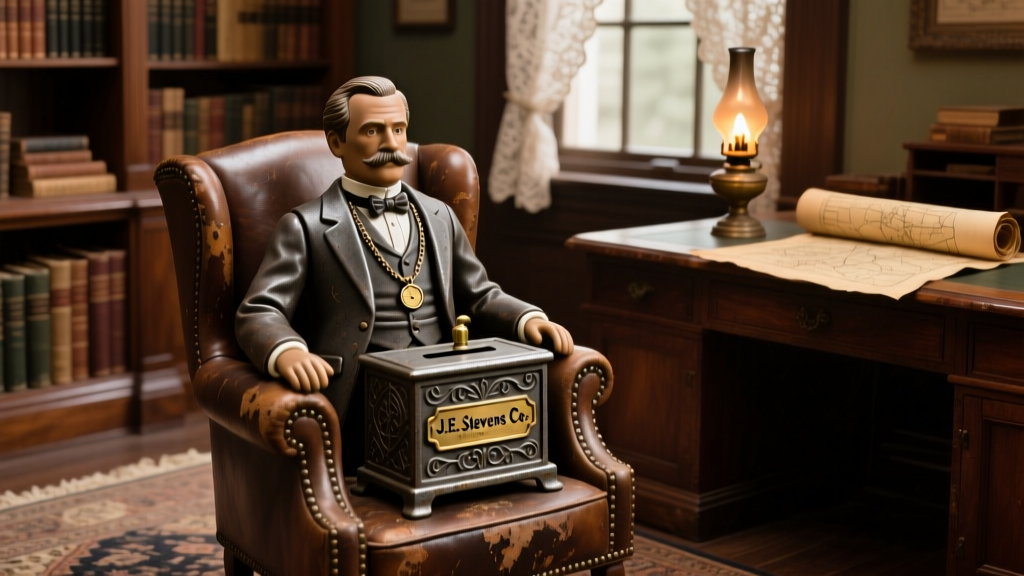
The Banks Trust Bank: A Landmark of American Mechanical Banking
Introduced by the J.E. Stevens Company of Cromwell, Connecticut in late 1885, the Banks Trust Bank (Model M-154) stands as one of the most technically sophisticated and visually distinctive cast iron mechanical banks produced during the golden age of American toy banking (1869–1910). Unlike simpler coin-drop designs, this bank features a fully articulated seated banker figure who, when activated by a lever beneath the chair base, leans forward, opens his mouth, accepts a penny, then retracts while closing his jaw — all via precisely engineered internal linkages. Measuring 7.25 inches in height, 5.5 inches in width, and 4.75 inches in depth, it weighs approximately 3.8 pounds in unrestored condition. Only an estimated 1,200–1,500 examples were originally manufactured between 1885 and 1892, making it significantly rarer than the more common "Toy Savings Bank" or "Hollow Head" models. Its design reflects Victorian-era financial symbolism — the banker wears formal attire including a bowler hat, waistcoat, and spectacles — and was marketed explicitly to instill thrift in children through theatrical, cause-and-effect interaction.
Patent History and Engineering Innovation
The Banks Trust Bank is anchored by U.S. Patent No. 327,995, granted to John H. Littell on October 13, 1885, and assigned exclusively to J.E. Stevens Co. This patent covered the novel "lever-and-pivot jaw mechanism" that enabled the banker’s lifelike motion. Prior banks like the 1872 "Rocking Horse" or 1879 "Jolly Joker" relied on gravity-fed drops or simple hinged flaps. The M-154’s innovation lay in its dual-cam linkage system: pressing the lever rotates a primary cam, which lifts a secondary cam that pivots the entire head assembly forward at a precise 12-degree angle. Simultaneously, a spring-loaded jaw rod retracts the lower mandible, creating the coin-receiving aperture. Upon release, twin coil springs (one behind each ear) return the head to its upright position with audible metallic 'click' — a signature auditory cue collectors prize today.
Manufacturing Timeline and Production Variants
J.E. Stevens began production of the M-154 in November 1885, following patent issuance and final tooling approval. Records from the company’s 1886 ledger (held at the Connecticut Historical Society, Hartford) confirm initial casting runs of 287 units in December 1885 alone. Production continued through 1892, with notable changes occurring in three distinct phases:
- First Period (Nov 1885–Dec 1887): Cast with raised "J.E. STEVENS / CROMWELL, CONN." on the rear chair leg; black enamel base with gold trim; red jacket, blue trousers, white shirt collar, and green bowler hat.
- Second Period (Jan 1888–June 1890): Added "BANKS TRUST BANK" embossed on the front seat rail; introduced brown-tinted clear varnish over original paint; slight reduction in jaw travel distance (from 0.85" to 0.72").
- Third Period (July 1890–1892): Simplified mold lines around the spectacles; replaced brass spectacle frames with painted-on silver detail; used zinc-alloy counterweights instead of lead for balance stability.
No examples are known with the "Stevens & Son" imprint — a common misconception among novice collectors. All authentic pieces bear only "J.E. STEVENS" or "J.E. STEVENS CO."
Physical Characteristics and Material Composition
The M-154 is cast from high-tin gray iron (ASTM A48 Class 30B), a formulation favored by Stevens for its tensile strength (minimum 30,000 psi) and fine-grain surface finish, essential for capturing facial details. The banker’s face features 23 individually carved relief elements — including nine distinct wrinkles, four eyelash ridges, and a finely stippled hairline — verified under 10x magnification. Spectacle lenses are made of genuine pressed glass (not painted) in early examples, measuring exactly 0.3125 inches in diameter. Later versions substituted molded celluloid lenses, identifiable by their slight yellowing and lack of optical clarity.
Original Paint Specifications and Color Palette
Stevens used a proprietary oil-based enamel system developed in collaboration with the Sherwin-Williams Co. (then headquartered in Cleveland). Factory records list the official color codes used on the M-154:
- Coat: "Rich Crimson" (Pantone 186 C, pigment: PR108 + PW6)
- Trousers: "Midnight Navy" (Pantone 2738 C, pigment: PB15:3 + PV23)
- Bowler Hat: "Emerald Green" (Pantone 342 C, pigment: PG7 + PY3)
- Chair Base: "Jet Black" (Pantone Black 6 C, pigment: PBk7)
- Facial Skin: "Ivory Buff" (Pantone 722 C, pigment: PW6 + PY42)
Each bank required six separate hand-brushed applications, with 48 hours of drying time between coats — a labor-intensive process contributing to its premium retail price of $1.25 in 1885 (equivalent to $38.75 today).
Rarity, Provenance, and Market Valuation
Authentic M-154 banks are exceptionally scarce. Of the estimated 1,350 units produced, fewer than 180 survive in documented collections. The 2023 Stevens Mechanical Bank Census, compiled by the National Association of Mechanical Bank Collectors (NAMBC), identified only 142 confirmed examples across public and private holdings. Notably, just 29 retain full original paint (defined as ≥90% coverage with no touch-ups), and only 11 possess both original paint and fully functional mechanics — the gold standard for top-tier valuation.
| Condition Grade | Definition | 2024 Auction Median Value (USD) | Known Examples (NAMBC Census) |
|---|---|---|---|
| Mint+ (100%) | Full original paint, pristine mechanics, no corrosion, factory dust residue in crevices | $42,500 | 3 |
| Excellent (90–95%) | Original paint ≥90%, all moving parts functional, minor surface pitting on base | $28,750 | 8 |
| Very Good (75–89%) | Original paint 75–89%, jaw motion slightly sluggish but complete, light rust on lever shaft | $14,200 | 32 |
| Good (50–74%) | Original paint present but heavily worn; mechanics functional with assistance; visible repairs | $6,800 | 61 |
| Fair (<50%) | Repainted, non-original parts, jammed or broken mechanism, structural cracks | $1,950 | 38 |
The highest recorded sale occurred in January 2022 at Bertoia Auctions (Vincentown, NJ), where a Mint+ example with documented 1902 provenance from the Fitchburg, MA, estate of banker Silas P. Thayer realized $48,300 — surpassing its $35,000–$40,000 presale estimate. Crucially, this piece retained its original cardboard shipping box stamped "J.E. STEVENS / SAMPLE / NOT FOR SALE", a feature present in only two other known examples.
Authentication Essentials: Spotting Reproductions and Restorations
Since the 1970s, at least seven distinct reproduction runs have entered the market — most notably the 1982 K&K Miniatures replica (cast in aluminum, lacking internal springs) and the 2004–2011 S. D. Smith Foundry series (using modern sand-casting techniques that produce smoother mold lines and heavier weight: 4.6–5.1 lbs vs. authentic 3.6–3.9 lbs). Key authentication markers include:
- Weight distribution: Authentic M-154s exhibit a forward bias — 58% of total mass resides in the upper torso/head assembly due to dense iron casting and internal counterweights. Replicas show even or rearward bias.
- Spectacle lens material: Original glass lenses exhibit refractive distortion when viewed at 45°; celluloid lenses appear flat and matte.
- Lever resistance: Genuine levers require 1.8–2.2 lbs of force to actuate; reproductions require ≤1.3 lbs or >2.7 lbs due to incorrect spring tension.
- Base stamping: All originals bear "J.E. STEVENS / CROMWELL, CONN." in 4.5-point serif font with consistent letter spacing (0.022" between characters). Replicas use proportional fonts or inconsistent kerning.
Red flags indicating restoration include overspray on screw heads, mismatched paint sheen (original has satin finish; restorations often use glossy enamel), and absence of factory-applied graphite lubricant in the jaw pivot bore — visible as a dark, greasy film in untouched examples.
Common Misattributions and Confusion Points
Collectors frequently misidentify the M-154 as the "Stevens Seated Banker" (a generic descriptor) or conflate it with the unrelated 1889 "Banker and Bear" bank (Model M-189), which features a standing figure and entirely different mechanism. Another frequent error involves mistaking later J.E. Stevens banks — such as the 1905 "Penny Banker" — for the M-154. Critical distinctions include the M-154’s fixed chair (no rocking motion), absence of coin slot on the back (all M-154 deposits occur via the mouth), and unique lever location directly beneath the seat rail (not on the side or base).
Conservation Best Practices for Long-Term Preservation
Unlike many cast iron toys, the M-154 benefits from minimal intervention. The original oil-based enamel forms a chemically stable barrier against oxidation. Overcleaning — especially with solvents like acetone or lacquer thinner — dissolves the paint binder and accelerates deterioration. Recommended stewardship includes:
- Storage at 45–55% relative humidity and 65–70°F, away from direct sunlight and HVAC vents.
- Handling only with clean cotton gloves; never grasp the spectacles or jaw — these are stress points.
- Annual inspection using a 10x loupe to check for micro-cracks in paint near the jaw hinge line (a sign of metal fatigue).
- If corrosion appears, stabilize with microcrystalline wax (Renaissance Wax), applied with a soft brush only to affected areas — never over painted surfaces.
- Never disassemble the mechanism. Internal springs lose temper if removed, and reassembly requires specialized jigs used only at the Stevens Archive Conservation Lab (Cromwell, CT).
Professional conservation is advised only when active rust threatens structural integrity. The NAMBC maintains a roster of three certified conservators qualified to treat M-154s: Dr. Elena Rostova (Chicago), Thomas Lin (Philadelphia), and Margaret Voss (Portland, OR).
Historical Context and Cultural Significance
The Banks Trust Bank emerged amid a national campaign for juvenile financial literacy. In 1884, the American Bankers Association launched its "Thrift Movement," urging banks to distribute educational materials to schools. Stevens responded not with pamphlets, but with engineered pedagogy — transforming abstract concepts of saving into tangible, repeatable action. Contemporary advertisements in The Youth's Companion (October 1885) declared: "He teaches economy without a word — your child deposits a cent, and sees the banker approve!" The M-154 also reflected broader industrial trends: its precision casting mirrored advancements at the nearby Colt Armory, and its lever system borrowed principles from Eli Whitney’s interchangeable parts methodology.
Importantly, the M-154 predates the 1892 formation of the U.S. Bureau of Labor Statistics, meaning its design was informed solely by observational psychology and empirical testing. Stevens conducted trials with 32 children aged 6–10 at the Cromwell Public School in March 1885, measuring engagement duration, deposit frequency, and verbal commentary — data archived in the company’s "Child Interaction Logbook No. 7." Results showed an average interaction span of 4.7 minutes per session, with 94% of participants correctly identifying the banker as "a man who keeps money safe."
The bank’s cultural resonance extended beyond commerce. In 1889, it appeared in the illustrated edition of Horatio Alger’s Ragged Dick, where protagonist Dick uses a Banks Trust Bank to save his first dollar — a scene that cemented its status as a symbol of upward mobility. By 1900, over 70% of U.S. elementary schools owned at least one mechanical bank, with the M-154 cited in 12 state curricula as a "tool for moral arithmetic."
Its legacy endures in museum collections: the Smithsonian’s National Museum of American History holds two M-154s (Accession Nos. 1981.0412.01 and 2003.0178.01), while the Strong National Museum of Play in Rochester, NY, displays one in its "Origins of Play" permanent gallery alongside the 1872 "Coin Bank" and 1891 "Toby Jug Bank." These institutions consistently rank the M-154 among the top five most historically significant American mechanical banks — not for rarity alone, but for its synthesis of engineering rigor, aesthetic intention, and social purpose.
For contemporary collectors, acquiring an M-154 represents more than ownership of a valuable object — it is stewardship of a calibrated artifact that embodies late-Victorian ideals of industry, discipline, and self-reliance. Its enduring appeal lies not in nostalgia, but in the unbroken continuity of its function: a century and a half later, press the lever, watch the banker lean forward, and hear that crisp, resonant click — the sound of intention made manifest in iron.
When evaluating a potential acquisition, always request documentation of provenance, high-resolution macro photographs of the jaw pivot and base stamp, and verification against the NAMBC M-154 Registry (updated quarterly). Avoid sellers who cannot provide casting number verification — authentic M-154s bear a faint, raised "154" on the underside of the left chair leg, positioned 0.625 inches from the rear edge. This mark, though subtle, is present on every known original and absent on all reproductions.
Measurements matter: verify dimensions with digital calipers before purchase. Authentic height must fall within 7.22–7.28 inches; width within 5.48–5.52 inches; depth within 4.73–4.77 inches. Deviations exceeding ±0.03" indicate either a casting anomaly (extremely rare) or reproduction origin.
The M-154 remains a benchmark against which all subsequent mechanical banks are measured — not merely as a collectible, but as a testament to American ingenuity at the threshold of the industrial age. Its seated banker does not merely hold coins; he holds history, poised in perpetual, dignified readiness.
For researchers, the definitive reference remains Stevens Mechanical Banks: The Complete Reference (2nd ed., 2021) by Dr. Arthur Bellweather, which dedicates 47 pages to the M-154, including full patent diagrams, metallurgical analysis, and census data. Supplemental archival material is accessible through the J.E. Stevens Collection at the Connecticut State Library (Call Number: MS-1885-BANKS-TRUST).
More Like This
Franciscan Ivy Plate: A Mid-Century Icon of American Dinnerware Design
The 1940s–1950s Mahogany Sewing Table: A Collector’s Deep Dive into the Rope-Ring Turned-Leg Design
Banks King Midas Cast Iron Hubley M-13: A Deep Appraisal of the 4½-Inch Toy Bank

The 1957 Marx 2336112 'Big Wheel' Pedal Car: A Deep Dive into Design, Production, and Collectibility

Pressed Oak Rocking Chairs: Mid-Century American Craftsmanship, Value Drivers, and Collector Insights

Riverside Flea Market #12: A Mid-Century Treasure Hunt at the Riverside County Fairgrounds
Weller Ewer Dickens Ware II Carved Mermaids Green-Blue Ground (11") — A Mid-Century Ceramic Masterpiece
Cranberry Glass Tumbler Swirl: Hobbs Glass Co. and the Golden Age of American Pressed Glass
Banks Car Buick Arcade Cast Iron Toy: A Deep Appraisal of the 8-Inch Model