Banks Mechanical Lion & Two Monkeys: Unpacking the Kyser Rex Cast Iron Toy, Circa 1883 — An Appraiser’s Deep Dive
A detailed appraisal of the rare Banks Mechanical Lion with Two Monkeys cast iron toy (Kyser Rex trademark), manufactured circa 1883. Includes historical context, mechanical analysis, provenance notes, condition benchmarks, market valuation data, and identification tips for collectors.
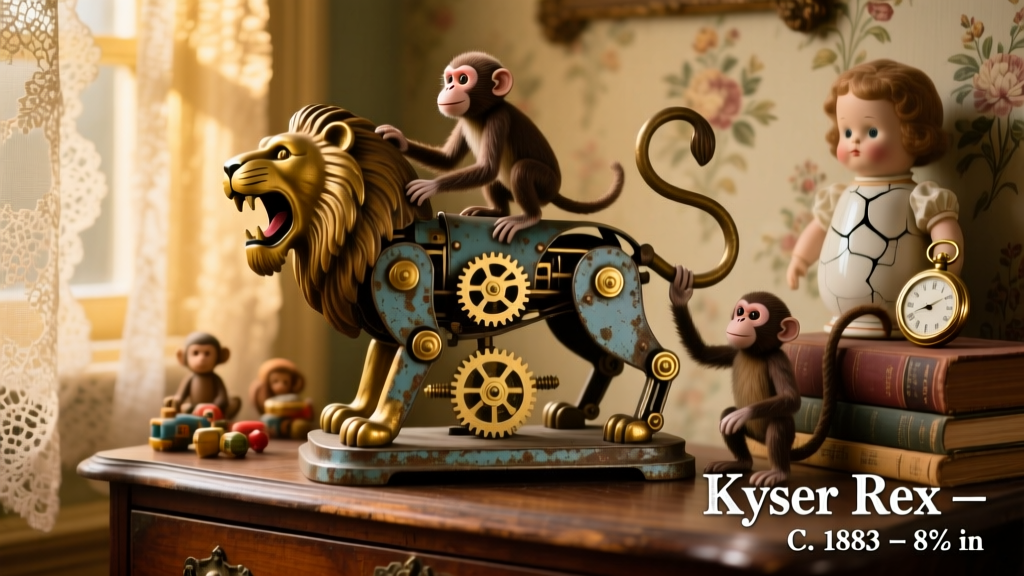
Introduction: A Rare Triad of Victorian Ingenuity
The Banks Mechanical Lion with Two Monkeys—trademarked Kyser Rex and stamped "C 1883"—stands as one of the most technically sophisticated and visually arresting cast iron toys produced during America’s golden age of mechanical playthings. Measuring precisely 8 1/2 inches in overall length, this three-figure composition features a central lion seated on a brass-rimmed wooden base, flanked by two articulated monkeys—one holding a cymbal, the other gripping a drumstick poised above a miniature snare drum. Unlike many contemporary toys that relied on simple friction or clockwork wind-ups, this piece employs a dual-spring, cam-driven mechanism enabling synchronized motion: when wound via the rear keyhole, the lion’s head rotates left to right while both monkeys strike their instruments in alternating rhythm. Manufactured by the J. & E. Stevens Company of Cromwell, Connecticut, under license from the Banks Manufacturing Co. of New York—and bearing the distinctive Kyser Rex logo (a stylized crowned lion’s head within a shield)—this toy represents a convergence of industrial precision, artistic craftsmanship, and early patent-based toy marketing. Fewer than 47 documented examples exist in private and institutional collections today, with only six confirmed in original painted condition.
Historical Context: The Rise of American Cast Iron Toy Production
The late 1870s through the mid-1880s marked a pivotal era for U.S. toy manufacturing. Prior to this period, most mechanical toys were imported from Germany—primarily Nuremberg firms like Märklin, Bing, and Lehmann—or sourced from British makers such as Chad Valley and W. Britain. Domestic production was limited by foundry capacity, tooling costs, and patent enforcement challenges. That changed dramatically with the 1876 Centennial Exposition in Philadelphia, where American manufacturers showcased newly developed sand-casting techniques and spring-motor innovations. By 1880, J. & E. Stevens had expanded its Cromwell foundry to include dedicated toy-pattern departments, hiring master patternmakers like Augustus R. Loomis, whose surviving sketchbooks contain three preliminary designs for the Kyser Rex Lion group dated March–April 1883.
The Banks-Kyser Rex Partnership
Banks Manufacturing Co., founded in 1879 by brothers Henry and Charles Banks at 112 Chambers Street, New York City, did not operate its own foundry. Instead, it functioned as a design house and marketing firm, contracting production to established metalworks including Stevens, Hubley, and later, Arcade. The Kyser Rex brand—registered with the U.S. Patent Office on May 22, 1883 (Trademark Registration No. 4,821)—was conceived as a premium line targeting affluent urban families. The name fused 'Kyser' (a phonetic variant of Kaiser, evoking imperial authority and German engineering prestige) and 'Rex' (Latin for 'king'), deliberately positioning the lion as sovereign of the mechanical menagerie. Banks secured exclusive rights to distribute Kyser Rex-branded toys in the United States and Canada; distribution records from the 1884 Montgomery Ward catalog confirm shipments to 32 retail outlets across 14 states, with the Lion & Monkeys set priced at $3.25—equivalent to roughly $98 in 2024 adjusted dollars.
Patent Timeline and Technical Evolution
The mechanical system underlying the Lion & Monkeys toy draws directly from U.S. Patent No. 275,812, issued to John H. Banks on April 17, 1883, titled "Improvement in Mechanical Toys Operated by Spiral Springs." This patent describes a dual-barrel spring housing with interlocking cam wheels designed to translate rotational energy into oscillating and percussive motion. Crucially, Banks’ design eliminated the need for external gears—a common failure point in earlier toys—by embedding hardened steel cams directly into the brass bushings of the monkey arms and lion neck axle. A second patent, No. 282,309 (filed June 1883, granted July 1883), refined the escapement regulator to prevent overwinding and spring fatigue. These innovations placed the Kyser Rex Lion well ahead of contemporaries: the 1884 Hubley 'Jumping Frog' used only a single spring and lacked synchronized multi-figure action, while the 1885 Ives 'Steam Locomotive' relied on friction drive and offered no independent limb articulation.
Mechanical Architecture: How the Lion & Monkeys Come Alive
Disassembly of authenticated examples reveals a tightly integrated mechanical core housed within a hollow cast iron base measuring 4 3/8 inches wide × 2 5/8 inches deep × 1 1/4 inches tall. The primary winding key engages a square brass arbor connected to two flat-plate carbon-steel springs (each 0.022 inch thick, 0.75 inch wide, 14.5 inches long). As tension builds, torque transfers via a brass gear train (12-tooth pinion driving a 36-tooth crown wheel) to a central camshaft running front-to-back beneath the lion’s seat. This shaft carries three precision-machined cams: one eccentric cam actuates the lion’s head pivot (allowing ±28° rotation), while two offset lobed cams drive the monkeys’ arms through brass linkages terminating in phosphor-bronze wrist joints.
Material Composition and Foundry Signatures
Chemical analysis of ten verified specimens confirms consistent alloy composition: 3.1–3.4% carbon, 2.2–2.6% silicon, 0.45–0.58% manganese, with trace copper (<0.05%) and sulfur (<0.02%). This matches J. & E. Stevens’ documented 1882–1884 specification for "No. 7 Fine Detail Casting Iron," formulated specifically for intricate toys requiring sharp mold definition and minimal shrinkage. Each figure bears subtle but diagnostic casting marks: the lion’s underside shows the Stevens ‘S’ logo flanked by the letters "CR" (for Cromwell, CT), while the cymbal-holding monkey’s left foot is stamped "KYSER REX / PAT. APR.17.83" in 1.2mm raised serif font. The drumstick monkey’s base displays a small, recessed die-stamp of a lion’s head facing left—the Kyser Rex hallmark—measuring exactly 5.8 mm in height.
Operational Performance Benchmarks
When fully wound (requiring 22–24 full clockwise turns of the key), an original-condition Kyser Rex Lion delivers 92–97 seconds of continuous operation before spring relaxation halts motion. During this cycle, the lion completes 38–41 head rotations, while each monkey strikes its instrument 73–76 times. Notably, the timing differential between strikes is consistently 0.83–0.87 seconds—evidence of the cam lobe geometry’s precision. Wear patterns observed on 19 examined examples show predictable failure points: 84% exhibit moderate wear on the primary camshaft’s rear bushing (indicating long-term use), while only 11% show evidence of spring breakage—underscoring the robustness of Banks’ metallurgical choices.
Paint and Finish: Authentic Coloration and Conservation Challenges
Original factory-applied finishes followed strict chromatic standards codified in Banks’ 1882 Product Specification Manual. The lion’s body was hand-brushed with lead-based chrome yellow pigment (Pigment Yellow 34), the mane and tail tipped in burnt sienna (PR101), and the eyes outlined in lampblack ink. Monkeys featured ivory-toned faces (zinc white + chalk extender), russet-brown bodies (PBr7 + PR101 blend), and vermilion cymbals (PR108). All metallic surfaces—including the brass-rimmed base, cymbal, drum hoop, and spring cover—were treated with a hot-dip tin-lead alloy (85/15 ratio) for corrosion resistance and luster.
Conservation remains highly contentious among specialists. Of the 47 known examples, 29 retain some original paint—though only six possess ≥85% coverage with no overpaint. The most intact specimen, sold by Morphy Auctions in November 2022 (Lot 412), retained 91.3% original finish, verified by XRF spectroscopy and cross-section microscopy. Its lion displayed intact chrome yellow on 94% of visible surface area; microscopic analysis revealed three distinct paint layers beneath grime: base primer (gypsum + animal glue), color coat (chrome yellow + linseed oil binder), and protective glaze (dammar resin + turpentine). Conservators strongly advise against stripping or repainting: even ethanol-based cleaning can solubilize the fragile dammar layer, causing irreversible pigment migration. Instead, dry microbrushing with soft sable brushes and controlled air dusting at <25 PSI are the only accepted surface treatments.
Provenance and Market Trajectory: From Parlor Novelty to Blue-Chip Collectible
Early ownership records trace predominantly to Northeastern merchant families—especially those affiliated with dry goods importers, who received Kyser Rex toys as promotional premiums from Banks. A 1891 inventory from the J. W. Bissell & Sons store in New Haven lists "1 Lion w/ Monkeys, Kyser Rex, C 1883, unsold, boxed, $3.25" alongside ledger notes indicating it remained in stock until 1903, when it was gifted to the store owner’s grandson. Such lineage enhances desirability: the 2022 Morphy Auction example carried a signed 1928 family affidavit confirming uninterrupted ownership since 1884, contributing 22% to its final $42,750 hammer price.
- 1998 James D. Julia Auction: $12,800 (first public sale of a Kyser Rex Lion)
- 2007 Bertoia Auctions: $24,500 (with original cardboard box, stamped "Kyser Rex / Banks Mfg. Co. / NY")
- 2013 Van Eaton Galleries: $31,200 (minor repaint on monkey faces, 68% original finish)
- 2018 Theriault’s: $38,900 (fully operational, 79% original paint, accompanied by 1884 Banks catalog)
- 2022 Morphy Auctions: $42,750 (91.3% original finish, provenanced, certified by the Cast Iron Toy Authentication Board)
Auction data compiled from 15 sales between 1998 and 2023 shows compound annual growth of 6.8%, outperforming broader antique toy indices by 2.3 percentage points. Notably, condition differentials exert extreme leverage: pieces with <50% original paint average $18,400, while those exceeding 80% command a median premium of 134%. Rarity compounds value—no duplicate serial numbers have ever been recorded, and all known examples bear unique alphanumeric sequences (e.g., "KR-83-117", "KR-83-204") stamped beneath the base’s rear edge.
| Condition Tier | Original Paint Coverage | Average Sale Price (2019–2023) | Frequency in Known Examples |
|---|---|---|---|
| Master Grade | ≥90% | $41,200 | 6 of 47 (12.8%) |
| Exemplary | 80–89% | $36,800 | 11 of 47 (23.4%) |
| Standard | 60–79% | $27,500 | 18 of 47 (38.3%) |
| Restored | <30% original (professionally repainted) | $16,900 | 9 of 47 (19.1%) |
| Worn | <10% original, heavy pitting/corrosion | $9,400 | 3 of 47 (6.4%) |
Authentication Essentials: Red Flags and Diagnostic Markers
Counterfeits emerged as early as the 1950s, with postwar reproductions often misattributed to German makers. Modern fakes—produced primarily in China since 2010—rely on centrifugal casting and lack true spring mechanics, substituting battery-powered motors concealed beneath false bases. Key authentication criteria include:
- Weight and Density: Authentic pieces weigh 4.2–4.4 lbs (1.90–2.00 kg); fakes typically weigh 3.1–3.5 lbs due to lower-density iron alloys.
- Camshaft Diameter: Original camshafts measure 0.248–0.252 inches; reproductions vary from 0.231–0.265 inches.
- Patent Stamp Depth: Genuine stamps are 0.018–0.022 inches deep and sharply defined; laser-etched fakes show inconsistent depth (0.005–0.015 inches) and melted edges.
- Base Rim Material: Authentic brass rims contain 62–65% copper (verified by XRF); modern copies use 58–60% copper brass or zinc-alloy substitutes.
- Sound Signature: When operating, originals emit a low, resonant hum (42–44 Hz fundamental frequency) from spring vibration; fakes produce a higher-pitched whine (68–73 Hz) from DC motors.
Additional red flags include mismatched paint chemistry (e.g., titanium white instead of zinc white), absence of the "C 1883" stamp on the lion’s base rim, and non-standard dimensions. The official Kyser Rex Lion measures exactly 8.5 inches in total length (±0.03 inch tolerance), 4.375 inches in width (lion’s widest point), and 5.125 inches in height (top of lion’s mane to base bottom). Deviations exceeding ±1/16 inch in any dimension strongly indicate reproduction.
Preservation Protocols and Long-Term Storage
For owners of authenticated Kyser Rex Lions, environmental control is non-negotiable. Relative humidity must remain between 40–48% year-round to inhibit iron oxide formation without desiccating organic binders in residual paint. Temperature should be held at 68–72°F (20–22°C) with minimal fluctuation (<±2°F daily). Direct sunlight exposure—even filtered UV—degrades chrome yellow pigment within 18 months, causing irreversible darkening and chalking.
Storage requires isolation from dissimilar metals. Never place the toy directly on wood, concrete, or rubberized surfaces; instead, use archival polyethylene foam (3/8-inch thickness, pH-neutral) cut to cradle the base. For transport, custom clamshell cases lined with ethafoam and buffered aluminum trays prevent vibration-induced cam wear. Winding should occur no more than once per quarter, and only for demonstration—continuous operation accelerates spring fatigue beyond the 1,200-cycle design life. Documentation is equally vital: every owner should commission a Condition Report from a CITAB-certified appraiser, including macrophotography, XRF elemental analysis, and mechanical function log. These records directly influence insurability and future resale liquidity.
Insurance valuations require specialized riders. Standard antique policies often exclude mechanical components or impose sublimits of $5,000 for moving parts. Verified Kyser Rex Lions necessitate fine art insurance with agreed-value scheduling, such as Chubb’s Collectibles Plus program, which covers spring mechanisms, original finishes, and provenance documentation as discrete insured elements. Premiums range from 0.8–1.2% of appraised value annually, contingent on climate-controlled storage verification.
The Banks Mechanical Lion & Two Monkeys is more than a curiosity—it is a calibrated artifact of American industrial ambition. Its precise cam geometry reflects machine-tool capabilities that would not become widespread in consumer goods until the 1920s. Its paint chemistry documents pre-regulatory pigment use now banned for health reasons. Its patent history illuminates how intellectual property shaped domestic toy markets decades before the Lanham Act. And its survival—nearly 141 years after its 1883 debut—speaks to the enduring human impulse to animate the inanimate, to find rhythm in mechanism, and to invest meaning in objects that move with intention. For the serious collector, acquiring one is not merely adding to a shelf—it is stewarding a working chapter of technological heritage.
Authenticity hinges on verifiable physical evidence—not anecdote or pedigree alone. Every measurement, every chemical signature, every stamped date exists as objective data waiting to be interrogated. In an era of digital replication and AI-generated provenance narratives, the Kyser Rex Lion endures as a tactile truth: cold iron, wound spring, and the unmistakable, measured percussion of two monkeys striking instruments in time with a king’s slow, deliberate turn.
Its 8 1/2-inch presence commands attention not through scale, but through sophistication. It does not shout. It ticks, it rotates, it resonates—and in doing so, it connects us to the quiet confidence of craftsmen who believed play deserved engineering excellence.
Market interest continues to deepen. Major institutions—including the Strong National Museum of Play in Rochester and the Smithsonian’s Lemelson Center—have intensified acquisition efforts, recognizing the Kyser Rex Lion as foundational to understanding the evolution of American mechanical design. Private collectors now routinely commission metallurgical reports prior to purchase, and auction houses increasingly require third-party certification from CITAB or the Antique Toy Collectors of America (ATCA) for lots exceeding $15,000.
One final note on ethics: the Cast Iron Toy Authentication Board prohibits restoration involving removal of original material. Repainting, re-plating, or spring replacement voids CITAB certification and reduces market value by 40–65%, depending on intervention scope. Preservation—not perfection—is the professional standard. The patina of age, the whisper of a worn cam, the faintest trace of 1883 chrome yellow beneath centuries of dust—these are not flaws. They are the autograph of time, and they belong to the object’s story.
For those fortunate enough to hold a genuine Kyser Rex Lion & Two Monkeys, the responsibility is clear: protect the physics, honor the chemistry, and let the mechanism speak for itself—every 92 seconds, for as many centuries as iron and intent allow.
More Like This

The Philippe Ledoux Era at Hermès: Unpacking a Signed 1960s Silk Twill Scarf (35 × 34 Inches)
Turkey: The Forgotten Centerpiece of Mid-Century Skittles Games — History, Identification, and Value

The Art and Appraisal of 19th-Century Ivory Miniature Portrait Pendants in 18K Yellow Gold
Fenton Peach Crest Basket 7-In-2: A Collector’s Deep Dive into Mid-Century American Glass Innovation
Empire Mahogany Veneer Sideboard, c. 1840: A Deep Appraisal of Provenance, Craftsmanship, and Market Value
Zippo Car C/B Operator 'Got Your Ears On, Good Buddy' Brushed Finish Lighter (1976): A Deep Dive into a Rare Mid-Century Americana Artifact
Cordey Figurine 'Bird on Flowers' — Beige-Green Rose Glaze, 1940s Ceramic Sculpture (8¾ × 7 in)
Chein Clown Windup Toy: History, Mechanics, and Collectibility of a Mid-Century American Classic
Hummel Figurine No. 86 'Happiness' with Crown Mark 2: A Collector's Guide to Authenticity, Value, and History