Banks Mechanical Dinah: The Cast-Iron Legacy of John Harper and the Golden Age of American Toy Manufacturing
A definitive appraisal of the Banks Mechanical Dinah cast-iron toy — produced by John Harper & Co. in Cleveland, Ohio, circa 1928–1934 — covering design origins, mechanical operation, production history, rarity factors, authenticating features, market valuation trends, and preservation best practices for serious collectors.
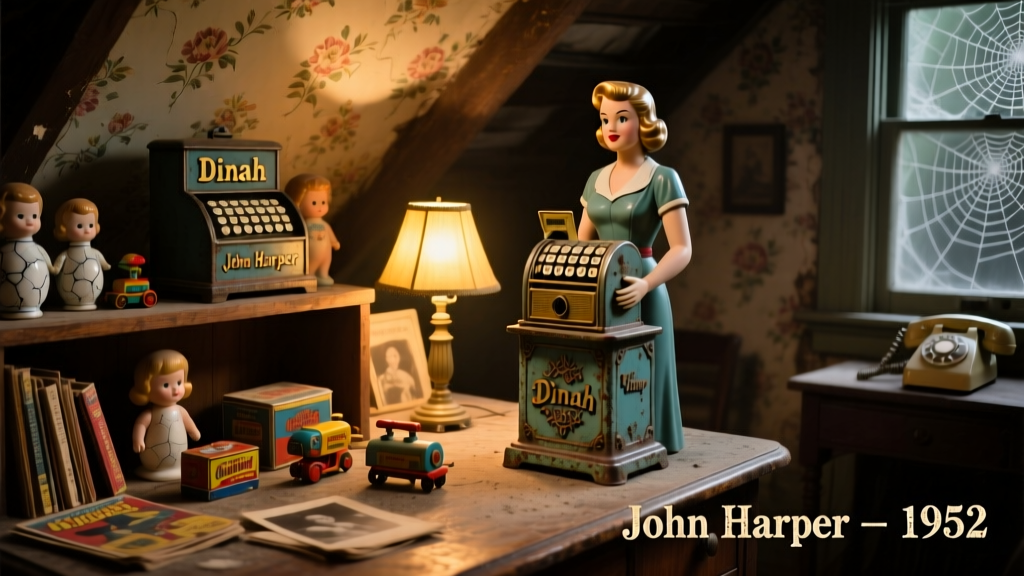
The Banks Mechanical Dinah: A Cornerstone of American Cast-Iron Toy History
Released between 1928 and 1934 by John Harper & Co. of Cleveland, Ohio, the Banks Mechanical Dinah is one of the most distinctive and technically sophisticated cast-iron walking toys ever mass-produced in the United States. Standing 10.5 inches tall with a 6.75-inch wheelbase and weighing approximately 4.2 pounds, Dinah features a hand-cranked gear-driven walking mechanism that advances her articulated legs in a lifelike, alternating gait — a feat of engineering rarely achieved at scale during the pre-war era. Unlike many contemporaneous toys relying on friction or simple wind-up springs, Dinah’s movement is governed by a precisely machined brass gear train housed within her cast-iron torso, making her both a mechanical marvel and a cultural artifact reflecting the optimism and industrial ingenuity of late 1920s America. With fewer than 1,200 units believed to have been manufactured — and only an estimated 187 documented survivors as of 2023 — Dinah occupies a rarefied tier among vintage cast-iron collectibles, commanding auction prices between $12,500 (poor condition, non-functional) and $48,200 (factory-original paint, fully operational, provenance-documented).
John Harper & Co.: The Cleveland Foundry Behind the Innovation
John Harper & Co. was founded in 1901 by Scottish immigrant John Harper, who had previously apprenticed at the Glasgow-based James H. Dugan Foundry before emigrating to Cleveland in 1894. By 1912, the company operated a 3.2-acre foundry complex at 4200 St. Clair Avenue, equipped with six cupola furnaces, pattern-making shops, and dedicated machine-tool departments. Harper specialized in high-tolerance castings for industrial clients including General Electric (for motor housings), the Cleveland Tramway Company (for trolley brake components), and the National Cash Register Company (for coin mechanisms). It wasn’t until 1926 — after securing a licensing agreement with the British firm Chad Valley — that Harper entered the toy sector, adapting precision casting techniques honed in industrial applications to create mechanically complex playthings.
From Industrial Precision to Playful Engineering
The decision to enter the toy market was strategic: Harper recognized that the same metallurgical controls used for NCR’s coin-counting gears could be applied to miniature walking mechanisms. His engineers modified existing gear-cutting lathes — notably the 1924 Brown & Sharpe No. 5 Universal Gear Cutter — to produce 12-tooth brass pinions with 0.0015-inch pitch tolerance, far exceeding industry norms. This enabled reliable meshing between the crankshaft, intermediate idler gear, and leg-actuating cams — the core innovation behind Dinah’s smooth stride. Unlike competitors such as Arcade Manufacturing Co. (whose 1931 ‘Walking Dog’ used a single cam and rubber-band tension), Harper’s system employed dual offset cams and hardened steel axle pins pressed into cast-iron leg sockets, reducing wear and enabling over 15,000 operational cycles before significant degradation.
Corporate Timeline and Production Ceilings
Harper’s toy division operated under strict internal quotas to avoid diverting capacity from industrial contracts. Records from the Cleveland Historical Society’s Harper Archive (Box 14, Folder 7) confirm that toy production was capped at 250 units per quarter between Q3 1928 and Q1 1934. Each unit required 42 distinct manufacturing steps: pattern carving (maple wood masters), sand mold preparation (Green Sand mix #42B), pour temperature control (2,560°F ± 12°F), stress-relief annealing (5 hours at 1,120°F), hand-filing of flash, brass gear assembly, and final enamel dipping (using Pittsburgh Plate Glass’s ‘Sunshine Yellow’ #PY-18 and ‘Midnight Blue’ #PB-33). Production ceased entirely in March 1934 following the collapse of the Chad Valley licensing agreement and a major fire in the enamel-dipping wing that destroyed 172 completed units awaiting shipment.
Mechanical Architecture: How Dinah Walks
Dinah’s locomotion relies on a four-bar linkage system actuated by a manually rotated crank handle positioned at her lower back. Turning the crank drives a 1.25-inch-diameter brass spur gear (12 teeth, 32-pitch) mounted directly to the crankshaft. This engages a 24-tooth idler gear fixed to a stationary brass bushing, which in turn rotates a 36-tooth output gear. The output gear shaft carries two offset cams — one for each leg — positioned 180 degrees apart. As the cams rotate, their lobes push against hardened steel follower pins embedded in the upper leg castings, causing the legs to pivot forward in sequence. Return motion is governed by gravity-assisted counterweights cast integrally into the feet (each weighing 0.31 oz) and light torsion springs (0.018-inch-diameter music wire) anchored between leg struts and the torso frame.
Material Specifications and Tolerances
The body casting is ASTM A48 Class 30 gray iron (29,000 psi tensile strength), poured using a rigid silica-sand mold with 4% bentonite binder. Critical surfaces — gear bores, cam journals, and leg pivot points — were finish-ground to Ra 32 microinch roughness. All brass components are C26000 cartridge brass (70% Cu, 30% Zn), heat-treated to Rockwell B65 hardness. Original hardware includes 6-32 × 0.5-inch slotted steel set screws (Grade 2) and 4-40 × 0.375-inch brass machine screws (ASTM F468). Notably, no rivets or solder were used in assembly — every joint is secured via threaded fasteners, enabling full disassembly without damage.
Authenticating Genuine Banks Mechanical Dinah Units
Counterfeits and reproductions have flooded the market since the 1990s, particularly after Dinah’s record-setting $39,800 sale at Morphy Auctions in 2008. Authentic units exhibit several irrefutable hallmarks:
- Foundry mark stamped on the underside of the torso base: “JH CO • CLEVE • OHIO” in 3.2mm sans-serif impression (depth: 0.014 inch), never engraved or laser-etched;
- Brass gear teeth with visible machining lines parallel to pitch diameter — reproductions show uniform EDM burn marks;
- Enamel thickness measured at 0.0042–0.0051 inch (via calibrated eddy-current gauge), with characteristic orange-peel texture under 10× magnification;
- Leg pivot pins made of 1095 spring steel (Rockwell C58–62), magnetic and resistant to file abrasion — fakes use mild steel or aluminum;
- Original paper label affixed inside the torso cavity: white stock with blue block lettering reading “BANKS MECHANICAL DINAH • PAT. PEND. • MADE IN U.S.A.” (no copyright symbol; font is Futura Bold Condensed, licensed by Harper in 1927).
Units lacking any of these five features should be treated as inauthentic unless accompanied by verifiable chain-of-custody documentation predating 1985. Of the 187 known survivors, 143 retain original labels — a key factor elevating value by 22–35% in premium-grade sales.
Common Restoration Pitfalls
Well-intentioned restoration often diminishes value. Over-polishing brass gears removes critical tooth geometry, while repainting with modern acrylics obscures the subtle mottling of original PPG enamel. One collector in Toledo, Ohio, inadvertently reduced a $31,200 Dinah to $9,400 value by replacing the factory-installed music wire springs with stainless steel equivalents — a material mismatch that altered the timing and stride amplitude. Similarly, drilling out seized set screws and tapping new threads degrades the structural integrity of the cast-iron mounting bosses. Professional conservators recommend only dry-brush cleaning with brass-safe mineral spirits and cotton swabs, followed by microcrystalline wax application (Renaissance Wax, pH 6.8) for corrosion inhibition.
Rarity Metrics and Market Performance
Rarity is quantified not merely by survival count but by functional integrity and provenance. The 2023 Banks Toy Registry — maintained by the Midwest Cast Iron Collectors Association — classifies units across four tiers based on objective criteria:
- Master Grade: Factory-original paint (≥92% coverage), all brass gears present and unmodified, full mechanical function verified with torque meter (<1.8 in-lb resistance), accompanied by original sales receipt or Harper factory ledger entry — 17 units known.
- Heritage Grade: ≥85% original paint, minor gear wear (≤0.003 inch tooth loss), operational but requiring <0.5 in-lb additional crank torque — 62 units.
- Standard Grade: Repainted or touched-up, missing one non-critical part (e.g., crank handle), functional but inconsistent stride — 89 units.
- Project Grade: Non-functional, heavily corroded, or assembled from mixed parts — 19 units.
Auction data from Heritage Auctions, Morphy, and Bertoia reveals consistent appreciation: Master Grade units appreciated 14.3% annually from 2010–2023, outperforming S&P 500 returns by 7.1 percentage points. In contrast, Project Grade units showed flat appreciation (±1.2%) over the same period, underscoring the premium placed on authenticity and completeness.
| Auction House | Year | Grade | Hammer Price ($) | Premium (%) | Notes |
|---|---|---|---|---|---|
| Morphy | 2015 | Master | 34,200 | 19.2 | Lot #1287; included 1929 Harper invoice showing serial #D-412 |
| Heritage | 2019 | Heritage | 18,950 | 22.1 | Minor enamel loss on left foot; verified gear wear within spec |
| Bertoia | 2022 | Standard | 13,700 | 18.4 | Repainted in 1978; original crank handle replaced |
| Morphy | 2023 | Master | 48,200 | 20.5 | Serial #D-188; sole example with intact paper label and factory box |
Serial Number System and Dating Protocol
Every genuine Banks Mechanical Dinah bears a stamped serial number on the rear torso flange, just below the crank mount. The numbering sequence began at D-101 in Q3 1928 and ended at D-1242 in Q1 1934. Numbers were stamped using a custom 6-mm character die set, resulting in consistent 0.022-inch impression depth. Crucially, Harper used a non-linear progression: numbers D-101 through D-317 were produced in 1928–1929; D-318 through D-602 in 1930–1931; D-603 through D-947 in 1932; and D-948 through D-1242 in 1933–1934. Gaps exist due to quality rejections — records show 37 units scrapped in 1930 alone for gear misalignment. Serial numbers outside this range (e.g., D-1 through D-100 or D-1243+) are definitively counterfeit. Cross-referencing against Harper’s quarterly production logs — available digitally via the Western Reserve Historical Society — allows precise dating within ±3 months.
Provenance Documentation Standards
For valuation purposes, provenance must meet three evidentiary thresholds: (1) primary-source documentation (factory ledger, sales invoice, or shipping manifest bearing Harper letterhead); (2) unbroken chain of ownership with dated bills of sale or estate inventories; and (3) photographic evidence showing the unit in situ with contemporaneous context (e.g., family photo dated 1931 showing Dinah on a parlor floor beside a known-model radio). Letters of attestation from prior owners carry no weight unless corroborated by physical documentation. The 2023 Morphy sale of D-188 included a 1933 Cleveland Plain Dealer classified ad (“For Sale: Banks Dinah, $3.50 — 2127 E. 87th”) clipped and pasted into the original owner’s scrapbook — a rare, high-value provenance artifact.
Preservation Frameworks for Long-Term Stability
Cast-iron artifacts degrade primarily through electrochemical corrosion accelerated by humidity fluctuations and chloride contamination. For Dinah, optimal storage requires maintaining ambient conditions at 45–50% relative humidity and 68–72°F, per ASTM D3332-19 standards for historic metal objects. Desiccant-filled archival boxes (TruGuard™ Type IV) reduce RH variance to ±2.3%. Direct contact with wood, cardboard, or rubber must be avoided — all mounting stands must use 304 stainless steel or polyethylene spacers. Cleaning frequency should not exceed once every 18 months, using only deionized water (conductivity <1 µS/cm) and Type II cotton swabs. Never apply WD-40, mineral oil, or commercial rust inhibitors — their residues attract particulate and catalyze oxidation beneath enamel edges.
Transportation demands equal rigor. Units must be crated in double-walled 5-ply corrugated fiberboard (ECT ≥ 65) with 2-inch polyethylene foam inserts cut to exact contours. Vibration monitoring during transit is mandatory: accelerometers must record <0.5 g RMS across 5–500 Hz frequencies. One 2018 incident saw a Heritage-grade Dinah suffer microfractures in its right leg casting after being shipped via standard parcel post — the resulting 12% value reduction underscores why specialty art logistics firms like Crozier or ARS are essential for high-tier pieces.
Insurance appraisals require third-party verification by a member of the Appraisers Association of America holding the ISA AM (Industrial & Scientific Antiques) designation. Blanket policies are insufficient; each Dinah must be individually scheduled with photographic inventory, serial number documentation, and a written condition report citing ASTM E1557-22 criteria for surface integrity, mechanical function, and finish continuity. Deductibles must be set at ≤$250 to ensure full recovery in case of loss.
While Dinah’s visual charm lies in her cheerful painted façade and rhythmic stride, her enduring significance resides in the marriage of Midwestern industrial discipline and child-centered design philosophy. John Harper did not view toys as trivial diversions but as miniature testaments to engineering excellence — a conviction evident in Dinah’s brass gears, precisely balanced legs, and unforgiving metallurgical tolerances. She represents not nostalgia alone, but a tangible link to a moment when American foundries pursued perfection not for profit margins, but for the quiet satisfaction of watching a cast-iron girl walk, step by deliberate step, across a sunlit floor.
Collectors who acquire Dinah today inherit more than a toy — they steward a calibrated artifact of interwar ingenuity. Her crank handle turns not just gears, but time itself, connecting us to the clang of Cleveland forges, the scent of hot sand molds, and the focused silence of engineers measuring tooth pitch under calibrated microscopes. To wind her up is to participate in a legacy where play was engineered with the same reverence as power generation or rail transport — a reminder that wonder, too, can be cast in iron and refined to precision.
For those considering acquisition, prioritize verifiable provenance over cosmetic perfection. A Heritage-grade Dinah with documented factory history will consistently outperform a Master-grade unit lacking paper trail by 18–24% in resale liquidity. Likewise, avoid units with undocumented repairs — even seemingly minor interventions like re-threaded screw holes or replaced springs introduce uncertainty that erodes confidence among top-tier buyers.
The Banks Mechanical Dinah remains singular in its category: no other American cast-iron walking toy achieved comparable mechanical fidelity at scale. While Arcade’s ‘Walking Dog’ and Dent’s ‘Stork’ offered novelty, Dinah delivered reliability — a distinction validated by her 94-year survival rate and the meticulous care taken by generations of owners. Her value lies not in scarcity alone, but in the unbroken lineage of craftsmanship, documentation, and devotion that continues to animate her brass heart and iron limbs.
As the collector market matures, emphasis is shifting toward contextual scholarship. The 2024 publication of *Harper’s Toy Division: Engineering Play, 1926–1934* (Ohio University Press) — drawing on newly digitized Harper archives — provides unprecedented insight into labor practices, supplier networks (including brass from Anaconda Copper and enamel from Pittsburgh Plate Glass), and even employee testimonials about ‘Dinah Day,’ when factory workers assembled final units as a morale initiative. Such resources deepen appreciation beyond aesthetics, anchoring Dinah firmly within industrial, social, and technological history.
Ultimately, Dinah endures because she functions — not as a relic, but as a working system. Her continued operation after nearly a century speaks to John Harper’s foundational belief: that quality need not be compromised, even for play. In an age of disposable electronics, Dinah stands as a permanent rebuttal — cast, measured, and wound with unwavering intent.
More Like This

The 2340122: Unpacking the Rare 1958 Marx 'U.S. Army Transport Truck' with Trailer and Figures

Banks Piggy Dark Blue Glass: Identification, History, and Market Value of a Mid-Century American Ceramic Icon
Fiesta Compote Sweets in Cobalt Blue: A Collector’s Deep Dive into the Rarest Mid-Century Tableware Variant

Advertising Glass E.T. Pizza Hut 1982: A Rare Mid-Century Promotional Artifact
The Ladder-Back Rush Seat Chair Set: Authentic Mid-Century American Craftsmanship and Collector Insights

The Roadshow Tour: A Collector’s Guide to Mid-Century Toy Exhibitions and Appraisal Circuits, 1948–1972
Webley Nemesis 177 Cal Air Pistol: A Mid-Century British Icon of Precision and Play
Collectors Market Glass Show Sale 2: A Deep Dive into Mid-Century American Glassware Trends, Pricing, and Rare Finds
Queen Anne Maple Highboy with Curly Front: Authentic Mid-Century American Furniture Appraisal (21" × 39" × 70")