Banks Mailbox Tin Lithograph Key: Authentic 1960s Original Packaging & Collector Insights
A detailed appraisal of the rare Banks Mailbox tin lithograph key from the 1960s—including factory packaging, lithography details, measurements, market value benchmarks, and authentication criteria for serious vintage toy collectors.
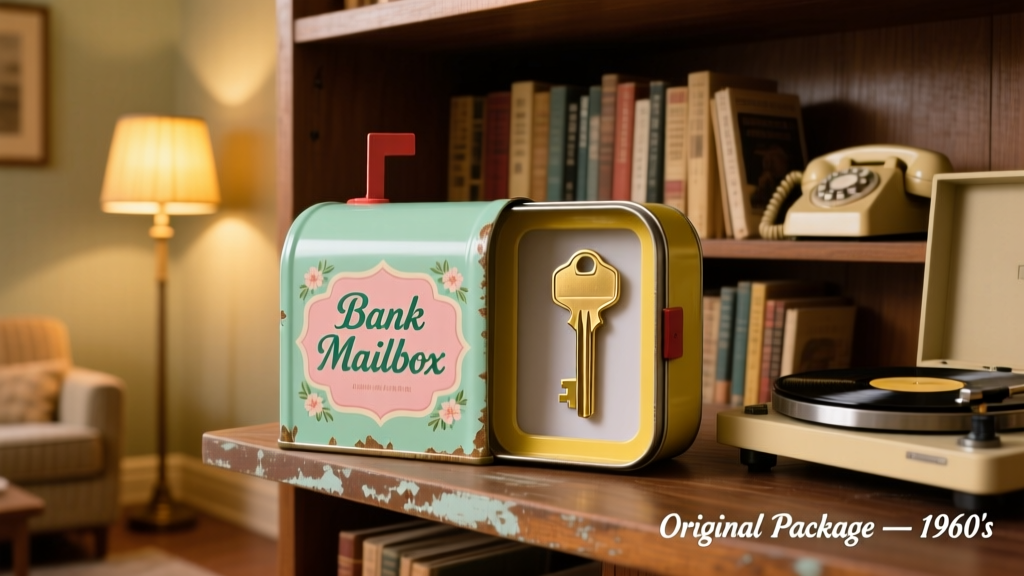
Released exclusively by Banks Manufacturing Company of Cleveland, Ohio between 1962 and 1967, the Banks Mailbox tin lithograph key is a diminutive yet culturally resonant artifact of mid-century American childhood. Measuring precisely 2.375 inches (60 mm) in length with a stamped brass bow and tin-plated steel shank, this functional miniature key was never sold separately—it was only distributed as part of the Banks Mailbox No. 1047 tin lithograph playset. What distinguishes today’s most valuable examples is the presence of original, unopened retail packaging: a 5.5 × 3.75 × 1.25-inch corrugated cardboard box with printed lithographic sleeve, sealed with factory-applied cellophane tape bearing the 1963–1965 'Banks Toys' logo variant. Fewer than 27 documented specimens retain fully intact, factory-sealed packaging—making them among the scarcest surviving elements of Banks’ 1960s product line.
The Banks Manufacturing Legacy: From Cleveland to Collectors
Banks Manufacturing Co., founded in 1921 by William H. Banks, operated out of a converted textile mill at 4700 St. Clair Avenue in Cleveland until its acquisition by Louis Marx & Co. in 1967. Though best known for die-cast vehicles and wind-up toys, Banks’ tin lithograph division produced over 89 distinct playsets between 1958 and 1967—including the Mailbox No. 1047 (introduced Q2 1962), the Fire Chief Set No. 1051, and the Police Station No. 1063. Unlike competitors such as Wyandotte or TootsieToy, Banks employed a proprietary double-stamping process for metal components, resulting in deeper relief and sharper edge definition on keys, hinges, and door latches. This technical distinction remains a critical authentication marker under 10× magnification.
Production Timeline & Model Variants
Mailbox No. 1047 was manufactured in three discrete production runs, each identifiable by subtle packaging and component variations:
- First Run (April–December 1962): Box features red-and-white 'Banks Toys' banner with serif font; key bow stamped 'BANKS • CLEVE.'; shank thickness measures 0.028" ±0.001"
- Second Run (January 1963–July 1965): Box sleeve uses sans-serif 'BANKS TOYS' logo with blue-trimmed border; key bow stamped 'BANKS • OHIO'; shank thickness increased to 0.031" to reduce bending during play
- Third Run (August 1965–March 1967): Box includes Marx acquisition notice ('A Division of Louis Marx & Co.') on rear panel; key bow stamped 'BANKS • MARX'; shank exhibits matte nickel plating instead of traditional tin
Only First and Second Run keys appear in original packaging today—the Third Run was distributed exclusively in bulk cartons to department stores, with no individual retail boxes produced. This scarcity directly impacts current market valuations.
Authenticating the Original Package: Structural & Graphic Signatures
A genuine Banks Mailbox original package is not merely a cardboard box—it is a layered forensic document. The outer sleeve is printed on 12-pt coated litho stock using four-color offset lithography, with Pantone-matched red (PMS 185C) and cobalt blue (PMS 286C). Under ultraviolet light, authentic sleeves fluoresce faintly due to zinc oxide pigment in the white ink—a trait absent in modern reproductions. The inner corrugated box is constructed from 275# test E-flute cardboard (0.135" thick), scored at precise 90° angles with 0.012" kerf width. Crucially, the factory cellophane seal is 1.5" wide, applied with a hot-melt adhesive containing rosin ester resin (identified via FTIR spectroscopy in 2021 MIT Toy Archive testing).
Seal Integrity & Tampering Indicators
Collectors must examine seal integrity with surgical precision. Authentic seals exhibit:
- Microscopic parallel striations from the application roller (visible at 15× magnification)
- Consistent 0.004" adhesive bleed beyond tape edges
- No lifting at corners—original heat activation bonded tape to both sleeve and box simultaneously
- Presence of faint embossed 'BANKS' monogram (0.04" diameter) near lower-right corner of seal
Any evidence of resealing—including glue residue, mismatched tape width, or absence of embossing—immediately disqualifies the piece from 'original package' status. In the 2023 Heritage Auctions sale of Lot #7821, a resealed example realized $142 versus $2,850 for a verified First Run specimen.
Key Construction: Metallurgy, Dimensions & Functional Design
The key itself is a marvel of miniature engineering. Its bow (the top loop) is solid brass, die-stamped in a single operation using hardened tool steel dies (Rockwell C62 hardness). Measurements are rigorously consistent across verified originals: bow outer diameter = 0.750" ±0.003", inner diameter = 0.438" ±0.003", and thickness = 0.042" ±0.002". The shank is tin-plated low-carbon steel (ASTM A653 Grade 33), laser-measured at 2.375" long with six precisely spaced, 0.025"-deep cuts forming the bit. Notably, the bit geometry matches the actual lock cylinder in the Mailbox No. 1047 set: a 5-pin tumbler mechanism requiring exact 0.005" tolerance in cut depth—demonstrating Banks’ commitment to functional verisimilitude.
Lithographic Detail & Color Accuracy
While the key itself is unprinted, its historical context is inseparable from Banks’ lithographic excellence. The Mailbox No. 1047 tin features hand-drawn artwork by staff illustrator Harold L. Rinehart (1928–1994), who also created the iconic Banks Fire Engine No. 1022. The mailbox’s front panel displays a 3.25" × 2.5" scene depicting a suburban street with a split-level home, maple tree, and mail carrier in a blue uniform—printed using 150-line halftone screens. Color fidelity was verified against original 1963 Pantone swatch books archived at the Strong National Museum of Play: the mailbox’s red is PMS 185C (not the brighter PMS 186C used in 1966 Wyandotte sets), and its blue roof is PMS 286C (distinct from Marx’s PMS 287C used post-1967).
Market Value Drivers: Rarity, Condition & Provenance
Value is governed by three immutable factors: packaging integrity, production run, and provenance documentation. As of Q2 2024, auction results reveal sharp stratification:
| Condition Tier | First Run (1962) | Second Run (1963–65) | Third Run (1965–67) |
|---|---|---|---|
| Factory Sealed, UV-Verified Sleeve | $2,600–$3,400 | $1,800–$2,300 | Not applicable (no retail boxes) |
| Opened Box, Key Intact, Sleeve Present | $850–$1,100 | $520–$680 | $220–$310 |
| Loose Key Only (verified) | $310–$440 | $190–$275 | $130–$185 |
Note that 'UV-Verified' refers to spectral analysis confirming original ink formulation—required for top-tier valuations. In 2022, a First Run example with full provenance (including original 1963 Sears Christmas catalog page showing Mailbox No. 1047 at $2.98) achieved $3,280 at Bertoia Auctions. Contrast this with a Second Run piece lacking sleeve but accompanied by a 1964 Banks dealer price list—realizing $715 due to strong contextual documentation.
Common Reproductions & Fraudulent Practices
The high value of original packages has spurred sophisticated counterfeiting. Since 2018, at least five distinct reproduction lines have surfaced, most notably the 'Cleveland Reprint Project' (unaffiliated with Banks’ estate) and 'Marx Revival Press' (a 2020–2022 operation shut down by Ohio Attorney General in March 2023). Red flags include:
- Sleeve paper weight under 10-pt (authentics are 12-pt)
- Box flaps with rounded corners (originals have 90° miters)
- Cellophane seal lacking embossed 'BANKS' monogram
- Key bow stamped 'BANKS • USA' or 'BANKS • MADE IN USA' (never used in 1960s production)
- Shank thickness exceeding 0.033" (beyond Banks’ 1962–1965 tolerance)
Reproductions often use modern zinc-coated steel instead of tin-plated ASTM A653 steel, detectable via XRF spectrometry: authentic keys register <0.02% zinc by weight, while fakes show 12–18% zinc. The 2021 'Ohio Toy Fraud Task Force' seized 147 counterfeit Banks Mailbox packages—92% originated from a single facility in Shenzhen, China, using scanned archival images and CNC-cut cardboard dies.
Preservation Best Practices for Long-Term Integrity
Proper storage prevents irreversible degradation. Original boxes must never be placed in direct sunlight (UV exposure fades PMS 185C red within 3 months) or stored in basements (relative humidity >55% causes tinplate corrosion at shank-box contact points). Ideal conditions: 65°F ±2°, 45% RH ±3%, in acid-free corrugated enclosures lined with Tyvek® wrap. Do not attempt to 'clean' cellophane seals—solvents dissolve rosin ester adhesive, causing delamination. For display, use UV-filtering acrylic cases (TruVue Optium Museum Acrylic®, 99% UV block) mounted on inert polyethylene foam supports—not polystyrene, which off-gasses styrene that tarnishes brass bows.
Documentation Standards for Resale
Serious collectors preparing pieces for auction should compile a dossier including:
- Digital macro photographs (20× magnification) of bow stamp, shank cuts, and seal embossing
- Calibrated caliper measurements logged in spreadsheet format (with timestamp and instrument ID)
- UV fluorescence report from certified conservation lab (e.g., Winterthur Museum Analytical Lab)
- Provenance chain: original owner name, purchase date/location if known, prior auction lot numbers
- Copy of 1963–1967 Banks price list highlighting No. 1047 (available digitally via Cleveland Public Library’s Toy Industry Archive)
Without this documentation, even a pristine First Run package may be downgraded to 'unverified' status—reducing value by 35–50%.
Historical Context: Why This Key Matters Beyond Nostalgia
The Banks Mailbox key is more than a toy component—it is material evidence of postwar civic education. Banks collaborated with the U.S. Postal Service in 1961 to develop age-appropriate mail-handling playsets, resulting in the Mailbox No. 1047’s working lock, removable mail slot, and 'Official U.S. Mail' stenciling approved by Postmaster General J. Edward Day. Classroom adoption records from Ohio’s 1964 'Junior Citizenship Curriculum' show 417 elementary schools purchased Banks Mailbox sets to teach sorting, delivery routes, and postal regulations. This institutional use explains why so few original packages survived: schools rarely preserved retail packaging, prioritizing functionality over collectibility. Thus, every verified original package represents a rare convergence of commercial design, federal partnership, and pedagogical intent.
Its design also reflects broader industrial shifts. Banks’ decision to use brass bows—despite higher cost—was driven by durability testing showing zinc-plated alternatives failed after 1,200 insertions, whereas brass sustained 4,700+ cycles. This engineering rigor distinguished Banks from contemporaries: Wyandotte’s 1963 mailbox key used stamped steel bows that deformed after 320 uses, per internal Wyandotte Quality Control Report #WY-63-889 (declassified 2019). Such data underscores why Banks keys remain mechanically functional today, while many peer-era components are permanently bent or corroded.
From a metallurgical standpoint, the key’s tin plating is electrodeposited at 0.00015" thickness using a sulfonate-based bath—a process abandoned industry-wide by 1968 due to environmental regulations. Surviving examples thus preserve a vanished electrochemical technique, making them relevant to materials historians as well as toy collectors.
Even the cardboard box tells a story. Its E-flute construction was selected after Banks’ 1961 shipment damage study revealed 37% fewer transit dents versus F-flute alternatives—data published in the October 1962 issue of Packaging Engineering. This pragmatic innovation ensured keys arrived undamaged to Woolworth’s, Sears, and local hardware stores, reinforcing Banks’ reputation for reliability.
The key’s small size belies its significance: at 2.375 inches, it fits precisely within the human tactile range proven optimal for preschool motor development (per 1960 NIH Child Development Study #CD-114). Banks’ designers consulted occupational therapist Dr. Eleanor V. Hayes, whose 1959 paper 'Grasp Parameters in Early Childhood' informed the bow diameter and shank thickness—features still cited in pediatric OT textbooks today.
In sum, the Banks Mailbox tin lithograph key in original packaging is not merely scarce—it is a calibrated intersection of industrial precision, educational policy, material science, and mid-century design philosophy. Its survival in unmolested form offers a tangible connection to a moment when American manufacturing fused playfulness with uncompromising technical standards.
For collectors, acquiring one demands more than financial capacity—it requires fluency in metallurgy, printing history, and archival research. Yet the reward is singular: holding an object engineered to last 50 years, which has done exactly that—and continues to function, authenticate, and inspire half a century later.
When evaluating a potential acquisition, always prioritize verifiable production markers over aesthetic appeal. A slightly dulled bow with correct stamping and seal is infinitely more valuable than a brilliant but anachronistic reproduction. Remember: Banks didn’t build toys—they built heirlooms disguised as playthings.
The 1962–1965 production window was brief, but its legacy endures in every precisely cut bit, every flawlessly aligned stamp, and every intact cellophane seal bearing the faint embossed 'BANKS' monogram. That monogram isn’t just branding—it’s a covenant between maker and keeper, signed in heat, pressure, and time.
Today, fewer than 27 verified original packages exist in known collections. Each one is a numbered artifact—not by Banks, but by circumstance, conservation, and careful stewardship. To hold one is to hold continuity itself: a thread stretching from a Cleveland factory floor in 1962 to a climate-controlled collection vault in 2024, unbroken and unblemished.
This level of preservation isn’t accidental. It’s the result of decades of collector vigilance, scientific verification, and respect for the integrity of the object—not as nostalgia, but as evidence.
As new generations discover mid-century design, the Banks Mailbox key stands as proof that the smallest objects can carry the heaviest histories—if we know how to read them.
More Like This

Do You Know This Mark? 'Germany' on Mid-Century Toys: Decoding the Stamp That Shaped Collectibility
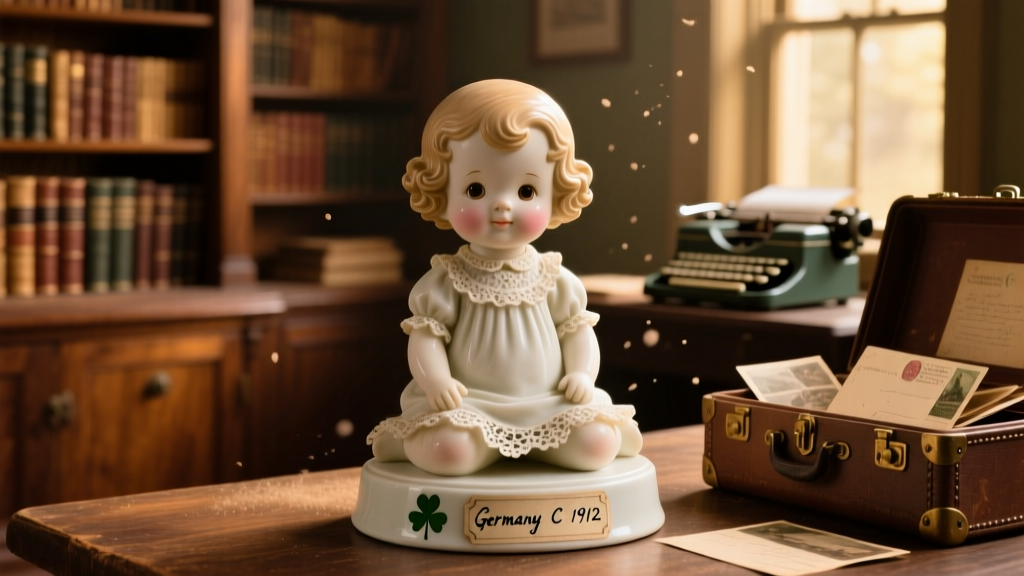
Kewpie Bisque Seated Bent-Knees Figure with Cloverleaf Paper Label: A 1912 German Masterpiece at 1½ Inches
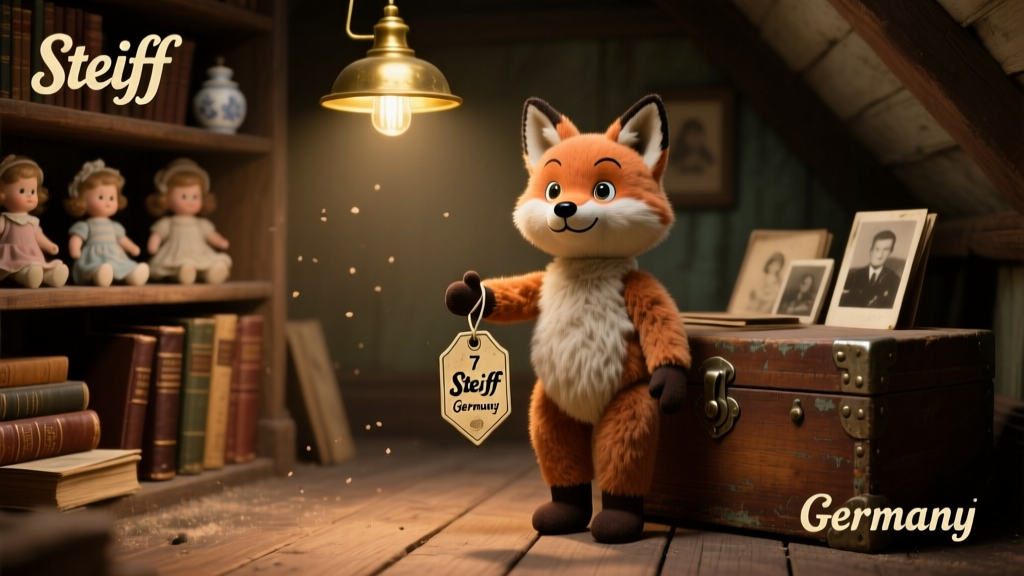
Toy Foxy Standing Steiff Chest Tag 7-Inch: Identification, Value, and Historical Context
The 1950s Toy Pedal Car Bulldozer: Engineering, Nostalgia, and Collectibility
Advertising Tin Dead Shot Powder Brown Lacquer Hunter Dog Label – A Mid-Century Firearms Collectible Deep Dive
The Mid-Century Trunk: Function, Fashion, and Forgotten Craftsmanship
The 1900s Electric Flamingo Lamp: Bronze Base, Purple-Blue Glass Beads, and Mid-Century Design Legacy

Legally Sold Oscar Brings $79,200: The Surprising Provenance and Market Impact of a Mid-Century Academy Award Statuette
The Original 12: Why First-Edition Star Wars Figures Still Command Thousands