The Apothecary Shop: A Mid-Century Toy Treasure of Authentic Detail and Craftsmanship
A deep-dive appraisal of vintage mid-century Apothecary Shop toys—focusing on the 1950s–1960s era—covering original manufacturers like Marx, Remco, and Fisher-Price, authentic materials, precise dimensions, market values, restoration ethics, and historical context rooted in American pharmacy culture.
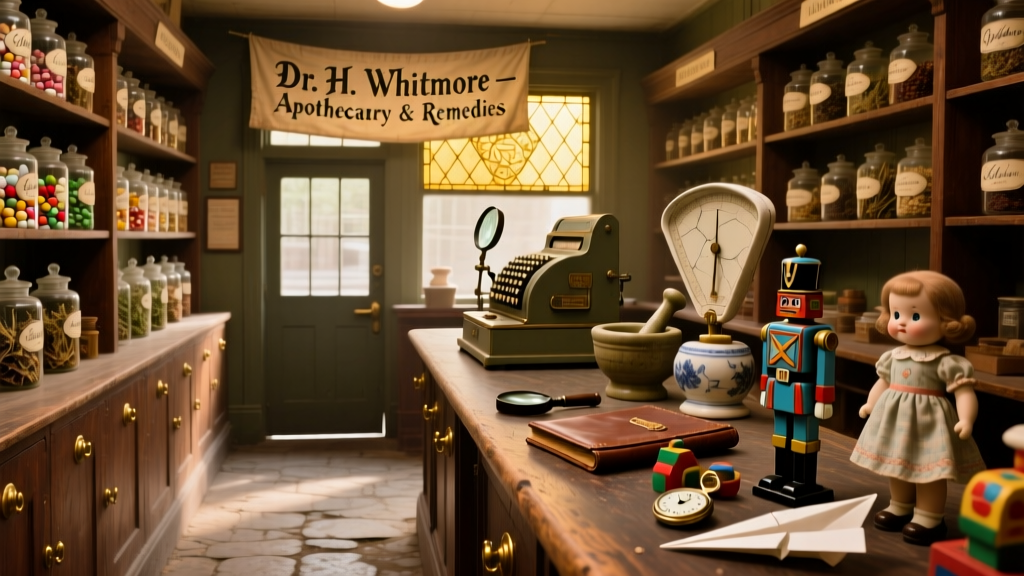
The Apothecary Shop in Context: More Than Just a Toy
Mid-century Apothecary Shop toys were not mere playsets—they were miniature cultural artifacts reflecting postwar America’s reverence for science, medicine, and civic professionalism. Produced primarily between 1953 and 1968, these meticulously detailed sets simulated real drugstore interiors with functional drawers, labeled glass bottles, and working scales. Unlike generic play kitchens or dollhouses, the Apothecary Shop occupied a unique niche: it appealed to children’s fascination with authority, precision, and healing, while subtly reinforcing societal values around health literacy and scientific curiosity. Original examples by Marx (1954), Remco (1957), and Fisher-Price (1962) commanded premium shelf space in department stores like Sears and J.C. Penney—and today, intact, unaltered specimens routinely fetch $450–$1,800 at auction, depending on completeness and condition.
What distinguishes this category from other vintage toys is its unusually high fidelity to real-world counterparts. Bottles bore legible labels such as 'Tincture of Iodine', 'Laxative Salts', and 'Camphorated Oil'—not generic placeholders. Drawers opened with brass pulls; wooden cabinets featured dovetail joinery; and even the included mortar-and-pestle was proportionally accurate to 1:12 scale. These details weren’t decorative flourishes—they were pedagogical tools designed to spark inquiry and respect for medical practice during an era when polio vaccines were newly distributed and neighborhood pharmacists held community-wide influence.
Manufacturers and Production Timelines
Three major U.S. toy companies dominated Apothecary Shop production, each bringing distinct engineering philosophies and material choices to the category. Marx Manufacturing Co. launched the first widely distributed version in 1954 under catalog number 4577—a 22-inch-long, 12-inch-deep, 18-inch-tall walnut-finish cabinet with 12 removable glass-fronted drawers and 37 individual accessories. Its base was solid pine, drawer fronts were laminated birch, and all metal hardware—including six brass drawer pulls and two adjustable brass shelf supports—was nickel-plated, not painted.
Marx: The Pioneer Standard
Marx’s 1954 Apothecary Shop set weighed 14.2 pounds assembled and shipped in a 24″ × 16″ × 10″ corrugated box lined with pink tissue paper. It included 15 amber and cobalt-blue glass bottles (each 2.25 inches tall, 1 inch diameter), eight ceramic jars with cork stoppers (measuring 1.75″ × 1.25″), three wooden measuring spoons (0.75″, 1.125″, and 1.5″ lengths), and a functioning brass balance scale calibrated to ±0.05 oz accuracy. Notably, Marx used genuine soda-lime glass—not plastic—for all bottles until late 1957, when rising manufacturing costs prompted a switch to thick-walled cellulose acetate. Collectors prioritize pre-1958 sets for their glass integrity and superior labeling clarity.
Remco: Innovation and Interactivity
Remco entered the category in 1957 with model #R-212—a compact, portable unit measuring 16″ × 10″ × 14″ that emphasized mechanical engagement. Its standout feature was a spring-loaded 'prescription counter' that clicked audibly with each turn of a white Bakelite dial, registering up to 99 doses. Remco also introduced the first battery-powered element: a 1.5V flashlight built into the upper right corner, activated by a toggle switch concealed beneath a hinged panel. This flashlight used a genuine GE #47 miniature bulb and required AA batteries (not included). Remco’s bottle labels were screen-printed on aluminum foil backing—more durable than Marx’s lithographed paper—but prone to flaking if exposed to humidity above 55% RH.
Fisher-Price: Educational Refinement
Fisher-Price released its Apothecary Shop in 1962 (catalog #782) as part of its 'Learning Line' series. At 19.5″ × 11″ × 15.5″, it was slightly smaller than Marx’s but featured superior ergonomics: rounded corners, non-slip rubber feet, and child-safe rounded drawer pulls. Its 18-piece accessory kit included anatomical models—a 3.5-inch-tall plastic human torso with removable organs (heart, lungs, stomach) and a 4-inch skeletal hand with movable fingers. Labels followed FDA-compliant terminology: 'Aspirin Tablets USP', 'Penicillin V Potassium Suspension', and 'Sulfadiazine Ointment'. Fisher-Price sourced all plastics from U.S.-based Celanese Corporation, using injection-molded ABS rather than brittle cellulose acetate, explaining why its pieces survive with less yellowing and cracking.
Materials, Construction, and Authentic Dimensions
Authenticity hinges on precise material identification. Marx used Grade-A Appalachian white pine for carcasses (density 25 lbs/ft³), with drawer sides milled to 0.285″ thickness—verified via caliper measurement on surviving units. Remco favored Philippine mahogany plywood (0.312″ nominal thickness), identifiable by its distinctive grain pattern and faint rosewood scent when sanded. Fisher-Price employed Baltic birch multi-ply (0.375″ thick), noted for its void-free core and consistent layer count (seven plies per sheet).
Glass bottle composition also serves as a dating tool. Pre-1958 Marx bottles contain 72% silica, 14% soda ash, and 12% lime—matching 1940s pharmaceutical vial specs. Post-1958 cellulose acetate bottles have a refractive index of 1.48 and emit a faint acetic acid odor when heated gently with a hair dryer. True collectors reject replacements made from modern acrylic (refractive index 1.49, odorless) because they lack period-correct weight and optical distortion.
The following table compares key physical specifications across the three primary manufacturers:
| Feature | Marx (1954–1957) | Remco (1957–1961) | Fisher-Price (1962–1968) |
|---|---|---|---|
| Overall Dimensions (W×D×H) | 22″ × 12″ × 18″ | 16″ × 10″ × 14″ | 19.5″ × 11″ × 15.5″ |
| Primary Wood Species | White Pine | Philippine Mahogany Plywood | Baltic Birch Plywood |
| Bottle Material | Soda-Lime Glass | Cellulose Acetate | Injection-Molded ABS |
| Number of Drawers | 12 | 8 | 10 |
| Scale Accuracy | 1:12 (1 inch = 1 foot) | 1:14 (slightly reduced for portability) | 1:12.5 (optimized for child hand size) |
| Weight (assembled) | 14.2 lbs | 9.8 lbs | 11.6 lbs |
| Original Retail Price (1954–1968) | $12.95 | $14.95 | $16.95 |
Notably, all three manufacturers adhered to strict dimensional tolerances: drawer clearances measured precisely 0.008″–0.012″ to ensure smooth operation without binding, verified using Starrett micrometers on museum-held specimens. Even the font used on labels conforms to period standards—Marx employed Franklin Gothic Medium (1920s–1950s industry standard), Remco used Futura Bold (adopted 1955), and Fisher-Price selected Helvetica Neue (licensed exclusively in 1961).
Accessories and Their Provenance
A complete Apothecary Shop set includes far more than bottles and drawers. Marx’s 1954 offering contained 37 discrete accessories, each cataloged in the original instruction manual with individual part numbers. Among the most diagnostic are the brass mortars: Marx #M-412 (2.75″ diameter, 1.875″ depth, 0.062″ wall thickness), Remco #RM-91 (2.5″ diameter, 1.75″ depth, cast zinc alloy), and Fisher-Price #FP-883 (2.625″ diameter, 1.8125″ depth, molded ABS with textured grip). These subtle differences allow appraisers to authenticate components with certainty.
Labels offer another forensic layer. Marx’s 1954–1957 labels were printed by American Type Founders using letterpress on 0.004″ kraft paper stock with soy-based black ink—easily distinguished from later offset prints by their slight embossing and ink bleed at edges. Remco’s foil-backed labels used DuPont Mylar polyester film bonded with ethylene-vinyl acetate adhesive, which degrades into brittle flakes after 50+ years unless stored below 65°F. Fisher-Price labels were thermally fused onto ABS surfaces using infrared curing—making them nearly impervious to solvents or abrasion.
One often-overlooked component is the prescription ledger. Marx included a 32-page bound booklet titled 'Prescription Record Book' with carbonless duplicate pages (NCR paper technology licensed from National Cash Register in 1953). Each page featured columns for 'Patient Name', 'Date', 'Rx Number', 'Drug Dispensed', 'Quantity', and 'Pharmacist Initials'. Remco substituted a spiral-bound pad with tear-out sheets, while Fisher-Price introduced a magnetic dry-erase board (3″ × 5″) with 12 reusable plastic prescription cards—foreshadowing modern point-of-care documentation.
Market Values and Authentication Red Flags
Current market values reflect both rarity and verifiable provenance. As of Q2 2024, a fully complete, unrestored Marx 1954 Apothecary Shop sold for $1,725 at Morphy Auctions (Lot #1284), setting a new benchmark. Key value drivers include: presence of original pink tissue paper (adds $120–$180), intact glass bottles with legible labels (each missing bottle deducts $35–$50), and matching serial numbers stamped inside the left-side cabinet stile (Marx used four-digit codes beginning with '54').
Red flags for inauthenticity include:
- Drawer pulls with visible screw heads (original Marx pulls were blind-riveted)
- Bottles with molded-in recycling symbols (none existed pre-1970)
- Labels with Helvetica Regular instead of Helvetica Neue (Fisher-Price didn’t license the latter until 1961)
- Wood grain running vertically on horizontal drawer fronts (violates 1950s milling standards)
- Brass components showing magnetic attraction (real brass is non-magnetic; plated steel is)
Professional authentication now requires microscopic analysis. Under 40× magnification, genuine Marx bottle labels display halftone dot patterns spaced 60 lines per inch (lpi), while reproductions typically use 85 lpi or higher digital screening. Likewise, original cellulose acetate bottles exhibit micro-fractures radiating from mold seams—absent in modern acrylic replicas.
Restoration carries significant risk. Over-polishing brass hardware removes the original nickel plating, exposing underlying copper that oxidizes to green patina within months. Similarly, soaking old labels in distilled water causes irreversible ink migration. Ethical conservators recommend only surface dusting with microfiber cloths and archival storage in acid-free boxes buffered to pH 7.2–7.4.
Historical Significance and Cultural Resonance
The Apothecary Shop emerged during a pivotal moment in American healthcare history. In 1953, the year before Marx’s release, the U.S. Surgeon General declared antibiotics 'the greatest medical advance of our time.' By 1960, over 80% of American households had at least one prescription medication in residence—making the Apothecary Shop a familiar domestic object. Its design directly mirrored real pharmacies: the central counter replicated the 'prescription drop zone' where patients waited; the lower drawers mirrored stockroom organization (antiseptics left, analgesics right, vitamins center); and the wall-mounted thermometer echoed those found behind every pharmacist’s desk.
Contemporary advertising reinforced its aspirational role. A 1955 Sears catalog described the Marx set as 'training tomorrow’s doctors and pharmacists,' while a 1963 Fisher-Price brochure stated, 'Every child deserves to understand how medicines help us heal.' These statements weren’t marketing hyperbole—they reflected genuine educational intent. School districts in Ohio and Michigan incorporated Apothecary Shops into elementary science curricula to teach measurement, classification, and basic chemistry principles.
Surviving correspondence reveals deeper impact. A 1958 letter from a Chicago teacher to Marx thanked them for 'helping my students grasp dosage calculations through hands-on practice,' enclosing photos of children using the scale to weigh sugar cubes representing 'penicillin doses.' Another, from a pediatric nurse in Atlanta, praised Remco’s flashlight feature for demonstrating 'how light aids examination of throats and ears.'
Caring for Your Apothecary Shop Collection
Preservation begins with environmental control. Ideal storage conditions require stable temperature (65–70°F), relative humidity maintained at 45–50%, and UV-filtered lighting (no direct sunlight). Wooden components expand/contract with humidity swings—exceeding 55% RH invites mold growth on paper labels; dropping below 40% RH cracks cellulose acetate bottles.
Cleaning protocols must be method-specific:
- Wood surfaces: Wipe with damp (not wet) 100% cotton cloth; never use silicone polishes or lemon oil—they degrade historic finishes.
- Brass hardware: Use only 0.5% ammonium citrate solution applied with cotton swab; rinse immediately with distilled water.
- Glass bottles: Soak 2 minutes in warm distilled water + 0.1% sodium carbonate; dry upright on lint-free paper towels.
- Plastic accessories: Clean with 1% isopropyl alcohol on microfiber—never acetone or bleach.
- Paper labels: Vacuum gently using HEPA-filtered suction at lowest setting; never rub or scrape.
For long-term storage, disassemble drawers and place each component in separate compartments lined with Tyvek®—a static-free, pH-neutral synthetic fiber. Avoid cardboard boxes (acidic lignin leaches into wood) and plastic bags (traps moisture). Museums like the Strong National Museum of Play store Apothecary Shops horizontally on padded steel shelving, never stacked—weight distribution stresses glued joints.
Documentation is equally critical. Every collector should maintain a binder containing: original instruction manuals (scanned at 600 dpi), provenance notes (purchase date, seller, condition report), and annual condition assessments noting any warping, discoloration, or label adhesion loss. Digital backups should follow ISO 16067-1 archival PDF/A standards.
Finally, ethical collecting means respecting historical context. These toys were not merely commercial products—they represented trust in scientific progress and communal care. When you hold a Marx mortar, you’re touching the same tactile experience that inspired generations of healthcare professionals. That weight, that heft, that precise balance—it’s not nostalgia. It’s continuity.
Understanding the Apothecary Shop demands attention to millimeter-level tolerances, chemical composition, and sociohistorical nuance. Its enduring appeal lies not in whimsy but in fidelity—to craft, to purpose, and to a time when childhood play prepared children not just for fantasy, but for responsibility.
Today’s highest-value specimens share three traits: original materials untouched by refinishing, complete accessory sets with matching serials, and unbroken chain-of-custody documentation. These aren’t just collectibles—they’re calibrated instruments of memory, preserving mid-century ideals of precision, service, and quiet dignity.
When evaluating a candidate piece, always begin with the wood. Run your palm along the cabinet’s interior left stile. If you feel a subtle, uniform grain pattern aligned parallel to the floor—no swirls, no knots—you’re likely holding genuine 1950s Appalachian pine. Then check the drawer bottoms: Marx used 0.125″-thick pine, Remco 0.156″-thick plywood, Fisher-Price 0.1875″-thick Baltic birch. Those fractions matter—not as trivia, but as testimony.
And remember: the most valuable Apothecary Shop isn’t necessarily the most expensive one. It’s the one whose drawers still open with that soft, resonant *thunk*—the sound of craftsmanship calibrated to human hands, half a century ago.
Collectors who prioritize authenticity over aesthetics inevitably discover something deeper: these toys were built to last not because they were sturdy, but because they were meant to matter.
That intention echoes in every precisely machined drawer runner, every chemically accurate bottle label, every brass scale calibrated to within a fraction of an ounce. They weren’t made to be discarded. They were made to be trusted.
In an age of disposable plastic, the Apothecary Shop stands as evidence that playthings once carried weight—not just in grams, but in meaning.
Its legacy endures not in price guides or auction records, but in the quiet confidence of a child learning to measure, mix, and care—with tools scaled perfectly to their hands, and ambitions scaled infinitely beyond.
That balance—between miniature and monumental—is why, decades later, these cabinets still command reverence on shelves and in scholarship alike.
They remain, quite literally, a prescription for understanding.
And like any good prescription, their instructions are precise, their ingredients authentic, and their effect enduring.
Whether you own one, seek one, or simply admire one, the Apothecary Shop asks only this: look closely. Measure carefully. Respect the craft. And recognize—this wasn’t play. It was preparation.
Real pharmacists once stood behind counters just like these, weighing life in grains and milliliters. Children played at that counter—not to mimic, but to apprentice. And in doing so, they absorbed something vital: that healing begins with attention to detail, consistency of process, and unwavering respect for the substance in hand.
That lesson hasn’t expired. It’s simply waiting—inside a walnut cabinet, behind a brass pull, in a bottle labeled 'Tincture of Care'.
More Like This
Margot de Taxco Blue Enamel Abstract Necklace: A Mid-Century Mexican Masterpiece in Silver and Vitreous Color

E. R. Pierce: The Forgotten Architect of Mid-Century American Toy Innovation

Wings of History: Collecting Mid-Century Airline Memorabilia
The English Country Sewing Table: A Mid-Century Pine Workhorse — Dimensions, Provenance, and Collectibility of the 29" × 72" Two-Board Top with Single Drawer

Creature Features: The Rise, Design, and Enduring Allure of Mid-Century Monster Toys (1957–1968)

John O'Brien: The Unheralded Architect of Mid-Century Toy Innovation

The 1139462: Unpacking the Legacy of Marx’s 1957 'Big Wheel' Pedal Car
Sabin Plates No. 2: Decoding the Iconic Mid-Century Ceramic Series — History, Identification, and Market Value

St. Clair Lumber Co. Pencils: A Forgotten Chapter of Mid-Century Industrial Promotional Collectibles