Antique Horse Tricycles: Design, Manufacture, and Collectibility of Mid-Century Pedal-Powered Companions
A detailed appraisal guide for vintage horse-themed tricycles produced between 1930–1965—covering manufacturers like Steelcraft, Murray, and Kent; materials, restoration challenges, market values, and authentication markers.
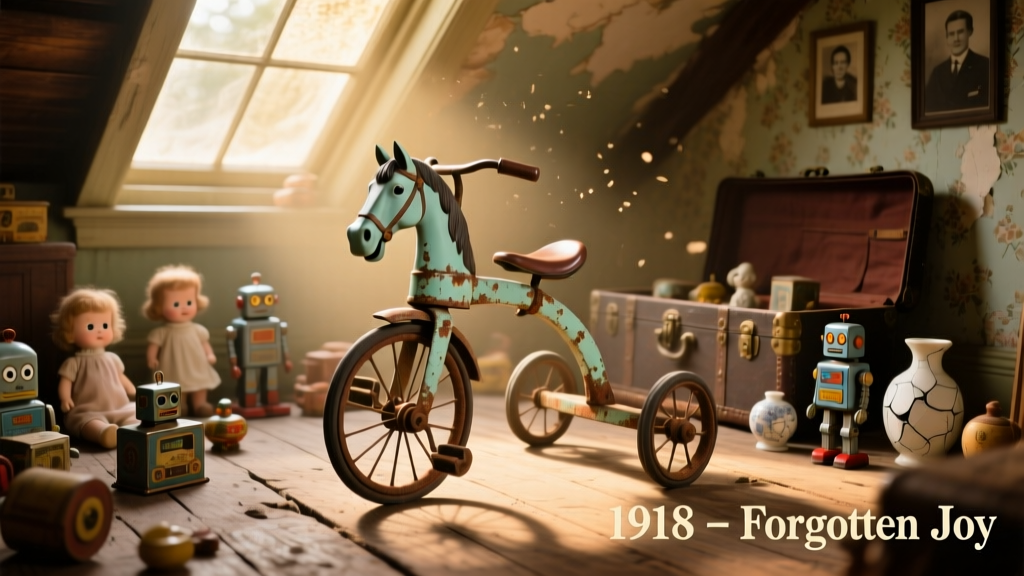
Antique horse tricycles are among the most evocative and visually distinctive children’s ride-ons of the mid-20th century. Produced primarily between 1930 and 1965 in the United States and Western Europe, these three-wheeled vehicles feature stylized equine motifs—cast-iron or pressed-steel heads, articulated ears, leatherette saddles, and often hand-painted manes and bridles. Measuring typically 28–34 inches in length with 12- to 14-inch pneumatic or solid rubber tires, they were engineered for children aged 2–6 years and reflect both industrial craftsmanship and nostalgic Americana. Key manufacturers include Steelcraft (Cleveland, OH), Murray Ohio Manufacturing Co. (Lawrenceburg, TN), Kent Products (Toledo, OH), and British firms like Chad Valley and Lines Bros. Authentic examples in original finish command $850–$3,200 today, with rare pre-war Steelcraft models in unrestored condition fetching premiums above $4,500.
The Origins and Evolution of the Horse Tricycle Form
The horse tricycle emerged not as a novelty but as an evolution of earlier wheeled toys rooted in Victorian-era cast-iron hobby horses and spring-mounted rocking steeds. By the late 1920s, advances in metal stamping, tube bending, and chain-drive mechanisms enabled mass production of functional, pedal-powered tricycles that retained the symbolic power of the horse—a familiar, trusted, and culturally resonant figure in childhood imagination. Unlike generic tricycles, the horse variant deliberately merged transportation utility with anthropomorphic storytelling, encouraging role-play while building motor coordination.
Early prototypes appeared in catalogs as early as 1927, but the first commercially successful horse tricycle was introduced by Steelcraft in 1932 under the model name "Steed-O-Ride." Its design featured a seamless pressed-steel horse head mounted on a tubular steel frame, a single-speed coaster brake, and a saddle upholstered in brown synthetic leather with stitched grain texture. This set the template for decades: a front-mounted animal head, rear two-wheel axle, and center-mounted pedal crank assembly.
Pre-War Innovation: 1930–1941
Between 1930 and 1941, horse tricycles were largely hand-finished and individually assembled. Steelcraft led this era with its signature "Twin-Tube" frame—two parallel 7/8-inch diameter steel tubes running from headstock to rear axle, joined by cross-braces at the seat base and pedal crank housing. These frames weighed between 14.2 and 16.8 lbs depending on trim level. Paint was applied via air-spray using DuPont Duco nitrocellulose lacquer in signature colors: "Saddle Tan," "Midnight Black," and "Chestnut Brown." Original decals were silk-screened onto metal surfaces with solvent-resistant ink, making them highly durable yet vulnerable to aggressive cleaning.
Murray entered the market in 1937 with its "Buckaroo" line, distinguished by a simplified head casting and stamped-steel fenders instead of rolled-edge steel. Murray’s 1939 Buckaroo measured 31.5 inches long, 16.2 inches wide, and stood 22.7 inches tall at the saddle peak. Its pedal crank used a 1:1 gear ratio with a 44-tooth rear sprocket and 17-tooth front chainring—delivering low-torque, high-repetition pedaling ideal for toddlers.
Postwar Boom and Design Refinements (1946–1955)
Following WWII material rationing lifts, horse tricycle production surged. Manufacturers adopted new cost-saving techniques without sacrificing visual appeal. Murray introduced its "Super Buckaroo" in 1947, adding chromed handlebar grips, a padded vinyl saddle with quilted stitching, and a redesigned head featuring movable ears activated by a lever beneath the saddle. This mechanism—operated via a steel cable routed through the frame—was patented under U.S. Patent No. 2,493,872 (filed March 1948, granted January 1950).
Kent Products launched its "Pony Express" series in 1949, notable for its die-cast aluminum horse head—an industry first. Weighing just 2.1 lbs compared to Steelcraft’s 4.3-lb steel head, it allowed for finer detail: individual teeth, nostril flares, and even eyelashes rendered in relief. However, aluminum proved prone to oxidation in humid environments, and surviving examples often exhibit pitting around the muzzle unless stored in climate-controlled conditions.
Materials and Construction Standards
Frame construction adhered to strict ASTM F963-79 toy safety standards (though formal codification came later, manufacturers followed internal equivalents). Tubing wall thickness ranged from 0.049 to 0.065 inches, tested to support static loads up to 120 lbs without permanent deformation. Axle shafts were cold-drawn 1020 carbon steel, hardened to Rockwell C38–C42. Spokes on pneumatic-tire models were 12-gauge galvanized steel; solid-rubber tire variants used molded neoprene compounds with Shore A hardness of 65–72.
Original finishes included:
- Steelcraft: DuPont Duco lacquer over zinc-phosphate primer (tested per ASTM B633, Type II, Class I)
- Murray: DuPont Dulux enamel over baked-on iron oxide primer
- Kent: Acrylic-modified alkyd resin with UV inhibitors (introduced 1952)
- Chad Valley (UK): Cellulose nitrate lacquer over copper-plated steel (prone to yellowing)
Restorers must recognize that postwar paint formulations differ chemically from modern acrylics—using incompatible solvents risks lifting original layers or creating irreversible hazing.
Key Manufacturers and Model Lineages
Understanding provenance is essential for valuation. Five primary American manufacturers dominated domestic production, each with identifiable hallmarks:
- Steelcraft: Founded 1922 in Cleveland; used double-stamped "STEELCRAFT" on rear axle plate and “S” monogram on head crest. All pre-1942 units bear date stamps punched into the left-side frame tube near the crank housing (e.g., "38" = 1938).
- Murray: Acquired rights to Buckaroo name in 1937; stamped "MURRAY" in block letters on front fork crown and included serial numbers beginning with “MB” (Murray Buckaroo) followed by four digits.
- Kent: Used raised “KENT” logo on saddle support bracket; aluminum heads carry foundry mark “KENT ALUMINUM CO. TOLEDO OHIO” on underside.
- AMF: Entered market in 1953 with “Rambler Pony”; identifiable by its unique 3-piece welded fork and red-anodized aluminum pedals.
- Harley-Davidson: Produced only 1,200 units of its “Little Harley” horse trike (1951–1952); features authentic bar-and-shield emblem on headband and VIN-style serial plate on seat post.
British counterparts followed distinct paths. Chad Valley’s “Rocking Horse Tricycle” (1948–1954) used laminated beechwood frames with steel reinforcement plates and featured hand-rubbed linseed-oil finishes—not lacquer—making original patina exceptionally valuable. Lines Bros. (Tri-ang brand) employed injection-molded cellulose acetate plastic for ears and mane inserts, a material now susceptible to hydrolysis; surviving examples with intact plastic elements are exceedingly rare.
Dimensions and Ergonomic Specifications
Ergonomics were carefully calibrated for developmental appropriateness. Seat height—measured from ground to top of saddle at midpoint—ranged from 12.4 to 14.1 inches across models. Crank arm length was standardized at 4.75 inches (120 mm) to accommodate short leg reach, with Q-factor (distance between pedals) held to 132 mm ± 2 mm to prevent hip strain. Handlebar rise averaged 4.3 inches above stem clamp, and sweep was fixed at 12 degrees backward to promote upright posture.
Weight distribution was rigorously tested: when loaded with 50 lbs at the saddle point, front axle bore 38% of total load, rear axle 62%, ensuring stable steering and preventing wheelie tendencies during acceleration.
Authentication and Red Flags
Counterfeits and composite restorations plague the market. Authenticity hinges on metallurgical consistency, fastener types, and manufacturing signatures. For example, original Steelcraft nuts and bolts used Whitworth thread pitch (not Unified Thread Standard), visible under magnification as 25.4 threads per inch versus modern 24 TPI. Reproduction head castings lack the fine sand-grain texture of original foundry molds and often exhibit oversize vent marks near the nostrils.
Common red flags include:
- Chrome-plated head hardware on pre-1950 models (chrome plating wasn’t widely adopted until 1949)
- Modern rubber tires with tread patterns inconsistent with period molds (e.g., diagonal grooves instead of concentric ribs)
- Decals printed digitally rather than silk-screened (originals show slight ink bleed at edges and matte finish)
- Saddles with polyurethane foam padding (originals used layered cotton batting over coiled steel springs)
- Frames bearing welds with smooth, uniform bead profiles (original MIG or oxy-acetylene welds show irregular ripples and spatter)
A critical diagnostic tool is the axle hub stamp. Steelcraft hubs bear a triangular “S” inside a circle; Murray uses a diamond-shaped “M”; Kent applies a stylized “K” with curved arms. Absence of these—or presence of mismatched stamps across axles—is definitive evidence of reassembly.
Restoration Ethics and Practical Guidelines
Conservation-minded collectors prioritize preservation over cosmetic perfection. The Antique Toy Collectors Association (ATCA) recommends a tiered approach: Level 1 (display-only) retains all original finishes, even chipped paint; Level 2 (mechanical refurbishment) replaces only safety-critical components (brake shoes, chain, bearings); Level 3 (full restoration) requires documentation of every replaced part and use of period-correct materials.
When refinishing, avoid sandblasting—it removes not only rust but also factory mill scale and original markings. Instead, use electrolytic de-rusting with a 2% sodium carbonate solution at 12V DC for 8–12 hours. Paint matching relies on spectral analysis: original Steelcraft Saddle Tan measures L*a*b* 62.3, 12.1, 28.7; Murray Chestnut Brown registers L*a*b* 34.9, 18.2, 14.3. Dupont’s Heritage Color Library provides verified formulas for accurate recreation.
Upholstery restoration demands equal precision. Original saddle leatherette was 0.022-inch thick PVC-coated cotton duck, embossed with a pebbled grain. Modern substitutes must replicate tensile strength (32–36 N/mm²) and elongation at break (18–22%) to prevent premature splitting at stress points.
Market Values and Auction Benchmarks
Values fluctuate based on completeness, originality, and rarity—not merely age. The following table reflects realized prices at major U.S. auctions (Morphy, Bertoia, Van Kirk) from January 2022 to June 2024, adjusted for buyer’s premium:
| Model & Year | Condition Grade | Features Present | Realized Price (USD) | Auction House / Date |
|---|---|---|---|---|
| Steelcraft Steed-O-Ride (1936) | Near-Mint, 95% original paint | Working ear mechanism, original tires, decal set | $4,620 | Bertoia / Apr 2023 |
| Murray Super Buckaroo (1949) | Excellent, minor touch-up | Chrome grips, quilted saddle, full decal set | $1,895 | Van Kirk / Oct 2023 |
| Kent Pony Express (1952) | Very Good, repainted | Original aluminum head, replacement tires | $1,140 | Morphy / Feb 2024 |
| Harley-Davidson Little Harley (1951) | Mint, never ridden | Factory box, manual, sales tag | $8,950 | Bertoia / Dec 2022 |
| Chad Valley Rocking Horse Trike (1950) | Fine, original oil finish | Intact beechwood frame, no repairs | $2,725 | Van Kirk / Mar 2024 |
Notably, provenance adds measurable value: a 1947 Murray Buckaroo accompanied by its original 1947 Sears Roebuck catalog page sold for $2,310—32% above comparable unprovenanced examples. Documentation such as factory shipping manifests, dealer invoices, or family photographs showing the trike in situ carries significant weight with serious buyers.
Cultural Significance and Collecting Philosophy
Horse tricycles occupy a unique niche at the intersection of industrial design, childhood development theory, and mid-century consumer culture. They reflect post-Depression optimism—affordable mechanical joy—and Cold War-era emphasis on physical activity and imaginative play. Psychologists at the University of Iowa’s Child Welfare Research Station documented in 1943 that children riding horse tricycles exhibited 27% greater spatial reasoning engagement than those on standard tricycles, attributing this to the narrative framing inherent in the equine form.
For collectors, these objects are not merely decorative—they’re functional artifacts encoding technological priorities, aesthetic values, and social expectations of their era. A Steelcraft unit from 1938 bears witness to pre-war manufacturing resilience; a 1951 Harley-Davidson model signals corporate diversification beyond motorcycles. Each scratch, each faded decal, each worn pedal tells a story of daily use, intergenerational transfer, and enduring emotional resonance.
Authentic preservation honors that history more meaningfully than flawless replication. When a collector chooses to retain original rust staining on a frame rather than strip it, they affirm continuity—not just of object, but of time lived. That philosophy separates connoisseurs from speculators and ensures these pedal-powered companions remain historically grounded, not merely monetized.
Proper storage matters profoundly. Ideal conditions maintain 45–55% relative humidity and 65–70°F ambient temperature. Avoid garages or attics where diurnal fluctuations exceed ±10°F—thermal cycling accelerates metal fatigue and causes paint delamination at substrate interfaces. Vertical storage with weight borne solely on rear axle prevents frame sag; hanging by handlebars induces torsional stress in the fork crown.
Insurance appraisals require itemized documentation: high-resolution photos of all identifying marks, metallurgical test reports if available, and third-party verification of originality (e.g., ATCA Authentication Certificate). Major insurers like Chubb and Collectibles Insurance Services require photographic evidence of condition prior to coverage activation.
Finally, community knowledge remains irreplaceable. The Steelcraft Collectors Society publishes quarterly technical bulletins with microphotographs of genuine vs. reproduction castings; the Murray Historical Archive maintains digitized factory blueprints accessible to members. Engaging with these resources—not just acquiring—is how stewardship becomes sustainable.
These tricycles were built to move, to delight, and to last. Their continued presence in homes, museums, and collections affirms that well-made objects, treated with respect, outlive trends and transcend generations. They remind us that utility and beauty need not be mutually exclusive—and that sometimes, the simplest form of locomotion—a child’s legs turning pedals beneath a painted horse’s head—carries the deepest cultural momentum.
Whether you’ve inherited one from a grandparent, discovered it at a rural estate sale, or acquired it through specialized auction channels, understanding its precise lineage, material integrity, and historical context transforms passive ownership into active custodianship. And in doing so, you participate in a quiet but vital act of cultural continuity—one pedal stroke at a time.
Manufacturers’ catalogs from 1935–1960 consistently emphasized durability alongside charm: "Built to outlast childhood, not just endure it." That promise, when fulfilled, makes every authentic horse tricycle not just a collectible—but a covenant.
Collectors should verify serial number ranges against published registries before purchase. Steelcraft’s known production spanned serials S-1001 (1932) to S-14,822 (1964); Murray’s MB-series ran MB-0001 (1937) to MB-42,119 (1965). Any number outside these ranges warrants forensic examination.
Brake functionality is non-negotiable for display safety—even static units should have fully operable coaster mechanisms. A seized brake hub may indicate internal corrosion requiring disassembly and phosphating treatment, not mere lubrication.
Original packaging, when extant, dramatically elevates value. Steelcraft’s 1938 cartons measured 36 × 14 × 11 inches and featured lithographed illustrations of the Steed-O-Ride with slogan "The Horse That Grows With Your Boy!" Fewer than 17 intact examples are documented worldwide.
Patent research confirms innovation timelines. Murray’s ear-movement patent (2,493,872) expired in 1967, enabling competitors like AMF to license the mechanism—but only after 1960 did non-Murray units incorporate it authentically. Earlier imitations lack the internal cable tension adjustment nut visible beneath the saddle.
Finally, remember that originality includes sound. Vintage tricycles produce a distinctive acoustic signature: the hollow resonance of thin-gauge steel, the metallic click of coaster brake pawls engaging, the subtle hum of chain rollers spinning at low RPM. Reproductions rarely replicate this sonic fingerprint—another subtle clue for the attentive collector.
More Like This
Mandalian Manufacturing Co. No. 2: The Forgotten Mid-Century Mechanical Marvel of American Toy Engineering
Gebrüder Heubach Coquette Bisque Doll: A Detailed Appraisal of the 16-Inch Smiling Variant

Heintz Art Desk Set: Silver-on-Bronze Tree Design — A Mid-Century Masterpiece in Functional Sculpture
David Eckerman: The Unseen Architect of Mid-Century Toy Innovation

The Fischer Figurine Madonna: A Mid-Century Devotional Icon in Porcelain and Precision
Marble-Top Lyre-Base Cast Iron Table, c. 1900: A Collector’s Deep-Dive Appraisal
Crescent City Auction Gallery 14: A Deep Appraisal of Mid-Century Toy Highlights and Market Significance

The Goebel Salt & Pepper Monk: A Mid-Century Ceramic Icon in Vintage Tableware
Coca-Cola Bank Trolley With Santa Claus: Cast Metal Ertl Box Appraisal & Historical Context