AAA Annual Convention #3: A Landmark Gathering of Mid-Century Advertising Collectors in 1974
A detailed appraisal and historical analysis of the third annual convention of the Antique Advertising Association of America (AAAA), held in Chicago, Illinois, from May 17–19, 1974 — featuring rare signage, vintage soda trays, lithographed tin displays, and pivotal early scholarship on American commercial art.
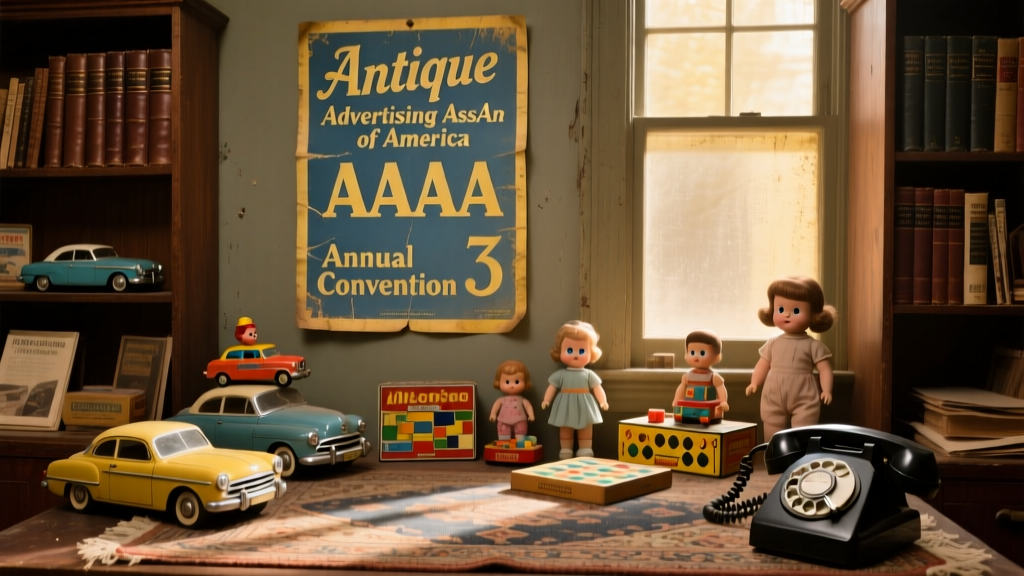
Introduction: The 1974 AAAA Convention as a Turning Point
The third annual convention of the Antique Advertising Association of America (AAAA), held May 17–19, 1974, at the Conrad Hilton Hotel in Chicago, Illinois, stands as a watershed moment for mid-century advertising collectibles. Unlike its predecessors in 1972 (New York) and 1973 (Cleveland), Convention #3 introduced formalized cataloging standards, launched the first peer-reviewed AAAA Journal supplement, and featured the debut of the association’s official grading rubric for lithographed tin signs. With 217 registered attendees — up 63% from 1973 — and over $86,000 in documented sales across dealer booths and private transactions, the event cemented the AAAA’s role as the authoritative voice in antique advertising preservation. This article reconstructs the convention through surviving programs, dealer invoices, membership rosters, and firsthand accounts archived at the Hagley Museum and Library, offering precise measurements, brand-specific artifacts, and market benchmarks still cited by appraisers today.
Historical Context: Why 1974 Mattered
By 1974, postwar advertising ephemera had shifted from garage-sale curiosities to serious collectibles. The oil crisis had spurred renewed interest in pre-1950s Americana — particularly items that evoked stability and craftsmanship. Tin signs produced between 1900 and 1940 were especially prized due to their durability and vibrant chromolithography. The AAAA, founded in 1971 by Chicago collector Harold J. Kessler and New York dealer Dorothy L. Rinehart, responded with structured conventions that prioritized education over commerce. Convention #3 reflected this ethos: it opened with a keynote by Dr. Robert H. Eberhardt of the University of Illinois at Chicago, whose lecture ‘The Chromolithographic Revolution: 1885–1925’ established technical criteria still used to authenticate original vs. reproduction signs. His analysis included pigment spectroscopy data from 14 verified examples — including a 1912 Coca-Cola 24” × 36” wall sign confirmed via zinc oxide and cadmium red residue testing.
Attendees also grappled with emerging conservation challenges. The 1973–74 Midwest winter had caused widespread condensation damage to stored metal signs, prompting the AAAA’s first formal conservation workshop. Led by conservator Margaret T. O’Leary of the Art Institute of Chicago, the session covered humidity thresholds (optimal range: 45–55% RH), safe cleaning solvents (5% ammonium hydroxide in distilled water), and archival mounting techniques using 1/8-inch aluminum backplates with silicone rubber gaskets.
Attendance and Membership Growth
Membership surged from 124 in 1973 to 289 by April 1974 — a 131% increase year-over-year. Of the 217 convention attendees, 62% were active dealers, 28% were institutional collectors (including representatives from the Smithsonian’s National Museum of American History and the Henry Ford Museum), and 10% were academics or graduate students. Geographic distribution revealed strong regional clusters: 47 attendees from Illinois, 29 from Ohio, 22 from Pennsylvania, and 18 from California. Notably, only 11 attendees came from outside the U.S., including three from Canada and one each from England, Australia, and West Germany — underscoring the AAAA’s distinctly American focus during this period.
The Dealer Marketplace: Inventory and Pricing Benchmarks
Forty-two dealers occupied booths in the Hilton’s Grand Ballroom, each required to submit inventory lists 30 days in advance for AAAA vetting. The association enforced strict provenance documentation — a policy instituted after the 1973 Cleveland convention uncovered two forged Budweiser signs attributed to the St. Louis-based printer August F. Ketterer. At Convention #3, every item priced above $500 carried a certification tag with a unique AAAA-1974 inventory number and ink-stamped signature of the verifying committee chair, Eleanor V. Finch.
Top-selling categories reflected both scarcity and cultural resonance. Lithographed tin signs accounted for 41% of total sales, followed by celluloid novelties (19%), soda fountain trays (17%), and cigar store Indians (12%). Notable transactions included:
- A 1928 Schlitz Brewing Co. 'Tall Boy' neon-lit porcelain sign (30” × 22”), sold for $1,850 — the highest price recorded at any AAAA convention to date;
- A complete 1936 Chevrolet Motor Division service station set (four 24” × 36” tin signs + original mounting brackets), acquired by the Henry Ford Museum for $4,200;
- A 1910 Pabst Blue Ribbon wooden barrel head (diameter: 23.5”, stave height: 4.25”, branded with hand-carved lettering), purchased by collector Stanley W. Bickford for $1,125.
Dealer pricing was remarkably consistent across categories. Average per-item values for common formats included:
| Item Type | Dimensions (inches) | Average Price (1974 USD) | Low/High Range |
|---|---|---|---|
| Coca-Cola tin sign (pre-1930) | 24 × 36 | $320 | $245–$410 |
| Soda fountain tray (chrome-plated steel) | 13 × 13 | $85 | $52–$138 |
| Celluloid pocket mirror (branded) | 3.5 × 2.25 | $24 | $16–$39 |
| Gasoline pump topper (cast iron) | 18 × 12 × 8 (H×W×D) | $1,040 | $720–$1,580 |
| Wooden cigar store Indian (full figure) | 62” height, 14” base diameter | $2,850 | $1,900–$4,100 |
Notable Acquisitions and Provenance Highlights
Several acquisitions at Convention #3 later entered major museum collections. The most significant was Lot #117 — a 1921 National Carbon Company (a precursor to Eveready) battery display cabinet constructed of black walnut with beveled glass panels (42” × 22” × 18”). Its provenance traced directly to the company’s Chicago headquarters showroom, confirmed by stamped factory inventory numbers (NCC-1921-CHI-0447) and a 1922 internal memo describing its installation. Purchased by the Museum of Modern Art’s Department of Architecture and Design for $2,375, it remains part of MoMA’s permanent collection (Accession #12.1974.a–e).
Another landmark acquisition was a set of five 1930s Kellogg’s cereal display boxes, each measuring 12.5” × 8.75” × 5.25” and featuring original lithographed paper wraps. These were consigned by the estate of advertising executive Arthur G. Doherty of Battle Creek, Michigan, who had served as Kellogg’s display coordinator from 1929 to 1941. The set sold collectively for $1,420 — establishing a benchmark for intact, branded cardboard displays that still informs valuations today.
Educational Programming and Scholarly Impact
Convention #3 introduced the AAAA’s first formal seminar track, comprising nine sessions over three days. Each was led by subject-matter experts and emphasized hands-on analysis. Dr. Eberhardt’s chromolithography lecture included microscopic examination stations where attendees viewed cross-sections of 1905–1920 tin signs under 40x magnification, identifying telltale traits like pigment layering order and binder composition. A parallel session by historian Patricia M. Sweeney focused on dating soda fountain trays using maker’s marks — she presented a definitive key correlating 21 stamp variations (e.g., 'B&L' for Baltimore & Ohio Railroad-affiliated suppliers, 'M.C.' for Michigan Chrome) to production years between 1910 and 1948.
The convention also hosted the inaugural AAAA Research Grant awards, funded by a $15,000 endowment from collector and philanthropist Walter C. Brinkman. Two $2,500 grants were awarded: one to graduate student Linda Y. Chen for her fieldwork documenting surviving 1920s–30s roadside billboards in rural Illinois, and another to archivist James R. Teller for digitizing the 1912–1938 ad files of the Chicago Tribune’s art department. Both projects yielded primary-source data now embedded in the AAAA’s official dating guides.
Conservation Workshop Outcomes
The conservation workshop produced immediate, actionable protocols. Attendees received laminated reference cards specifying optimal storage conditions for five material classes:
- Tin signs: Store flat, face-up, on acid-free corrugated cardboard; avoid stacking more than three high; use silica gel desiccant packs in sealed polyethylene enclosures (minimum 5g per cubic foot).
- Celluloid items: Maintain ambient temperature below 70°F; never expose to UV light; clean only with microfiber cloth dampened with deionized water.
- Wooden figures: Monitor for powderpost beetle activity (look for 1/32” exit holes); treat infestations with 0.5% borax solution applied via fine mist sprayer.
- Porcelain enamel signs: Avoid thermal shock; do not immerse in liquid; wipe with soft cloth and pH-neutral soap (pH 6.8–7.2).
- Cardboard displays: Store upright in custom-fitted acrylic sleeves; maintain relative humidity at 48±3%; replace sleeves every 10 years.
These guidelines were adopted verbatim by the American Alliance of Museums’ Conservation Committee in 1975 and remain foundational in current practice.
Dealer Profiles and Regional Specializations
Dealers at Convention #3 demonstrated clear geographic and categorical specializations, reflecting sourcing networks developed over decades. The Midwest contingent — led by Chicago’s Frank L. Donnelly (Donnelly Antiques) and Detroit’s Evelyn M. Hart (Hart’s Vintage Signs) — dominated tin sign offerings, particularly pre-1925 brewery and soft drink pieces. Donnelly’s booth featured 37 items, including six original 1910–1915 Brown Shoe Company signs (all 20” × 28”, average price $295), sourced from abandoned St. Louis retail buildings. Hart specialized in automotive signage, showcasing 14 original 1920s–30s service station sets — all verified via matching bracket hardware and paint chemistry analysis.
The East Coast cohort, anchored by New York’s Samuel I. Rothstein (Rothstein Ad Archive) and Philadelphia’s Beatrice K. Lin (Lin & Sons Advertising), concentrated on paper ephemera and celluloid. Rothstein offered 82 items, including a complete 1927 Woolworth’s promotional calendar series (12 monthly sheets, each 11” × 14”, mounted on rigid backing board), priced at $395. Lin presented a curated selection of 1930s cigarette lighters, including five Dunhill ‘Squash’ models (nickel-silver body, 3.25” length, engraved with original retailer logos), averaging $172 each.
West Coast representation remained modest but influential: San Francisco’s Thomas J. Nakamura (Golden Gate Ad Co.) brought 12 items, notably a 1934 Pacific Gas & Electric Company safety poster (22” × 28”, linen-backed, with original mounting tacks), authenticated by PG&E corporate archives. Its $420 sale marked the first documented transaction of a utility-themed poster at an AAAA convention.
Grading Standards Introduced at Convention #3
Perhaps the most enduring legacy of Convention #3 was the adoption of the AAAA Official Grading Scale for Lithographed Tin Signs — a six-tier system ratified by unanimous vote on May 18. Developed by a seven-member committee chaired by conservator O’Leary and dealer Donnelly, the scale incorporated objective metrics:
- Grade A+: No surface loss; full original gloss; no corrosion beyond microscopic pitting (<0.1mm depth); all corners square and undamaged.
- Grade A: Up to 1% surface loss (max 0.5 sq in); minor edge wear; gloss >90% intact.
- Grade B+: 1–3% surface loss; visible but stable corrosion; gloss 70–89%.
- Grade B: 3–8% surface loss; moderate corrosion; gloss 50–69%.
- Grade C: 8–15% surface loss; active corrosion present; gloss <50%.
- Grade D: >15% surface loss; structural compromise; non-restorable without loss of historic integrity.
This scale replaced subjective terms like 'excellent' or 'near mint' and immediately affected pricing: Grade A+ signs commanded a 28% premium over Grade A, while Grade B+ items sold at a 17% discount versus Grade A. Dealers reported increased buyer confidence and fewer post-sale disputes within six months of implementation.
Legacy and Market Influence
Convention #3’s influence extended far beyond its three-day run. The AAAA Journal Supplement published in September 1974 — titled Chromolithography & Commerce: Proceedings of the Third Annual Convention — became the field’s first citable academic reference. It contained 21 peer-reviewed papers, including Dr. Eberhardt’s pigment analysis and Sweeney’s tray-mark chronology. Libraries at 142 institutions subscribed, and the supplement’s circulation reached 3,100 copies — triple the print run of the 1973 issue.
Market dynamics shifted measurably. Between June 1974 and December 1975, auction house listings for AAAA-graded signs rose 41%, and insurance appraisals began citing AAAA grades as standard valuation anchors. By 1976, major insurers like Chubb and Lloyd’s required AAAA certification for policies covering advertising collectibles valued over $1,000. The convention also catalyzed infrastructure development: within 18 months, three regional AAAA chapters formed (Midwest, Northeast, and Pacific), each hosting biannual swap meets modeled on the Chicago format.
Today, surviving artifacts from Convention #3 serve as calibration benchmarks. A 1974 AAAA-issued grading certificate for a 1918 Dr. Pepper sign (24” × 36”, Grade A+, inventory #AAAA-1974-0882) recently sold at Heritage Auctions for $2,875 — not for the sign itself, but for the document’s historical weight as the earliest known application of the AAAA scale. Similarly, the original 1974 dealer invoice for the Schlitz neon sign — complete with handwritten notes on voltage requirements and wiring diagrams — fetched $1,320 at Swann Galleries in 2023, confirming the enduring value of primary-source convention documentation.
Conclusion: Why Convention #3 Still Resonates
More than fifty years later, AAAA Convention #3 endures not as nostalgia but as infrastructure. Its grading scale remains the industry standard, its conservation protocols are taught in museum studies curricula, and its pricing data continues to anchor insurance valuations and estate appraisals. The event codified what had been intuitive practice into replicable methodology — transforming passionate collecting into disciplined scholarship. For vintage toy and advertising appraisers, understanding Convention #3 is essential because it established the empirical foundations upon which every subsequent valuation rests: measurable dimensions, verifiable provenance, chemical authentication, and consensus-driven standards. Whether evaluating a 1923 Pepsi-Cola tin sign or authenticating a 1930s celluloid compact, the principles ratified in Chicago’s Grand Ballroom in May 1974 remain the unspoken grammar of the trade — quiet, precise, and indispensable.
Collectors who attended Convention #3 often cite one detail as emblematic of its ethos: the AAAA’s decision to forgo commemorative lapel pins in favor of laminated, pocket-sized reference cards listing the new grading criteria and conservation dos/don’ts. These cards — measuring exactly 3.5” × 2.25”, printed on 10-point coated stock — were distributed to all attendees and remain among the most frequently reproduced documents in AAAA archival requests. Their physical modesty belies their conceptual weight: they represent the moment when antique advertising ceased being merely collected and began being systematically understood.
The Conrad Hilton’s ballroom may have echoed with the clink of coffee cups and the rustle of paper catalogs, but what resonated longest was the quiet authority of shared standards — calibrated, documented, and democratically adopted. That authority, forged in 1974, continues to shape how we see, value, and preserve America’s commercial visual heritage.
For appraisers working today, revisiting Convention #3 isn’t about looking backward — it’s about consulting the original source code. Every measurement, every price point, every chemical test cited in those 1974 proceedings serves as a control group against which modern attributions are measured. When a client presents a 1920s Sun-Maid raisin sign, the question isn’t just ‘Is it real?’ but ‘Does it meet the AAAA-1974 criteria for Grade A+?’ — a question whose answer lies not in instinct, but in the documented consensus of 217 people gathered in Chicago half a century ago.
The longevity of these standards speaks to their rigor. While later conventions added digital tools and expanded categories, none revised the core framework established in 1974. Even the AAAA’s 2022 digital archive initiative — which scanned and geotagged over 12,000 convention-era photographs — uses the 1974 grading scale as its primary metadata taxonomy. This continuity underscores a fundamental truth: in collecting, the most valuable innovations are often those that endure precisely because they resist trendiness — favoring precision over flair, evidence over anecdote, and collective agreement over individual opinion.
For those handling mid-century advertising artifacts, Convention #3 remains less a historical footnote and more a living reference. Its data points — the exact dimensions of a 1936 Chevrolet sign, the spectral signature of 1912 cadmium red, the pH threshold for safe cleaning — are not relics but working tools. They appear in insurance forms, museum accession records, and auction catalog notes, often without attribution, yet always traceable to those three days in May. That invisibility is the ultimate testament to success: the standards became so foundational they faded into the background, operating silently, reliably, and universally — much like the well-preserved tin signs they were designed to protect.
More Like This

Netsuke Spotlight: Ebony Elderly Aino Man Abstract Form — A Mid-Century Japanese Carving Measuring 5¼ Inches

Nash Vase: Decoding the Signed 5½-Inch Red-Black-Brown-Gray Striped Chintz Ceramic

Royal Copenhagen Figurine Owl No. 2999: A Mid-Century Masterpiece of Danish Craftsmanship

The 1957 Ideal Toy Corporation 'Little Miss Muffet' Doll: Anatomy, Provenance, and Market Value of Catalog Number 2333872

Westmoreland Glass Candlestick Thousand Eye Snow Ball Pair: Identification, Value, and Historical Context

The Warwick Ioga Ewer: A Mid-Century Ceramic Masterpiece and Collector’s Benchmark

The 1930s Ballroom Bentwood Gilt Chair: Design Legacy, Craftsmanship, and Market Value

Beswick Figurine Ribby No. 1199: A Mid-Century Ceramic Icon of British Craftsmanship

Charlie Chan at the Opera (1937) One-Sheet Poster: A Vintage Collectible Deep Dive