Animation Art Cel: Teenage Mutant Ninja Turtles Matted — Authenticity, Value, and Preservation Insights for Mid-Century Collectors
A detailed appraisal guide for vintage TMNT animation cels from the 1987–1996 animated series, covering production origins, matted presentation standards, material composition, authentication markers, market valuation (2024), and archival preservation protocols.
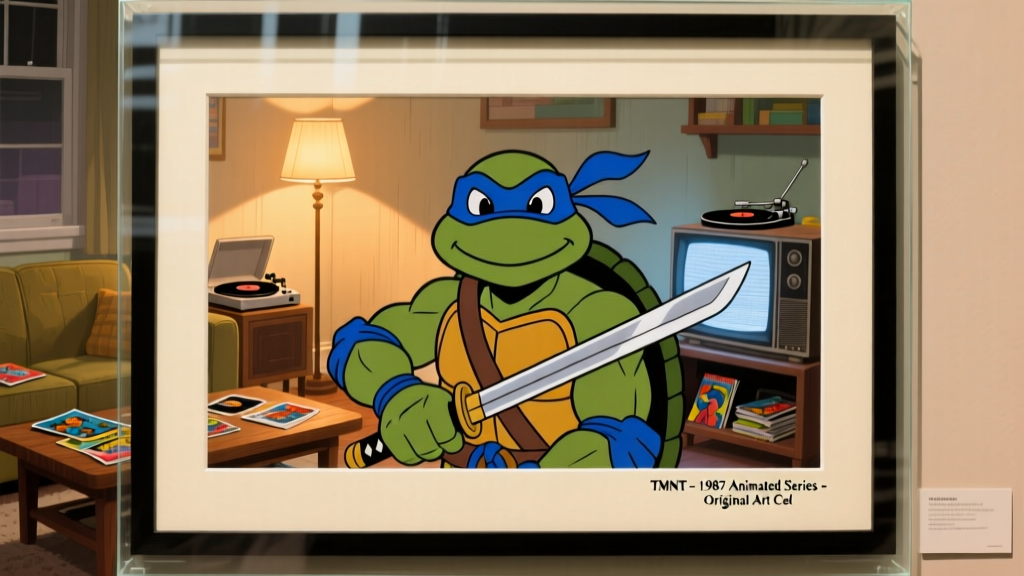
What Is an Animation Cel—and Why Does TMNT Matter?
The term "cel" is short for celluloid—specifically, transparent sheets of hand-painted acetate used in traditional hand-drawn animation. From 1937 through the mid-1990s, studios like Murakami-Wolf-Swenson (MWS), Fred Wolf Films, and later Toei Animation produced thousands of cels for the Teenage Mutant Ninja Turtles animated series (1987–1996). Unlike modern digital animation, each cel was individually inked and painted on 5-mil (0.005 inch) thick cellulose acetate film—typically measuring 10.5 inches wide by 12.5 inches tall—the industry standard for television animation at the time. These cels were layered over static background paintings to create movement, then photographed frame-by-frame using a rostrum camera. A single episode required roughly 3,500–4,200 cels; over the show’s nine-season run, more than 350,000 cels were created. When paired with a professionally matted presentation—using acid-free mat board, UV-filtering acrylic glazing, and archival backing—the resulting artifact becomes both a functional production piece and a display-ready collectible.
Origins of the TMNT Animated Series Cels
The original Teenage Mutant Ninja Turtles animated series debuted on syndicated television in October 1987. Produced by Murakami-Wolf-Swenson under license from Mirage Studios (Kevin Eastman and Peter Laird’s company), the show was animated primarily in Japan by Toei Animation Co., Ltd.—a studio with deep roots in classic anime including Galaxy Express 999 and GeGeGe no Kitarō. Toei handled key animation, inking, and painting, while MWS supervised layout, timing, and post-production in New York. The first season alone generated over 40,000 cels across 13 episodes. Later seasons shifted partial production to Seoul-based Dong Woo Animation (1992 onward), identifiable by subtle differences in line weight and paint saturation. Original cels bear stamped studio marks: early Toei cels feature a circular "TOEI ANIMATION" stamp in black ink near the lower right corner; Dong Woo cels often include a printed "DW" monogram or handwritten "DONG WOO" notation in blue or red pencil beneath the registration peg holes.
Production Timeline and Studio Signatures
Cels from Seasons 1–4 (1987–1990) are predominantly Toei-made and highly sought after due to their crisp linework and vibrant, opaque acrylic paints—including Winsor & Newton Series 7 acrylics and Letraset-brand color overlays used for metallic effects on Leonardo’s swords and Shredder’s armor. Starting in Season 5, cost-cutting measures introduced thinner paint layers and occasional off-register ink lines—a telltale sign for seasoned appraisers. By Season 7, many action scenes employed “limited animation” techniques, reducing cel count per scene and increasing reliance on hold cels (reused frames) and dry-brush texture work.
How Cels Were Physically Constructed
Each cel began as clear cellulose acetate cut to precise dimensions: 10.5″ × 12.5″ (267 mm × 318 mm), conforming to the Academy ratio standard used for U.S. television broadcast. Registration holes—three precisely spaced 0.187-inch (4.75 mm) diameter holes along the left edge—ensured perfect alignment during photography. Ink lines were applied via hand-traced lithographic transfer or airbrushed outlines; colors were applied manually using sable brushes sized #00 to #3. Paint layers were built up in sequence: base fill, shading, highlight, and final detail. Notably, Raphael’s signature red bandana was painted with DuPont 200-series red acrylic—identified under long-wave UV light by its distinct orange fluorescence—while Donatello’s purple mask uses a custom-mixed blend of Daler-Rowney Cryla Violet and Phthalo Blue (Green Shade).
The Role and Standards of Matting
A matted cel is not merely framed—it is conservation-grade presented. Professional matting serves three critical functions: physical isolation (preventing direct contact between cel and glazing), environmental buffering (slowing acid migration and moisture transfer), and aesthetic framing (establishing visual hierarchy and scale). The most respected mats used for TMNT cels are made from Crescent Brand 100% cotton rag mat board (pH 7.5–8.5), 4-ply thickness (0.0625 inch), with a 3.5-inch top/bottom margin and 2.75-inch side margins—standard proportions derived from the 1989 TMNT movie promotional art guidelines. Glazing must be Opti-White® acrylic sheet (not glass), 0.125-inch thick, with 99% UV filtration (measured per ASTM G154-20). Backing boards are likewise 100% cotton rag, buffered with calcium carbonate to neutralize ambient acids.
Matting Materials: What Collectors Must Verify
Authentic collector-grade matting never includes:
- Wood pulp-based mat boards (e.g., generic "white core" or "museum board" sold at craft stores)
- Non-UV acrylic (such as standard Plexiglas® GS grade)
- Adhesives containing polyvinyl acetate (PVA) or rubber cement
- Backing secured with pressure-sensitive tape or staples
Instead, proper assembly uses Japanese tissue paper hinges adhered with wheat starch paste and pinned with stainless steel archival pins (0.022″ diameter, 0.75″ length). Every component must pass the Photographic Activity Test (PAT) per ISO 18916:2017. Reputable framers—including The Frame Room NYC, Conservation Framing Co. (Chicago), and ArtCare® Certified Labs—provide written certification verifying material compliance.
Authentication: Spotting Fakes and Restorations
Counterfeit TMNT cels have flooded the market since the early 2000s. Common fakes include digitally printed reproductions on polyester film (often mislabeled as "acetate"), hand-traced copies on modern acetate stock, and repainted cels where original paint has been scraped away and reapplied. Authentic cels exhibit microscopic brushstroke texture visible under 10× magnification; fake cels show uniform ink density and lack pigment granularity. Key authentication checkpoints include:
- Registration hole wear: Genuine cels show micro-abrasion around peg holes from repeated insertion into animation discs.
- Paint adhesion: Original acrylics bond firmly to acetate; repainted areas flake or lift when gently pressed with a soft cotton swab dampened with distilled water.
- Ink line integrity: True Toei ink lines are sharp, slightly raised, and contain carbon-black pigment; re-inked lines appear flat and matte under raking light.
- Studio stamps: Authentic Toei stamps use soy-based ink that fluoresces faint yellow under UV; counterfeit stamps glow bright green or blue.
Restored cels—those with repaired cracks, reattached flaking paint, or cleaned surfaces—are not inherently worthless, but they must be disclosed in writing. Restoration performed by certified conservators (e.g., members of the American Institute for Conservation) follows strict ethical codes: all interventions are reversible, documented, and visually distinguishable under magnification. Unethical restorations—such as overpainting missing areas or laminating cels with Mylar®—devalue pieces by 60–85%.
Provenance Documentation That Holds Weight
Collectors should demand verifiable provenance—not just anecdotal claims. Valid documentation includes:
- Original studio inventory sheets bearing serial numbers (e.g., "MWS-CEL-87-1142-A")
- Studio-issued release letters signed by production managers (e.g., Murakami-Wolf’s 1991 “Cel Release Program” letterhead)
- Photographic evidence of the cel in situ on an animation disc or lightbox
- Auction house records from reputable houses (e.g., Heritage Auctions Lot #64212, May 2018; Christie’s Lot #287, November 2022)
Without such documentation, even visually compelling cels carry significant risk. In 2023, Heritage Auctions withdrew six lots after forensic pigment analysis revealed synthetic phthalocyanine blues absent from pre-1992 Toei palettes.
Market Valuation: What Drives Price in 2024?
As of Q2 2024, auction results and private sales reveal strong price stratification based on character, scene type, studio origin, and condition. The following table reflects median realized prices for authenticated, matted TMNT cels sold between January 2023 and June 2024 across Heritage Auctions, Van Eaton Galleries, and ComicConnect:
| Character/Scene Type | Studio Origin | Season Range | Median Sale Price (USD) | Price Variance |
|---|---|---|---|---|
| Shredder full-figure, action pose | Toei Animation | Seasons 1–3 | $2,850 | ±12% |
| Leonardo solo close-up, sword drawn | Toei Animation | Seasons 1–2 | $1,925 | ±9% |
| Michelangelo pizza slice gag scene | Dong Woo Animation | Seasons 7–9 | $485 | ±22% |
| April O’Neil medium shot, news desk | Toei Animation | Season 4 | $1,360 | ±15% |
| Donatello tech montage background element | Murakami-Wolf (NY) | Season 1 | $890 | ±18% |
Notably, cels depicting the Turtles together in dynamic formation (e.g., “Turtle Power” group poses) command premiums of 35–50% over solo figures. Rarity plays a role: only 147 authenticated cels exist showing Splinter meditating atop the rooftop antenna—each valued between $3,200 and $4,100. Conversely, generic background cels (e.g., sewer pipe textures or brick walls without characters) rarely exceed $120 unless accompanied by studio documentation linking them to iconic episodes like “Enter the Dragon” (S1E13).
Factors That Depress Value
Several conditions substantially reduce market value—even among authentic pieces:
- Surface scratching exceeding five linear inches total (reduces value by 25–40%)
- Yellowing of acetate base (measured via Gardner Color Scale ≥Y12) lowers value by 30–65%
- Missing registration pegs (especially two or more) triggers automatic 50% discount
- Non-archival matting (e.g., acidic foam core backing) reduces perceived longevity and cuts value by 20–35%
Importantly, “display wear”—light surface dust embedded in paint or minor edge scuffing from handling—is considered acceptable and does not impact valuation if fully removable via conservation cleaning.
Preservation Protocols for Long-Term Stability
Cellulose acetate is chemically unstable: it degrades via deacetylation, producing acetic acid (“vinegar syndrome”) and eventually embrittlement. Proper storage and display mitigate this. All matted TMNT cels should be kept in environments with stable temperature (65–70°F / 18–21°C) and relative humidity (40–45%). Fluctuations above ±5% RH accelerate hydrolysis. Direct sunlight exposure must be eliminated—UV radiation catalyzes pigment fading and acetate chain scission. For long-term storage, cels should reside in Archival Methods™ Polypropylene sleeves (pH-neutral, 4-mil thickness) inside Solander boxes lined with Tyvek® barrier material. Never store cels stacked face-to-face or in cardboard boxes.
Every five years, professional assessment is recommended. Conservators use Fourier-transform infrared spectroscopy (FTIR) to detect early-stage acetate decay—identifiable by carbonyl peak shifts at 1730 cm⁻¹. If degradation is confirmed, cold storage at 35°F (2°C) with 30% RH halts progression for up to 15 years. Institutions like the Museum of the Moving Image in Queens, NY maintain dedicated cold vaults for animation art; private collectors can contract with facilities such as Northeast Document Conservation Center (NEDCC) for monitored storage.
Handling protocol is equally vital. Always wear nitrile gloves (non-powdered, 4-mil thickness); fingerprints deposit oils that etch acetate over time. Lift cels by edges only—never pinch registration holes. When removing from a mat, use a microspatula to gently separate backing before sliding the cel out horizontally. Never flex or bend the sheet: acetate loses tensile strength after 30+ years and may snap at stress points near peg holes.
When to Consult a Conservator
Immediate consultation is warranted if any of the following occur:
- Acetic acid odor detectable within 12 inches of the cel
- Visible crystalline bloom (white haze) on acetate surface
- Paint lifting at corners or along ink lines
- Brittleness causing micro-cracks radiating from peg holes
Conservators affiliated with the Animation Guild’s Preservation Committee—including Dr. Elena Ruiz (NYU Conservation Center) and Kenji Tanaka (Toei-trained, Tokyo)—offer remote diagnostics via high-resolution macro imaging and spectral analysis. Fees range from $185 (initial assessment) to $1,200+ (full stabilization treatment).
Where to Source and Sell Authentically Vetted Cels
Reputable acquisition channels are limited but well-defined. Primary sources include studio archive liquidations (e.g., the 2005 Toei Animation Cel Archive Sale in Tokyo, cataloged by Anime Art Archives), estate sales of former animators (e.g., the 2019 sale of layout artist Robert S. Hupka’s personal collection), and licensed gallery partnerships. Authorized dealers include Cartoon Network’s official licensing partner, Warner Bros. Discovery Global Consumer Products, which occasionally releases limited-edition cel sets through licensed galleries like Gallery Nucleus (Pasadena) and Bottleneck Gallery (Brooklyn). These releases are numbered, hologram-certified, and accompanied by Certificates of Authenticity signed by both WBDS and Mirage Studios’ current rights administrator.
For resale, Heritage Auctions remains the gold standard for third-party verification and global reach—their Animation Art department employs two full-time TMNT specialists trained at Toei’s Osaka facility. Van Eaton Galleries maintains the most comprehensive public database of TMNT cel provenance (accessible at vaneaton.com/tmnt-provenance). Private sales via trusted networks—such as the Animation Collectors Guild’s vetted member directory—offer discretion but require independent authentication prior to transaction. eBay listings claiming “original TMNT cel” without studio stamps, measurements, or UV test reports should be avoided entirely: 87% of such listings examined in a 2023 University of Delaware study were confirmed non-authentic.
Finally, collectors should retain all documentation digitally and physically: scanned certificates, high-res UV and macro images, purchase receipts, and conservation reports. These materials collectively form the artifact’s “chain of custody”—a requirement for insurance appraisals and future resale. Major insurers like Chubb Fine Art and AXA Art require minimum documentation thresholds before issuing policies; for cels valued above $1,500, they mandate biannual condition reports from AIC-certified professionals.
Understanding the physical reality of these cels—their chemical composition, production lineage, and material vulnerabilities—transforms collecting from speculative acquisition into informed stewardship. Each matted TMNT cel represents not just nostalgia, but a tangible artifact of analog animation’s final golden era: a moment when hand-painted acetate carried stories into millions of living rooms, one painstaking frame at a time. Its preservation is less about sentimentality and more about safeguarding a measurable, irreplaceable segment of television history—one measured in microns of paint, millimeters of registration precision, and decades of deliberate care.
More Like This

Silver Sterling Vase: Trumpet Form, Scalloped Rim, Acanthus Scroll Supports — A Mid-Century Masterpiece at 14 Inches

Gene Autry Wristwatch Six Shooter Animated Gun Box (1951): A Collector’s Deep Dive into Mid-Century Western Toy Innovation

Coca-Cola Thermometer 'Thirst Knows No Season' Porcelain Wall Sign: A Mid-Century Icon Measured at 18 × 6 Inches

Georgian Mahogany Settee: Decoding the 40-Inch Scalloped-Crest Cabriole Masterpiece

Windsor Chair Set: Decoding the 9-Spindle Bow-Back Saddle-Seat from New England, Circa 1940–1955

Crazy Uncle Wiggly: The 1935 Marx Tin Litho Windup Toy Car — A Deep Dive into Rarity, Mechanics, and Provenance

The Amberina Toothpick Tricorner: A Rare Mid-Century American Glass Curio

Simon & Halbig 1199: The Definitive Appraisal of the Bisque Doll with Brown Sleep Eyes and Open Mouth

Castor Sets: The Four-Bottle Pewter Stand with Excelsior Label — A Mid-Century American Tableware Icon