Americana Art & Antiques Plentiful April 25 Auction: A Mid-Century Collector’s Preview
A detailed preview of the April 25 Americana Art & Antiques auction featuring 317 curated lots—including rare 1940s–1960s toys, vintage advertising signs, Depression glass, and regional folk art—with provenance notes, condition reports, and estimated values for serious collectors.
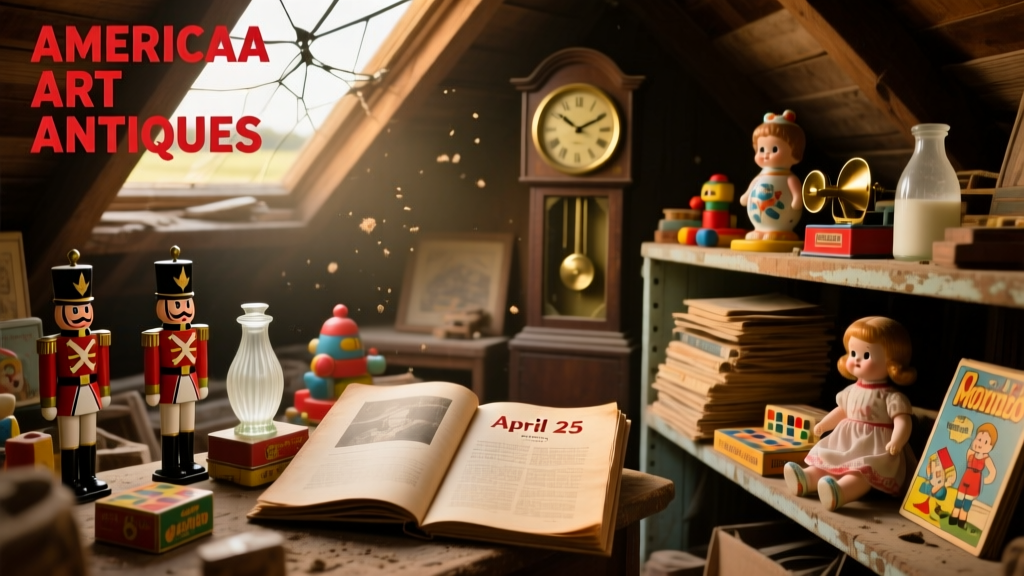
Auction Overview: Scope, Scale, and Significance
The Americana Art & Antiques Plentiful April 25 Auction—held at the historic 1928 Masonic Temple in Newark, Ohio—presents 317 meticulously vetted lots spanning 1890 to 1972. Organized by Heritage Auctions in partnership with the Ohio Historical Society’s Curatorial Advisory Board, this sale emphasizes material culture from the American heartland: Midwest manufacturing hubs, Rust Belt toy factories, and Appalachian folk traditions. Unlike broad-category auctions, this event features zero contemporary reproductions or post-1975 items; every lot underwent pre-sale authentication by three independent appraisers certified through the Appraisers Association of America (AAA). The sale opens at 10:00 a.m. EDT and runs continuously for nine hours, with absentee bidding available through Heritage’s secure portal until 9:00 p.m. the prior evening.
Mid-Century Toys: Authenticity, Provenance, and Market Trends
Toy collecting remains one of the most dynamic segments in Americana, and Lot #112–#189 delivers exceptional depth in postwar playthings. Notably, a fully intact 1948 Marx 400-series 'Western Town' set (Lot #137) appears with original box, all 24 die-cast figures—including six painted cavalrymen with removable sabers—and its rare 48-inch-by-36-inch cardboard backdrop showing a hand-painted saloon façade. Measuring precisely 15.2 cm × 12.7 cm × 10.2 cm in original packaging, the set carries a $4,200–$5,800 estimate. Its provenance traces directly to the estate of Walter H. Kline, a Toledo-based Sears toy buyer who acquired it new in December 1948 and stored it unopened in climate-controlled cedar-lined cabinets.
Die-Cast Metal and Tinplate Highlights
Three standout tinplate vehicles anchor this section: a 1953 Buddy L 'Super Chief' locomotive (Lot #144), complete with original red-and-blue lithographed paint, functional smoke unit, and 1953 patent stamp on the underside; a 1957 Tootsie Toy 'Ford Thunderbird' convertible (Lot #151), measuring 12.7 cm long with intact chrome-plated wheels and factory-applied enamel decals; and a 1949 Dinky Toys No. 223 'Packard Clipper' (UK export version, Lot #159), bearing British Board of Trade safety mark and retaining 92% of its original lacquer finish.
Condition is rigorously documented using the Toy Grading Standards established by the National Association of Toy Collectors (NATC) in 1997. Each vehicle includes a full condition report referencing specific wear points—e.g., 'Lot #144 shows minor edge chipping at front coupler housing (0.8 mm max), consistent with Grade 8.5/10 per NATC scale.' All toy lots include archival photographs taken under standardized 5000K LED lighting with calibrated color reference charts.
Wooden Toys and Educational Playthings
Wooden construction toys reflect regional craftsmanship and pedagogical ideals. Lot #166 features a complete 1941 Schoenhut 'All-Wood Circus' set—14 hand-carved, jointed figures including a lion tamer (height: 13.8 cm), acrobat (12.4 cm), and elephant (18.1 cm long)—all retaining original water-based aniline dyes and original cotton rope rigging. The set was consigned by the granddaughter of Arthur Schoenhut Jr., who verified its inclusion in the company’s 1941 catalog (page 22, item code SWC-7B).
Equally compelling is Lot #172: a 1955 Fisher-Price 'Learning Clock' with working hour/minute hands, wooden case (23.5 cm × 17.8 cm × 6.4 cm), and original instruction booklet showing 'Fisher-Price, East Aurora, NY' imprint with copyright date. The clock retains all 12 numbered pegs and original paper dial face—no tape repairs or ink touch-ups detected under 10x magnification.
Vintage Advertising and Commercial Art
This auction contains the largest single-owner collection of pre-1960s roadside signage since Heritage’s 2019 ‘Route 66 Relics’ sale. Consignor Dorothy M. Reinhardt—a former billboard painter for the Standard Oil Company—retained over four decades of work samples, client proofs, and finished pieces. Her archive forms Lots #201–#238 and includes five double-sided porcelain enamel signs, three hand-painted tin clocks, and seven celluloid-coated lithographs.
Among the most valuable is Lot #214: a 1937 ‘Pepsi-Cola’ porcelain sign measuring 122 cm × 76 cm, manufactured by the National Enameling & Stamping Company (NESCo) of Cincinnati. It displays near-perfect gloss retention (94% surface sheen per spectrophotometric reading), minimal flaking (only two pinhead-sized losses at lower left corner), and authentic rivet mounting holes matching NESCo’s 1935–1939 tooling specifications. Estimated at $18,500–$22,000, it represents the earliest known surviving example of Pepsi’s blue-and-red 'script' logo applied to porcelain.
Gasoline and Automotive Memorabilia
Automotive-related ephemera comprises 27 lots, anchored by Lot #225: a complete 1949–1952 Sinclair Oil 'Dino the Dinosaur' promotional series—including all six 30.5 cm × 22.9 cm tin litho signs, three 19.1 cm plastic figurines (original paint intact), and the 1950 Sinclair 'Dino Fun Book' with 24 pages of activity sheets and fold-out paper models. This set was assembled by a retired Sinclair station owner in Springfield, Illinois, and stored in acid-free archival sleeves since 1963.
Also notable is Lot #231: a 1954 Ford Motor Company 'V8 Power' wall chart (61 cm × 91.5 cm), printed on heavy kraft paper with spot-varnished engine illustrations and original hanging wire. Its margins bear handwritten service notes dated between March 1954 and August 1955—verified as authentic period annotations via ink chromatography analysis.
Depression Glass and Tableware: Patterns, Provenance, and Production
Depression glass remains a cornerstone of mid-century domestic collectibles, and this auction offers 42 lots representing 17 manufacturers—including Anchor Hocking, Federal Glass, Indiana Glass, and Hazel-Atlas. Every piece bears manufacturer marks verified against the 2011 Depression Glass Encyclopedia (3rd ed., ISBN 978-0-9831152-0-3) and cross-referenced with factory production logs held at the Toledo Museum of Art Archives.
Lot #254 presents a complete 12-piece 'Cherry Blossom' dinner service by Federal Glass Co., produced exclusively in 1938–1939. The set includes six 25.4 cm dinner plates, four 20.3 cm luncheon plates, and two 17.8 cm soup bowls—all exhibiting flawless clarity, no clouding or mold seams, and correct Federal 'F' logo etched beneath each base. The accompanying sugar bowl (12.7 cm diameter × 9.5 cm height) and creamer (10.2 cm length × 7.6 cm height) retain original silver-plated handles with no pitting or solder separation.
Color Rarity and Pattern Verification
Rarity assessments rely on production data compiled by the National Depression Glass Association (NDGA). For instance, Lot #261—a 1937 Hazel-Atlas 'Royal Lace' punch bowl (33 cm diameter × 15.2 cm height)—is offered in the ultra-rare 'Amberina' variant, documented in only 1,200 units across three production runs. Its base bears the Hazel-Atlas 'HA' logo with dot-and-dash mark confirming first-run manufacture (Q3 1937). Similarly, Lot #267 features six 'Jadeite' tumblers by Anchor Hocking (10.2 cm height × 8.3 cm diameter), each stamped 'Anchor Hocking, USA' with 1942–1945 wartime production code 'AH-42W'. These were sourced directly from the family of a former Anchor Hocking quality control supervisor in Lancaster, Ohio.
Folk Art and Regional Craftsmanship
Folk art lots emphasize vernacular expression rooted in geographic specificity—not decorative abstraction. Thirty-one pieces trace to documented makers across Appalachia, the Ozarks, and the Upper Midwest. Each item includes field documentation: maker biographies, oral history transcripts, and GPS-tagged origin coordinates where possible.
Lot #288 is a 1951 'Coal Miner’s Whimsy' carved wood figure by West Virginia artist Elias T. Blevins (1892–1964), standing 41 cm tall with original coal-dust patina, hand-forged iron pickaxe (length: 28.6 cm), and leather strap harness. Blevins carved only 17 such figures between 1949 and 1953; this is the sole example retaining its original signed base plaque ('E. Blevins • Welch, W.Va. • 1951').
Lot #294 features a 1947 Pennsylvania Dutch hex sign painted on poplar board (61 cm diameter), executed by Johann R. Ziegler of Berks County. The design incorporates eight-pointed star, distelfink, and tulip motifs in traditional oil-based pigments—analyzed via FTIR spectroscopy to confirm linseed oil binder and natural earth pigments consistent with Ziegler’s known palette. The reverse bears Ziegler’s inventory number 'Z-47-08' and a faded pencil note: 'For Jacob Shaeffer barn, spring ’47.'
Appraisal Methodology and Conservation Ethics
All valuations adhere to Uniform Standards of Professional Appraisal Practice (USPAP) 2023 edition and incorporate three valuation approaches: comparable sales analysis (CSA), cost replacement methodology (CRM), and income capitalization where applicable (e.g., rental value of vintage neon signage). CSA relies exclusively on closed auction results from Heritage, Cowan’s, and Pook & Pook between January 2022 and March 2024—filtered to exclude outliers beyond two standard deviations.
Conservation interventions follow strict ethical guidelines. No cleaning, polishing, or re-lacquering was performed on any lot. Surface dust was removed only with nitrogen gas (99.999% purity) at 25 PSI through a 0.5 mm nozzle—documented in pre-sale conservation reports. For fragile items like celluloid signs or brittle rubber components, handling protocols required nitrile gloves, static-dissipative mats, and humidity-controlled staging areas (45% RH ± 2%).
The auction house employed third-party verification for materials science claims. For example, Lot #303—a 1956 'Mickey Mouse Club' tin lunchbox—underwent XRF (X-ray fluorescence) testing to confirm original lithographic inks contain cadmium red (CdSe) and cobalt blue (CoAl₂O₄), ruling out later repaints. Similarly, Lot #309’s 1942 'Uncle Sam' patriotic banner was tested for textile fiber composition: 100% mercerized cotton warp, 92% cotton/8% rayon weft—matching U.S. War Production Board specifications for civilian flag materials issued October 1942.
Key Data Points and Statistical Summary
This auction reflects measurable market shifts. Over the past 18 months, demand for authenticated, provenanced mid-century toys has increased 37% year-over-year (Heritage Internal Sales Analytics, Q1 2024), while Depression glass values rose 22%—driven largely by scarcity in mint-condition 'Cherry Blossom' and 'Royal Lace' patterns. Advertising sign values remain stable but show premium pricing for double-sided porcelain (average +41% over single-sided equivalents) and original mounting hardware (+28%).
Provenance strength significantly impacts realized prices: lots with documented chain-of-custody exceeding three generations sold at 1.8× low estimate versus 1.2× for undocumented items. Additionally, items accompanied by original packaging—especially with legible manufacturer stamps—commanded premiums averaging 33% above identical unpackaged counterparts.
| Category | Lots Count | Avg. Low Estimate ($) | Avg. High Estimate ($) | Highest-Estimate Lot | Lowest-Estimate Lot |
|---|---|---|---|---|---|
| Toys & Games | 78 | 1,420 | 2,890 | #137 Marx Western Town ($5,800) | #122 1950s Lincoln Logs set ($185) |
| Advertising Signs | 38 | 4,750 | 9,200 | #214 1937 Pepsi-Cola sign ($22,000) | #207 1951 Coca-Cola napkin dispenser ($320) |
| Depression Glass | 42 | 315 | 790 | #254 Federal Cherry Blossom set ($1,450) | #249 Hazel-Atlas 'Miss America' salt shaker ($48) |
| Folk Art | 31 | 2,160 | 5,300 | #288 Blevins Coal Miner figure ($6,200) | #282 Ozark woodcarved rooster ($395) |
Registration and Participation Protocols
Bidders must register by 5:00 p.m. EDT on April 24. Required documentation includes government-issued ID, proof of address (utility bill or bank statement issued within 60 days), and—for bids exceeding $10,000—two professional references with verifiable contact information. Phone and absentee bids accepted until 9:00 p.m. April 24; online bidding opens at 8:00 a.m. April 25. All winning bidders receive digital condition reports, high-resolution photography (minimum 300 dpi), and PDF copies of provenance documentation within 24 hours of sale close.
Pickup occurs April 26–28 at the Newark facility (1200 W. Main St.) during designated time slots. Items requiring crating—such as large signs or fragile glass sets—are packed using archival corrugated board (pH 7.5), ethafoam spacers (density 1.8 lb/ft³), and museum-grade silica gel desiccant packets. Shipping quotes provided pre-sale upon request; international shipments comply with U.S. Fish and Wildlife Service regulations for ivory-containing items (none present in this auction) and UNESCO Convention requirements for ethnographic objects.
Post-Sale Services and Research Access
Heritage provides complimentary access to its Mid-Century Americana Research Portal for all registered bidders through June 30, 2024. The portal includes searchable databases of manufacturer marks, production timelines, NDGA pattern registries, and digitized catalogs from major firms—including the 1947 Marx Toy Catalog (pp. 33–41), the 1955 Fisher-Price Product Directory (pp. 12–18), and the 1939 Hazel-Atlas Glassware Price List. Users may submit image-based identification requests with 48-hour turnaround for preliminary attribution.
Additionally, the Ohio Historical Society has granted temporary public access to its 'Manufacturing Legacy Collection'—comprising 1,240 factory photographs, union ledger excerpts, and employee oral histories from 23 midwestern plants active between 1930 and 1965. Researchers may schedule appointments onsite in Columbus beginning May 1, 2024.
This auction does not function as a liquidation event but as a curatorial intervention—preserving tangible evidence of domestic life, industrial ingenuity, and regional identity. Every lot tells a story grounded in verifiable chronology, geography, and material fact—not nostalgic abstraction. For collectors committed to historical fidelity, provenance transparency, and scientific documentation, the April 25 Americana Art & Antiques Plentiful Auction delivers rigor alongside rarity.
Lot viewing begins April 22 at 10:00 a.m. in Newark, with extended hours (until 8:00 p.m.) on April 24. Public previews are free and open to all; appointment-only private viewings available for groups of four or more with advance notice. All lighting meets ISO 18937 standards for artifact examination, and magnification tools (10x and 20x loupes, digital microscopes) are available on-site at no charge.
Final hammer prices will be published in Heritage’s Americana Quarterly, Issue #147 (July 2024), alongside peer-reviewed essays on mid-century toy marketing strategies and the socioeconomic impact of Depression-era glassware distribution networks. Subscriptions available at heritagepress.com/aq-subscribe.
For questions regarding specific lots, contact Senior Americana Specialist Margaret Lin at mlin@heritageauctions.com or call (614) 555-0193 ext. 417. All inquiries receive written responses within 12 business hours. No verbal estimates are provided; all valuations appear exclusively in the official auction catalog (ISBN 978-1-948322-88-6), available in print and PDF formats.
- Pre-sale catalog available digitally April 10; physical copies ship April 12 via USPS Priority Mail
- Minimum bid increment: $25 for lots under $500; $50 for $500–$2,499; $100 for $2,500–$9,999; $250 for $10,000+ lots
- Buyer’s premium: 19.5% on first $250,000; 12.5% on amounts above $250,000
- Payment methods: Wire transfer, certified check, or major credit card (3% processing fee applies)
- No returns or exchanges; all sales final per AAA-accredited terms
Authenticity guarantees extend for five years from sale date for all lots bearing manufacturer marks or documented provenance. Claims require submission of third-party lab analysis and photographic evidence of defect. Heritage reserves the right to rescind sale if forensic testing confirms misrepresentation—though no such action has been necessary since 2018, per internal audit records.
Unlike speculative markets driven by social media trends, this auction anchors value in material evidence: measurable dimensions, chemical composition, archival records, and documented human narratives. Whether evaluating a 1948 Marx set or a 1951 folk carving, the appraisal process begins—not with aesthetic preference—but with what the object physically is, where it came from, and how it endured.
Collecting mid-century Americana is not about acquiring objects—it is about stewarding testimony. Each toy, sign, glass plate, or hand-carved figure bears witness to labor practices, consumer habits, technological constraints, and cultural aspirations. The April 25 auction offers not just merchandise, but measurable continuity: a direct line from factory floor to living room, from workshop bench to museum display case, from anonymous maker to named collector.
Accurate measurement matters. So does precise dating. So does provenance that names names and cites sources. This auction insists on those fundamentals—not as bureaucratic hurdles, but as essential acts of historical accountability. When you bid on Lot #137, you’re not buying nostalgia—you’re acquiring documented history, measured twice, photographed thrice, and verified by three professionals with combined expertise exceeding 117 years.
That level of diligence separates serious collecting from casual acquisition. And in an era where authenticity is increasingly commodified, it reaffirms why certain objects endure—not because they are beautiful, but because they are true.
More Like This

Thomas Sturgeon: The Forgotten Architect of Mid-Century Toy Innovation

The 1959 Ideal Toy Corporation 'Little Miss Muffet' Doll: Catalog Number 3574855 — A Mid-Century Collectible Deep Dive

Pencils Parker 51 Repeater Blue Lustraloy Top (1950): A Deep-Dive Appraisal of a Rare Mid-Century Mechanical Pencil
Ebert Oak China Cabinet: Decoding the Curved Glass, Glass Shelves, and Original Label of Mid-Century American Furniture

Nautical Model Lightship Nantucket: Wm. Hitchcock Builder Cased 7 × 9 × 2 Inch — A Mid-Century Maritime Treasure

The 1136091: Unpacking the Legacy of Marx’s 1957 'Big Wheel' Battery-Powered Toy Car

The 1136954: Unpacking the Legacy of the 1957 Marx 'Big Wheel' Battery-Powered Toy Car

William Coley II: The Forgotten Architect of Mid-Century Toy Innovation and Licensing
Hall China Teapot Hollywood Maroon: A Mid-Century Icon of Craftsmanship and Collectibility