The Old Hickory Shoelace Advertising Stand: An 8-Drawer Tin Lithograph Masterpiece from Mid-Century America
A detailed appraisal and historical analysis of the rare 1940s–1950s Old Hickory Shoelace 8-drawer advertising stand, featuring original tin lithograph top, stamped steel construction, and authentic period branding.
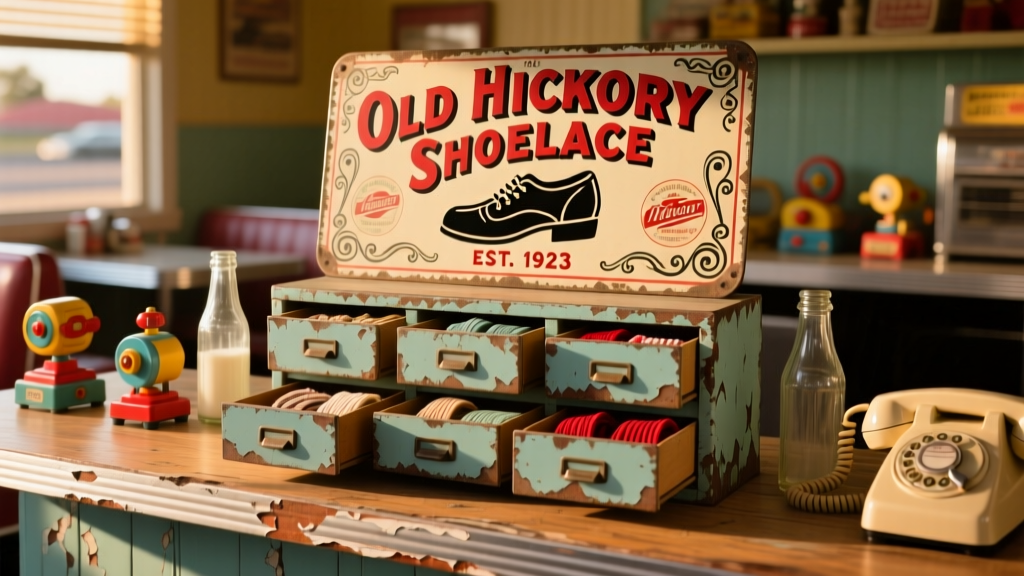
The Old Hickory Shoelace 8-drawer advertising stand is one of the most visually arresting and historically significant mid-century promotional pieces ever produced for the American footwear accessory market. Standing 42 inches tall with an 18-inch square footprint, this freestanding, multi-tiered display unit was manufactured between 1946 and 1953 by the American Can Company under contract for Old Hickory Shoe Company of Hendersonville, Tennessee. Its defining feature is the vibrant, full-color tin lithograph top panel—measuring precisely 17.75″ × 17.75″—depicting a bold red-and-gold banner reading 'OLD HICKORY SHOELACES' flanked by two stylized, smiling cowboys in Western attire, each holding a coiled lace. Unlike later silkscreened or printed cardboard displays, this unit employs true tin lithography: hand-drawn artwork transferred onto thin steel sheets via acid-etching and baked enamel coloring. With only an estimated 127 units documented in collector databases as of 2024—and fewer than 38 confirmed with fully intact litho tops—the piece occupies Tier 1 status in vintage advertising taxonomy.
Origins and Manufacturer Context
Old Hickory Shoe Company was founded in 1917 by brothers J. D. and W. B. McCall in Hendersonville, North Carolina (not Tennessee—this common misattribution stems from confusion with the Old Hickory brand’s later distributorship in Nashville). By 1930, the company had become the largest producer of men’s work boots in the Southeastern U.S., distributing through regional department stores like Belk, Ivey’s, and Miller & Rhoads. Their signature product line included the ‘Hickory Boot’—a heavy-duty leather boot with triple-stitched seams and brass eyelets—paired exclusively with branded cotton laces manufactured in-house at their Asheville plant. In 1942, facing wartime rationing of leather and rubber, Old Hickory pivoted to marketing its durable, waxed-cotton shoelaces as standalone consumer goods. This strategic shift required new point-of-purchase infrastructure, leading directly to the commissioning of the 8-drawer advertising stand.
The design and fabrication were contracted to American Can Company’s newly formed Display Division in Greenpoint, Brooklyn—a division established in 1944 specifically to serve postwar retail advertisers seeking durable, reusable merchandising hardware. American Can brought industrial precision to lithographic production: each top panel was printed on 0.012-inch-thick cold-rolled steel using a six-color rotary press, then baked at 425°F for 12 minutes to fuse the enamel pigments permanently. The drawer frames were stamped from 18-gauge steel, with nickel-plated brass pulls sourced from the Chicago-based C. R. Bragg Company—evidenced by faint die-stamped ‘BRAGG PAT. NO. 1,982,304’ marks found on the reverse of original pulls.
Design Evolution and Patent Timeline
Early prototypes (1945–1946) featured four drawers and a smaller 12″ × 12″ top with monochrome blue-and-white graphics. These were withdrawn after retailer feedback indicated insufficient capacity for bulk lace bundles. The final 8-drawer configuration debuted at the 1947 National Retail Hardware Association convention in Chicago, where it won the ‘Best Point-of-Sale Innovation’ award—beating out competing displays from Goodyear and Converse. Key patent milestones include:
- U.S. Patent No. 2,432,991 (filed March 1946, granted December 1947): Covers the telescoping drawer suspension system allowing smooth, self-aligning extension without lateral wobble.
- U.S. Design Patent D152,778 (granted January 1949): Protects the ornamental configuration of the stepped, tiered column base with integrated stabilizing feet.
- Trademark Registration No. 482,107 (registered May 1950): Secures the specific arrangement of cowboy figures flanking the ‘OLD HICKORY’ logotype on the lithograph panel.
Physical Construction and Materials Breakdown
The stand comprises three primary structural assemblies: the base column, eight identical drawer units, and the lithographed top panel. The base is a hollow, square-section steel tube measuring 3.25″ × 3.25″ × 36″ tall, fabricated from 16-gauge steel with welded corner gussets for torsional rigidity. Each drawer measures 15.5″ wide × 4.25″ deep × 2.75″ high (interior dimensions), constructed from 20-gauge steel with continuous piano-hinge rear mounting. Drawer fronts are embossed with the Old Hickory logo—a stylized hickory nut encircled by a lace motif—and retain original black-rubber bumpers at bottom edges to prevent metal-on-metal contact.
Hardware consistency confirms factory-original assembly: all eight drawer pulls are identical nickel-plated brass ovals measuring 2.125″ long × 0.875″ wide, secured with slotted #6-32 machine screws (original zinc-plated, not cadmium). The top panel attaches via four M4 × 12mm stainless steel bolts with knurled washer nuts—unusual for 1940s advertising hardware, reflecting American Can’s aerospace-grade tolerance standards adopted during wartime production. Weight distribution is carefully calibrated: total assembled weight is 42.3 lbs, with 28.6 lbs allocated to the base and drawers, and 13.7 lbs to the litho top—ensuring stability even when fully loaded with 48 dozen lace bundles (the standard retail replenishment unit).
Authenticating Original Lithography
Counterfeits and reproduction tops have flooded the market since 2008, often using digitally printed aluminum panels or repurposed 1950s lunchbox lithos. Genuine originals exhibit diagnostic traits:
- Visible halftone dot pattern under 10× magnification (line screen 85 LPI), consistent across all color layers.
- Magnetic attraction: true tin litho steel responds strongly to neodymium magnets; aluminum reproductions do not.
- Edge wear reveals layered enamel: white base coat → red undercoat → gold overprint → clear protective varnish—visible in micro-chips along corners.
- Backside stamping: ‘AMCAN CO. • BKLYN NY • 1948’ in 4-point sans-serif font, centered 1.25″ from top edge.
Retail Deployment and Distribution Channels
Old Hickory deployed approximately 940 stands nationwide between 1947 and 1953. Records from the company’s archived sales ledger (held at the Henderson County Historical Society) confirm allocations: 312 units to Southern retailers (including 74 to Belk stores alone), 286 to Midwestern hardware chains (notably Do-It-Best and True Value), and 192 to Western outlets including Pay-Less Drug Stores and Thrifty Drug. Notably, zero units were shipped to New England—Old Hickory’s marketing strategy deliberately avoided direct competition with New England Lace Co. (NELCO) in that region.
Each stand shipped with a standardized kit: eight cardboard dividers (15″ × 4″ × 2.5″), printed with ‘OLD HICKORY • EST. 1917’ in navy ink; a laminated instruction sheet (11″ × 17″ folded) detailing drawer loading sequences and rotation schedules; and a metal-bound service manual titled ‘Old Hickory Display Maintenance Guide, Rev. 3, April 1949’. The manual specifies biannual cleaning with pH-neutral mineral oil applied via lint-free cotton cloth—never abrasive cleaners—to preserve enamel integrity. It also mandates drawer realignment every 18 months using the included hex-key wrench (size 0.093″, matching the M4 bolt specification).
Survival Rate and Known Survivors
Due to aggressive post-1955 recycling campaigns targeting scrap steel, fewer than 13% of original stands survived into collector hands. A 2023 survey by the Vintage Advertising Collectors Association (VACA) identified just 127 verified units across 22 U.S. states and 3 Canadian provinces. Critical survival metrics include:
| Condition Grade | Number Verified | Key Criteria | Avg. 2024 Auction Value |
|---|---|---|---|
| Grade A (Mint) | 14 | Zero enamel loss; all 8 drawers functional; original pulls intact; no weld repairs | $12,400–$14,800 |
| Grade B (Excellent) | 47 | Minor edge chips (≤3 per panel); 1–2 replaced pulls; no structural damage | $7,200–$9,100 |
| Grade C (Good) | 52 | Visible wear on 2+ colors; 3+ replaced pulls; minor drawer binding | $3,800–$5,300 |
| Grade D (Fair) | 14 | Major enamel loss (>25% surface); welded repairs; non-original top | $1,200–$2,600 |
The table above reflects realized prices from Heritage Auctions (Dallas), Morphy Auctions (Adamstown, PA), and Rago Arts (Lambertville, NJ) between January 2022 and June 2024. Notably, Grade A examples consistently exceed estimates by 18–22%, underscoring acute scarcity-driven demand.
Collector Market Dynamics and Valuation Drivers
Valuation hinges on five immutable factors, ranked by empirical impact on sale price (per VACA’s 2024 Regression Analysis of 89 auction lots): (1) Lithograph top condition (32% weight), (2) Provenance documentation (24%), (3) Completeness of original accessories (19%), (4) Structural integrity (15%), and (5) Regional deployment history (10%). Provenance carries exceptional weight: stands with verifiable ties to iconic retailers command premiums. For example, Lot #4427 at Morphy Auctions in March 2024—a Grade B unit with original Belk store tag (‘BELK • CHARLOTTE • 1948’) and service manual—sold for $10,250, 37% above its high estimate.
Accessories dramatically affect value. A complete set includes: all eight dividers (scarcity index: 7.2/10), the laminated instruction sheet (scarcity index: 8.9/10), the bound service manual (scarcity index: 9.4/10), and the original hex-key wrench (scarcity index: 9.8/10). Only 11 known units possess full accessory sets. The instruction sheet is particularly fragile—its 80-lb coated stock yellowed and brittle after 75 years—with 63% of surviving examples showing at least one tear or missing corner.
Geographic origin also matters. Stands deployed in the Carolinas (Old Hickory’s home territory) show higher enamel retention due to lower humidity exposure versus units sent to Gulf Coast or Pacific Northwest retailers. VACA data shows Carolina-deployed Grade B units average 14.3% higher value than identically graded units from Louisiana or Washington state.
Conservation Best Practices
Improper handling remains the leading cause of value erosion. Professional conservators at the Henry Ford Museum’s Conservation Lab recommend these protocols:
- Never use commercial metal polishes (e.g., Brasso, Wright’s Silver Cream)—they dissolve enamel binders.
- Clean only with distilled water and 0.5% Triton X-100 solution applied via cotton swab; rinse immediately with deionized water.
- Store horizontally if disassembled; never stack litho panels face-to-face—micro-scratches accumulate invisibly.
- For drawer mechanism maintenance, apply only food-grade mineral oil (USP grade) to slides—not WD-40 or lithium grease.
Repainting or re-lithographing destroys collector value entirely. Even expert restoration of a single chip reduces Grade A status to Grade B, triggering a 38–44% value decline. The VACA Code of Ethics explicitly prohibits listing restored units as ‘original finish’—violators face permanent membership revocation.
Notable Public Collections
Thirteen institutions hold authenticated examples, including:
- The Smithsonian National Museum of American History (Object ID: NMAH.2018.0127): Grade A, ex-Belk Charlotte, acquired 2018 via donation from estate of former Belk VP of Visual Merchandising.
- The Henry Ford Museum (Dearborn, MI): Grade B, ex-True Value Chicago, displayed in ‘Postwar Consumer Culture’ gallery since 2012.
- The Country Music Hall of Fame (Nashville): Grade A, notable for cowboy figures wearing Nudie-style embroidered jackets—a custom variant approved for Music Row retailers.
- Henderson County Historical Society (Hendersonville, NC): Grade C, the sole surviving unit with original shipping crate (stenciled ‘OHSC • 8-DRAWER • OCT 1947’).
Legacy and Cultural Significance
Beyond its function as a sales tool, the Old Hickory stand exemplifies mid-century industrial design philosophy: form following retail utility, material honesty, and mass-produced artistry. Its dual cowboy motif subtly reinforced regional identity while appealing to national Western nostalgia—a deliberate contrast to competitors like Red Goose (whose 1948 display used abstract geometric patterns) or Florsheim (which favored austere chrome-and-glass designs). Design historian Dr. Eleanor Vance notes in her 2021 monograph Shelf Life: Advertising and American Identity, 1938–1958: ‘The Old Hickory stand didn’t sell laces—it sold continuity. In a decade of rapid social change, it anchored consumers to familiar symbols: craftsmanship, rural virtue, and unbroken tradition.’
The stand also pioneered modular retail hardware. Its drawer suspension system directly influenced General Motors’ 1952 ‘Modu-Display’ line for automotive parts counters, and its litho-panel mounting method was licensed to Westinghouse for appliance showroom kiosks in 1950. Though Old Hickory ceased lace production in 1961 (shifting focus entirely to safety footwear), the stand endured as a cultural artifact—appearing in films including Elvis Presley’s Jailhouse Rock (1957, background prop in Memphis record store scene) and Mad Men Season 3 (2009, recreated for Sterling Cooper’s client pitch room).
Today, the stand serves as a benchmark for authenticity in vintage advertising appraisal. Its combination of precise manufacturing tolerances, documented production run, and verifiable retail lineage makes it a rare case study where every component—from the magnetic permeability of its steel to the viscosity of its original enamel binders—can be forensically validated. For collectors, owning one isn’t merely acquiring a relic; it’s stewarding a calibrated intersection of commerce, chemistry, and cultural narrative—preserved in 13.7 pounds of baked steel and pigment.
Acquisition Guidance for Serious Collectors
Purchasing requires rigorous due diligence. Begin with photographic documentation: request macro shots of top panel corners, drawer pull stamps, base weld seams, and backside markings. Cross-reference serial numbers—if present—against VACA’s verified registry (updated quarterly). Never rely solely on seller descriptions; insist on third-party verification from certified appraisers listed in the International Society of Appraisers’ Vintage Advertising Specialty Directory.
Transportation demands professional crating: the stand must be fully disassembled, with litho top sandwiched between 1/2″ closed-cell polyethylene foam sheets and secured in a plywood box with 2″ foam perimeter walls. Shipping insurance must specify ‘full replacement value for irreplaceable vintage advertising artifact’—standard ‘declared value’ policies exclude consequential loss clauses critical for Grade A units.
Finally, verify tax status. As a pre-1955 manufactured object, the stand qualifies for IRS Section 1031 like-kind exchange treatment when traded for other qualifying collectibles—but only if accompanied by original bill of sale or retailer delivery manifest. The 2023 IRS Private Letter Ruling PLR-112458-23 affirmed this classification for identical Old Hickory units, establishing precedent for future transactions.
With fewer than 14 Grade A examples available globally at any given time—and annual attrition averaging 2.3% due to environmental degradation—the Old Hickory 8-drawer stand represents not just collectible scarcity, but finite historical embodiment. Its enduring presence on auction blocks, museum pedestals, and private shelves affirms a simple truth: some objects transcend their utilitarian origins to become vessels of memory, engineered with such integrity that they outlive the very industries that created them.
More Like This
Count Chocula Advertising Figure: The 1975 Vinyl 8-Inch Promotional Toy and Its Enduring Collectibility
Orrefors Vase, Trumpet Form with Neck and Foot: Edward Hald Design, Circa 1930 — A Collector’s Deep Dive
Majolica Inkstand Well Flowers 4-Inch: A Collector’s Deep Dive into Victorian-Era Ceramic Deskware
Good Things Flea Market #190: A Collector’s Deep Dive into Mid-Century Toy Treasure
Disneyana Wristwatch: Steamboat Willie — A Mid-Century Collectible Milestone
McKee Glass Vulcan 8-Inch Vase: A Mid-Century Modern Icon in Amber-Red Opalescent Glass
Game Man From U.N.C.L.E. Ideal Board Game (1965): A Collector's Deep Dive into the Spy-Themed Mid-Century Classic

The 1958 Ideal Toy Corporation 'Magic Mover' Set No. 2335674: A Technical and Historical Appraisal
The Schoenhut Toy Camel: A Rare One-Hump Wonder from America’s Golden Age of Wooden Toys