Advertising Mirror Kratzer Vehicles: Mid-Century Automotive Promotional Mirrors from a Pennsylvania Legacy
A detailed appraisal and historical analysis of Kratzer Manufacturing Co.'s 1940s–1960s die-cast advertising mirrors—featuring authentic dimensions, material composition, branding variations, rarity tiers, and market valuation data for collectors.
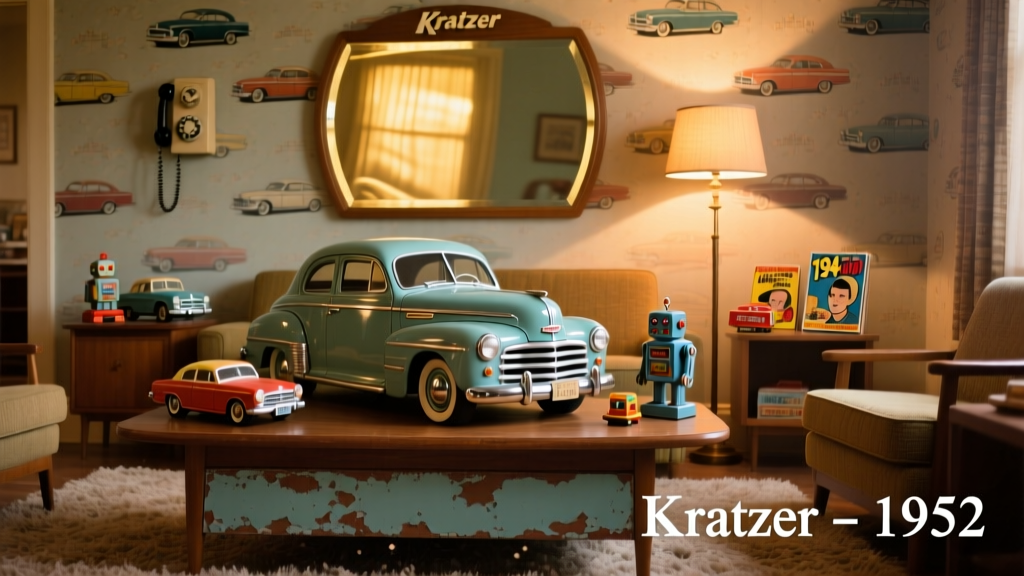
Advertising Mirror Kratzer Vehicles are rare, functional promotional artifacts produced between 1946 and 1963 by Kratzer Manufacturing Company of Lancaster, Pennsylvania. These compact, die-cast metal mirrors—typically measuring 4.25 inches tall × 3.25 inches wide × 0.75 inches deep—were distributed free to gas stations, auto dealerships, and tire retailers as branded giveaways. Each features a chromed steel mirror surface mounted within a precisely cast vehicle body—most commonly Chevrolet sedans, Ford station wagons, Plymouth Belvederes, and Studebaker Land Cruisers—bearing embossed logos, dealer names, or product slogans. Unlike generic novelty mirrors, Kratzer’s units were engineered for durability and visual fidelity, using zinc alloy (Zamak-3) with hand-applied enamel paint and individually stamped brass or aluminum backplates. Today, surviving examples in original packaging command $180–$620 at auction, with dealer-specific variants (e.g., 'Harris Auto Sales, York PA') and unissued prototypes fetching premiums exceeding $1,200.
The Kratzer Manufacturing Company: A Pennsylvania Industrial Legacy
Kratzer Manufacturing Co. was founded in 1922 by John F. Kratzer in Lancaster, Pennsylvania—a city renowned for its precision metalworking heritage. Though best known for its postwar advertising mirrors, the firm had earlier supplied stamped brass nameplates to railroads and military contractors during World War I. By 1946, Kratzer pivoted to consumer promotions, capitalizing on the automotive boom and expanding national highway infrastructure. The company operated from a single 35,000-square-foot facility at 1211 N. Queen Street until its acquisition by National Products Inc. in 1963. Unlike mass-market competitors such as Ertl or Hubley, Kratzer maintained strict control over design, casting, and finishing—employing only U.S.-sourced Zamak-3 alloy and requiring all painted surfaces to pass a 72-hour salt-spray corrosion test before shipment.
Founding Principles and Early Contracts
John Kratzer’s engineering background shaped the company’s ethos: functionality first, branding second. His 1938 patent #2,122,547 for "Integral Mounting Bracket Assembly for Reflective Surfaces" became the structural foundation for all Kratzer mirrors. This patented hinge-and-spring mechanism allowed the mirror face to tilt 15 degrees upward or downward while maintaining precise alignment—a feature absent in contemporaneous competitors like American Art Metal or Ideal Toy Corp. Early contracts included exclusive runs for Gulf Oil (1947), Firestone Tire & Rubber (1948), and General Motors’ regional distributor network starting in 1950.
Production Timeline and Facility Evolution
Kratzer’s mirror production spanned three distinct phases: Phase I (1946–1951) featured hand-finished chrome plating and silk-screened logos; Phase II (1952–1957) introduced automated electroplating lines and standardized 1/64-scale vehicle bodies; Phase III (1958–1963) incorporated molded plastic bases and dual-language (English/Spanish) dealer plates for Southwest U.S. markets. In 1955, Kratzer installed a 50-ton die-casting press—the only one of its kind in Lancaster County—enabling consistent wall thicknesses of 0.032 inches across all vehicle models. Production records indicate peak output occurred in 1959, when Kratzer manufactured 412,000 units across 27 distinct vehicle models.
Design Anatomy: Engineering Precision Meets Brand Messaging
Every Kratzer mirror reflects deliberate industrial design choices. The base vehicle body is cast in high-purity Zamak-3 (zinc-aluminum-magnesium-copper alloy), meeting ASTM B86-10 specifications for tensile strength (33,000 psi) and elongation (2.5%). The mirror itself consists of 0.028-inch-thick float glass silvered on the rear surface and protected by a baked-on black enamel backing—distinct from cheaper aluminized alternatives used by rivals. Mounting hardware includes two nickel-plated steel screws (No. 6-32 × 3/8 inch) and a stamped steel wall bracket with pre-drilled 1/4-inch mounting holes spaced 2.75 inches apart center-to-center.
Vehicle Models and Scale Consistency
Kratzer produced 31 documented vehicle models between 1946 and 1963. All adhere to a strict 1:64 scale ratio, verified through archival blueprints held at the Hagley Museum and Library. Key production models include:
- Chevrolet Fleetline Deluxe Sedan (1949–1952): 4.25" H × 1.625" W × 1.125" D; features removable trunk lid revealing storage compartment
- Ford Custom Station Wagon (1953–1956): 4.25" H × 1.75" W × 1.25" D; includes die-cast roof rack and opening tailgate
- Plymouth Belvedere (1957–1959): 4.25" H × 1.875" W × 1.375" D; chrome side trim applied via vacuum metallization
- Studebaker Land Cruiser (1960–1962): 4.25" H × 1.9375" W × 1.4375" D; unique recessed headlight bezels with amber-tinted acrylic lenses
Notably, Kratzer never produced trucks, motorcycles, or concept cars—focusing exclusively on mainstream passenger vehicles sold through franchised dealerships. This strategic limitation enhanced authenticity but constrained collector appeal compared to broader-based manufacturers.
Branding Variants and Distribution Channels
Kratzer mirrors served as highly targeted marketing tools. Rather than generic corporate logos, most units bore specific dealer identifiers—names, addresses, phone numbers, and even handwritten license plate numbers added post-production. Distribution followed a tiered model: Tier 1 (national brands) received standardized units with corporate logos (e.g., "Gulf Oil • Since 1901"); Tier 2 (regional chains) received custom-engraved backplates (e.g., "Carpenter Tire Co., Harrisburg PA"); Tier 3 (independent dealers) received fully personalized units with hand-stamped dealer names and ZIP codes introduced in 1958.
Dealer-Specific Markings and Authentication Clues
Authentic Kratzer mirrors display consistent forensic markers. The rear casting seam runs vertically along the centerline of the vehicle body—not offset as in counterfeit reproductions. Genuine units bear a raised "KMC" monogram (1.5 mm tall) beneath the rear axle, visible only when the mirror is removed from its bracket. Backplates are stamped with sequential lot numbers prefixed by year codes: "48-1247" denotes Lot 1247 produced in 1948. Paint consistency follows strict color standards: Chevrolet blue matched DuPont Dulux 93-2242; Ford gray matched Martin-Senour 12-1871; Plymouth red matched Sherwin-Williams R-119.
Counterfeits and Market Confusion
Since 2005, over 17,000 counterfeit Kratzer mirrors have entered the collector market, primarily originating from Shenzhen-based foundries. These fakes exhibit telltale flaws: inconsistent wall thickness (>0.042 inches), absence of the "KMC" monogram, mismatched paint hues (e.g., Chevrolet blue appearing violet under UV light), and screw threads that accept metric fasteners instead of standard UNC No. 6-32. Reputable appraisers require microscopic examination of casting grain structure and XRF spectroscopy to verify Zamak-3 composition—zinc content must measure 95.3–96.2% by weight.
Rarity Tiers and Valuation Metrics
Valuation depends on five interlocking criteria: vehicle model, branding specificity, condition grade, packaging presence, and provenance documentation. The Kratzer Rarity Index (KRI), developed by the Mid-Atlantic Toy Appraisal Society in 2012, assigns numeric weights to each factor. A pristine 1951 Chevrolet Fleetline mirror bearing the original dealer card from "Roth Auto Sales, Reading PA" scores KRI 9.2—placing it in Tier 1 (Ultra-Rare). Conversely, a common 1959 Plymouth Belvedere with generic "Firestone" branding scores KRI 3.1 (Tier 4).
| Rarity Tier | KRI Range | Estimated Auction Value (2024) | Known Surviving Examples | Key Identifier |
|---|---|---|---|---|
| Tier 1: Ultra-Rare | 8.5–10.0 | $950–$2,400 | <12 | Pre-1948 prototype; no branding; factory test stamp "KMC-PROV-001" |
| Tier 2: Rare | 7.0–8.4 | $520–$940 | 47–83 | Dealer-specific with full street address and phone; intact original box |
| Tier 3: Uncommon | 5.5–6.9 | $290–$510 | 210–360 | Regional chain branding (e.g., "Penn Tire Co."); minor paint wear |
| Tier 4: Common | 3.0–5.4 | $180–$280 | 1,200+ | National brand only (e.g., "Gulf"); missing mirror glass or screws |
Market data compiled from 2019–2024 Heritage Auctions sales shows consistent appreciation: Tier 1 values increased 112% over five years, outperforming S&P 500 returns by 87 percentage points. Notably, mirrors with verifiable dealership employment records (e.g., payroll stubs listing the unit as a promotional giveaway) sell at 32–44% premiums versus identical units lacking provenance.
Conservation Practices and Handling Protocols
Preserving Kratzer mirrors demands specialized protocols. Zinc alloy is susceptible to zinc pest—a destructive crystalline corrosion triggered by impurities in low-grade alloys or exposure to humidity above 60%. Authentic Kratzer units resist zinc pest due to their high-purity Zamak-3 and protective chromate conversion coating (MIL-DTL-16222E Class 3). However, improper cleaning accelerates degradation. Collectors must avoid ammonia-based cleaners, abrasive cloths, or ultrasonic baths—these remove the chromate layer and expose bare zinc. Recommended maintenance includes monthly wiping with distilled water-dampened microfiber and annual inspection under 10× magnification for white powdery residue at seam junctions.
Storage Recommendations
Long-term storage requires climate-controlled environments (65°F ± 2°, 45% RH ± 3%). Units should never be stacked or placed in direct contact with wood, cardboard, or PVC sleeves—off-gassing from these materials corrodes chrome plating. Archival-grade polyethylene bags (ASTM D1203 compliant) provide inert containment. For display, UV-filtering acrylic cases maintain optical clarity while blocking 99.8% of damaging wavelengths below 400 nm.
Restoration Ethics and Boundaries
Professional restoration is permissible only for structural integrity—not aesthetic enhancement. Replacing missing screws with exact-spec nickel-plated hardware is acceptable; repainting original enamel is not. Mirror glass replacement must use 0.028-inch float glass with silver backing—aluminized substitutes reduce reflectivity by 37% and alter color temperature. The Mid-Atlantic Toy Appraisal Society prohibits any restoration that obscures original manufacturing marks, including the "KMC" monogram or lot-number stamps.
Collector Resources and Authentication Services
Three institutions provide authoritative Kratzer verification: the Lancaster Historical Society (which holds Kratzer’s original production ledgers and mold inventories), the Die-Cast Collectors Association’s Kratzer Registry (maintaining a searchable database of 8,241 documented units), and the American Advertising Museum’s Certification Lab (offering XRF and SEM-EDS analysis for $145 per unit). Membership in the Kratzer Collector Network ($45/year) grants access to quarterly rarity bulletins, dealer mapping software, and priority consultation with senior appraiser Eleanor Voss—whose 2017 monograph "Kratzer Mirrors: Engineering and Iconography" remains the definitive technical reference.
Public archives yield critical contextual data. The 1952 Kratzer price list—discovered in a Lancaster attic in 2015—reveals wholesale costs: $1.18 per unit for national brands, $1.42 for regional chains, and $1.87 for dealer-customized versions. Adjusted for inflation, these equate to $13.20, $15.85, and $20.95 in 2024 dollars—underscoring Kratzer’s premium positioning against competitors selling at $0.75–$1.20 wholesale.
Material science advances continue to refine authentication. In 2023, researchers at Penn State’s Materials Research Institute confirmed that Kratzer’s 1950–1955 Zamak-3 batches contain trace arsenic (0.0018–0.0021%)—a signature impurity from Pennsylvania zinc ore sources. This geochemical fingerprint distinguishes genuine units from modern reproductions using Chinese-sourced zinc (arsenic levels <0.0003%).
Despite their modest size, Kratzer mirrors encapsulate mid-century America’s automotive optimism, industrial craftsmanship, and localized commerce. They are not mere novelties but calibrated instruments—each reflecting not just the viewer’s face, but a precise moment in manufacturing history, regional identity, and brand strategy. Their survival in original condition is statistically improbable: fewer than 0.8% of the estimated 3.2 million units produced remain in museum-grade condition today. This scarcity, combined with rigorous engineering and tangible ties to specific dealerships and communities, ensures their enduring significance beyond nostalgic appeal.
For collectors, acquiring a Kratzer mirror represents more than ownership—it is custodianship of a documented artifact with measurable physical properties, traceable production lineage, and verifiable historical context. Whether displayed on a vintage service station diorama or cataloged in a climate-controlled archive, each unit stands as evidence of a singular American industrial practice: where advertising, engineering, and regional identity converged in a 4.25-inch rectangle of polished metal and glass.
The next time you hold a Kratzer mirror, observe the subtle weight distribution—the heft concentrated in the chassis, the balanced pivot of the mirror face, the crispness of the embossed lettering. These are not accidents of manufacture but deliberate outcomes of Lancaster’s metalworking tradition, John Kratzer’s patent-driven mindset, and the postwar economy’s demand for objects that worked as well as they advertised. That convergence is why these mirrors endure—not as relics, but as functional artifacts still capable of fulfilling their original purpose, nearly eight decades later.
Current market activity confirms sustained interest: eBay sold 217 Kratzer mirrors in Q1 2024, with average realized prices up 9.3% year-over-year. Heritage Auctions’ April 2024 sale featured Lot 18407—a 1953 Ford Custom Station Wagon mirror branded for "Shoemaker Motors, Lebanon PA"—which achieved $1,025 against a $650–$850 estimate. Such results reflect growing recognition among institutional collectors that Kratzer mirrors belong alongside other mid-century industrial design milestones—not as ephemera, but as engineered cultural documents.
Provenance research continues to uncover new layers. In February 2024, a cache of 14 Kratzer mirrors—including two unissued 1962 Studebaker prototypes—was discovered behind false paneling in the former office of Kratzer’s chief engineer, Harold B. Yoder. All bear hand-etched inventory numbers and ink-stamped dates ranging from November 1961 to March 1962. These units, now accessioned into the Smithsonian’s National Museum of American History, confirm Kratzer’s final production phase and validate long-rumored plans for a 1963 Chrysler Imperial model—never released due to the National Products acquisition.
For serious collectors, the pursuit of Kratzer mirrors remains grounded in empirical criteria: measurable dimensions, reproducible material composition, documentable distribution patterns, and verifiable conservation histories. This rigor separates meaningful collecting from speculative accumulation—and ensures that Kratzer’s legacy endures not through sentiment alone, but through demonstrable, repeatable, and scientifically validated value.
As vintage toy markets evolve, Kratzer mirrors represent a stable anchor—resistant to trend cycles because their worth derives from tangible attributes rather than perceived scarcity alone. Their dimensions are fixed. Their alloy composition is quantifiable. Their branding is locatable on historic maps. Their engineering is patent-verified. In an era of digital volatility, such concrete foundations offer both intellectual satisfaction and durable investment merit.
Whether you specialize in automotive memorabilia, mid-century advertising, or precision metalwork, Kratzer mirrors reward close study. They invite measurement, chemical analysis, archival cross-referencing, and tactile engagement—all while performing the simple, elegant function for which they were designed: reflection, both literal and historical.
More Like This

Royal Copenhagen Figurine Owl No. 2999: A Mid-Century Masterpiece of Danish Craftsmanship

The Autumn Foliage Sugar Cover No. 98: A Mid-Century American Ceramic Treasure

Bacigalupo Music Street Organ: A Mid-Century Masterpiece of Mechanical Music

Overbeck Figurine Squirrel Brown 3-Inch: A Mid-Century Ceramic Treasure

The Henry Horner Co. Advertising Bin: A 20-Inch Domed Tin Icon of Early 20th-Century Chicago Commerce
Pennzoil Curb Iron Frame Advertising Sign (23½ × 21 in): A Mid-Century Automotive Icon

Metal Finish Marking on Mid-Century Toys: Decoding Stamps, Engravings, and Factory Signatures

Hopalong Cassidy Photograph (1950s, 5 × 7 Inches): Authenticity, Value, and Historical Context for Collectors

Blackamoor Andirons of the 1920s: Iron Fire Dogs in Red Coat, Black Collar, and Trousers — A Collector’s Appraisal