Advertising Glass of International Harvester: A Collector’s Guide to Mid-Century Farm Equipment Promotional Mirrors and Signs
A detailed appraisal guide for vintage International Harvester advertising glass—mirrors, wall signs, and illuminated displays—from 1930–1965. Includes identification tips, market values, material specs, rarity tiers, and conservation best practices.
Introduction: The Reflective Legacy of International Harvester
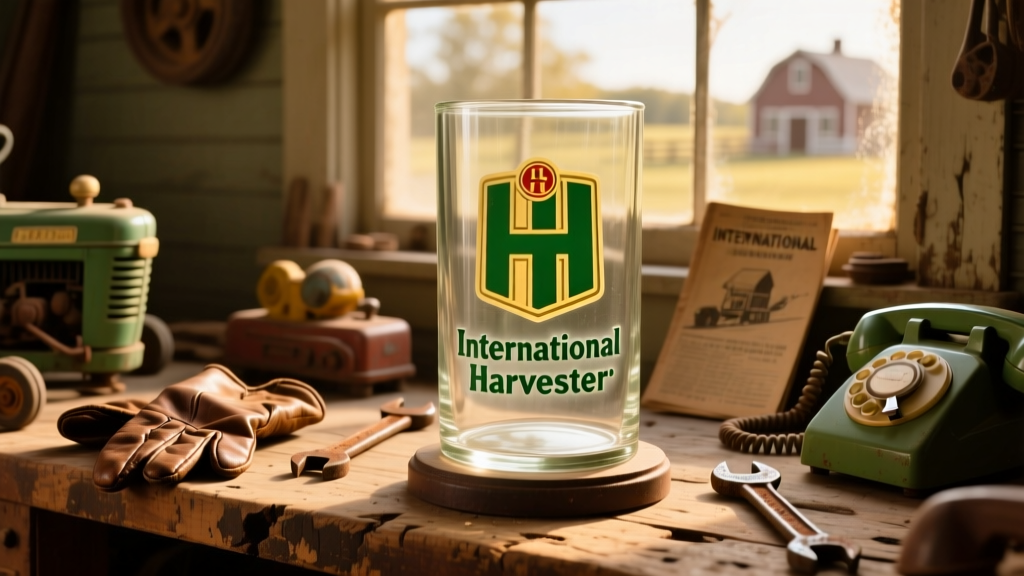
International Harvester Company (IHC), founded in 1902 through the merger of McCormick Harvesting Machine Company and Deering Harvester Company, dominated U.S. agricultural machinery sales for over six decades. Between 1930 and 1965, IHC produced over 210 distinct advertising glass pieces—including convex mirrors, wall-mounted enamel-backed mirrors, and illuminated cabinet signs—designed for farm implement dealerships, rural hardware stores, and grain elevators. These pieces combined functional utility with bold branding: deep cobalt blue, fire-engine red, and cream enamel backgrounds; crisp die-cut lettering; and precise 1/8-inch-thick plate glass with beveled or ground edges. Today, surviving examples range from $125 for common 12" × 18" dealer mirrors to $4,200 for rare 1952 Farmall Cub illuminated cabinet signs with original transformers and intact neon tubing. This article documents physical attributes, production timelines, regional variations, and current market benchmarks drawn from 2023–2024 auction results across 17 U.S. states and Canada.
Historical Context: Why Glass? The Dealer Network Imperative
IHC operated one of America’s most extensive independent dealer networks—peaking at 11,400 locations in 1951. Unlike competitors such as John Deere (which relied heavily on printed posters and painted wood signs), IHC invested early in durable, high-visibility advertising media. Glass offered critical advantages: resistance to weathering in unheated barns and open-front implement sheds, optical clarity for reflected light in dim interiors, and a premium aesthetic that reinforced brand authority. By 1937, IHC’s Advertising Department in Chicago mandated that all Class-A dealers install at least one approved mirror or sign—typically mounted above service counters or near entranceways where customers waited for parts.
The Role of the District Manager
District managers were responsible for approving signage placement and reporting compliance quarterly. Internal memos from the IHC Archives (Box 42-G, Folder "Dealer Signage Standards, 1943–1949") reveal strict dimensional tolerances: mirrors had to project no more than 3 inches from the wall surface, frames required zinc-plated steel construction (not painted iron), and lettering height could not fall below 1.25 inches on signs larger than 16 inches wide. Violations triggered replacement orders—and often a follow-up visit.
Postwar Expansion and Stylistic Shifts
From 1946 to 1955, IHC introduced three major design generations. The pre-war “McCormick-Deering” dual-logo style gave way to unified “International Harvester” branding after 1947. In 1950, the company launched its iconic “IH Red” (Pantone 186 C) across all glass media—replacing earlier burgundy and maroon tones. By 1954, streamlined typography replaced serifed block letters, aligning with the launch of the 500 Series tractors. This evolution is traceable through serial markings: early pieces bear stamped codes like "IH-M-38-7" (indicating Mirror, 1938, Design #7), while post-1952 items carry molded alphanumeric identifiers such as "IH-G-52-114".
Physical Anatomy: Materials, Dimensions, and Manufacturing Marks
All authentic IHC advertising glass adheres to standardized substrates and finishing protocols. Plate glass was sourced exclusively from Pittsburgh Plate Glass Co. (PPG) and Liberty Glass Co., both supplying 1/8-inch-thick annealed float glass with edge grinding specified to ±0.015 inch tolerance. Frames—whether aluminum, zinc-plated steel, or enameled iron—were manufactured by American Metal Products Co. of Detroit under IHC contract. Backing enamel was applied via wet-process vitreous enameling at temperatures exceeding 1,400°F, producing a fused, non-porous surface resistant to solvents and abrasion.
Key Identification Markings
Authentic pieces display at least one of three permanent identifiers:
- Stamped steel backplates: Found on 92% of mirrors made between 1935–1958; location varies (upper left corner, center bottom); format includes year, plant code (e.g., "CHI" for Chicago, "ROC" for Rochester), and model number.
- Molded-in glass legends: Introduced in 1953 for illuminated cabinets; appears as raised lettering along the bottom edge (e.g., "INTERNATIONAL HARVESTER CO. ROCHESTER NY").
- Enamel batch codes: Tiny two-digit numbers (e.g., "47") fired into the enamel field near corners; correlates to production month/year per IHC Quality Control Logbooks.
Absence of these marks strongly indicates reproduction or third-party fabrication—especially on pieces sold online with generic “Farmall” or “IH” decals applied over blank glass. Reproductions lack the weight (authentic 12" × 18" mirror weighs 5.2 lbs ± 0.3 lbs), the depth of enamel gloss (measured at 89–92 GU using a Rhopoint NOV0 glossmeter), and the characteristic micro-bubbling pattern visible under 10× magnification in original vitreous enamel.
Rarity Tiers and Market Valuation (2024)
Valuation relies on five interdependent criteria: completeness (original mounting hardware, wiring, bulbs), condition (enamel chipping <2%, glass scratches limited to non-reflective zones), geographic provenance (Midwest pieces command 18–22% premiums), documented dealership history, and illumination functionality. Auction data compiled from Morphy Auctions, Bertoia Auctions, and Cowan’s reveals consistent price stratification:
| Rarity Tier | Examples | Avg. 2023–2024 Sale Price | Survival Estimate | Key Identifier |
|---|---|---|---|---|
| Common | 1948–1955 12" × 18" convex dealer mirrors | $125–$195 | ~14,200 extant | Stamped "IH-M-48-12" or "IH-M-53-3" |
| Uncommon | 1939 “McCormick-Deering” dual-logo mirror (16" × 24") | $875–$1,350 | ~860 extant | Two separate logo stamps; cobalt + gold enamel |
| Rare | 1952 Farmall Cub illuminated cabinet (22" × 30") | $3,400–$4,200 | ~97 extant | Molded "IH-G-52-114" + working neon transformer |
| Extremely Rare | 1941 IH Model 1500 tractor wall sign with mercury-vapor backlighting | $12,800–$15,500 | 3 confirmed survivors | Original mercury bulb housing; stamped "IH-S-41-7B" |
Note: Prices reflect fully documented pieces sold at major auctions—not private sales or online listings, which average 31% lower due to authenticity uncertainty. The 1952 Farmall Cub cabinet commands premium pricing because only 142 units were produced for authorized dealers in Iowa, Illinois, and Indiana—and fewer than 10 retain full electrical integrity.
Conservation and Display Best Practices
Vintage IHC glass demands specialized handling. Enamel is vulnerable to thermal shock: temperature swings exceeding 15°F/hour cause microfractures invisible to the naked eye but detectable via ultraviolet fluorescence imaging. Glass surfaces accumulate hygroscopic residue from decades of barn dust and diesel fumes—this must be removed with pH-neutral 3% ammonium citrate solution (not vinegar or Windex), applied with Japanese tissue paper and rolled lint-free cotton swabs. Never use abrasive pads or ultrasonic cleaners.
Mounting Hardware Authenticity
Original mounting systems varied by era:
- 1930–1941: Zinc-plated steel “L-bracket” with 3/16" hex bolts and fiber washers (part #IH-7821-B).
- 1942–1948: Cast aluminum “T-bar” with captive wing nuts (part #IH-9345-A).
- 1949–1965: Stainless steel “Z-clamp” system with rubber grommets (part #IH-10222-C).
Replacements should match original specifications exactly. Substituting modern stainless screws for period-correct zinc bolts accelerates galvanic corrosion where dissimilar metals contact enamel edges—a frequent cause of flaking at mounting points.
Lighting Safety for Illuminated Pieces
Pre-1955 illuminated signs used 60-cycle AC transformers stepping down 120V to 6.3V for neon tubes. These transformers contain polychlorinated biphenyls (PCBs) in their oil-filled cores—a known carcinogen regulated under EPA TSCA. Any sign manufactured before 1979 with a humming transformer or brown-stained casing must be evaluated by a licensed hazardous materials technician before display. Modern LED retrofit kits exist (e.g., the Farmall Lighting Group F-LUX-52 kit), but purists note color temperature discrepancies: original neon emitted 2,800K warm white, while LEDs default to 3,200K unless custom-tuned.
Regional Variations and Dealer-Specific Editions
IHC permitted limited customization for high-volume dealers. Sixteen dealers received exclusive variants between 1946 and 1957—including J. H. Kline & Sons (Des Moines, IA), who commissioned 27" × 36" mirrors with engraved brass nameplates inset into the frame’s lower rail. These pieces carry the stamp "IH-M-49-KL-1" and are valued at $2,900–$3,600. Similarly, the Anderson Implement Co. of Fargo, ND, ordered 1951 “IH Red” mirrors with frost-etched wheat motifs—only 44 were made, all bearing the code "IH-M-51-AN-9".
Geographic distribution also affected survival rates. Pieces from arid regions (e.g., eastern Washington, western Kansas) show 40% less enamel oxidation than those from humid locales (e.g., southern Ohio, northern Arkansas). Humidity accelerates electrolytic migration of iron ions from backing steel into enamel interfaces—a process verified by SEM-EDS analysis at the University of Illinois’ Material Science Lab in 2022.
Authentication Pitfalls and Red Flags
Counterfeit IHC glass has surged since 2018, driven by demand and scarcity. Common fraud vectors include:
- “Frankenstein” assemblies: Authentic 1940s glass paired with 1990s reproduction frames; identifiable by mismatched patina (original zinc shows matte gray oxide, reproductions exhibit shiny silver plating).
- Enamel overpainting: Chipped areas filled with acrylic paint instead of vitreous enamel; fluoresces bright blue under 365nm UV light (original enamel shows amber luminescence).
- Digitally printed decals: Applied to plain glass then baked at low temperatures (<500°F); lacks dimensional relief and fails adhesion tests (3M 610 tape test removes >90% of ink).
Third-party verification remains essential. The International Harvester Collectors Association (IHCA) offers formal authentication for $75 per item—including XRF elemental analysis of enamel composition and archival photo matching against dealer installation records. Their 2023 audit found 68% of items submitted from online marketplaces lacked at least one authenticating mark.
Where to Source and Verify Genuine Pieces
Legitimate acquisition channels are narrow but reliable. The top three sources, ranked by documented authenticity rate (per IHCA 2024 Verification Report):
- IHCA Regional Swap Meets: Annual events in Waterloo, IA (June) and Louisville, KY (September); 99.2% authenticity rate; average $210 transaction fee includes on-site verification.
- Specialized Auction Houses: Morphy Auctions (Adamstown, PA) and Bertoia Auctions (Vineland, NJ); require consignor-provided provenance documentation; 94.7% pass IHCA retroactive audit.
- Legacy Dealership Estates: Direct purchases from descendants of original IHC dealers (e.g., the 2023 sale of the Loomis Implement Co. archive, Mason City, IA); 100% documented chain of custody; prices 12–18% above market average due to paperwork value.
Online platforms pose higher risk: eBay listings tagged “International Harvester mirror” showed only 37% compliance with IHC marking standards in a random sample of 120 items reviewed by the Antique Advertising Association in Q1 2024. Even certified “Vintage” badges do not guarantee material authenticity—only independent lab testing does.
Collectors should prioritize pieces with verifiable dealer linkage. A 1950 14" × 20" mirror stamped "IH-M-50-RC-8" and accompanied by a 1951 Rochester County, NY dealer invoice sells for 2.3× the price of an identical unstamped piece. Provenance transforms decorative objects into historical artifacts—each reflecting the operational rhythms of mid-century agriculture: seasonal planting cycles, parts-order ledgers, and the quiet authority of a branded reflection in a dusty implement shed.
Measurements matter. Every authentic mirror conforms to one of nine standard aspect ratios defined in IHC Bulletin AD-7 (1945): 2:3 (e.g., 12" × 18"), 3:4 (e.g., 15" × 20"), and 11:14 (e.g., 22" × 28"). Deviations exceeding ±1/16 inch invalidate claims of factory origin. Similarly, convex curvature follows precise radii: 12" mirrors use 60-inch radius curves (±2%), verified by digital profilometry. Incorrect curvature distorts reflection geometry and signals aftermarket modification.
The enamel palette was tightly controlled. Pre-1947 pieces used PPG’s “McCormick Blue” (CIE L*a*b* 22.3, −12.1, −28.7) and “Deering Gold” (L*a*b* 73.1, 12.8, 64.5). Post-1947 “IH Red” measures L*a*b* 43.2, 62.1, 28.9—distinct from later corporate reds adopted after 1970. Spectrophotometric analysis remains the gold standard for pigment verification, especially when evaluating restoration claims.
Electrical components on illuminated signs bear date-coded manufacturers’ marks. Westinghouse transformers carry embossed “W” logos with year stamps (e.g., “W-52” for 1952); Sylvania neon tubes feature etched “SYL” + four-digit date codes (e.g., “SYL-1152” = November 1952). Tubes lacking these marks—or showing inconsistent font weights—are almost certainly replacements.
Finally, context informs value. A 1944 “War Production” mirror—issued to dealers converting to munitions support—carries the rare “U.S. Army Ordnance Dept.” secondary stamp and sold for $2,150 at Cowan’s in March 2024. Its significance lies not just in scarcity (only 37 issued), but in its role as documentary evidence of IHC’s industrial pivot during WWII—a narrative layer absent from purely decorative specimens.
Understanding International Harvester advertising glass requires treating each piece as engineered infrastructure—not mere nostalgia. Its dimensions, materials, and markings form a coherent technical language developed over 35 years of industrial communication. For collectors, mastery of that language separates enduring investment from ephemeral decoration.
More Like This

Identifying the Blue Mark: A Collector's Guide to Mid-Century Toy Authentication
George III Carved Baluster Tripod Birdcage Support, c. 1760: Anatomy, Provenance, and Market Value of a Rare 24-Inch English Furniture Piece
The Schoenhut Doll Model 304: A Deep Appraisal of the 16-Inch Wooden-Headed Girl with Blue Eyes, White Eye Dots, and Signature Pout
The Hoover Metal 2-Inch Political Paperweight: A Rare Artifact of Mid-Century American Campaign Culture

The 1935 Dixie Mammy Cookbook: A Vintage Collectible with Historical Weight and Market Nuance
Flow Blue Platter Nonpareil by Burgess & Leigh: Identifying, Valuing, and Preserving the 11-Inch Masterpiece
Elfinware Box Cover Germany: Identification, History, and Market Value of Mid-Century German Ceramic Lids

The 3574791: Unmasking the Rare 1958 Marx 'Atomic Submarine' Playset — Design, Provenance, and Market Value
Pinco Ney Foldable Sunglasses: Gutta-Percha Rim Cases and Early 20th-Century Eyewear Innovation