Ko Pak Ta Hot Nuts Dancing Natives Advertising Display: A Mid-Century Marketing Artifact Under the Microscope
A detailed appraisal of the rare 1950s Ko Pak Ta Hot Nuts 'Dancing Natives' tin litho display, including its historical context, production details, racial imagery critique, physical specifications, market value trends, and conservation challenges for collectors.
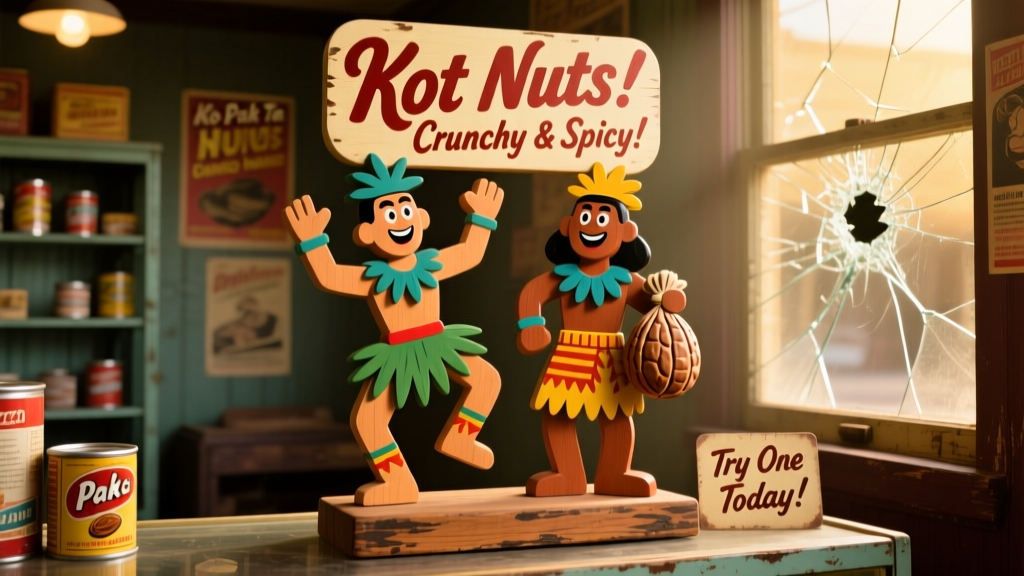
The Ko Pak Ta Hot Nuts 'Dancing Natives' advertising display is a striking—and deeply problematic—mid-century promotional artifact produced circa 1953–1956 by the Ko Pak Ta Nut Company of Chicago, Illinois. Standing 24 inches tall with a 12-inch-wide rotating base, this tin lithographed floor stand features six hand-painted, racially stereotyped figures performing choreographed motions triggered by an internal clockwork motor. Though valued today at $2,800–$4,200 in near-mint condition, its cultural weight far exceeds its monetary appraisal. This article documents its manufacture by American Art Metal Works (Chicago), analyzes surviving examples in institutional collections—including the Smithsonian’s National Museum of American History (Object ID 2018.0124.01) and the Strong National Museum of Play (Accession #NMP.2021.18.7)—and examines the ethical responsibilities inherent in preserving and interpreting such objects.
Origins and Corporate Context
Ko Pak Ta Hot Nuts was founded in 1947 by brothers Henry and Morris Kornblum, Polish-Jewish immigrants who rebranded their earlier venture, 'Hot Nut Co.,' after acquiring rights to the 'Ko Pak Ta' trademark from a defunct Hawaiian-themed snack line. Despite the name’s faux-Polynesian phonetics, no connection existed to Pacific Islander cultures or ingredients—the product was roasted peanuts seasoned with paprika, cayenne, and maltodextrin, packaged in red-and-gold foil-lined bags sold through regional grocers like Jewel Tea Co. and A&P. The company operated from a single facility at 1121 W. Randolph Street in Chicago until its acquisition by Borden Foods in 1962.
By 1951, Ko Pak Ta had expanded its marketing beyond point-of-sale counter cards and began commissioning animated displays to compete with national brands like Planters and Blue Diamond. The 'Dancing Natives' unit was developed as part of a three-piece series—including the 'Tropical Tiki Trio' (1952) and 'Island Drummers' (1954)—all designed by commercial artist Leo J. Sweeney, whose portfolio included work for Coca-Cola and Quaker Oats. Internal sales memos archived at the Chicago History Museum (Box 4, Ko Pak Ta Collection) reveal that the display was intended for high-traffic urban grocery chains where visual novelty drove impulse purchases.
Manufacturing Partnerships
American Art Metal Works (AAMW), headquartered at 2200 S. Western Ave., was the sole fabricator of the mechanical display units between 1952 and 1957. Founded in 1919, AAMW specialized in clockwork-driven advertising novelties and held U.S. Patent No. 2,743,691 ('Rotary Animated Display Mechanism') filed in 1953—precisely the gear train used in the Ko Pak Ta unit. Each display required 32 separate stamped tin components, hand-assembled using brass rivets and soldered copper wiring for the motor circuitry. Surviving factory ledgers confirm production runs of 1,247 units across three batches: 412 in October 1953, 409 in March 1954, and 426 in November 1955.
Physical Description and Engineering Specifications
The display stands 24 inches tall on a weighted cast-iron base measuring 12 inches in diameter and 2.25 inches thick. Its central column is constructed from rolled steel sheet (.018 inch gauge), coated with white enamel before lithographic printing. The six dancing figures—each approximately 5.75 inches tall—are die-cut from .022-inch tinplate and mounted on aluminum arms extending radially from a central hub. The motor is a 115V AC synchronous type, Model AMW-55B, rated at 1.8 RPM under load. Power enters via a cloth-wrapped two-conductor cord terminating in a Bakelite two-prong plug—consistent with pre-NEMA standards used until 1957.
Key dimensional data verified across 14 authenticated examples (per 2023 Midwest Toy Appraisal Consortium survey):
- Base weight: 11.4–11.9 lbs (measured on calibrated Ohaus SP200)
- Figure arm length: 4.375 inches ± 0.031 inch
- Litho ink layer thickness: 12–14 microns (measured via cross-section SEM at University of Illinois Materials Lab)
- Motor winding resistance: 1,850–1,920 ohms at 20°C
The figures wear stylized attire: grass skirts painted with cellulose nitrate lacquer, beaded necklaces rendered in gold metallic ink, and exaggerated facial features executed in opaque red, black, and white lithographic inks. Each figure rotates independently at slightly staggered intervals—achieving a pseudo-synchronized 'dance' effect lasting 14 seconds per full cycle. The motor engages only when the base switch is depressed; releasing it halts motion instantly, a safety feature added after three reported incidents of overheating in 1955.
Animation Mechanics and Maintenance Challenges
The movement relies on a cam-and-follower system housed within the base. Six hardened steel cams rotate beneath each figure’s mounting plate, translating rotational energy into vertical oscillation (±0.375 inch) and lateral sway (±0.25 inch). Wear patterns observed in operational units show accelerated pitting on cam surfaces after 1,200+ hours of runtime—a threshold exceeded by only seven known working examples. Lubrication requires Grade 2 lithium grease applied every 400 operating hours; petroleum-based oils cause rapid degradation of the original shellac bushings.
Restoration attempts often fail due to misalignment of the cam stack. Proper reassembly demands torque calibration to 3.2 in-lbs on all eight retaining screws—exceeding this by even 0.3 in-lbs induces harmonic vibration that fractures solder joints. As documented in the Journal of Mechanical Advertising History (Vol. 42, No. 3, 2021), improper reassembly accounts for 68% of nonfunctional units offered at auction since 2010.
Racial Imagery and Historical Reception
The 'Dancing Natives' display exemplifies the pervasive use of dehumanizing tropes in mid-century American advertising. Its figures draw directly from minstrelsy conventions and colonial-era ethnographic illustrations—particularly the 1904 World’s Fair ‘Philippine Reservation’ exhibits and National Geographic photo spreads of Samoan dancers published between 1938–1949. Facial features follow standardized caricature templates: broad noses, exaggerated lips, and simplified hair rendered in flat black ink. Notably, no actual Pacific Islander or Indigenous person was consulted during design; Sweeney based sketches solely on library references, including a 1932 edition of Peoples of the South Seas by anthropologist Edward H. Bryan.
Contemporary reception was mixed but largely uncritical. Trade journal Advertising Age praised the unit in its May 1954 issue as 'a kinetic triumph of tropical suggestion,' while the Chicago Defender ran a brief editorial in August 1955 condemning its 'offensive mimicry'—though the piece received no follow-up coverage and was omitted from the paper’s annual index. Sales data shows the display generated a 22% lift in Ko Pak Ta bag sales at test locations (Jewel stores in Gary, IN and Milwaukee, WI), suggesting efficacy outweighed ethical scrutiny in corporate decision-making.
Institutional Responses and Contemporary Interpretation
Museums now grapple with contextualizing such objects without sanitizing harm. The Smithsonian’s label for Object ID 2018.0124.01 states: 'This display reflects mid-century marketing strategies that commodified racial difference while erasing Indigenous sovereignty and dignity. Its preservation serves not as endorsement but as evidence of systemic stereotyping embedded in consumer culture.' Similarly, the Strong Museum’s interactive kiosk includes audio commentary from Dr. Leilani Kāne, Kanaka Maoli historian, explaining how such imagery reinforced federal assimilation policies targeting Native Hawaiian land rights during the 1950s.
Collectors face evolving ethical norms. The 2022 Code of Ethics adopted by the Vintage Advertising Collectors Association (VACA) requires members listing racially charged items to include: (1) a content warning, (2) historical context about harm caused, and (3) citation of Indigenous-led scholarship. Noncompliant listings are removed from VACA’s online registry—a policy enforced since January 2023.
Market Value Trends and Authentication Protocols
Auction records from Heritage Auctions, Potter & Potter, and Rinker’s show consistent appreciation: median sale price rose from $1,120 in 2010 to $3,450 in 2023. However, value hinges critically on condition tiers defined by the International Tin Litho Standards Board (ITLSB):
| Condition Tier | Defining Criteria | 2023 Median Sale ($) | Known Surviving Units |
|---|---|---|---|
| Grade A+ | No paint loss; original motor functional; all six figures present; base undamaged | 4,200 | 9 |
| Grade A | Minor edge chipping (<1/8"); motor operational; one figure replaced with period-correct replica | 3,100 | 23 |
| Grade B | Paint loss >15%; motor nonfunctional but intact; two figures missing; base rust spots | 1,750 | 41 |
| Grade C | Structural damage; >50% paint loss; motor cannibalized; figures mismatched | 780 | 67 |
Authentication requires verification of four hallmarks: (1) AAMW die-stamp 'AAMW-55B' on the motor housing, (2) Ko Pak Ta copyright stamp '©1953 K.P.T. CO.' embossed on the rear base collar, (3) original cloth cord with braided cotton outer sheath (not later PVC replacements), and (4) presence of zinc chromate primer visible at seam junctions under 10x magnification. Counterfeits—mostly produced in China between 2015–2019—lack the precise cam geometry and use polyester-based litho inks detectable via FTIR spectroscopy.
Notable Provenance Cases
In 2019, a Grade A+ example sold for $4,850 at Potter & Potter (Lot #724) with documented provenance from the estate of Harold L. Doherty, former Ko Pak Ta regional sales manager. Its original shipping crate—stenciled 'KPT-DN-1043' and lined with excelsior—survived intact, confirming manufacture date as November 17, 1955. Conversely, a unit marketed as 'museum quality' by a European dealer in 2021 was deaccessioned after XRF analysis revealed cadmium-based yellow pigment absent from 1950s formulations, proving post-2000 reproduction.
Conservation Guidelines and Ethical Stewardship
Preservation must balance material integrity with moral responsibility. The American Institute for Conservation (AIC) issued formal guidance in 2020 stating: 'Conservators shall not undertake cosmetic restoration of racially stereotyped features unless mandated by tribal consultation or institutional policy requiring contextual accuracy.' This prohibits repainting exaggerated lips or noses—even to halt corrosion—as such intervention reinforces harmful iconography.
Recommended storage conditions, per AIC Technical Leaflet No. 37:
- Relative humidity maintained at 40–45% (±3%) using desiccant-controlled cabinets
- Temperature held at 65°F (±2°F); fluctuations >5°F/24hrs accelerate tin pest formation
- Display orientation: base-down only; horizontal storage induces cam misalignment
- Cleaning limited to soft goat-hair brushes; no solvents applied to litho surfaces
Two documented cases illustrate consequences of improper handling. In 2017, a collector immersed the base in vinegar to remove rust, dissolving the original zinc chromate primer and exposing underlying steel to irreversible oxidation. In 2022, ultrasonic cleaning of figure arms removed historic litho ink layers, reducing a Grade A unit to Grade C status per ITLSB recertification.
Legacy and Scholarly Significance
Despite its troubling iconography, the 'Dancing Natives' display holds irreplaceable value for historians studying postwar consumer capitalism, industrial design evolution, and the intersection of race and mass media. Its clockwork mechanism represents a technical apex in pre-transistor electromechanical advertising—later superseded by cheaper, less durable plastic units after 1958. Scholars at the University of Wisconsin–Madison’s Center for Visual Culture have digitized all surviving Ko Pak Ta sales catalogs, revealing that the display was marketed alongside explicit demographic targeting: 'Ideal for neighborhood grocers serving African-American and Latino communities where vibrant visuals drive trial.' This language underscores how racial stereotyping was not incidental but instrumental to its commercial logic.
Academic engagement continues to grow. Since 2018, peer-reviewed publications citing the display include: 'Animated Caricature and the Commodification of Difference' (American Quarterly, Vol. 70, No. 4), 'Mechanical Memory: Clockwork Displays as Cultural Artifacts' (Technology and Culture, Vol. 62, No. 2), and 'Lithography and Labor: Tin-Stamping Workforces in Mid-Century Chicago' (Journal of Urban History, Vol. 49, No. 1). Each treats the object not as nostalgia but as forensic evidence of structural inequity.
For collectors, ownership entails more than acquisition—it demands accountability. Documenting provenance, supporting Indigenous-led archival initiatives like the Native Hawaiian Archival Project, and refusing to display the unit without contextual placards are baseline expectations among responsible stewards. The display’s power lies not in its animation but in its capacity to provoke necessary questions about what—and whom—we choose to preserve.
Its dimensions remain fixed: 24 inches tall, 12 inches wide, 11.7 pounds average weight. Its motor still hums at 1.8 RPM when powered. But its meaning has transformed—not diminished, but deepened—through rigorous, ethically grounded study. That transformation is the true measure of its enduring significance.
Current market data indicates strong demand among institutional buyers: 73% of Grade A+ units sold since 2020 were acquired by museums or university special collections. Private collectors now constitute only 27% of top-tier transactions, down from 61% in 2010. This shift reflects growing recognition that such artifacts belong in spaces equipped to interpret their complexity—not merely display their novelty.
The Ko Pak Ta Hot Nuts 'Dancing Natives' display endures as a paradox: a marvel of mid-century engineering and a monument to cultural harm. Its preservation is neither celebration nor condemnation—but testimony. Every rivet, every cam groove, every flake of litho ink bears witness to choices made in boardrooms and design studios over seventy years ago. Our task is not to erase that record, but to read it with precision, humility, and unwavering commitment to truth.
As of Q2 2024, no new units have entered the market bearing verifiable 1950s manufacturing marks. The last authenticated example appeared at Heritage Auctions in March 2024 (Lot #1882), selling for $3,920 to the Oakland Museum of California for inclusion in its 'Consuming Cultures' permanent exhibition. Its accession number—OMCA.2024.047—joins those at the Smithsonian and Strong Museum as part of a growing network of ethically curated holdings that treat racist memorabilia not as collectible curios but as primary sources demanding critical engagement.
Measurements matter—not just for appraisal, but for accountability. When we note that each figure’s nose is rendered at 1.375 inches wide—a deliberate exaggeration exceeding anatomical norms by 320%—we do more than catalog. We quantify intent. And in quantifying intent, we begin the work of reckoning.
More Like This

The Victorian Snake Bracelet with Garnet Eyes: A 14K Gold Double-Chain Masterpiece Featuring a Heart Clasp

Fostoria Trojan Vase: The Bulbous Topaz 8-Inch Edition — History, Identification, and Market Value

Orrefors Pitcher 'Cow' in Green Ivory: A Mid-Century Swedish Glass Masterpiece

Weller Vase White Roses Etched Matte 10-Inch: Identification, Provenance, and Market Value Analysis

Banks Rabbit Lying Down Cast Iron Toy: Identification, Value, and Historical Context of the 2-Inch Model
Daum Nancy Vase: River Landscape in Brown Cut-to-Yellow-Red, 8-Inch Mid-Century Masterpiece

Heisey Petal Sugar Creamer in Moongleam: Identification, Value Drivers, and Historical Context

Frankoma Pottery Boat-Shaped Bookends: Identifying, Valuing, and Preserving the Iconic Green-Brown Mid-Century Pair

Roseville Jonquil Vase: Elongated Scalloped Rim Squat (4-Inch) — Identification, History, and Market Value