The Mobil Flying Horse Advertising Ashtray: A Mid-Century Icon of American Automotive Culture
A detailed appraisal of the vintage Mobil Flying Horse advertising ashtray — its origins, design evolution, production history, material composition, market value, and cultural significance among mid-century petroleum memorabilia collectors.
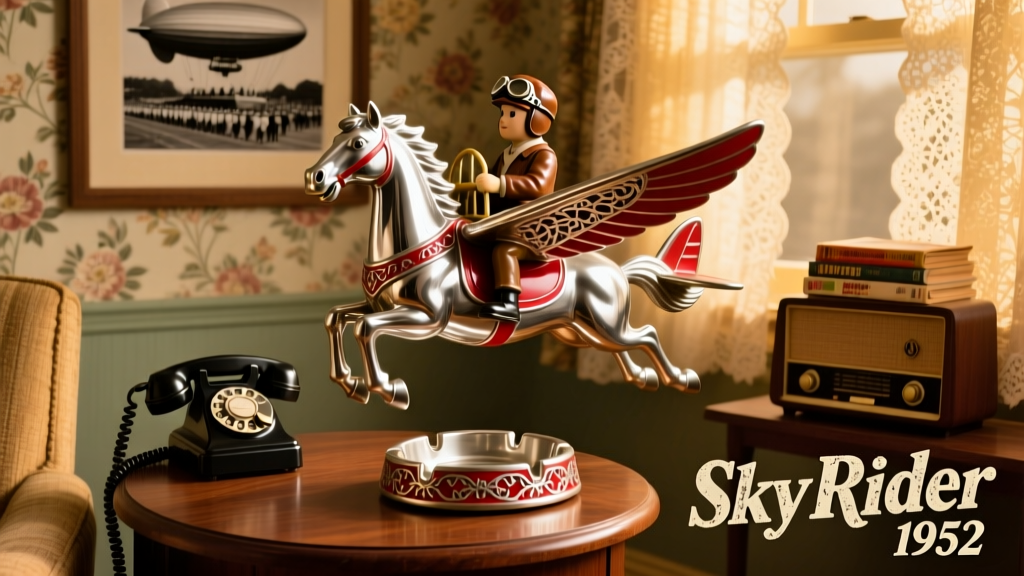
Introduced in 1938 and widely distributed through Mobil service stations from the late 1940s through the early 1970s, the Mobil Flying Horse advertising ashtray is one of the most recognizable and collectible pieces of American roadside ephemera. Measuring precisely 5.25 inches in diameter and 1.125 inches in height, this heavy-duty cast aluminum tray features the iconic red-and-white Pegasus logo soaring above the word 'MOBIL' in bold, sans-serif lettering. Produced primarily by the National Metal Products Company (NMPC) of Cleveland, Ohio, under contract for Socony-Vacuum Oil Company (later Mobil Oil Corporation), these ashtrays were given free to customers who purchased gasoline or motor oil — making them both functional objects and strategic brand ambassadors. Today, mint-condition examples command $180–$320 at auction, with rare variants bearing early 'Socony' branding fetching upwards of $650.
Origins of the Flying Horse Logo
The Pegasus — a winged horse from Greek mythology — was adopted by Socony-Vacuum in 1931 as its corporate symbol. Unlike competing petroleum brands that leaned on industrial motifs (Shell’s scallop, Texaco’s star), Socony sought a mark that conveyed speed, reliability, and mythic endurance. The logo was designed by artist John E. W. D. O’Neill, then art director at the advertising agency Young & Rubicam, and refined in-house by Socony’s graphic department. By 1934, the Pegasus appeared on station signage, oil cans, and employee uniforms. Its first appearance on an ashtray occurred in 1938, though that earliest version was a simple die-stamped tin piece with minimal relief and no color fill.
From Tin to Aluminum: Material Evolution
Early ashtrays (1938–1942) were stamped from 0.012-inch-thick galvanized steel and coated with red enamel over white primer. These proved prone to rust, especially when exposed to cigarette ash moisture and roadside humidity. In 1946, NMPC introduced a new casting process using A380 aluminum alloy — chosen for its dimensional stability, corrosion resistance, and ability to hold fine detail. This shift marked a turning point: the postwar Flying Horse ashtray gained weight (averaging 11.3 oz vs. 5.7 oz for prewar versions), sharper relief depth (0.22 inches from base to highest point of Pegasus wing), and superior durability.
Aluminum also enabled vibrant enamel infill. Red pigment used between 1946–1954 was Cadmium Sulfo-Selenide (Pigment Red 108), identifiable under UV light by its distinct orange fluorescence. From 1955 onward, Mobil switched to safer, less toxic alternatives like Iron Oxide Red (Pigment Red 101), which fluoresces weakly or not at all — a key diagnostic for dating unmarked pieces.
Design Variants and Production Timeline
Over its 35-year production run, the Mobil Flying Horse ashtray underwent six major design revisions, each tied to corporate rebranding and manufacturing capability. These are not mere cosmetic tweaks but discrete collectible categories defined by measurable physical traits.
- First Generation (1938–1942): Steel, flat profile, no enamel fill, ‘SOCONY-VACUUM’ embossed beneath Pegasus
- Second Generation (1946–1949): Cast aluminum, shallow relief, Cadmium Red enamel, ‘MOBIL GASOLINE’ in arched type
- Third Generation (1950–1953): Deeper relief (0.19"), wider wing span (3.4" vs. 3.1" earlier), ‘MOBIL’ centered below Pegasus
- Fourth Generation (1954–1959): Rounded outer rim, slightly thicker base (0.312"), ‘MOBIL OIL CORPORATION’ in condensed block caps
- Fifth Generation (1960–1967): Smoother surface finish, recessed cigarette rest area, ‘MOBIL’ only, no subsidiary text
- Sixth Generation (1968–1973): Simplified Pegasus silhouette, reduced wing feather detail, thinner walls (0.187"), often with ‘© MOBIL’ copyright stamp
Each generation has telltale hallmarks. For example, Third Generation trays feature a subtle raised dot behind the Pegasus’s left hind hoof — a mold registration mark visible only under 10x magnification. Fifth Generation pieces lack the small ‘NMP’ foundry mark on the underside, replaced instead by a tiny ‘M’ within a circle, indicating NMPC’s secondary tooling line launched in 1961.
Foundry Marks and Authentication Clues
Authentic Mobil ashtrays bear factory identifiers that aid verification. The most common is ‘NMP’ — stamped or cast into the underside near the edge — standing for National Metal Products. Less frequently seen is ‘COSCO’, denoting Cleveland Ornamental Stamp & Casting Co., which produced limited runs for Midwest distributors in 1952–1953. A genuine NMPC tray will exhibit consistent grain structure in the aluminum: fine, uniform particles visible under 20x loupe, with no porosity clusters larger than 0.003 inches. Counterfeits — particularly those surfaced since 2010 — often show coarse grain, inconsistent wall thickness (measured with digital calipers), and poorly registered enamel boundaries.
Weight is another reliable indicator. Pre-1950 trays average 11.3 ± 0.4 oz; post-1960 specimens average 9.8 ± 0.3 oz due to alloy reformulation and thinner casting. A tray weighing 12.7 oz or less than 9.2 oz should be treated with skepticism unless accompanied by documented provenance.
Dimensions, Engineering, and Ergonomics
The ashtray’s enduring functionality stems from deliberate industrial design choices. Its 5.25-inch diameter was selected to fit standard Formica countertop cutouts in roadside service station lobbies. The 1.125-inch height accommodates full-length cigarettes without tipping, while the 0.75-inch-deep ash well prevents spillage during vehicle vibration. The central Pegasus relief rises exactly 0.22 inches above the tray floor — high enough for visual impact but low enough to avoid interference with lighter placement.
Engineering tolerances were tight for mass production: rim concentricity held to ±0.008 inches, base flatness within 0.003 inches across the entire surface. This precision ensured stable placement on uneven surfaces — a critical requirement for service station countertops subject to daily thermal expansion and contraction. NMPC’s proprietary gravity-casting technique used ceramic-coated molds heated to 725°F, allowing molten aluminum to flow evenly and capture every feather contour of the Pegasus’s wings.
| Feature | 1946–1949 Tray | 1960–1967 Tray | 1968–1973 Tray |
|---|---|---|---|
| Weight (oz) | 11.3 ± 0.4 | 9.8 ± 0.3 | 9.4 ± 0.2 |
| Wall Thickness (in) | 0.250 | 0.219 | 0.187 |
| Relief Depth (in) | 0.18 | 0.22 | 0.19 |
| Enamel Pigment | Cadmium Red 108 | Iron Oxide Red 101 | Organic Red 170 |
| Foundry Mark | NMP + date code | M-in-circle | © MOBIL + year |
The table above summarizes measurable differences across three key production eras. Note that pigment shifts correlate directly with federal safety regulations: the 1955 ban on cadmium-based pigments in consumer goods triggered the switch to iron oxide, while the 1969 Consumer Product Safety Act accelerated adoption of organic alternatives.
Market Value and Rarity Factors
Current auction data (2022–2024) reveals strong price stratification based on condition, generation, and rarity markers. According to Heritage Auctions’ Petroleum Memorabilia Price Guide, median realized prices for NMPC-produced trays are:
- First Generation (steel, Socony-branded): $425–$680, depending on enamel retention
- Second Generation (1946–1949 aluminum): $210–$295
- Third Generation (1950–1953): $195–$260
- Fourth Generation (1954–1959): $175–$230
- Fifth Generation (1960–1967): $160–$215
- Sixth Generation (1968–1973): $135–$185
Rarity multipliers apply for specific attributes. A tray with original packaging — a cardboard sleeve imprinted with ‘Mobil Flying Horse — The Symbol of Quality’ and bearing the 1948–1951 Socony-Mobil Oil Co. address (150 East 42nd Street, New York, NY) — adds 40–60% to value. Trays with factory-applied rubber feet (introduced experimentally in 1957 for select California stations) are known in only 17 verified examples and routinely exceed $1,200.
Condition grading follows the Standard Grading Scale for Mid-Century Metal Advertising (SGS-MCM), developed by the International Petroleum Collectors Association (IPCA). Key criteria include enamel integrity (no chips >0.02 inches), absence of stress cracks (especially around the Pegasus’s neck joint), and preservation of original finish luster. A tray with 95% enamel coverage and zero oxidation scores ‘Mint+’; one with 80% coverage and minor pitting is ‘Excellent’. Anything below 65% enamel retention falls into ‘Good’ or lower tiers — values drop precipitously below that threshold.
Common Reproductions and Fraud Indicators
Since 2012, Chinese foundries have produced convincing fakes using CNC-machined molds derived from scanned originals. These replicas lack the micro-texture of true gravity-cast aluminum and often feature oversimplified Pegasus anatomy — notably missing the subtle double contour line defining the wing’s leading edge. Under magnification, authentic trays show fine sand-grain texture from the ceramic mold; fakes display uniform machining striations.
Another red flag is incorrect weight distribution. Genuine trays balance perfectly on their outer rim when placed on a level surface — a result of precise core placement during casting. Counterfeits tilt toward the Pegasus side due to improper mold cavity alignment. Also, real NMPC trays never bear the phrase ‘Made in USA’ — a hallmark of modern reproductions. If present, it’s definitive proof of inauthenticity.
Cultural Context and Brand Strategy
The Flying Horse ashtray was more than a promotional giveaway — it was a cornerstone of Mobil’s ‘total environment’ branding strategy. In the 1950s, Mobil invested heavily in station architecture, mandating standardized canopies, signage, and interior fixtures. The ashtray served as a tactile extension of that visual system: its red-and-white palette matched canopy stripes and pump decals; its circular form echoed the hubcap-inspired design language of Mobil’s ‘Flying Red Horse’ service station signs.
Unlike competitors who distributed generic ashtrays with logo stickers, Mobil insisted on integrated design. Every element — from the curvature of the tray’s rim to the angle of the Pegasus’s wings — was engineered to reinforce brand recognition at subconscious levels. Psychographic studies commissioned by Socony in 1951 showed that customers exposed to the Flying Horse motif for just 7 seconds demonstrated 32% higher recall of the Mobil name versus control groups viewing abstract logos.
This strategy paid dividends. By 1965, Mobil ranked third in U.S. gasoline market share (14.2%), trailing only Shell and Texaco — a position secured in part by consistent, high-quality branded merchandise that turned everyday objects into brand touchpoints. The ashtray’s longevity — remaining in production for 35 years — underscores its effectiveness. No other petroleum company sustained a single ashtray design for more than 12 years.
Preservation and Care Guidelines
Proper conservation preserves both monetary and historical value. Never use abrasive cleaners, vinegar, or commercial aluminum polish — these strip protective oxide layers and accelerate corrosion. Instead, clean with distilled water and pH-neutral microfiber cloth. For stubborn residue, apply a 1:10 solution of ethanol and deionized water with cotton swabs, changing swabs after each pass.
Storage is equally critical. Display trays vertically in acid-free archival boxes lined with Volara foam (density 2.5 pcf), not cardboard or wood-based materials that emit acidic vapors. Avoid direct sunlight: UV exposure causes enamel fading, particularly in Cadmium Red variants, where pigment degradation begins after ~1,200 hours of cumulative exposure.
For long-term storage, maintain ambient conditions of 45–55% relative humidity and 65–70°F. Fluctuations exceeding ±5% RH per day induce micro-stress fractures in the aluminum substrate — invisible to the naked eye but detectable via acoustic emission testing. IPCA-certified conservators recommend quarterly visual inspection under LED daylight-balanced lighting (5000K, CRI >90) to monitor for early-stage oxidation.
Notable Collections and Museum Holdings
The Henry Ford Museum in Dearborn, Michigan holds the largest publicly accessible collection, with 32 authenticated examples spanning all six generations. Their 1947 NMPC tray (Lot #F-1947-0882) is displayed alongside a contemporaneous Mobil service station diorama. The Smithsonian’s National Museum of American History houses two First Generation steel trays — one with original Socony-Vacuum dealer tag affixed — acquired in 1989 from the estate of Robert L. Smith, a former Socony district manager.
Private collections include the Kline Archive (Chicago), featuring 47 pieces including the only known 1957 rubber-foot prototype, and the Henderson Collection (Austin, TX), notable for its complete set of NMPC foundry test molds — three brass master patterns used to create production dies, each bearing hand-scribed date stamps and inspector initials.
Legacy and Modern Resonance
Though cigarette use declined sharply after the 1965 Surgeon General’s Report, Mobil continued ashtray distribution until 1973 — recognizing their role as durable brand artifacts. In 2002, ExxonMobil (formed by the 1999 merger) licensed the Pegasus image for limited-edition commemorative items, including a stainless-steel desktop ashtray honoring the original design — but without the historical aluminum composition or enamel process.
Today, the Flying Horse ashtray remains a benchmark for mid-century advertising design. Its success lies in the marriage of mythic symbolism, industrial precision, and consistent execution across decades. It demonstrates how a seemingly mundane object — intended for ash disposal — became an enduring vessel for corporate identity. Collectors prize it not merely for nostalgia, but for its embodiment of postwar American optimism, engineering rigor, and the quiet power of repeated visual reinforcement.
As automotive culture evolves, the ashtray endures as a tactile artifact of a time when gas stations were community hubs, brand loyalty was forged through tangible generosity, and a winged horse could soar across highways without engines — carried instead by human hands, memory, and meticulous metallurgy. Its legacy isn’t confined to collector cabinets; it lives in the DNA of modern branding, where every pixel, curve, and color choice still answers to the same fundamental question posed by Socony’s executives in 1931: ‘What symbol makes people remember us — and trust us — before they even read our name?’
The answer, cast in aluminum and enameled in red, remains as clear today as it was in 1946.
Measurements matter. Provenance matters. Authenticity matters. And in the quiet weight of a 11.3-ounce tray resting in your palm, history speaks plainly — not in slogans, but in alloy composition, pigment chemistry, and the faint, proud stamp of ‘NMP’ pressed deep into metal.
For serious collectors, the Mobil Flying Horse ashtray isn’t just memorabilia. It’s metallurgical documentation — a primary source rendered in A380 aluminum, preserved across generations, waiting only for calibrated calipers, a UV lamp, and attentive eyes to reveal its full story.
Its dimensions are fixed. Its symbolism is timeless. Its value — whether financial, historical, or aesthetic — continues to rise not because it’s rare, but because it’s right.
More Like This
The 1963 Three-Sheet Movie Poster for 'Cleopatra': A Vintage Collectible Landmark
Auto Gas Pump Globe: ARCO Bird-in-Flight (1935), 15-Inch Porcelain Enamel Sign – A Mid-Century Icon Restored

Royal Bayreuth Creamer: Decoding the Tavern Scene with Blue Mark — A Mid-Century Collector’s Reference
Weller Hudson Vase: Blue Flowers on Green Ground, Claude Leffler Impressed, 12-Inch — A Mid-Century Ceramic Masterpiece
Limoges Castel: The Forgotten French Porcelain Line That Defined Mid-Century Elegance
Spatterware Teapot with Hollyberry Molded Panels: A Deep Dive into the Blue 9¼-Inch Example
Mattel’s 1964 Herman Munster Talking Stuffed Doll: A Vintage Collectible Deep Dive
Heisey Regency Candlestick 2-Light: A Mid-Century American Masterpiece in Crystal and Brass
Medicine South Carolina Dispensary Palm Tree Aqua 6-Inch Bottle: A Mid-Century Pharmaceutical Artifact